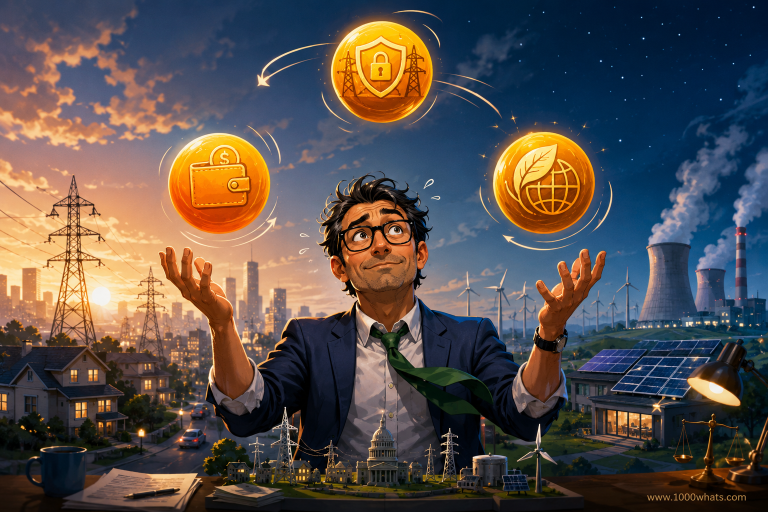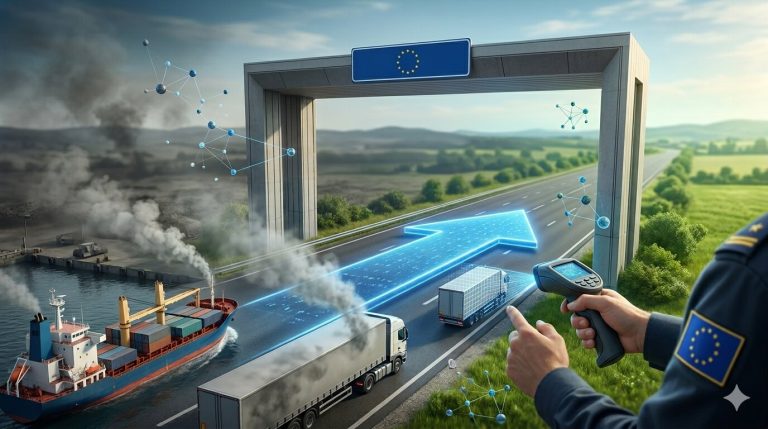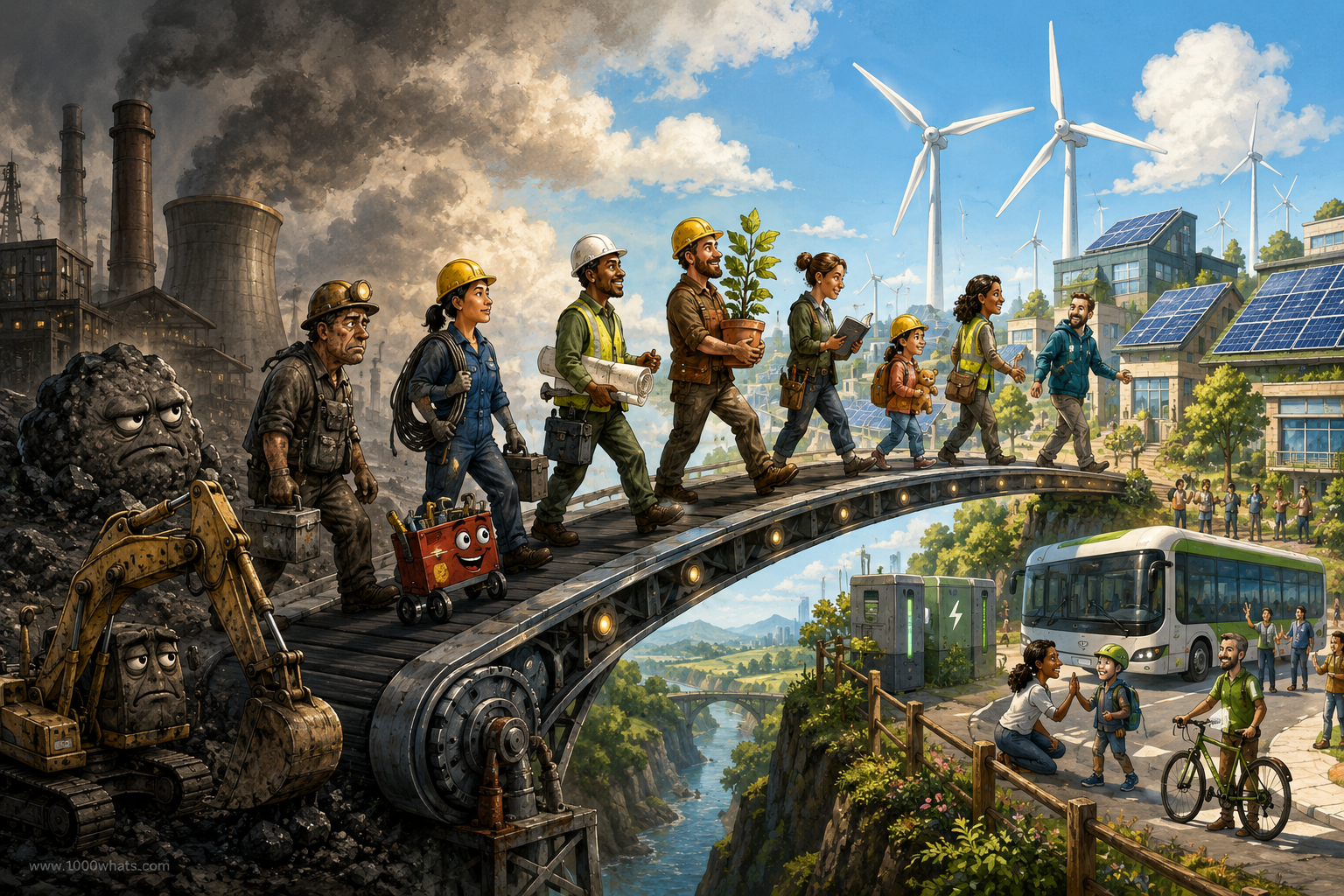
Everybody loves the clean-energy future in theory.
Solar panels? Lovely. Cleaner air? Excellent. Fewer smokestacks coughing over entire towns? Hard to argue with that.
Then comes the annoying question nobody can dodge forever: who pays for the change, who loses first, and who gets left holding the wrench when the old economy shuts down?
That, in plain English, is where the just transition comes in.
It is the part of climate policy that refuses to act like people are side effects. A country can close coal plants, electrify transport, build wind farms, and upgrade buildings. Fine. Necessary, even. But if the result is job losses, higher bills, hollowed-out towns, and politicians saying “learn to code” with a straight face, that is not a just transition. That is a costume party where unfairness shows up dressed as progress.
⚡ “A just transition is climate action with a memory: it remembers who built the old system and who might get crushed while we build the new one.”
Welcome to 1000whats — the place where energy, climate, and technology stop pretending they’re complicated on purpose.
What is the just transition?
Let’s strip off the jargon and look at the machine underneath.
A just transition is the idea that the shift to a low-carbon economy should be fair. Fair to workers. Fair to communities. Fair to households that already feel like their energy bill is a personal insult.
The International Labour Organization puts it more formally: a just transition means moving toward environmentally sustainable economies in a way that is inclusive, creates decent work, reduces inequality, and leaves no one behind. It also emphasizes social dialogue and labor rights, which is the official-sounding way of saying, “Maybe ask the people affected before you rearrange their lives.”
So no, this is not just about hugging wind turbines.
It is about making sure the cleaner economy does not arrive by kicking down the front door of working families.
Why does the just transition exist?
Because transitions are never just technical.
People talk about climate change like it is a physics problem. In one sense, sure. Too much greenhouse gas, too much warming, too many nasty consequences. Physics does not negotiate. Fair enough.
Societies, however, are not made of equations. They are made of jobs, habits, mortgages, bus routes, unions, supply chains, local tax bases, and towns built around one giant employer with a smokestack. When that employer disappears, the spreadsheet may look cleaner, but the town does not magically turn into a battery factory by lunchtime.
The ILO says climate action tied to a just transition can create major social and economic benefits, and it cites research suggesting implementation of the Paris Agreement could produce a net gain of 18 million jobs by 2030. Nice. Promising. But here is the catch: gains on paper do not automatically help the 52-year-old boiler technician whose plant shuts down next year.
The International Energy Agency adds another uncomfortable detail: as of 2023, fewer than 15% of coal workers were covered by coal-specific just transition policies. In other words, the world loves talking about fairness a lot more than it loves funding it.
⚡ “People are rarely against transition itself. They’re against being volunteered as the sacrifice.”
How does a just transition work?
Not through magic. Not through vibes. Not through a minister saying “innovation” twelve times in a speech.
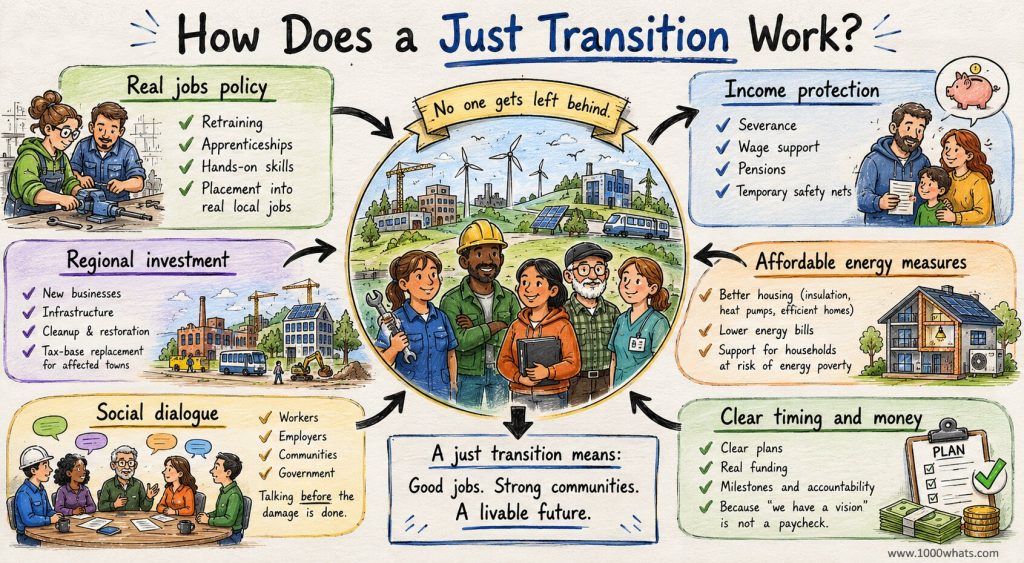
In practice, a just transition usually needs a few boring-but-crucial ingredients:
- Real jobs policy — retraining, apprenticeships, and placement into work that actually exists nearby
- Income protection — severance, wage support, pensions, or temporary safety nets for workers in declining sectors
- Regional investment — new businesses, infrastructure, cleanup work, and tax-base replacement for affected towns
- Affordable energy measures — better housing, energy efficiency, and support for households at risk of energy poverty
- Social dialogue — workers, employers, local communities, and government talking before the damage is done, not after
- Clear timing and money — because “we have a vision” is not a paycheck
The European Commission’s Just Transition Mechanism is basically this idea with a wallet attached. It is meant to help the most affected regions, industries, and workers, and it includes support for employment opportunities, re-skilling, energy-efficient housing, fighting energy poverty, and access to clean, affordable, secure energy. The mechanism is designed to mobilize around €55 billion from 2021 to 2027.
Here is the trick most people do not see: a just transition is not only worker policy. It is place policy.
Lose one refinery job in a big, diversified city and the shock hurts. Lose 800 jobs in a town that more or less exists because of that refinery and suddenly the diner, the mechanic, the school budget, and the little league sponsor are all sweating too.
A simple example
Imagine a coal plant in a town called Riverbend.
A bad transition looks like this:
The plant closes. Workers get a thank-you email, maybe a fruit basket if management is feeling poetic, and the government promises “future opportunities” sometime between now and the heat death of the universe.
A just transition looks more like this:
- Cleanup and decommissioning work starts first, so jobs do not vanish overnight
- Grid upgrades and renewable projects are lined up before closure
- Local workers get priority for training and hiring
- Small businesses receive support so the town does not collapse in sympathy
- Homes are retrofitted to cut energy bills, especially for low-income families
- The community gets a seat at the table before decisions are locked in
That is the difference.
One approach says, “Sorry, history happened to you.”
The other says, “We are changing the system, and we are going to do it without pretending your life is disposable.”
Real-world examples of the just transition
1. The European Union: helping coal and carbon-heavy regions land the plane
The EU’s Just Transition Mechanism focuses on the regions most exposed to the shift away from fossil fuels and carbon-intensive industry. Its support is tied to territorial plans up to 2030 and includes re-skilling, employment support, energy poverty measures, and funding pathways for affected regions. That matters because a transition is much easier to cheer for when it comes with jobs, housing upgrades, and actual investment instead of a motivational poster.
2. South Africa: the hard mode version
South Africa’s Just Energy Transition is a good reminder that fairness gets much harder when a country is dealing with poverty, inequality, unemployment, energy insecurity, and heavy fossil-fuel dependence all at once. The official framing is not simply “close coal.” It is about moving to cleaner energy while dealing with social risk at the same time. Which is exactly the point: in the real world, energy transition is never happening on a clean whiteboard. It is happening in a crowded room full of history.
⚡ “The energy transition is easy in PowerPoint. It gets interesting the moment real towns show up.”
Pros and cons of the just transition
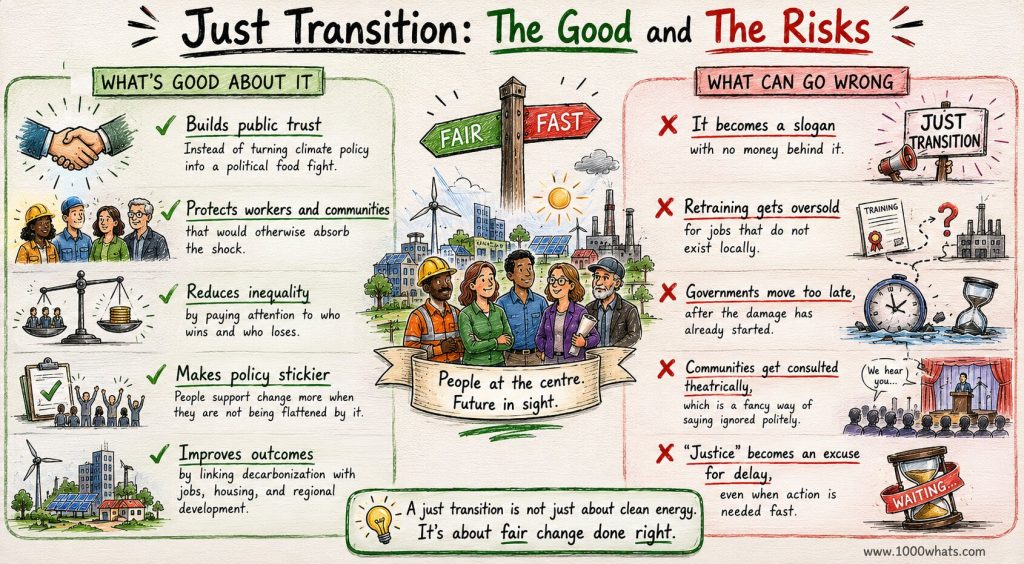
What’s good about it
- Builds public trust instead of turning climate policy into a political food fight
- Protects workers and communities that would otherwise absorb the shock
- Reduces inequality by paying attention to who wins and who loses
- Makes policy stickier because people support change more when they are not being flattened by it
- Improves outcomes by linking decarbonization with jobs, housing, and regional development
What can go wrong
- It becomes a slogan with no money behind it
- Retraining gets oversold for jobs that do not exist locally
- Governments move too late, after the damage has already started
- Communities get consulted theatrically, which is a fancy way of saying ignored politely
- “Justice” becomes an excuse for delay, even when action is needed fast
That last point matters. A just transition is not a reason to do nothing. It is a reason to do the hard thing properly.
Why the just transition matters today
Because the clean-energy economy is growing, but not evenly.
The IEA says only one-quarter of clean energy job growth since 2019 has happened in emerging and developing economies outside China, even though those economies represent 60% of the global labor force. Meanwhile, coal jobs are structurally declining in many regions, and many workers still lack targeted transition support. That is a recipe for backlash if governments treat fairness as a footnote.
From a market perspective, this is not some soft, optional add-on.
A transition that people reject is a transition that slows down. Projects get blocked. Elections flip. Energy bills become political dynamite. Every badly managed closure becomes a warning label for the next project.
What most people do not see is that fairness is not the enemy of speed. Very often, fairness is the only thing that makes speed politically survivable.
Final thoughts
The just transition is a wonderfully annoying idea because it ruins lazy thinking.
It tells climate hawks they cannot ignore livelihoods. It tells fossil-fuel defenders they cannot use workers as human shields forever. It tells governments that progress is not measured only in megawatts, but also in whether people can still live decently while the system changes.
My own view? If the transition is not just, it will not stay democratic for long. People will resist it, resent it, and eventually vote against the people managing it.
So yes, build the wind farms. Upgrade the grid. Electrify the buses. Shut the dirtiest stuff down.
Just do not act surprised when people ask the most important question of all:
“Okay, but what happens to us?”
Got a favorite real-world example of a just transition done well—or badly? Drop it in, and let’s pick it apart.
Until next time, stay curious! 😎
Discover more from 1000whats
Subscribe to get the latest posts sent to your email.