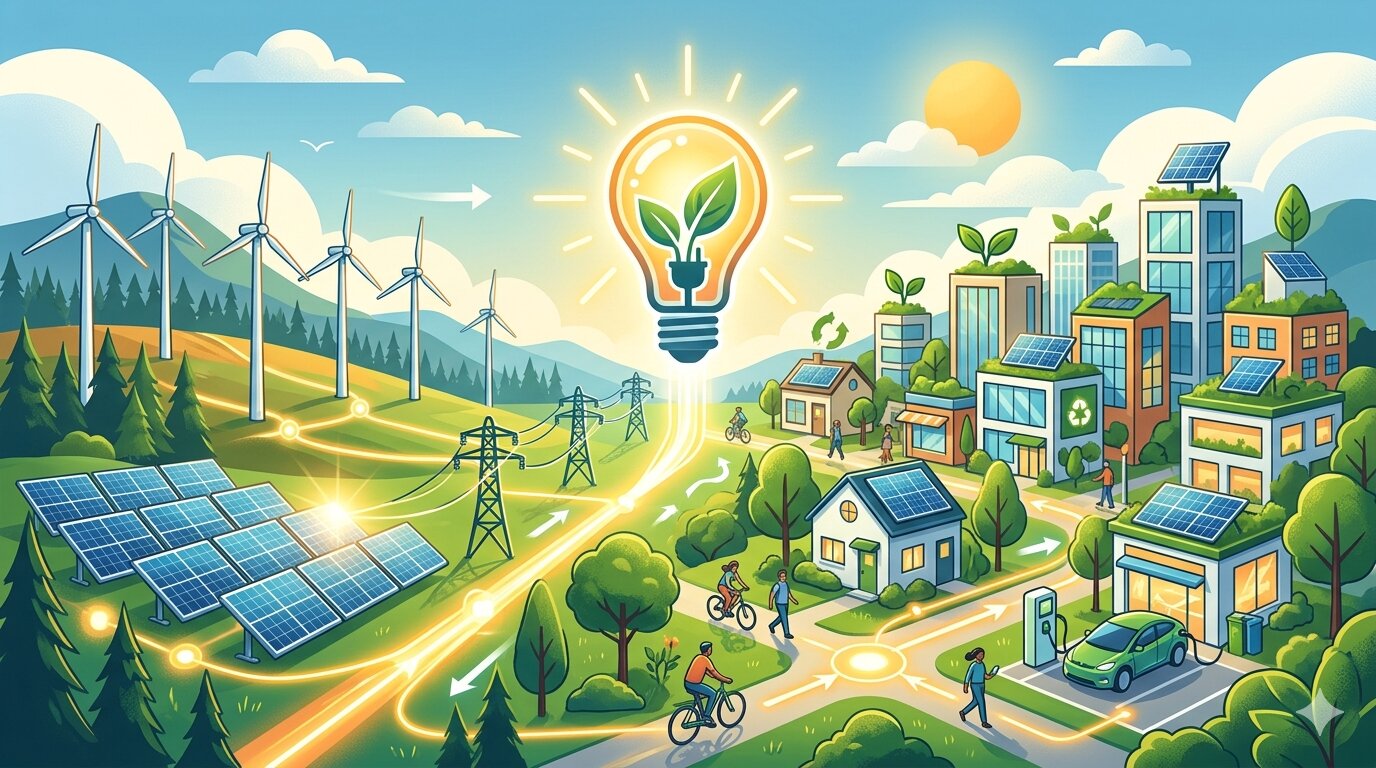
Which would you rather have? An endless supply of gasoline? Or a car so efficient that gas stations almost become irrelevant?
That question gets to the heart of energy efficiency.
Most people hear “efficiency” and imagine compromise. Smaller rooms. Dimmer lights. Lukewarm showers. A joyless life run by thermostats and guilt.
That is not what energy efficiency is.
Energy efficiency is not about using less because you have to. It’s about wasting less because you finally can. And that distinction matters more than ever.
From a market perspective, energy efficiency is almost absurdly attractive. It cuts costs, eases pressure on infrastructure, improves energy security, and lowers emissions—often all at once. Yet it still gets treated like the boring cousin of shiny new power plants and futuristic batteries.
That is a mistake.
⚡ “The cheapest kilowatt-hour is the one you never had to generate.”
Welcome to 1000what.com, where I turn everyday curiosity into discoveries worth sharing.
What is energy efficiency?
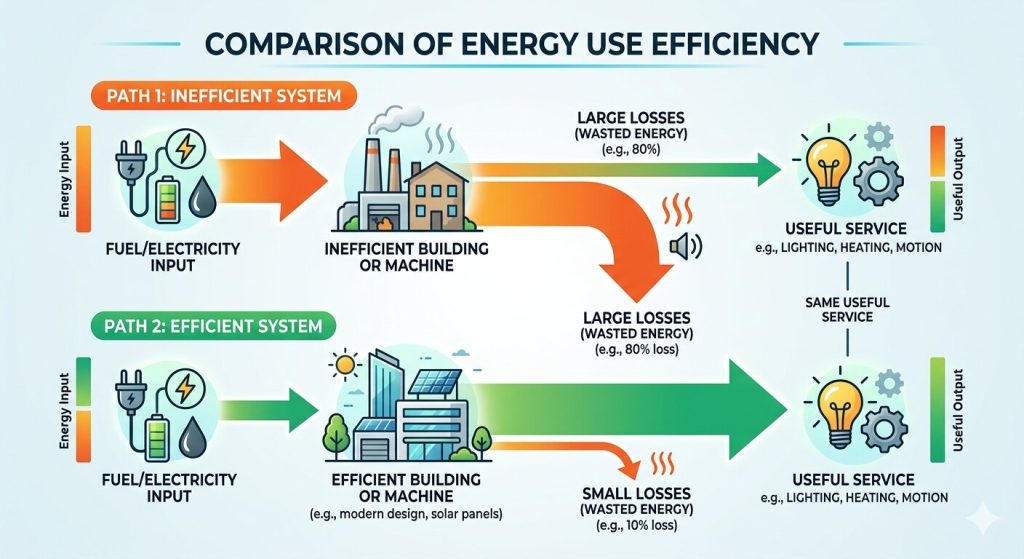
At its simplest, energy efficiency means delivering the same service with less energy input.
That service could be:
- Heating your home
- Cooling an office
- Lighting a warehouse
- Running a factory motor
- Moving a car down the road
- Keeping food cold in a supermarket
So when an LED bulb gives you the same light as an old incandescent bulb while using a fraction of the electricity, that is energy efficiency.
When a heat pump warms a building with far less energy than a resistance heater, that is energy efficiency.
When a car travels farther on the same gallon of fuel, that is energy efficiency too.
The point is not less output. The point is less waste.
Why does energy efficiency exist?
Because energy systems are full of losses.
That’s the part most people don’t see.
A shocking amount of energy gets burned, leaked, dissipated, or dumped as useless heat before it ever becomes something useful. Engines waste energy. Buildings leak it. Old appliances gulp it. Industrial processes throw it away like it is free.
In practice, energy efficiency exists because the old way of doing things was often brutally wasteful.
Here is what energy efficiency tries to fix:
- Technical waste — inefficient motors, boilers, lighting, and machines
- Building losses — poor insulation, air leaks, weak windows, outdated HVAC
- Behavioral waste — heating empty rooms, overcooling offices, leaving systems running
- System waste — weak grid coordination, transmission losses, bad load timing
Efficiency is the grown-up response to a simple question:
Why keep producing more energy if we are still wasting the energy we already have?
How does energy efficiency work?
It works by improving the ratio between energy input and useful output.
That sounds technical, but the logic is simple.
You want the same result—warmth, motion, light, cooling, production—but with less fuel or electricity going in. There are usually three ways to make that happen:
1. Better technology
This is the obvious one.
Newer technologies are often designed to reduce losses and deliver more useful work per unit of energy.
Examples include:
- LED lighting instead of incandescent bulbs
- High-efficiency motors instead of legacy industrial motors
- Heat pumps instead of electric resistance heating
- Condensing boilers instead of conventional boilers
- Smart thermostats instead of crude manual control
2. Better design
Sometimes the biggest efficiency gains come before a machine is even turned on.
A well-designed building needs less heating and cooling. An efficient factory line avoids wasted motion and heat. A well-designed city reduces transport energy demand.
Efficiency is often won on the drawing board, not on the utility bill.
3. Better operation
This is where many organizations quietly leave money on the table.
You can have excellent equipment and still waste energy through bad scheduling, poor maintenance, and lazy control settings.
In practice, some of the fastest wins come from:
- Optimizing operating hours
- Fixing compressed air leaks
- Adjusting temperature setpoints
- Maintaining filters and motors
- Matching energy use to actual demand
⚡ “Energy waste rarely looks dramatic. Usually, it hums quietly in the background and sends you the bill later.”
Energy efficiency vs. energy conservation
These two get mixed up all the time, but they are not the same.
Energy conservation means using less energy by reducing activity.
Energy efficiency means using less energy while maintaining the same outcome.
Examples help.
Turning off the lights and sitting in the dark is conservation.
Switching to LEDs while keeping the same brightness is efficiency.
Driving less is conservation.
Getting a car that goes twice as far on the same fuel is efficiency.
Both matter. But efficiency is especially powerful because people usually do not have to give something up.
That is why it scales.
Real-world examples of energy efficiency
Energy efficiency is everywhere once you know what to look for.
In homes
- LED bulbs
- Better insulation
- Double- or triple-pane windows
- Heat pumps
- Efficient refrigerators and washing machines
- Smart thermostats and zoned heating
A well-insulated home does not just save energy. It also feels better to live in. Fewer drafts. More stable temperatures. Less noise. That is the hidden beauty of efficiency: it often improves comfort while cutting costs.
In transport
- Fuel-efficient engines
- Hybrid drivetrains
- Electric vehicles
- Better aerodynamics
- Lightweight materials
- Low rolling resistance tires
This is where your gasoline question hits hardest. Unlimited fuel sounds powerful. But a vehicle that barely needs fuel is smarter, cheaper, and more resilient.
In industry
- Variable speed drives on motors
- Waste heat recovery
- Efficient pumps and fans
- Process optimization
- Advanced controls and automation
- Energy management systems
From a market perspective, industry is where efficiency gets very real, very fast. Small percentage gains in big energy-consuming facilities can translate into enormous cost savings.
In commercial buildings
- Smart lighting controls
- Occupancy sensors
- High-efficiency chillers
- Building automation systems
- Demand-controlled ventilation
What most people don’t see is that commercial buildings often waste energy when nobody is even paying attention. Efficiency turns that blind spot into an opportunity.
A simple real-world example
Imagine two homes sitting side by side on the same street.
Both families want the living room at 72°F in winter. They both want hot showers, and they both use lights, appliances, and Wi-Fi.
But one home is old, drafty, poorly insulated, and heated with outdated equipment. The other has good insulation, a heat pump, LED lighting, and smart controls.
Same comfort. Same basic lifestyle. Very different energy bill.
That is energy efficiency in one picture.
It is not about asking the second family to suffer. It is about asking why the first family’s home is leaking money through the walls.
The pros of energy efficiency
There is a reason efficiency is often called the “first fuel.”
It delivers a lot of value at once.
Key benefits
- Lower energy bills
- Reduced fuel and electricity demand
- Improved energy security
- Lower greenhouse gas emissions
- Less strain on grids and infrastructure
- Better comfort and performance
- Higher competitiveness for businesses
- Reduced exposure to price volatility
In practice, energy efficiency is one of the few energy strategies that helps households, companies, and governments at the same time.
The cons and limitations
Efficiency is not magic, and pretending otherwise does not help.
Here are the real limitations:
- Upfront costs can be a barrier
- Payback periods are not always immediate
- Split incentives can block action, especially in rentals
- Poor information leads to bad decisions
- Rebound effects can eat into savings if people use more because it feels cheaper
- Old infrastructure can be hard to retrofit
That last point matters.
A lot of efficiency potential sits inside buildings, factories, and transport systems that were never designed with modern performance in mind. Retrofitting them is possible, but it is not always simple.
⚡ “Energy efficiency is not flashy. It doesn’t roar, spin, or explode. It just quietly rewrites the economics.”
Why energy efficiency matters today
Because the energy world has changed.
Power is more expensive than many people expected. Grid reliability is under pressure in many places. Electrification is accelerating. Climate goals are tightening. And demand is growing from EVs, heat pumps, cooling, and digital infrastructure.
That means efficiency is no longer a side topic.
It is now a core strategy.
Why build more generation, more pipelines, more import terminals, and more backup capacity if part of the problem is that we still use energy badly?
From a system view, efficiency does four big things today:
- Cuts costs faster than many supply-side solutions
- Reduces dependency on imported fuels
- Buys time for grid expansion and clean energy buildout
- Helps decarbonize without waiting for perfect technology
In other words, energy efficiency is not just about saving money on your bill.
It is about building an energy system that is harder to break, easier to afford, and smarter to run.
Final thoughts
Energy efficiency sounds modest. Almost too modest.
It does not promise infinite fuel. Instead, it makes fuel less important.
And that is why it matters.
In a world obsessed with producing more energy, efficiency asks a far more uncomfortable question: why are we still wasting so much of what we already have?
That question is not just technical. It is economic. Political. Strategic. And deeply personal every time a utility bill lands in your inbox.
My view is simple: energy efficiency is not the backup plan. It is one of the smartest front-line tools we have.
What do you think—does energy efficiency still get overlooked in the public conversation, or is it finally getting the attention it deserves?
Until next time, stay curious!
Discover more from 1000whats
Subscribe to get the latest posts sent to your email.