There’s a mistake people make about energy.
They imagine the whole problem is solved once a wire reaches the house.
But a wire is not warmth.
A wire is not a cooked dinner.
A wire is not a bill you can afford.
That is the trick at the heart of energy poverty.
A family can have a meter on the wall, a bulb in the ceiling, even a fridge in the kitchen, and still be energy poor. Why? Because energy is only useful when it is available, reliable, affordable, and enough for a decent life. Miss even one of those, and the machine of ordinary living starts to wobble.
⚡ “A connection to energy is not the same thing as access to a decent life.”
Welcome to 1000whats — where big energy words get chopped into bite-sized sparks.
What is energy poverty?
In plain English, energy poverty means not having enough usable energy to live safely, healthily, and with dignity.
In the global development world, that usually means lacking reliable and affordable electricity and clean cooking. In Europe, the term often points to households that cannot adequately heat or cool their homes, keep the lights on, or power basic appliances without sacrificing other essentials. The wording changes a bit across institutions, but the idea is the same: essential energy services are missing, too costly, too unreliable, or all three at once.
Here is the simplest way to think about it:
- No access: there is no electricity connection, or no clean way to cook.
- Bad access: the power comes and goes, voltage is weak, or fuel is unsafe.
- Unaffordable access: the service exists, but the household cannot really use it without falling behind on rent, food, or medicine.
- Inefficient access: the home leaks heat or traps summer heat, so families pay more and still remain uncomfortable.
That last one is the sneaky part.
What most people don’t see is that energy poverty is not only about energy. It is also about buildings. A badly insulated apartment is like trying to heat the outdoors. You can spend money heroically and still lose the battle.
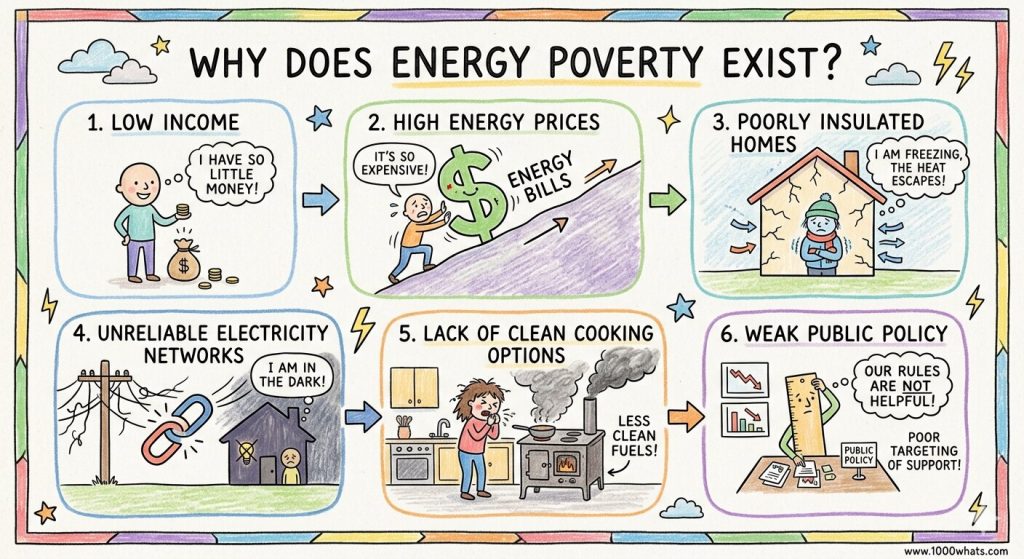
Why does energy poverty exist?
Because energy poverty is really a pile-up of several problems pretending to be one problem.
The big drivers are familiar:
- Low income
- High energy prices
- Poorly insulated homes
- Unreliable electricity networks
- Lack of clean cooking options
- Weak public policy or poor targeting of support
From a market perspective, energy poverty often appears where the energy system is asking low-income households to absorb risks they were never built to carry.
If gas prices spike, wealthier households can absorb the shock.
If a heat pump breaks, wealthier households can replace it.
If the home is drafty, wealthier households can renovate.
Poorer households usually get the opposite bargain: the worst buildings, the least efficient appliances, and the highest pain per dollar spent. That is why energy poverty does not perfectly overlap with income poverty. You can be above the official poverty line and still be trapped in a cold, expensive home.
⚡ “Energy poverty is what happens when the energy system sends its bill to the people least able to redesign the system.”
How does energy poverty actually work?
Let’s make it mechanical.
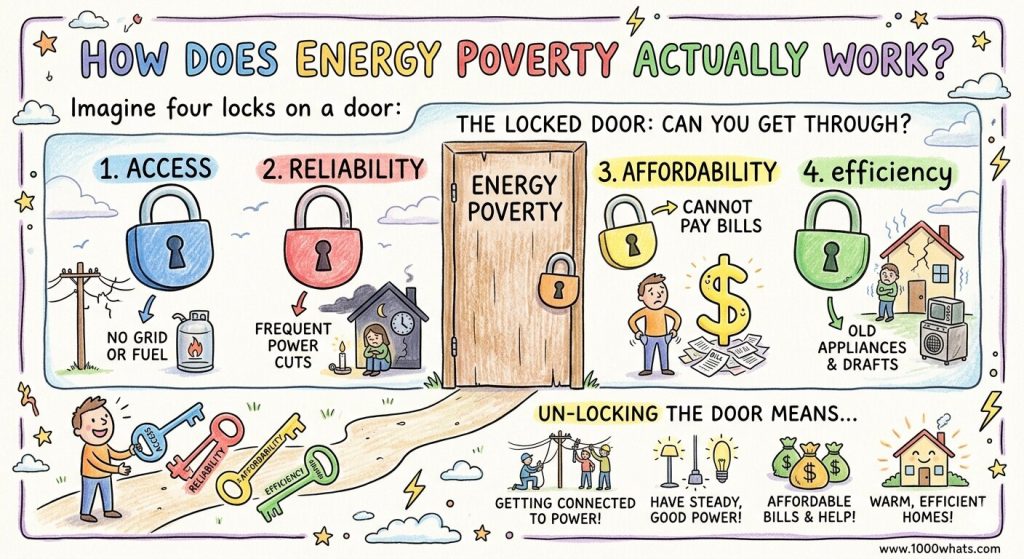
Imagine four locks on a door:
- Access
- Reliability
- Affordability
- Efficiency
To get a decent energy life, all four locks must open.
If you have no grid connection, the first lock is closed.
If the power cuts out every day, the second lock is closed.
If the bill is too high to use the service normally, the third lock is closed.
If your home leaks heat in winter and traps heat in summer, the fourth lock is closed.
That is energy poverty. Not a mysterious social theory. Just a chain with weak links.
In practice, this means households start rationing comfort. They heat one room instead of three. They skip air conditioning during dangerous heat. They cook with charcoal or wood because the alternative is too expensive or unavailable. Children study under dim light. Medicine storage becomes unreliable. Work-from-home becomes a joke. Life gets smaller.
Real-world examples of energy poverty
1. The drafty apartment in Europe
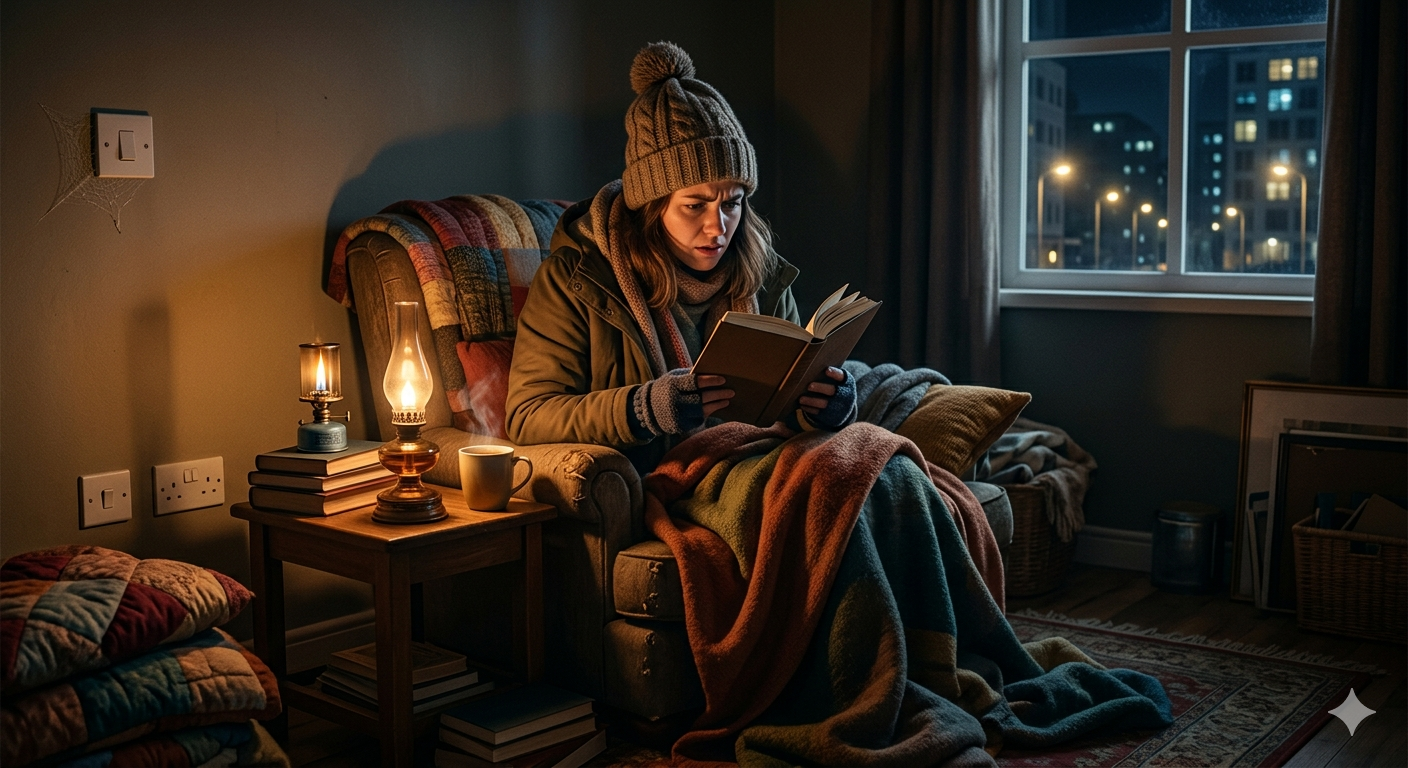
A widow in an old apartment block has electricity and gas. On paper, she is connected. In reality, the windows leak heat, the walls are poorly insulated, and winter energy bills eat a painful share of her income.
So she does something perfectly rational and quietly dangerous: she turns the heat down.
That is energy poverty.
The EU defines energy poverty around access to essential services like adequate heating, cooling, lighting, hot water, and appliance use. In 2024, 9.2% of people in the EU said they could not keep their home adequately warm, down from 10.6% in 2023 but still a large number of people living in discomfort or risk.
2. The “electrified” village that still can’t really use electricity
Now picture a village that has technically been connected to electricity.
Wonderful headline. Ribbon-cutting. Photos.
But the voltage is unstable, outages are common, and appliances fail. The clinic cannot depend on refrigeration. Small businesses cannot run tools consistently. Families still use candles or backup fuels when the power disappears.
The World Bank notes that energy poverty can persist even in electrified places because people may still lack adequate, reliable, and affordable energy use. The IEA says 750 million people worldwide still lacked electricity in 2023, and in sub-Saharan Africa the number without electricity remained around 600 million in 2024.
3. The wood-fired kitchen that poisons the cook
This is the version of energy poverty many people in richer countries forget exists.
A household cooks on an open fire or an inefficient stove using wood, charcoal, dung, kerosene, or coal. The meal gets cooked, yes. But the kitchen fills with smoke. The walls darken. The lungs pay the real bill.
The WHO says around 2.1 billion people still cook with polluting fuels or inefficient stoves, and household air pollution was linked to 2.9 million deaths in 2021, including more than 309,000 deaths of children under five. Women and children often bear the greatest burden because they spend more time around the fire and fuel collection.
⚡ “Sometimes energy poverty doesn’t look like darkness. Sometimes it looks like smoke.”
Why energy poverty matters today
Because energy is not a luxury add-on. It is a platform for everything else.
No reliable energy means weaker health care, lower educational outcomes, less economic opportunity, worse housing, and more exposure to heat, cold, and air pollution. That is why energy poverty is not just a utility problem. It is a public health problem, a housing problem, a development problem, and a fairness problem.
And the issue is changing shape.
In Europe, it is no longer just winter heating. The European Commission now explicitly points to summer energy poverty as heat waves make cooling a survival issue for vulnerable households. Meanwhile, globally, progress toward universal access is still too slow: the IEA says current trends would still leave 645 million people without electricity in 2030, while the WHO says current trajectories would leave nearly 1.8 billion people without clean cooking solutions by 2030.
That is the modern twist.
We used to think of energy poverty as a problem of darkness. Now it is also a problem of overheating, dirty air, failing grids, and bad buildings.
How do we fix energy poverty?
Here’s where things get interesting.
People love one magic bullet. But energy poverty laughs at magic bullets.
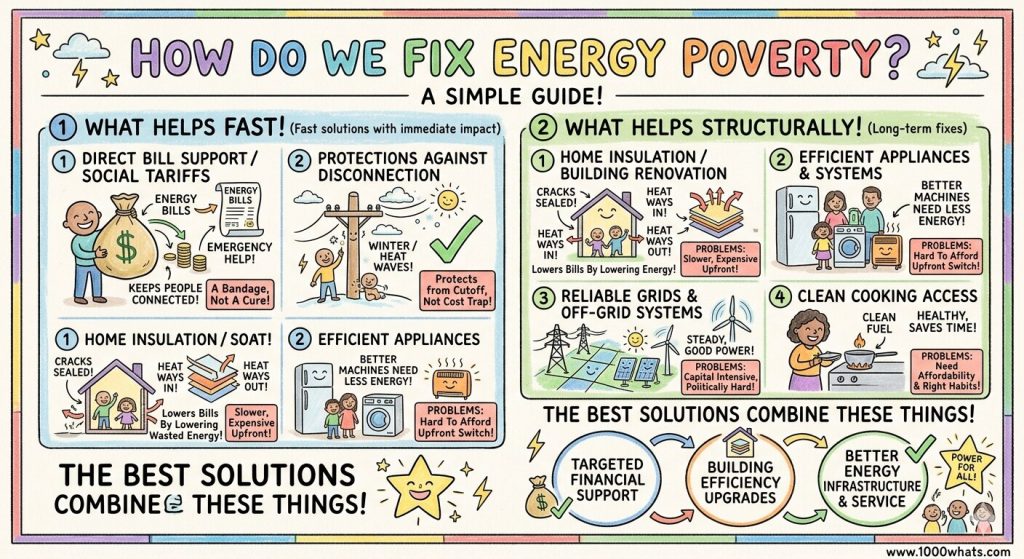
You need short-term relief and long-term repair at the same time.
What helps fast
- Direct bill support or social tariffs
Good for emergencies. Keeps people connected. Prevents immediate harm.
Problem: it can become a permanent bandage on a structural wound. - Protections against disconnection
Important during winter or heat waves.
Problem: it protects the household from cutoff, but not from the underlying cost trap.
What helps structurally
- Home insulation and building renovation
This is one of the most powerful fixes because it lowers bills by lowering wasted energy.
Problem: it is slower, more expensive upfront, and often hardest to deliver in rental housing. - Efficient appliances and heating/cooling systems
Better machines reduce the energy needed for the same comfort.
Problem: households in energy poverty usually cannot afford the upfront switch. - Reliable grids, mini-grids, and off-grid systems
Essential where access is still missing or unreliable.
Problem: capital-intensive, politically complicated, and uneven in rollout. - Clean cooking access
A huge health win and often a huge time-saving win.
Problem: the stove alone is not enough; fuel supply, affordability, and user habits matter too.
In practice, the best solutions usually combine three things:
- Targeted financial support
- Building efficiency upgrades
- Better energy infrastructure and service quality
That is less flashy than shouting “just cut prices,” but it actually works better.
A simple way to explain energy poverty to anyone
Try this:
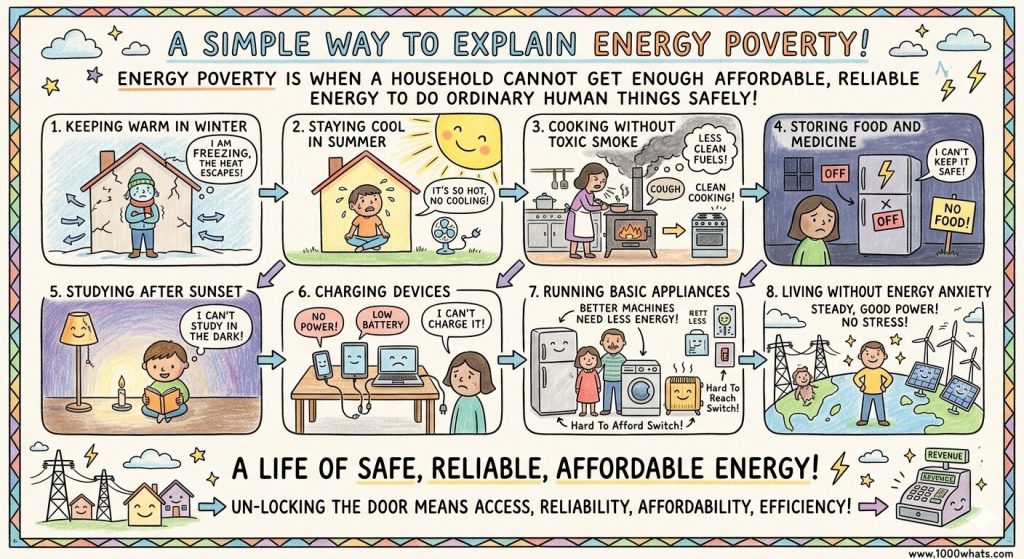
Energy poverty is when a household cannot get enough affordable, reliable energy to do ordinary human things safely.
That includes:
- keeping warm in winter
- staying cool in summer
- cooking without breathing toxic smoke
- storing food and medicine
- studying after sunset
- charging devices
- running basic appliances
- living without constant energy anxiety
That’s it.
No jargon required.
Final thoughts
Energy poverty sounds like a technical phrase, but it really describes something painfully human: the inability to turn energy into a livable life.
My view is simple. We should stop treating this as a side issue for social workers or utility regulators. It sits right at the center of modern life. If a society can build data centers, high-speed trains, and AI tools, it can also figure out how to keep people warm, cool, lit, and healthy.
And that is the real test.
Not whether energy exists.
Whether people can actually use it.
What example of energy poverty have you seen most clearly in real life: high bills, cold homes, blackouts, or dirty cooking fuels?
Until next time, stay curious! 😎
Discover more from 1000whats
Subscribe to get the latest posts sent to your email.