Most people never think about energy security.
They think about electricity when the Wi-Fi dies. They think about fuel when prices spike. They think about the grid when a storm knocks out power and the house suddenly feels prehistoric.
That’s the strange thing about energy: when it works, it’s invisible. When it fails, it becomes the only thing that matters.
Modern life runs on a quiet assumption that energy will always be there. The lights will switch on. The fridge will stay cold. Trains will move. Hospitals will operate. Data centers will hum. But that assumption is not a law of nature. It’s the result of systems, infrastructure, politics, planning, money, and a lot of fragile coordination.
That’s energy security.
And no, it’s not just about “having enough energy.” It’s about having the right energy, in the right place, at the right price, at the right time.
⚡ “Most people never think about energy security until the system blinks.”
Welcome to 1000whats, where we untangle big energy ideas without making them sound like a regulatory filing.
What is energy security?
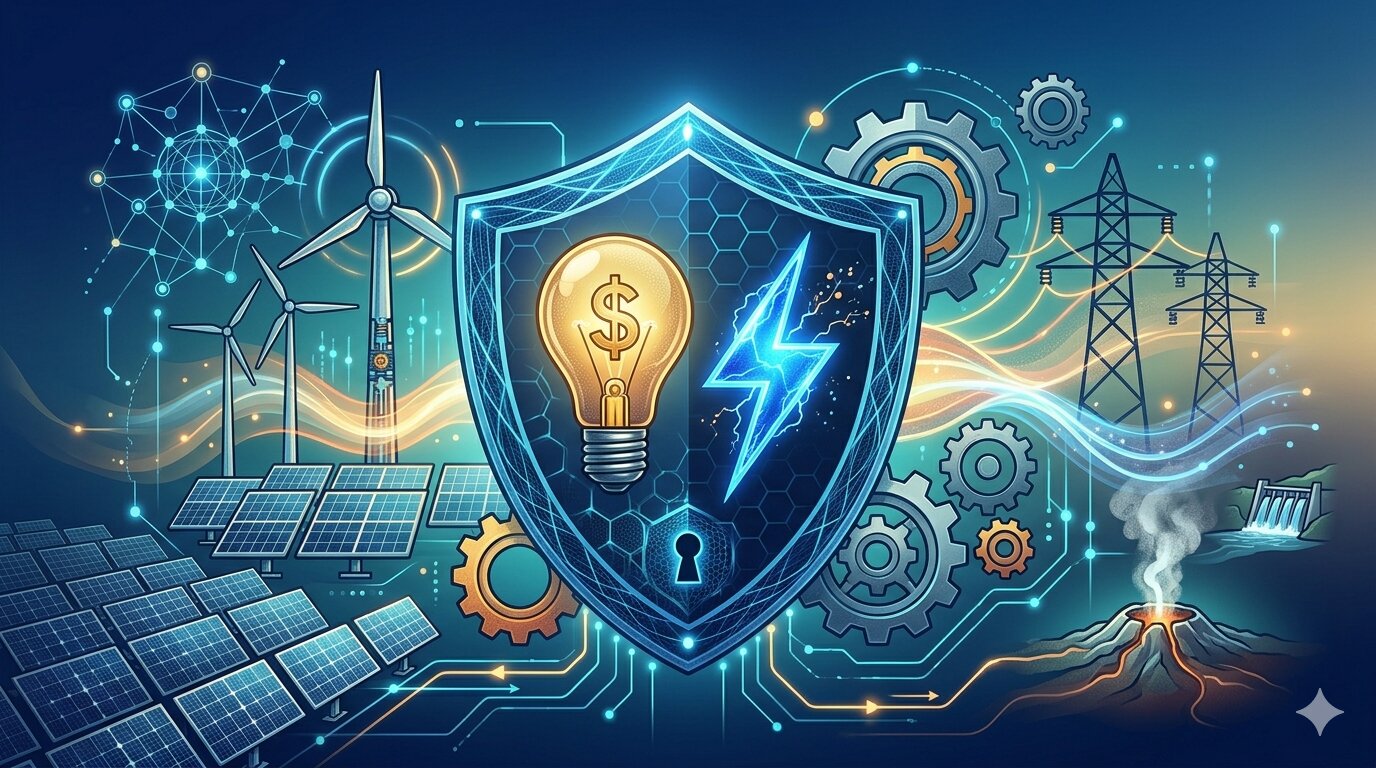
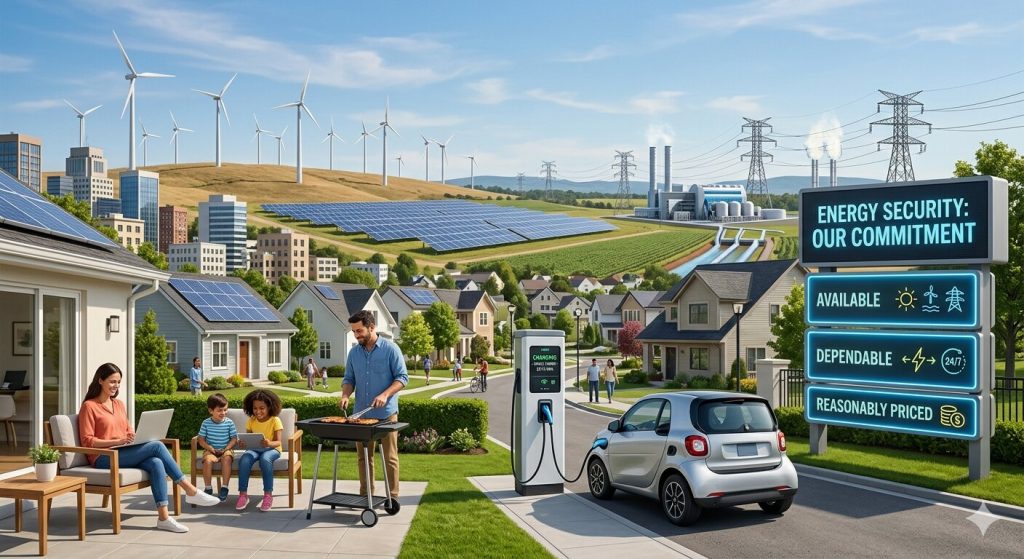
At its core, energy security means a reliable, affordable, and resilient supply of energy.
Simple enough. But the reality is bigger.
Energy security is not just about whether a country has oil, gas, coal, wind, or sunshine. It also includes:
- whether energy can be delivered without disruption
- whether people and businesses can afford it
- whether infrastructure can survive shocks
- whether the system can adapt to war, weather, cyberattacks, and market chaos
- whether today’s energy choices are still workable tomorrow
In practice, energy security lives at the intersection of supply, price, infrastructure, and resilience.
Global institutions define it in slightly different ways, but they all orbit the same core idea: energy must be available, dependable, and reasonably priced.
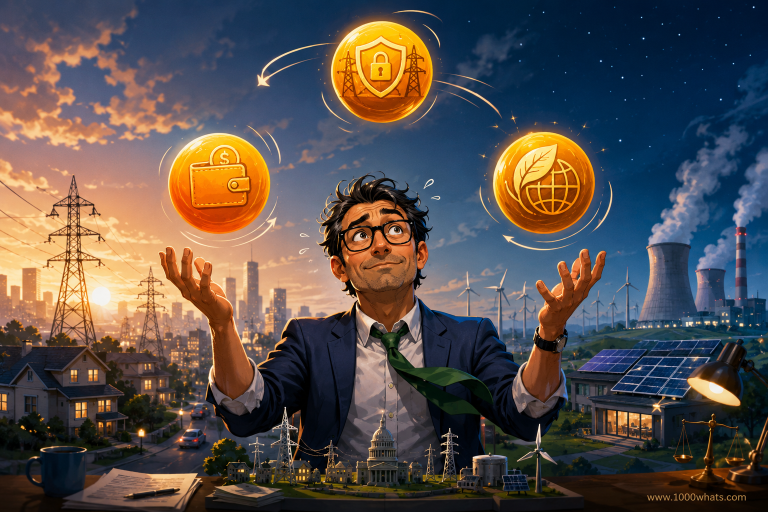
What most people don’t see is that energy security is not a static condition. It’s a balancing act. A country can have plenty of fuel and still be insecure if its grid is weak, its imports are concentrated, or its citizens can’t afford the power.
Why does energy security exist?
Because dependence is the rule, not the exception.
Human civilization has always been shaped by its ability to harness energy. Fire changed survival. Coal powered industry. Oil transformed transport. Electricity rewired everything.
Every leap in prosperity came with a new form of dependence.
That dependence creates risk.
If fuel supply is disrupted, prices spike. If infrastructure fails, economies stall. If power becomes unaffordable, social pressure builds fast. If a country relies too heavily on one supplier, one technology, or one route, vulnerability creeps in.
So energy security exists for a brutally practical reason: modern society cannot function without a stable energy backbone.
How energy security works in the real world
Let’s make this less abstract.
Imagine you drive to work every day. Your first concern is obvious: do you have fuel in the tank?
But that’s only the beginning.
To keep driving next week, and the week after, several things must all go right:
- fuel must be produced or imported
- it must be transported safely
- stations must exist near you
- prices must stay within reach
- fuel quality must meet standards
- supply must survive wars, storms, strikes, and market shocks
And then the plot thickens.
Let’s say gasoline becomes too expensive. Or the nearest station is too far away. Or geopolitical conflict disrupts crude supply. Or policy pushes you toward an electric vehicle instead. Great — now the question becomes: is the electricity grid ready, and is charging accessible and affordable?
That’s the point.
Energy security is not one problem. It’s a chain of problems. And the chain is only as strong as its weakest link.
⚡ “Energy security is not just about supply. It’s about continuity under pressure.”
The different scales of energy security
Energy security is not only a national issue. It plays out on multiple levels.
National energy security
This is the classic version: can a country meet demand without dangerous dependence or repeated disruption?
Regional energy security
Neighboring countries often depend on one another through pipelines, grids, interconnectors, and shared reserves.
Corporate energy security
For companies, it means stable energy costs and uninterrupted operations. A factory that loses power does not care whether the cause was geopolitics or a transformer failure.
Community energy security
Local resilience matters too. Microgrids, backup power, local renewables, and storage can all strengthen communities during disruptions.
Household energy security
At the most personal level, this is about whether families have access to reliable and affordable energy for heating, cooling, cooking, mobility, and daily life.
Global energy security
From a market perspective, this is where things get messy. Energy markets are interconnected, so a war, shipping disruption, or export restriction in one region can ripple across the world.
What are the core elements of energy security?
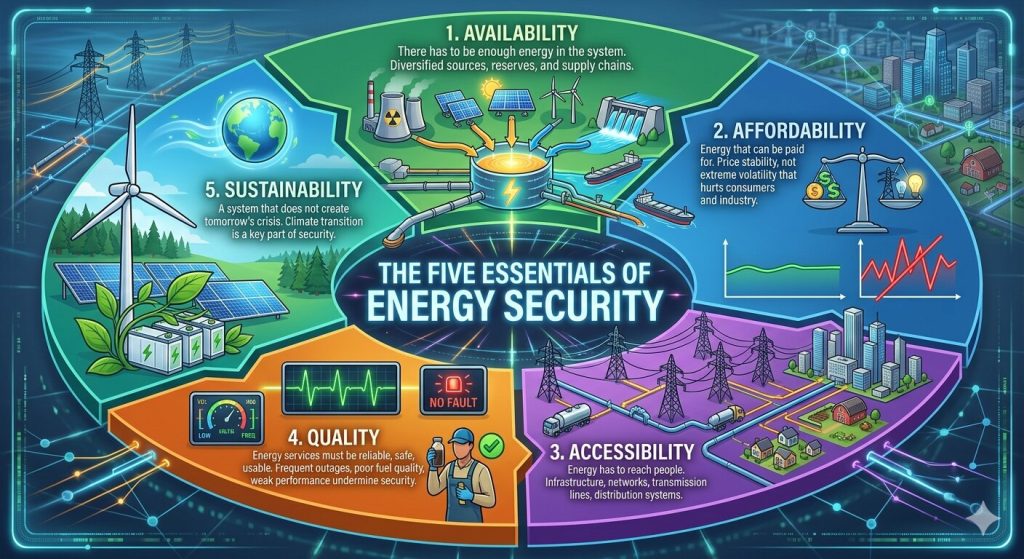
Different frameworks use different labels, but most versions boil down to five essentials:
1. Availability
There has to be enough energy in the system.
That means diverse sources, adequate reserves, and a supply chain that is not dangerously concentrated.
2. Affordability
Energy that exists but cannot be paid for is not secure.
Price stability matters almost as much as price level. Volatility can wreck households, utilities, and industrial planning.
3. Accessibility
Energy has to reach people.
This is about infrastructure, networks, fuel stations, transmission lines, distribution systems, and fair access across regions and populations.
4. Quality
Energy services must be reliable, safe, and usable.
Frequent outages, poor fuel quality, unstable voltage, or weak system performance all undermine security.
5. Sustainability
A system that solves today’s needs by creating tomorrow’s crisis is not truly secure.
That is why the climate transition now sits inside the energy security conversation, not outside it.
Is energy security a goal or a strategy?
It’s both.
As a goal, energy security is the desired outcome: a system that reliably supports society and the economy.
As a strategy, it’s the collection of decisions used to get there: diversification, storage, infrastructure investment, efficiency, domestic production, grid modernization, diplomacy, and regulation.
This matters because some people talk about energy security like it’s an end state. It isn’t. It’s more like fitness. You don’t “achieve” it once and move on. You maintain it continuously.
What threatens energy security?
Energy security is constantly under pressure from old risks and new ones.
Here are the big threats:
- Uneven resource distribution: not every country has the same energy resources
- Import dependence: relying too heavily on one supplier or route is dangerous
- Geopolitical conflict: wars, sanctions, and trade disputes can scramble supply
- Infrastructure weakness: aging grids, pipelines, ports, and refineries create fragility
- Extreme weather: storms, heatwaves, floods, and droughts increasingly damage energy systems
- Price volatility: markets can destabilize even when physical supply still exists
- Technology bottlenecks: some transitions require infrastructure that does not yet exist at scale
- Cybersecurity risks: digitalized energy systems are powerful, but also more exposed
- Energy poverty: access and affordability remain unresolved in many places
- Transition tensions: shifting from fossil fuels to cleaner systems creates new dependencies, especially around grids, storage, and critical materials
What most people don’t see is that every energy transition solves one set of vulnerabilities while creating another.
Coal had one risk profile. Oil had another. Gas introduced another. Renewables reduce some geopolitical and emissions risks, but they also demand new thinking around storage, transmission, flexibility, and supply chains.
What are the benefits of energy security?
When energy security is strong, the benefits spread everywhere.
Economic benefits
- more stable growth
- lower exposure to price shocks
- better industrial competitiveness
- stronger investment confidence
Social benefits
- more reliable public services
- better health and education outcomes
- less energy poverty
- improved quality of life
Environmental benefits
- easier integration of cleaner technologies
- more efficient use of resources
- greater resilience to climate-related shocks
Strategic benefits
- lower geopolitical vulnerability
- greater national resilience
- stronger crisis response capacity
And what are the costs?
Energy security is not free.
Building a secure energy system can involve:
- expensive infrastructure
- backup capacity that is rarely used
- strategic reserves
- regulatory complexity
- trade-offs between cost, speed, and resilience
- environmental impacts from certain supply choices
- social conflict around projects, land use, and resource development
From a market perspective, the cheapest system on paper is not always the safest system in reality.
⚡ “A low-cost energy system can still be a highly fragile one.”
That is the uncomfortable truth behind many policy debates.
How do we measure and improve energy security?
You can’t improve what you don’t measure.
In practice, energy security is assessed through a mix of indicators, models, and policy frameworks.
Common ways to measure it
- diversity of energy supply
- import dependence
- reserve margins
- outage frequency
- energy affordability
- fuel price exposure
- grid resilience
- renewable share
- storage capacity
- access to energy services
Common ways to improve it
- diversify fuel sources and suppliers
- strengthen grids and interconnections
- invest in storage and flexibility
- improve energy efficiency
- modernize infrastructure
- develop emergency response plans
- encourage domestic production where sensible
- support clean technologies that reduce long-term dependence
- create stable, transparent regulation
Real-world examples of energy security in action
Energy security is not just theory. It shapes institutions and policy choices around the world.
The International Energy Agency (IEA)
Created in response to oil shocks, the IEA helps countries coordinate emergency responses and strategic reserves.
The European Union’s Energy Union
This approach aims to strengthen market integration, diversify supply, improve efficiency, and accelerate decarbonization.
The International Renewable Energy Agency pushes renewable deployment as part of a more secure and sustainable energy system.
National resilience strategies
Many governments now combine traditional energy policy with grid hardening, storage, domestic manufacturing, cybersecurity, and critical mineral planning.
That last point is important.
The energy transition does not eliminate security concerns. It relocates them.
How can individuals contribute to energy security?
This is where people usually shrug and assume it’s all up to governments.
It isn’t.
Individuals matter more than they think.
You can strengthen energy security by:
- using energy more efficiently at home
- reducing waste through smarter appliances and insulation
- adopting flexible consumption habits
- supporting cleaner transport when practical
- learning how your local energy system works
- backing policies that improve resilience, affordability, and clean supply
- participating in community energy or demand-response programs where available
In practice, personal action will not replace system design. But it absolutely helps reduce stress on the system and makes communities more resilient.
Imagine a world with no energy security problem
It would look very different.
Energy would be abundant, affordable, clean, and resilient. Outages would be rare. Energy poverty would shrink. Geopolitical leverage over fuel would weaken. Innovation would accelerate. Communities would be less vulnerable to shocks.
In that world:
- renewable energy would scale smoothly
- grids would be stronger and smarter
- storage would be widespread
- clean transport would be normal
- vulnerable households would not have to choose between heat and food
- energy access would be treated as a foundation of modern life, not a privilege
Sounds idealistic?
Maybe.
But energy progress has always started as imagination before it became infrastructure.
Final thoughts
Energy security is one of those ideas that sounds boring right up until the moment it becomes personal.
And then it becomes everything.
It shapes whether economies grow, whether hospitals keep running, whether families can afford heat, whether industries stay competitive, and whether the clean energy transition actually holds together under real-world pressure.
The biggest mistake is to think energy security is just about producing more energy.
It isn’t.
It’s about designing a system that is reliable, affordable, adaptable, and durable. A system that can survive shocks without collapsing into panic. A system built not only for efficiency, but for resilience.
That’s the real challenge now.
Not just keeping the lights on tonight — but building an energy system that still works when the world gets messy.
What do you think is the biggest threat to energy security today: price volatility, geopolitics, grid fragility, or the challenges of the energy transition?
Drop your take below.
Until next time, stay curious!
Discover more from 1000whats
Subscribe to get the latest posts sent to your email.