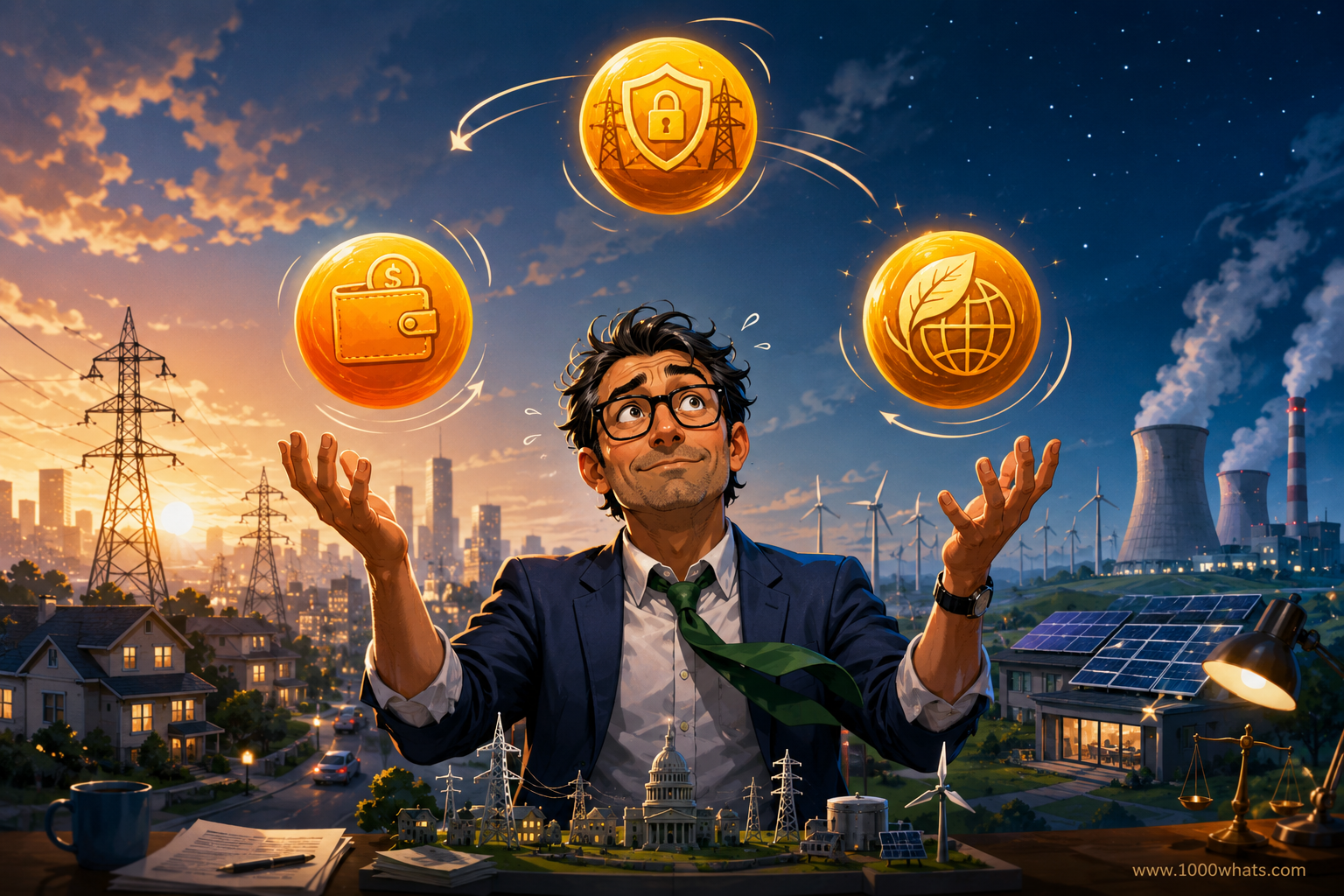
Ever tried juggling three oranges?
It looks easy when someone else does it. Then you try it yourself and discover a marvelous truth about reality: gravity is not on your side.
One orange is manageable. Two feels ambitious. Three is where the universe starts laughing.
That, more or less, is the energy trilemma.
Policymakers, utilities, regulators, and governments are all trying to keep three oranges in the air at once:
- Energy security — keep the lights on
- Energy affordability — keep bills from becoming a form of emotional abuse
- Environmental sustainability — stop frying the atmosphere for short-term convenience
And here’s the fun part: those three goals don’t always cooperate. They bicker. They sabotage each other. They behave like siblings trapped in a car for twelve hours.
⚡ “The energy trilemma is what happens when physics, politics, and your electricity bill all want different things.”
So let’s crack it open in plain English.
Welcome to 1000whats — where I explain why energy is basically juggling flaming oranges.
What is the energy trilemma?
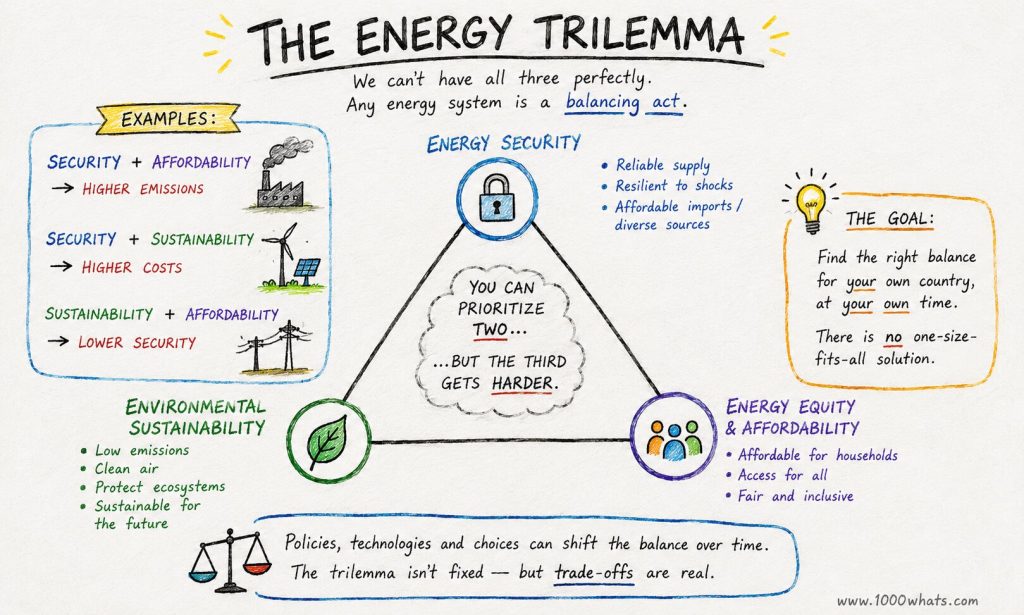
The energy trilemma is the challenge of balancing three things at the same time: secure energy supply, affordable and accessible energy, and environmental sustainability. The World Energy Council uses those three dimensions—security, equity, and environmental sustainability—as the backbone of its framework, and it has been tracking countries against them for more than a decade.
Put less politely, the energy trilemma asks:
How do we build an energy system that doesn’t crash, doesn’t bankrupt people, and doesn’t wreck the planet?
That’s it. That’s the beast.
Not very glamorous. Extremely important.
Why does the energy trilemma exist?
Because energy systems are not magic.
You don’t get electricity from good vibes and ministerial speeches. You get it from mines, pipelines, transmission lines, turbines, solar panels, gas terminals, batteries, wires, contracts, backup systems, and people who wake up at 3 a.m. when something explodes.
Every decision helps one goal a bit and can annoy another.
For example:
- A country can lean hard on cheap fossil fuels and keep power steady for a while, but emissions rise and long-term climate damage gets worse.
- A country can rush toward clean energy without enough grid upgrades, storage, or backup, and reliability can get shaky.
- A country can lock in extra supply for security, but households may still get hammered if prices spike.
The IEA describes today’s version of the problem as the triple challenge of energy security, climate change, and rising geopolitical risks, while the World Energy Council warns that the trade-offs get tougher as energy systems become more decentralized, decarbonized, and digital.
So the trilemma exists because the world insists on being real.
Annoying, but educational.
The three parts of the energy trilemma
1. Energy security: “Please let the lights stay on”
Energy security means having energy that is available, reliable, and resilient enough to meet demand now and later. In practice, that means enough fuel, enough power plants, enough grid capacity, enough storage, enough backup, and enough protection from shocks—whether those shocks come from war, weather, cyberattacks, or dumb planning.
From a market perspective, security is not just about “having energy somewhere.” It is about getting the right energy to the right place at the right time without the whole system wheezing like an asthmatic accordion.
A few everyday examples:
- Natural gas storage before winter
- Backup generation for heat waves
- Grid upgrades so power can move where it’s needed
- Diverse supply chains so one bottleneck doesn’t ruin everything
2. Energy affordability: “Can normal people actually pay for this?”
Affordability—often wrapped into energy equity—is about keeping energy accessible and reasonably priced for households and businesses. If electricity exists but Grandma can’t afford to turn on the heater, congratulations, your system is technically working and socially failing.
What most people don’t see is that affordability is not just about the price per kilowatt-hour. It also depends on:
- Income levels
- Housing efficiency
- Grid charges and taxes
- Fuel prices
- Market design
- Whether homes and businesses have alternatives
Cheap energy on paper can still feel expensive in real life.
3. Environmental sustainability: “Maybe let’s not torch the future”
Environmental sustainability means building an energy system that reduces pollution, cuts emissions, improves efficiency, and limits damage to ecosystems and public health. In the trilemma framework, this is the leg that asks whether today’s energy choices are compatible with a livable tomorrow.
This includes things like:
- Lower carbon emissions
- Cleaner air
- Better efficiency
- Less waste
- Smarter use of land and resources
That does not mean every “green” solution is automatically perfect. Batteries need minerals. Wind and solar need grids. Bioenergy can get messy. Hydropower can upset rivers. Reality, once again, refuses to be tidy.
⚡ “Clean energy is not a magic wand. It’s a toolbox. And toolboxes only help if you know which wall you’re about to hit.”
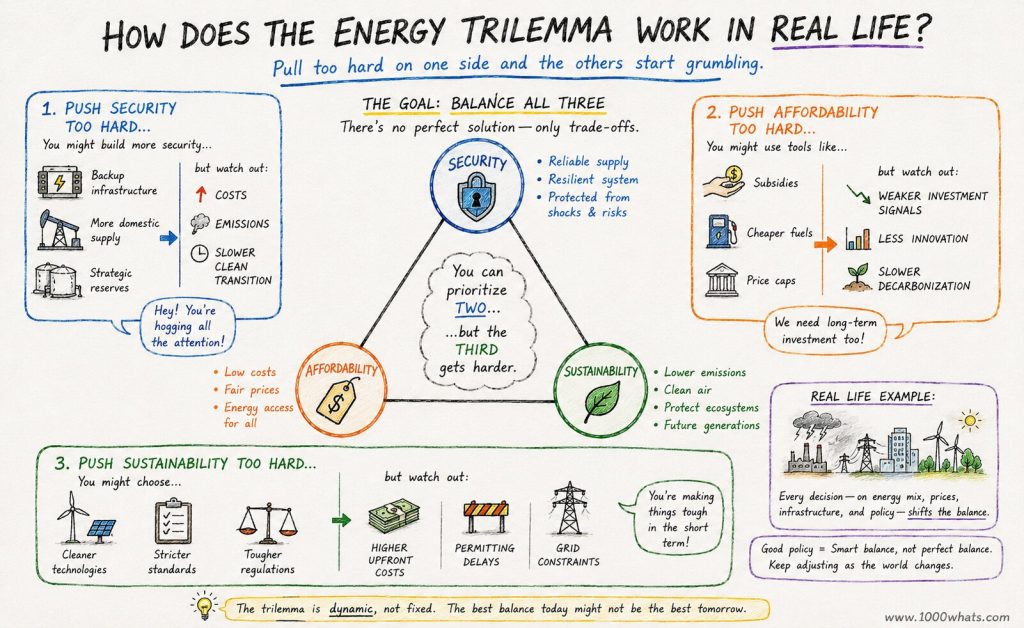
How does the energy trilemma work in real life?
Think of it less like a triangle on a consultant’s slide and more like a three-way tug-of-war.
Pull too hard on one side and the others start grumbling.
Here’s the basic pattern:
- More security can mean more backup infrastructure, more domestic supply, or more reserves—but that can raise costs or emissions.
- More affordability can mean subsidies or cheaper fuels—but those choices can weaken investment signals or slow decarbonization.
- More sustainability can mean cleaner technologies and stricter rules—but upfront costs, permitting delays, or grid constraints can bite in the short term.
In practice, the game is not to “win” one side. The game is to avoid doing something stupid while trying to improve all three over time.
That’s why the World Energy Council treats the trilemma as a balancing exercise rather than a single-score beauty contest. Its framework is meant to help leaders compare how well energy systems manage those competing demands across more than 120 countries.
Real-world examples of the energy trilemma
Example 1: Europe’s energy shock after Russia invaded Ukraine
This is the trilemma with the gloves off.
After Russia’s invasion of Ukraine, Europe got a brutal lesson in energy security. Gas supply risks surged. Prices spiked. Governments scrambled to protect households and industry. Some short-term responses helped with security, but they also pushed up costs and, in some places, led to more coal use—creating tension with sustainability goals. The World Energy Council explicitly links that shock to rising costs and renewed trade-offs across security, equity, and sustainability.
That’s the trilemma in one sentence:
keep energy flowing, keep society functioning, and try not to backslide on climate.
Easy to say. Ugly to do.
Example 2: A fast-growing developing economy
Imagine a country trying to electrify more homes, build factories, and grow fast.
It needs more energy now, and preferably cheap. Coal or gas might look attractive because they are familiar, dispatchable, and often easier to plug into existing systems. Yet those choices can lock in emissions and future environmental costs. Go too hard and too fast on expensive clean build-out without support, meanwhile, and affordability can suffer. That tension between access, cost, and environmental protection sits at the heart of the trilemma.
Example 3: Your house, yes your actual house
Suppose you install rooftop solar.
Nice move. On sunny days, your power bill may shrink. Great for affordability. It can also lower emissions. Lovely. Add a home battery and you get a bit more resilience during outages. Suddenly one choice is helping all three.
But now the punchline: if the upfront cost is huge, not everyone can do it. So a solution that looks brilliant for one homeowner may not scale fairly across society.
And there it is again—the energy trilemma, standing in your driveway.
⚡ “What most people don’t see is that every ‘simple’ energy fix drags a little parade of side effects behind it.”
Why the energy trilemma matters today
Because the world is trying to rewire its energy system during an era of climate pressure, geopolitical tension, and infrastructure strain.
The IEA has framed the current moment around energy security, climate action, and geopolitical risk, while also stressing the importance of diverse energy sources, diverse supply chains, manufacturing capacity, and critical minerals. The World Energy Council, for its part, says the balance is getting harder as systems become more decentralized, decarbonized, and digital.
Translation: this is no longer a niche debate for conference people with lanyards.
It affects:
- Your utility bill
- Industrial competitiveness
- Grid reliability
- Climate targets
- National security
- Investment decisions
- Whether “the transition” feels exciting or just expensive
From a market perspective, the trilemma matters because energy transitions fail when they are technically clever but politically stupid.
People will tolerate change.
They do not enjoy freezing for it.
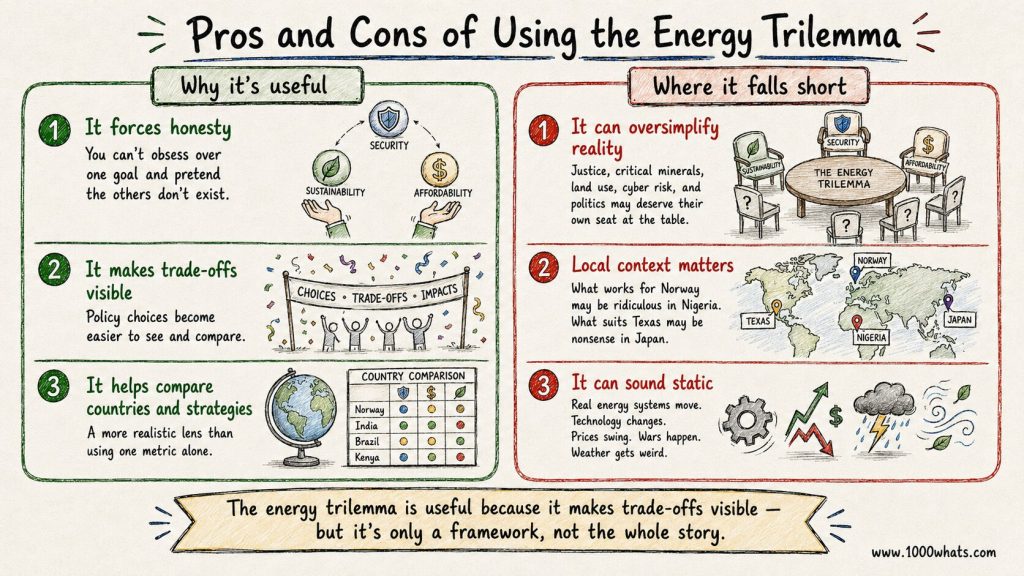
Pros and cons of using the energy trilemma as a framework
Why it’s useful
- It forces honesty. You cannot obsess over one goal and pretend the others don’t exist.
- It makes policy trade-offs visible. That alone is worth a small parade.
- It helps compare countries and strategies in a more realistic way than using one metric alone.
Where it falls short
- It can oversimplify reality. Justice, critical minerals, land use, cyber risk, and politics can all deserve their own seat at the table.
- Local context matters. What works for Norway may be ridiculous in Nigeria. What suits Texas may be nonsense in Japan.
- It can sound static. Real energy systems move. Technology changes. Prices swing. Wars happen. Weather gets weird.
The World Energy Council’s newer work reflects exactly that point: the framework is evolving as the real-world system gets messier.
So, what’s the answer?
No, the answer is not “just build more of everything.”
That’s not a strategy. That’s a toddler at a buffet.
The smarter answer is usually some combination of:
- Diverse energy sources
- Grid investment
- Energy efficiency
- Storage and flexibility
- Better market design
- Thoughtful regulation
- Protection for vulnerable households
- A realistic transition plan instead of a fantasy slogan
The IEA’s emphasis on diversity across energy sources, supplies, and clean energy supply chains strongly suggests that resilience comes from not betting the farm on one miracle solution. That is an inference, but a pretty solid one.
Final thoughts
The energy trilemma is not some obscure academic buzzword.
It is the reason energy debates never stay simple for long.
You want cheap power? Fine. You want clean power? Sensible. You want reliable power? Obviously. The trouble starts when you demand all three instantly, everywhere, with no trade-offs, no infrastructure, and no political friction.
Physics smirks at that kind of optimism.
Still, this is the hopeful bit: the trilemma is not proof that progress is impossible. It is proof that progress requires better balancing, better design, and fewer fairy tales.
And that’s where the real fun starts.
What do you think is the hardest part to balance today—security, affordability, or sustainability?
Until next time, stay curious! 😎
Discover more from 1000whats
Subscribe to get the latest posts sent to your email.