A mid-sized developer had just won rights to build a 20MW solar farm on the outskirts of a sun-soaked town. The land was perfect. The permits? Approved. The financing? Locked in. They had done what developers do best—line everything up.
But now came the hard part: actually building it.
The deadline was tight. The pressure was on. And one truth stood out—they were developers, not constructors.
They knew enough to realize that construction wasn’t just about bricks and beams. First, they’d need someone to create detailed designs. Then, they’d need to buy gear, materials, and panels. That meant a procurement team. After that, they’d need a reliable construction firm to bring it all to life.
And then the real headache began:
Who would coordinate all these teams? Who would connect it to the grid? And when something went wrong—as it always does—who would be responsible?
That’s when someone in the room finally asked, “What if we don’t do this piece by piece? What if we hand it all to one expert team—from A to Z?”
That’s how they found the EPC agreement.
Welcome to 1000whats, where I break down energy puzzles into simple, useful insights. I’m here to make the complex stuff feel a little less intimidating—and maybe even a bit fun.
What is an EPC agreement?
Think of an EPC agreement like hiring a master builder for your dream home—but instead of a house, it’s a solar farm. The acronym stands for Engineering, Procurement, and Construction. It’s often called a turnkey contract, because when it’s all done, the project owner can quite literally “turn the key” and power it on.
You get a finished project, not a pile of parts.
But here’s what it doesn’t cover—because this surprises a lot of people.
An EPC deal stops at construction. It doesn’t touch what comes before—like permitting, financing, or land development. That’s all on the developer. And it doesn’t handle what comes after—like operations or maintenance. That usually falls under a separate agreement with a different team.
So, while EPC covers a critical stretch of the journey, it’s only one leg of the marathon.
It builds the engine, but doesn’t fuel it or drive it.
Who are the main parties in the EPC agreement?
In any EPC setup, three main characters take the stage:
1. The project owner
Also called the principal or employer, this is the visionary—the one with the idea, the land, and the money. This party initiates the project and defines the goals. Instead of building it themselves, they hire the right team to make it real.
They dream it, fund it, and wait for the keys.
2. The EPC contractor
Known as the turnkey contractor or main contractor, this team does the heavy lifting. They design the system, buy the equipment, and build the whole thing from start to finish. Their promise? Deliver a fully functional project that meets all specs.
They turn blueprints into buildings, and stress into solutions.
3. The subcontractors
These are the vendors or suppliers—the specialists. They don’t work for the project owner directly. Instead, they report to the EPC contractor, providing the specific gear, services, or expertise needed along the way.
They bring the parts that power the whole.
Together, these three roles form the backbone of the EPC contract. The project owner sets the vision, the EPC contractor makes it real, and the subcontractors help build the puzzle—one piece at a time.
What are the key features of an EPC agreement?
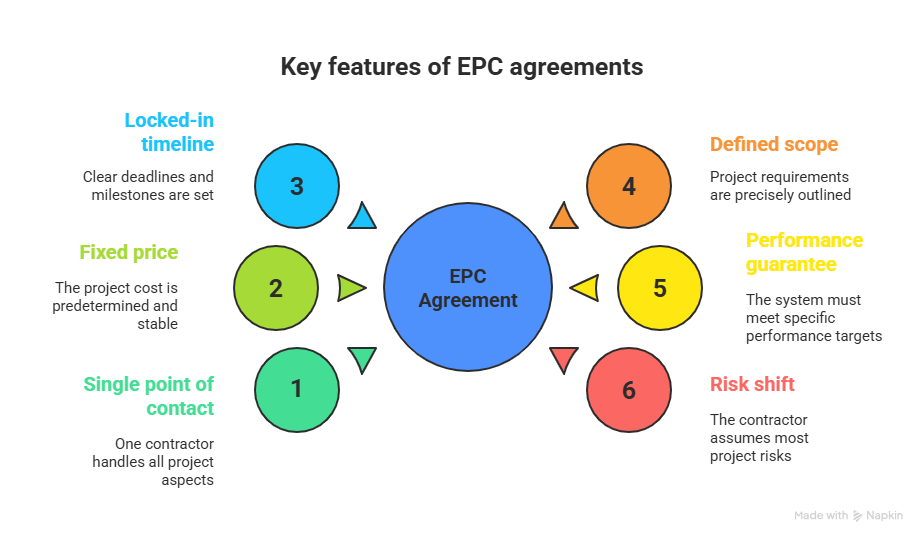
An EPC agreement isn’t just a contract—it’s a promise, wrapped in structure, signed with accountability. Here’s what makes it tick:
1. One face, one voice
You talk to one person—the EPC contractor. Not five teams. Not a dozen suppliers. Just one. That’s your go-to for every question, crisis, or update.
It’s like hiring a wedding planner who handles everything—venue, food, music, even the flowers.
2. Fixed price, no surprises
From day one, the cost is set. No creeping invoices. No shock add-ons. The price covers everything: engineering, materials, labor, testing—even the warranty.
What you sign is what you pay.
3. Locked-in timeline
The EPC contractor doesn’t just build—they race the clock. A clear deadline is agreed upfront, with milestones along the way. If they miss the mark, they pay the price.
Late delivery? Their problem, not yours.
4. Defined scope, no guesswork
The project owner outlines exactly what’s needed. The EPC team delivers precisely that. From output capacity to environmental rules, every requirement is baked into the contract.
The blueprint isn’t a suggestion. It’s a checklist.
5. Performance guaranteed
Once the system’s built, it has to work. Not just run, but perform to a promised standard. If it doesn’t hit efficiency, capacity, or reliability targets, the contractor has to fix it—or pay up.
You don’t just get a product. You get proof it performs.
6. Risk? Shifted
Delays, mistakes, defects? The EPC contractor eats those. They carry the bulk of the risk, not the project owner. It’s their job to deliver a working system, not excuses.
You’re buying peace of mind, not just solar panels.
This structure turns complexity into confidence. That’s why EPC agreements remain the gold standard in large-scale energy projects.
What are the benefits of an EPC agreement?
Choosing an EPC agreement isn’t just a legal decision—it’s a strategic move. For project owners and contractors alike, the benefits are tangible and powerful.
1. Clear communication
With EPC, there’s no relay race between ten different teams. One contractor handles everything. That means fewer meetings, fewer misunderstandings, and faster decisions.
You talk to one person, not a chorus.
2. Price certainty
Forget budget blowouts. The cost is locked in from the start. If prices go up or mistakes happen, the contractor covers it—not the project owner.
Your wallet rests easy. The contractor carries the risk.
3. Deadline discipline
Time is money, and EPC contracts treat it that way. The timeline is set in stone. If there’s a delay, the contractor pays the penalty.
Late isn’t your problem—it’s theirs.
4. No scope creep
The specs are agreed upfront. No drifting goals or sudden add-ons. The contractor must deliver exactly what’s promised, nothing less.
The goalposts don’t move.
5. Guaranteed performance
When the project goes live, it has to work—efficiently, reliably, and safely. The EPC contractor guarantees this. If the system underperforms, they fix it or face financial consequences.
They don’t just hand over keys—they hand over results.
6. Risk transfer
Design errors, cost overruns, delays, defects—these aren’t your headaches anymore. The contractor assumes most of the risk. You get a finished product without the stress of managing every pitfall.
You own the project, not the problems.
In short, an EPC agreement offers clarity, control, and peace of mind. It turns a messy, multi-party process into a single, accountable path from blueprint to reality.
What are the challenges of an EPC agreement?
EPC agreements offer control and convenience, but they don’t come without trade-offs. For both owners and contractors, the model has a few pressure points worth knowing.
1. Rigidity in the contract
Once signed, the EPC agreement locks in scope, budget, and deadlines. That’s great for predictability—but a pain if you need to make changes. Even minor tweaks often trigger renegotiations, paperwork, or extra costs.
Flexibility takes a backseat to structure.
2. Heavy dependence on one contractor
The project owner bets big on one team. They hand over control of design, equipment choices, and construction decisions. If that team stumbles, there’s not much the owner can do except wait—or pay.
You’re not just hiring a contractor. You’re tying your fate to them.
3. Premium price tag
With great responsibility comes great markups. EPC contractors build in buffers for every risk they take—delays, cost hikes, design problems. Those buffers show up in the contract price.
You’re buying peace of mind—but it’s not cheap.
4. Contractor’s high-stakes risk
From the contractor’s side, the pressure is immense. They shoulder nearly all the risk: design flaws, supplier delays, site issues—you name it. And they still have to hit fixed price and performance targets.
One bad assumption, and their margin can vanish.
In essence, EPC agreements simplify execution but demand absolute clarity upfront. They work best when both sides understand the rules—and the risks.
What are the different types of EPC agreements?
Not all EPC contracts are built the same. The right structure depends on how much risk you’re willing to carry—and how much control you want to keep. Here are the main types:
1. Lump sum turnkey (LSTK)
This is the classic EPC contract. The contractor delivers a fully functional, ready-to-run system for a fixed price. All risks—from design flaws to delays—sit squarely on the contractor’s shoulders.
One price, one promise. The owner just turns the key.
It’s popular for a reason: simplicity, predictability, and maximum risk transfer.
2. Cost reimbursable
Here, the contractor gets paid for actual costs, plus a fee or margin. It’s more flexible and transparent—but it shifts risk back to the project owner. Costs can grow if the project runs into surprises.
You see every dollar spent—but you might spend more than you planned.
This model works well when the scope isn’t fully defined or changes are expected.
3. Unit price contracts
Think of this as building by the piece. The owner pays a fixed rate for each unit—like per meter of cable or per panel installed. It’s useful when parts of the job aren’t nailed down yet.
You pay as you go, based on the work that gets done.
This approach balances structure and adaptability, especially in projects with uncertain quantities.
Each contract type offers a different blend of risk, control, and flexibility. The smartest choice depends on your project’s complexity—and your appetite for surprises.
How to choose the right EPC contractor for your project?
Choosing an EPC contractor is like choosing a co-pilot for a high-stakes mission. You’re trusting them to take your vision, navigate complexity, and land the project smoothly. The wrong choice can burn your budget—or your reputation.
So how do you make the right call? Here’s how to do it wisely:
1. Start with homework
Before reaching out to anyone, understand your own project. What’s the scope? What are your must-haves? What’s your timeline and budget? Also, dig into local regulations, industry standards, and known risks in your project’s region.
If you don’t know what you need, how will you know who can deliver it?
This prep work gives you clarity—and leverage.
2. Ask around
Referrals are gold. Talk to peers, consultants, or partners who’ve done similar projects. Who did they hire? Would they hire them again? Online reviews help too—but nothing beats firsthand experience.
Reputation isn’t built by websites—it’s built by results.
Check case studies, testimonials, and completed projects to see who walks their talk.
3. Compare proposals, not just prices
When you’ve got a shortlist, ask for detailed proposals. Look beyond numbers. Evaluate their approach, timeline, deliverables, and risk management. Are they clear? Realistic? Thoughtful?
The cheapest bid often hides the most expensive surprises.
A strong proposal tells you two things: what they’ll do—and how they think.
4. Interview like it’s a partnership
A proposal tells you what. An interview tells you who. Talk to their team. Ask about past mistakes—and how they fixed them. Probe their problem-solving approach. Look for confidence without arrogance, and experience without shortcuts.
You’re hiring a team, not a document.
Make sure you can communicate well with them. Trust matters just as much as skill.
5. Negotiate the details, not just the deal
Once you’ve chosen your top pick, lock in a contract that’s clear, fair, and balanced. Define the scope, deadlines, costs, responsibilities—and what happens if something goes wrong.
A good contract protects the relationship, not just the project.
Include terms for change orders, dispute resolution, and performance guarantees. The clearer the rules, the fewer the surprises.
Choosing the right EPC contractor isn’t about picking the biggest name or the lowest bid. It’s about finding a partner who can carry the load—without dropping the ball.

Final thoughts
If you’ve made it this far, thanks for sticking with me. I hope this gave you not just information, but insight.
EPC agreements are like the Swiss Army knife of project delivery in renewable energy—versatile, efficient, and powerful. They offer control, clarity, and speed. But they also demand careful planning, the right partner, and a crystal-clear contract.
Whether you’re a developer, investor, or just curious about how big solar farms get built, there’s more to explore. So if this sparked a few questions in your mind, good! That’s where the real learning begins.
Here are a few questions worth chewing on:
- How does EPC stack up against other delivery models like design-build or construction management?
- What separates a successful EPC project from one that goes sideways?
- What trends—like digital twins or AI-driven project management—are reshaping EPC in renewable energy?
- And what’s on the horizon for EPC contractors as the clean energy race accelerates?
I’d love to hear your thoughts. Drop a comment, share a story, or ask a question.
Until next time—stay sharp, stay curious, and keep building better.