

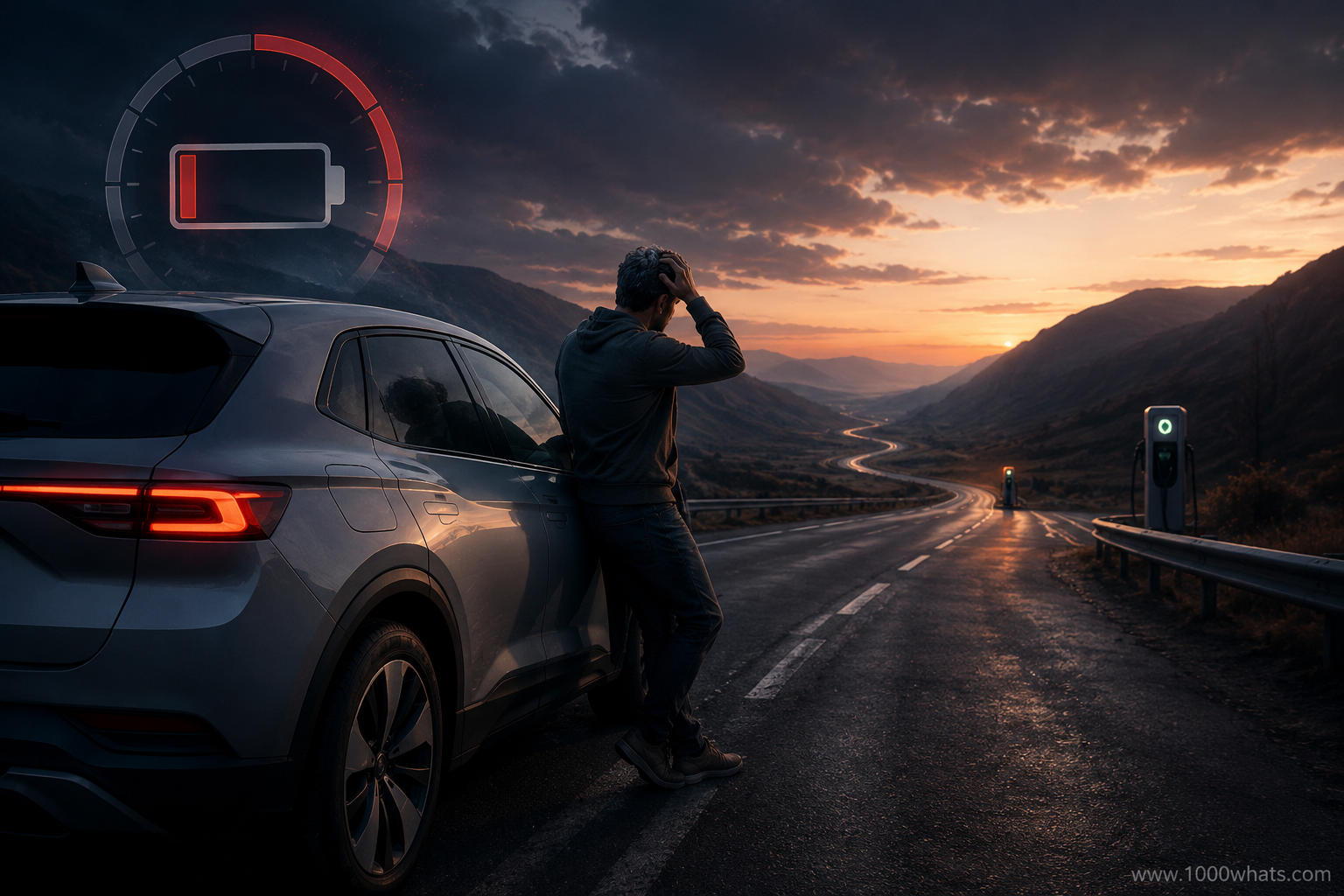
Funny name, isn’t it?
Range anxiety is not a disease or some psychology buzzword. It’s the fear that your electric car might run out of charge before you reach your destination or find a charger.
That makes it a technology problem with economic consequences: drivers worry, buyers hesitate, and engineers get yelled at.
⚡ “Range anxiety is what happens when your battery is still half full, but your imagination is already empty.”
Welcome to 1000whats — where we explain the energy world without making it sound like punishment. Today’s suspect: the fear that your EV might become a very stylish chair.
What is range anxiety?
Let’s keep it brutally simple.
Range anxiety is the fear that your electric car won’t have enough charge to reach its destination. On longer trips, that fear often comes with a second worry: will charging be available when you need it?
Now, that fear can be rational, exaggerated, or somewhere in between.
A gas driver sees “one-quarter tank” and shrugs. An EV driver sees “42 km remaining” and suddenly becomes a mathematician, meteorologist, electrical engineer, and amateur philosopher.
Can I make it?
How cold is it?
Is that charger public-public, or fake-public?
Will the highway chew through range faster than the car promised?
That’s range anxiety in action.
Why does range anxiety exist?
Because human beings are not calculators.
We are storytelling machines. Give us a battery estimate, and we immediately start writing a disaster movie.
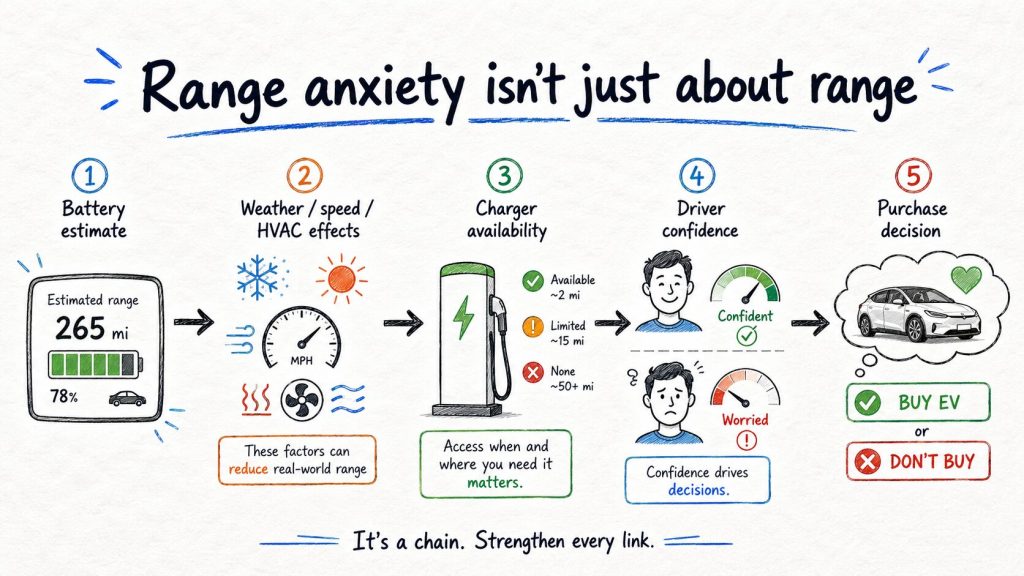
What most people don’t see is that range anxiety is not only about battery size. It’s about trust. Trust in the charger network. Trust in the route planner. Trust in the car’s estimate. Trust that “available” really means available, and not “available if you download three apps, summon a QR code, and sacrifice your afternoon.” The IEA notes that a denser fast-charging network helps address range anxiety, but it also points out something deliciously annoying: not all “public” chargers are truly easy to use. Some are semi-public, some have limited hours, and some are tangled up in plug-type or payment issues.
Technology helped create the problem, of course, so technology is being dragged in to solve it.
Battery ranges have improved. The IEA says the average battery electric car range is now almost 380 km — about 236 miles — and sales-weighted EV range rose roughly 10% between 2020 and 2025. Charging infrastructure has also expanded along long-distance corridors. That’s real progress. Still, the same report says range remains one of the key considerations for buyers, which tells you something important: facts improve faster than feelings.
⚡ “A machine can gain 30 more miles of range. A worried brain can lose 100 without moving an inch.”
How does range anxiety actually work?
In practice, it usually goes like this:
- Your car gives you a number.
- Your brain subtracts weather, traffic, highway speed, hills, heater use, bad luck, and cosmic betrayal.
- The number stops feeling like science and starts feeling like gambling.
That mental spiral gets worse when real-world conditions start nibbling at the battery. The U.S. Department of Energy says higher speeds drain EV batteries faster than slower driving, hard acceleration hurts range, and heating or air conditioning can be a major extra load. In cold weather, the effect gets especially dramatic: DOE says EV range can drop by up to 32% in freezing conditions on one consumer page, and another DOE page says range can drop about 41% in mixed city and highway driving at -5°C when cabin heat is in play.
So yes, the fear is sometimes emotional.
Unfortunately, physics is sitting right behind the emotion, nodding.
Real-world examples of range anxiety
Example 1: The easy daily commute
You drive 22 km to work, charge at home overnight, and maybe top up at the office once in a while.
Honestly? Range anxiety should barely bother you here.
This is the part many non-EV drivers miss. A lot of everyday driving is boring, repetitive, and short enough that modern EVs handle it just fine. The worry tends to flare up when routine gives way to uncertainty.
Example 2: The winter road trip
Now let’s make things interesting.
Your EV says 300 km.
Your destination is 215 km away.
Looks safe, right?
Then winter shows up wearing steel-toed boots.
You’re on the highway. The cabin heater is running. The trunk is full. The kids want the seats warm. Suddenly that comfortable buffer starts shrinking like a cheap T-shirt in a hot dryer. Cold weather, heating loads, and highway driving all eat into battery range. That’s not paranoia. That’s engineering with a sense of humor.
Example 3: The charger that exists in theory
This one is my favorite because it’s so modern.
You planned well. You found a charger on the map. You arrived with 14% left.
Beautiful.
Then the charger is behind a hotel gate, blocked by another car, out of service, or incompatible with your app, account, or plug situation. The IEA explicitly warns that “public charging” does not always equal accessible charging, which is a fancy way of saying: the charger may be real, but not for you.
Why range anxiety is really an economics and technology story
Here’s the mischievous truth.
Despite the name, range anxiety is not just a driver feeling. It’s a market signal.
If enough buyers fear inconvenience, manufacturers sell fewer cars. If sales slow down, automakers push harder on bigger batteries, better route planning, faster charging, smarter software, and clearer range estimates. Policymakers get involved too, because charging infrastructure matters for adoption. In plain English: fear messes with demand, so the whole system scrambles to remove the fear.
That’s why your note is dead-on in spirit: economists spot the hesitation, then technology gets the angry phone call.
“Fix it.”
“Fix the battery.”
“Fix the chargers.”
“Fix the map.”
“Fix the user experience.”
“Also make it cheap.”
Very relaxing industry. No pressure.
Pros and cons of range anxiety
Let’s be fair. Even annoying things can have side effects that are weirdly useful.
The upside
- It forces better technology. Automakers don’t get to coast when customers worry.
- It pushes charging networks to improve. More chargers, faster chargers, better locations, clearer data.
- It makes drivers pay attention to efficiency. Route planning suddenly becomes less dumb.
The downside
- It scares people away from EVs even when an EV would work perfectly for their real daily life.
- It makes buyers obsess over maximum range and sometimes pay for more battery than they actually need. The broader charging access can reduce pressure to just keep increasing battery size.
- It distorts the conversation. People start acting like every car must be built for a cross-country blizzard escape mission, when most cars spend their lives doing school runs, grocery trips, and parking badly.
⚡ “Range anxiety is useful only in tiny doses — like salt, caffeine, or relatives during the holidays.”

So, is range anxiety still a big deal?
Yes — but not in the same way it used to be.
The old version was blunt: the battery is too small.
The newer version is trickier: the whole experience must feel dependable.
That means range anxiety fades not just when battery numbers rise, but when the entire charging ecosystem feels boringly reliable. Boring is the dream, by the way. Nobody boasts about their gasoline experience because it’s dull and predictable. EV charging wins the day when it becomes equally unremarkable. Denser networks, standardization, and reliable station information all help make charging feel more convenient and reassuring.
Final thoughts
Range anxiety is real, but it’s also a little theatrical.
Sometimes the car truly is close to empty. Sometimes the driver is just haunted by old EV stereotypes, bad charger stories, and a battery percentage that feels more dramatic than a fuel gauge ever did.
My take? Range anxiety matters less as a verdict on EVs and more as a test of whether the industry can make electric driving feel normal. Not heroic. Not experimental. Just normal.
And that’s the whole game.
Have you ever felt range anxiety yourself, or do you think it’s mostly overblown now?
Until next time, stay curious! 😎
Discover more from 1000whats
Subscribe to get the latest posts sent to your email.
