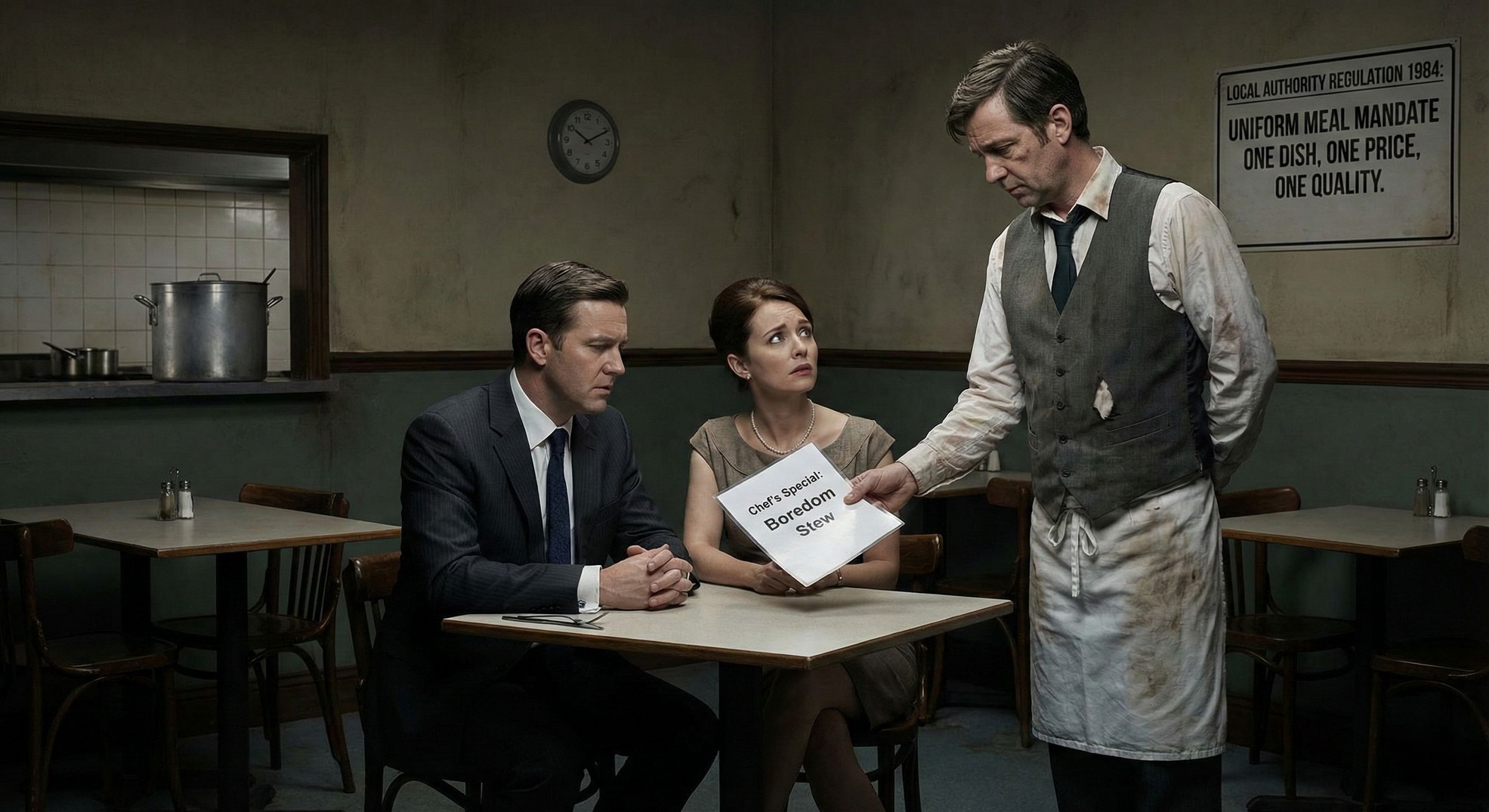
Picture this: your town has exactly one restaurant. That’s it.
But hey, you’ve got plans! You’ve dressed up, grabbed your significant other, and strolled in feeling fancy. You settle into your seats, ready for a culinary adventure, when the waiter glides over with a flourish.
He hands you the “menu,” and… hold up. It’s not a menu. It’s a tragic little flyer with exactly one dish on it: “Chef’s special: Boredom stew.” No appetizers. No desserts. Not even a lonely, day-old breadstick to soften the blow. Just one sad, soul-crushing option staring back at you. Bon appétit?
You might lean over to the waiter and ask, “Hey, why’s there only one thing on here? Did the chef just give up?”
The waiter, with a look that says they’ve answered this question a thousand times, explains, “Well, the local authorities decided that restaurant can only serve this one dish. It’s to make sure everyone gets the same ‘high-quality’ food at a ‘reasonable’ price.”
You’d blink, processing that, and maybe say, “So you’re telling me there’s an entire bureaucracy making sure I eat this one bowl of beige disappointment?”
The waiter would nod solemnly, adding, “They even inspect us regularly to make sure we’re following the rules. No secret side dishes allowed.”
The great energy menu makeover
That’s exactly what the energy market used to be—a one-dish diner where the monopoly chef cooked up the same old thing. You didn’t pick your power; your power picked you. And you just had to deal. That was life under the iron lid of heavily regulated energy.
Then came deregulation, and boy, it didn’t tiptoe in. Nope. Deregulation kicked down the door like a rockstar chef in a reality TV finale, shouting, “Say goodbye to boring energy! Here’s competition, baby!”
Rules and restrictions got sliced and diced, sautéed into oblivion. The electricity market? Fully unleashed. Companies started cooking up a buffet of options: Solar energy? Absolutely. Wind power? You got it. Competitive rates? Oh, honey, pile your plate high.
And that’s where we come in. Welcome to 1000whats, your backstage pass to the gloriously messy, occasionally baffling saga of electricity deregulation. Together, we’ll explore how it changed the game, where it shines, and where it leaves us scratching our heads
Ready? Let’s peel back these layers, one fascinating bite at a time.
What is energy deregulation?
Deregulation.
Deregulation sounds like one of those things you’d explain to a toddler and feel like a total genius: “De-regulation. We take some rules and—poof!—they’re gone.” Simple, right?
But it’s more than legal jargon—it’s a big deal in how markets work.
At its core, deregulation is the process of reducing or removing government rules that control how industries operate. In economic terms, it means opening up markets to competition by limiting or eliminating monopolies and central oversight.
Deregulation means reducing or removing government rules in specific areas of the economy.
At its core, deregulation is about pulling the government out of the driver’s seat in certain industries—like energy—and letting the free market take the wheel. It’s the difference between your mom picking your outfits for you (regulated markets) and suddenly being told, “Go ahead, dress yourself!” (deregulated markets). Sounds freeing, right? Except sometimes you end up wearing mismatched socks and a shirt you outgrew last year. We’ll dive into that a bit later.
Deregulation isn’t just about energy—it’s a revolution that has transformed industries like airlines, telecommunications, and banking.
Remember when flying meant choosing between a handful of expensive airlines? Or when you could only get your phone service from one national provider, complete with high prices and zero flexibility?
Deregulation changed all that. It introduced competition, driving down prices and unlocking innovation. Airlines started offering budget options, phone companies competed for customers with better plans, and suddenly, consumers had the power to choose.
Energy deregulation: Powering competition
Energy deregulation is about breaking up the old monopolies in electricity and natural gas markets.
Deregulation brings competition into the mix, letting you choose your energy supplier—just like selecting your phone or internet provider. Your local utility still takes care of delivery and maintains the infrastructure, but now you decide who supplies the energy—electricity or gas—that powers your home or business.
Deregulation lets you shop for energy like you shop for shoes.
The four key functions of the electricity and gas market
Before diving into the nitty-gritty of energy deregulation, let’s clarify something: the electricity and gas markets revolve around four main functions. These functions are like stepping stones, representing the journey from creating energy to using it to charge your phone or heat your soup.
Here’s how it all breaks down:
Generation: Where it all begins
It all starts with creating the energy. For electricity, this happens in power plants—whether fueled by coal, natural gas, nuclear energy, or renewables like wind and solar. For gas, it’s extracted from underground reserves. This stage is essentially the “factory” of the energy world, where raw materials are transformed into usable power.
Transmission: The long road ahead
Once energy is produced, it needs to travel, and that’s where transmission comes in. Think of this as the highway system for energy. High-voltage power lines and pipelines move electricity and gas over long distances, connecting power plants and gas fields to regional hubs closer to where you live.
Distribution: The final delivery
Now that energy has traveled miles and miles, it’s time for the local delivery. Distribution is like the last-mile service in e-commerce—your electricity or gas is routed from the local substations and pipelines to your home or office. This involves lower-voltage power lines and smaller gas pipes designed for safe, direct access.
Distribution: bringing the power from the ‘warehouse’ to your doorstep.
Supply (a.k.a. retail): The face of the market
Finally, there’s supply, often referred to as retail. This is the stage where energy companies (suppliers) sell energy to you. They handle customer service, billing, and offer different plans tailored to your needs—fixed rates, green energy, or perks like free weekend power. Supply is where you, the consumer, get to make choices, especially in deregulated markets.
Supply: Where energy becomes a product you can shop for.
Want the full story on Electricity retail?
I unpacked it on 1000whats → https://1000whats.com/electricity-retail/
Why these functions matter
These four stages—generation, transmission, distribution, and retail—are the backbone of how energy markets function. Understanding them is key to grasping how deregulation changes the game, especially since deregulation mainly affects generation and retail while keeping transmission and distribution regulated for safety and reliability.
With that foundation, you’re ready to see how the system transforms under deregulation. Let’s dive in!
How does energy deregulation work?
Energy deregulation isn’t just about throwing a bunch of rules out the window and crossing fingers. It’s a well-organized shake-up of a monopoly-dominated system that lets competition finally take the stage. Think of it as turning a one-man band into a full orchestra.
To make sense of it, let’s walk through the process step by step.
The old way: One monopoly to rule them all
In the days before deregulation, the energy market was a tightly controlled monopoly. A single utility company handled everything:
- Generation: They owned the power plants or gas extraction facilities.
- Transmission: They managed the high-voltage lines or large pipelines.
- Distribution: They delivered energy directly to homes and businesses.
- Supply: They sold the energy and decided how much you’d pay.
It was an all-in-one system, and consumers had no choice but to play along. Prices weren’t competitive, innovation was slow, and customer service was, well, let’s just say “forgettable.” Monopolies prioritized efficiency over flexibility, which worked for a while—until it didn’t.
Back then, picking your energy plan felt like shopping for a car when there was only one model—and one color. No choices. Just ‘black.’
The new way: Breaking up the monopoly
Deregulation changed the rules. Instead of one company controlling every aspect of energy, the market was split into its core functions:
- Generation: Independent companies now produce electricity or gas, competing to sell it at wholesale prices.
- Transmission and Distribution: These remain regulated, ensuring energy gets delivered safely and efficiently to your home.
- Supply (Retail): This is where competition thrives. Suppliers now compete to sell energy directly to you, offering various pricing plans, perks, and renewable options.
Deregulation broke the monopoly into pieces, so now companies fight for your business instead of just assuming they have it.
What stays regulated?
Even in deregulated markets, not everything is up for grabs. Transmission and distribution are still managed by local utilities and regulated by the government. Why? Because maintaining the infrastructure—power lines, substations, and pipelines—is a massive, shared responsibility. Allowing competition in this area would mean duplicating networks and endless digging in your neighborhood.
Competition is great for selling energy—but no one wants three sets of power lines crisscrossing their backyard.
Want the full story on Energy regulation?
I unpacked it on 1000whats → https://1000whats.com/energy-regulation/
What does this mean for consumers?
In a deregulated market, you now have the power to:
- Choose your energy supplier: Compare pricing, plans, and perks to find the best fit.
- Support renewables: Pick a supplier that prioritizes wind, solar, or other green energy sources.
- Lock in savings: Take advantage of fixed-rate plans to avoid surprises on your bill.
Your local utility still delivers the energy and handles outages, but you get to decide where your energy comes from and how much you pay.
Why focus on electricity and gas?
You might wonder why we focus so much on electricity and natural gas and still call it “energy deregulation.” The answer lies in their unique role in our lives and their dominance in the energy landscape.
Electricity and gas: The backbone of energy consumption
Let’s face it: electricity and natural gas are the rockstars of the energy world.
Electricity powers everything from your fridge to your TikTok binges, while natural gas keeps your house toasty, fuels factories, and—plot twist—helps generate more electricity. Together, they’re like the peanut butter and jelly of energy—reliable, essential, and way better together..
That’s why deregulation focuses on these two. They’re the energy MVPs, touching almost every part of our daily lives. If energy were a dinner party, electricity and gas would be the guests everyone’s actually excited to see.
Infrastructure: The key to direct delivery
Unlike gasoline or coal, which just hang out in trucks or piles until someone needs them, electricity and gas are high-maintenance divas. They require a sprawling network of power lines, transformers, and pipelines just to get to your house. Building and maintaining all that infrastructure used to be so pricey and complicated that monopolies were given the job, like a bad group project where one kid does everything.
Deregulation doesn’t kick these monopolies out entirely—it just says, “Hey, we’ll keep the pipes and wires, but now other companies get to sell the stuff running through them.” It’s like keeping the pizza oven but letting anyone make the pies.

Impact on the broader energy market
Deregulating electricity and gas doesn’t just shake up your energy bill—it sets off a chain reaction across the whole energy world. For instance:
- Renewable energy: Wind and solar now get to play in the big leagues, feeding into deregulated markets with their cleaner, greener power. It’s like inviting the health-food crew to a burger-eating contest—they’re not just participating; they’re changing the menu.
- Natural gas: This cleaner-burning option is stepping in as coal’s slightly more eco-friendly cousin. Think of it as swapping out your cranky, smoke-spewing uncle for the one who only smells like BBQ once in a while.
By opening up these markets, deregulation doesn’t just spark competition; it fires up innovation, setting the stage for a future that’s cleaner, smarter, and way more exciting than just watching your meter spin.
Why call it “energy deregulation”?
We stick with the term “energy deregulation” because electricity and natural gas are the undeniable stars of the energy world. They’re what people think of first when it comes to powering their homes and businesses. These markets are the most visible, most essential, and—let’s be honest—the most fun to shake up with a little competition.
Traditional fuels like coal and oil? They’re the old-timers in the corner. Useful in their day, but not exactly known for innovation or adaptability. Electricity and gas, on the other hand, are the multitaskers of the energy world—powering everything from your fridge to your furnace and driving sustainable energy transitions.
While deregulation focuses on these two major players, the ripple effects go far beyond. Renewables like wind and solar get a boost, cleaner energy systems take shape, and the entire energy economy starts buzzing with innovation. So, even if coal and oil don’t get a front-row seat, they can still feel the impact from the sidelines.
Why was energy deregulation introduced?
You see, deregulation isn’t just something that happens out of the blue. It’s more like the final act of a long drama—the “regulations era” coming to an end.
That was the time when governments heavily controlled industries to ensure stability, fairness, and, let’s be honest, to keep things simple.
But over time, cracks started to show. Costs rose, innovation stalled, and monopolies became a little too comfortable. By the time deregulation arrived, it wasn’t just an experiment—it was a response to years of frustration with a system that no longer worked.
The system worked… until it didn’t
For decades, regulation was the hero of the story. It tamed chaos, kept prices steady, and ensured electricity and gas reached even the most remote corners of the country. But as the years rolled on, those same rules started to feel a bit… stifling. Imagine a system so tightly controlled that companies didn’t need to innovate or compete. It’s like telling a runner, “Great job getting to the finish line—now just jog in place for the next 50 years.”
Monopolies: great for board games, terrible for inovation.
Thriving sectors of the ’80s: Free markets on fire
Let’s take a trip to the 80s—a decade that felt pretty ordinary at the time but now has us longing for its charm.
The 1980s loved free markets, and some industries ran with it. With fewer restrictions and more competition, innovation soared, prices dropped, and life got cooler for consumers.
- Electronics: Sony’s Walkman, Apple’s computers, and IBM’s PCs turned tech into household staples.
- Retail: Walmart and Carrefour mastered global supply chains, making shopping cheaper and shelves fuller.
- Automotive: Toyota and Honda’s reliable, fuel-efficient cars gave Western automakers a serious wake-up call.
- Aviation: U.S. airline deregulation meant flying went from luxury to affordable—cramped seats included.
These industries proved that less regulation and more competition could spark massive growth. The result? A decade of innovation, convenience, and, well, peanuts in the sky.
By that time, the energy sector was feeling the heat. The usual monotony of paying monthly bills was starting to feel like flipping through a black-and-white TV in a world of color. People craved action—faster responses, modern solutions, and maybe even a little excitement (or at least something less boring than meter readings).
Deregulation doesn’t show up uninvited—it’s what happens when old rules can’t keep up with new realities.
But the energy companies were still hitting snooze on those calls. They clung to their old ways, managing to ignore the growing demand for agility and innovation like a stubborn grandparent refusing to try Wi-Fi. Change was knocking, but the energy sector wasn’t exactly rushing to answer the door. But not for long.
The 80s roll into the 90s: Enter climate change
As we move through time and step into the late 80s, a massive tide is rising that the energy sector simply cannot ignore—climate change. By the 1990s, the world had officially hit panic mode over global warming. Scientists waved the data; everyone saw the CO2 levels climbing like a thermometer on a scorching day. And who was the prime suspect for this carbon chaos? The energy sector, the traditional fossil-fuel enthusiast.
Want the full story on Global warming?
I unpacked it on 1000whats → https://1000whats.com/global-warming-the-heat-the-causes-and-the-future/
The big question: What now?
The world knew it needed answers: less polluting energy, innovative ways to cut CO2 emissions, and sustainable solutions to tackle the growing climate crisis. So naturally, the question was posed to the big, state-owned, heavily regulated energy companies: “What can you do to fix this?”
Their response? A collective shrug. Decades of cozy monopolies and predictable routines had left them about as dynamic as a sloth on a hot afternoon. The industry that powered the world was utterly unprepared to pivot.
Understanding deregulation means seeing it not as a sudden shift, but as the inevitable result of a long process.
A radical shift in thinking
Clearly, the old system wasn’t going to cut it. The solution? A complete reorganization of the energy sector. It needed competitiveness to drive efficiency, innovation to spark creative solutions, and an environment that attracted serious investment in cleaner, greener technologies.
The world couldn’t afford to wait any longer. Deregulation wasn’t just an economic experiment anymore—it was becoming an environmental necessity. The energy sector was being told: adapt or get out of the way, because the future demanded a cleaner, faster, and smarter approach to power.
What are the benefits of energy deregulation?
Deregulation didn’t just rearrange the energy furniture—it brought in a full makeover team. For consumers, businesses, and the industry, it promised something fresh and exciting. Let’s break it down:
| Benefit | What it really means |
| Dynamic pricing | Prices now dance to the beat of supply and demand. Sure, it’s a little chaotic, but hey, chaos breeds competition! Suppliers fight to outdo each other with deals and innovations. |
| Consumer choice | Stuck with one boring energy plan? Not anymore. Now you can pick plans that fit your lifestyle, whether you’re a midnight gamer or a daytime sun-worshipper. |
| Lower energy costs | When suppliers compete, consumers win. Companies cut prices to stay in the game, which means you keep more money for coffee—or solar panels. |
| Innovation | Newbies in the market bring gadgets and green energy dreams: time-of-use pricing, wind power, solar panels…it’s like an energy tech playground. |
| Job creation | More players in the market mean more jobs in energy production, distribution, and the fancy tech that makes it all work. Bonus: your neighbor might finally stop complaining about unemployment. |
| Reduced bureaucracy | Less red tape means smoother operations. Think of it as upgrading from a flip phone to a smartphone—just easier, faster, and less likely to make you scream. |
| Diverse energy sources | A competitive market supports all kinds of energy: solar, wind, geothermal, you name it. The result? A system less prone to meltdowns and price freak-outs. |
Deregulation doesn’t just lower prices; it gives consumers the power (pun intended), inspires creativity, and creates a more resilient energy future.
Who knew making markets wild and competitive could actually be a good thing? 😉
Deregulation and renewable revolution
Deregulation didn’t just flip the energy market on its head—it made room for a surprise guest star: renewable energy.
Was renewable energy around before? Sure, but it looked a lot like your grandpa’s favorite old-school band. Big hydropower plants ruled the stage, and they were impressive, no doubt, but not exactly versatile. If you wanted something smaller, cooler, or more innovative? Forget it. A market run by a single, state-owned monopoly didn’t leave room for creative side gigs.
But then deregulation walked in, said, “Let’s mix things up!”—and everything changed. Suddenly, the monopoly wasn’t calling all the shots. Smaller, scrappier players got a chance to shine. Wind farms started popping up in the middle of nowhere. Solar companies showed up at your door asking if they could park panels on your roof. Even funky ideas like geothermal and battery storage joined the party. What used to be one-size-fits-all turned into a choose-your-own-adventure energy market.
Deregulation didn’t just change the rules; it changed the players, and renewable energy became the star.
And here’s the kicker: competition didn’t just bring renewables into the mix—it made them cheaper. Companies scrambled to outdo each other with greener, smarter, and more affordable options. Solar panels stopped being a rich-people thing and started showing up on suburban rooftops everywhere. Wind turbines became the unofficial mascots of countryside innovation. Even consumers got to play along, picking plans that matched their vibe: green energy, hybrid options, or even joining community-led power projects.
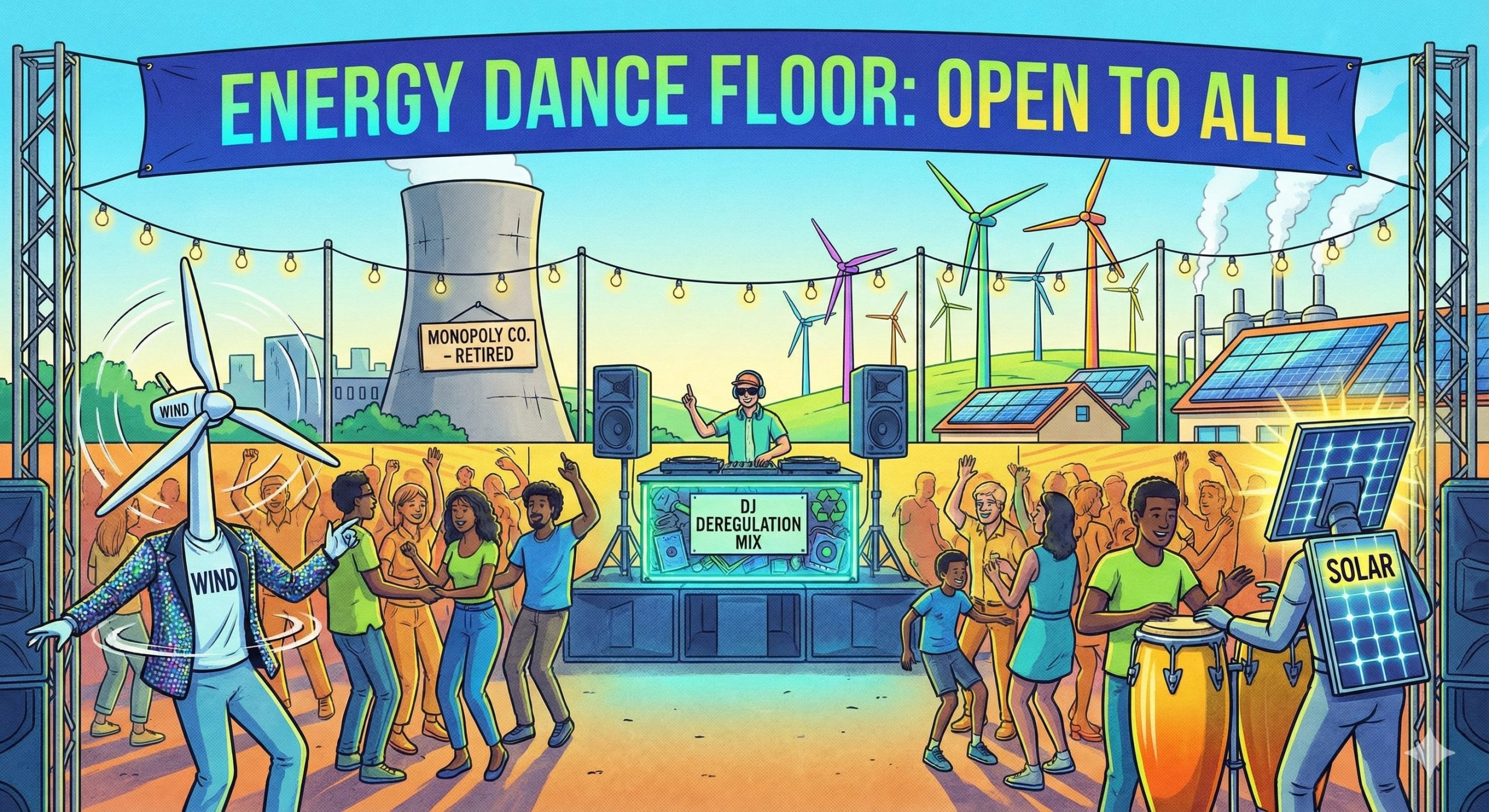
So, what did deregulation really do? It turned a slow, clunky monopoly into a vibrant, renewable-powered dance floor. The best part? The music’s just getting started.
What are the downsides of energy deregulation?
Every heroic tale has its plot twist, and deregulation is no exception. While it brought freedom, innovation, and some wallet-friendly perks, it also came with its fair share of headaches.
Here’s a closer look at the downsides of removing the training wheels from the energy market:
| Downside | What it means |
| Fluctuating prices | Remember when energy prices were carved in stone? Those days are gone. Now, supply, demand, and speculation rule. Prices can swing wildly—like a rollercoaster ride nobody signed up for. |
| Consumer vulnerability | Markets may feel “free,” but your wallet might not. Without fixed prices, sudden price hikes can zap your budget faster than a faulty circuit. Some countries cap household prices just to avoid a mutiny. |
| Complexity | Regulated markets were simple: one supplier, one price. Deregulated markets? A labyrinth of suppliers, pricing plans, and contracts. It’s like trying to find your way out of IKEA. |
| Lack of transparency | In theory, competition makes things clear. In reality, pricing and contracts often feel more like a magician’s trick—”Now you see it, now you don’t!” Making informed decisions becomes a puzzle. |
| Market manipulation | Ah, the dark side of deregulation. Early on, clever players exploited loopholes to create chaos (and profits). In extreme cases, manipulation even caused blackouts. Talk about lights out, literally! |
Deregulation brought competition and innovation, but it’s not all sunshine and wind turbines. Prices fluctuate, the market’s a maze, and sneaky players can exploit the system. So, while deregulation has its perks, it also comes with a side of “buyer beware.” Maybe keep a flashlight handy—just in case.
The irony of energy deregulation
Ever tried fixing a leaky faucet, only to flood the whole bathroom?
Energy deregulation can sometimes feel like that. The idea was to make everything better—more competition, more choice, lower prices. But, surprise! Sometimes it ends up delivering the opposite.
Here’s how:
Lack of competition: Wait… what?!
The whole point of deregulation was to smash monopolies, right? And it worked! Those old-school, government-run giants were dethroned.
But here’s the plot twist: the free market can sometimes play favorites.
Big companies flex their muscles, get even bigger, and dominate the market in a way that starts to look suspiciously monopoly-like. They can even manipulate prices, leaving everyone else asking, “Did we really just trade one giant for another?”
“Come one, come all!” Deregulation waved goodbye to pesky regulatory barriers, but it didn’t account for the other hurdles. Setting up shop in the energy market isn’t like opening a lemonade stand. It’s more like starting a rocket company—massive investments, complicated rules, and, oh yeah, big companies already own the playground. They’ve got the cash, the expertise, and the economies of scale to keep newbies out. Turns out, deregulation just swapped one kind of gatekeeping for another.
Less consumer choice: Seriously?
Deregulation promised us a buffet of options, but sometimes it feels like we’re back to a single dish. Why? Once companies settle into a nice, cozy market position, they don’t always hustle to woo customers. With fewer competitors to push them, they might offer less variety, fewer perks, and pricing plans that feel more meh than marvelous. It’s like going to a restaurant with a full menu, only to be told, “Actually, we only have chicken.”
The takeaway
Energy deregulation was supposed to be the knight in shining armor, rescuing us from clunky old monopolies. And in some ways, it was. But like any big fix, it came with a few unexpected hiccups. The moral of the story? Be careful what you wish for—sometimes the “free market” gets a little too free.
The deregulation controversy
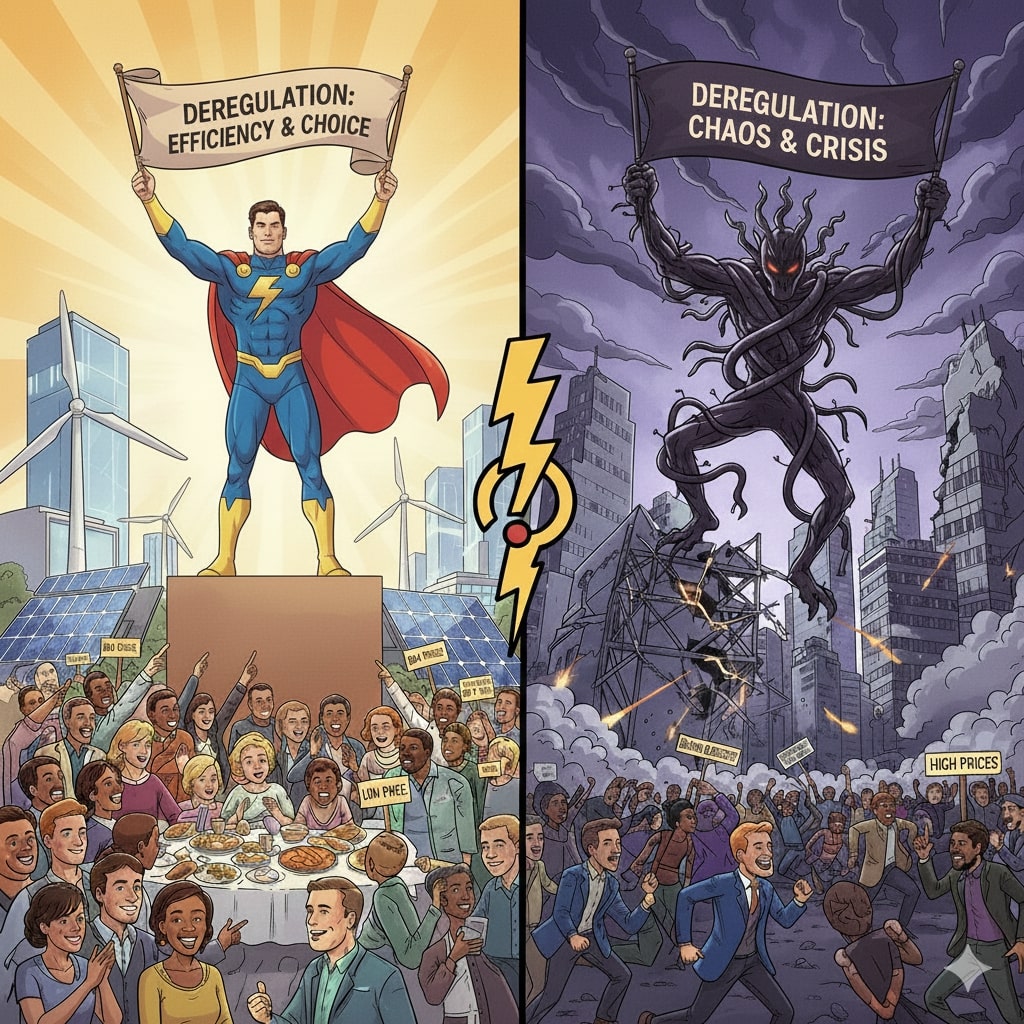
So, is energy deregulation a hero or a villain? If that question popped into your head, congratulations—you’ve joined the world’s most heated energy debate. Seriously, people have argued less about pineapple on pizza.
The case for deregulation: “It’s awesome!”
Fans of deregulation wave their banners high, claiming it’s the best thing since sliced bread (or maybe since solar panels). They point to success stories where deregulated markets delivered efficiency, innovation, and a buffet of customer choices. Competition lit a fire under the industry, they argue, and everyone benefited—except maybe the monopolies (cue tiny violins).
The case against deregulation: “It’s a disaster!”
Then there are the critics, ready to roll out their Exhibit A: the California Energy Crisis of the early 2000s. That mess—rolling blackouts, skyrocketing prices, and a sprinkling of market manipulation—was like a bad reality show nobody wanted to watch. Critics insist regulated markets could have prevented the chaos.
Even deregulation’s biggest cheerleaders start sweating when crises hit. Case in point: the European Union. After decades of shouting, “Free the market!” they had to slap on price caps in 2022 to calm the madness of spiking gas and electricity costs. Turns out, even the free market sometimes needs a timeout.
So… who’s right?
Honestly, the whole debate feels like arguing whether cats or dogs are better. Deregulation wasn’t “good” or “bad”—it was necessary. It broke down old barriers and pushed the energy industry to evolve.
But here’s the kicker: no market runs perfectly without rules. Some guardrails are still needed to keep things from spiraling out of control.
The real solution? Learn from history, tweak the system, and aim for the sweet spot—a little regulation to keep the peace, and a little deregulation to keep things exciting. Energy markets, like life, work best with balance.
“Deregulation does not mean discarding rules, but rather refining them to eliminate unnecessary burdens and complexities.” – Alan Greenspan
Final thoughts
Ah, unlike the never-ending saga of the deregulation debate, we’ve finally reached the end of this post. Cue the victory music! While economists, policymakers, and your one uncle who’s obsessed with energy markets will probably argue about this forever, we can at least pat ourselves on the back for making it through without dozing off.
Here’s the deal: deregulation is a wild ride. It’s like a rollercoaster with some epic highs (innovation! competition! renewable energy!) and a few stomach-dropping lows (price spikes, market chaos, and the occasional blackout). But at the heart of it all, it’s a story about trying to make energy work better for everyone.
So, whether you’re a fan of free markets, a nostalgic lover of regulated calm, or just someone who wants their electric bill to not feel like a ransom note, there’s something for everyone in the great deregulation debate.
Now, before you go, here’s a thought: maybe deregulation isn’t about picking sides—it’s about keeping the lights on and the future bright. That’s enough power talk for today—go treat yourself to something fun. Maybe even turn off a light or two on your way out. Conservation starts with you, my friend.
Food for thought: Let’s get curious
Got a few brain cells to spare? Here are some fun questions to chew on:
- What unexpected perks could deregulation bring to your household? (Maybe cheaper bills or bragging rights for choosing green energy?)
- How might deregulation shape the future of renewables? (Wind turbines on Mars, anyone?)
- What hurdles are we likely to trip over on this deregulation journey? (Spoiler: it’s probably going to involve money and politics.)
- Are there hidden gems for consumers in the deregulation treasure chest? (Time to dig deep and find out.)
Over to you
I hope this post gave you a good chuckle and a clearer idea of what deregulation is all about. Got burning questions or sizzling comments? Share them below! Let’s keep this energy conversation electrified—pun absolutely intended. ⚡
Stay curious!