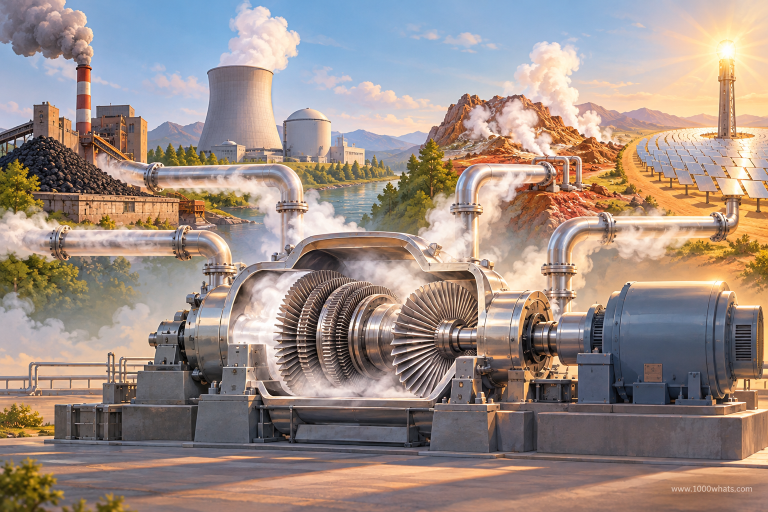
The strange thing about renewable energy is that we spend an enormous amount of time looking up.
At the sun.
At the wind.
At clouds.
At weather forecasts.
Geothermal energy asks a different question:
Have you tried looking down?
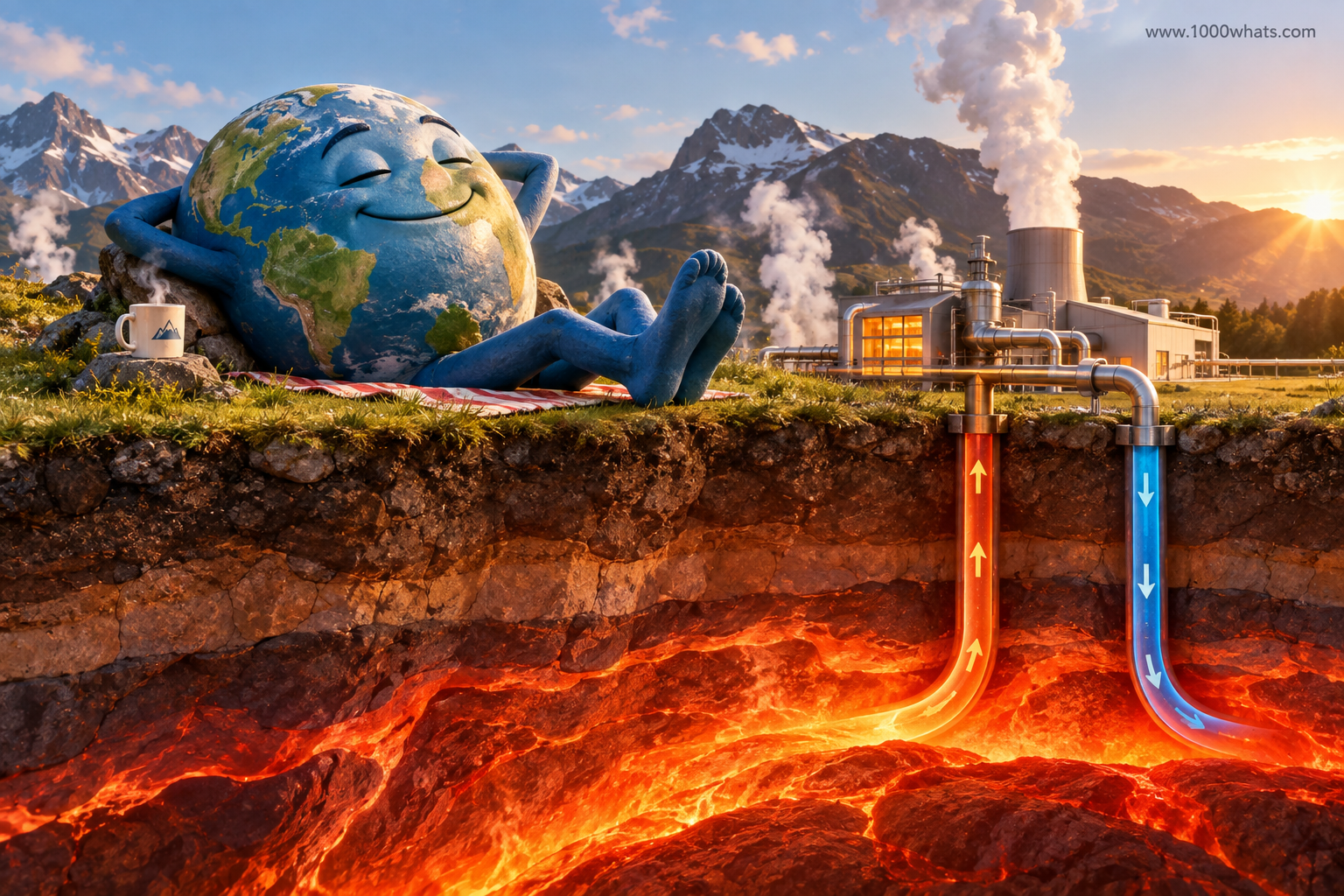
Because beneath the pavement, farmland, forests, oceans, office buildings, and whatever else we have placed on the surface, the planet is hot.
Not metaphorically hot.
Actually hot.
Dig deep enough and rock temperatures rise.
In the right geological conditions, underground water gets hot enough to emerge as hot springs, erupt as geysers, heat buildings, or eventually produce steam that spins an electricity-generating turbine.
And unlike solar irradiance or wind speed, the Earth’s underground heat does not normally disappear because somebody moved the clock to 7 p.m.
Welcome to 1000whats — where today the power plant is hiding underneath the parking lot.
This is geothermal energy.
⚡ “Solar and wind harvest energy arriving at Earth. Geothermal taps energy already underneath it.”
First, where does the heat actually come from?
Go deep into the Earth and things become increasingly unpleasant for humans and increasingly interesting for energy engineers.
The planet contains a huge amount of thermal energy.
Some of that heat is left over from Earth’s formation.
A significant continuing source comes from the radioactive decay of naturally occurring elements inside the planet.
The U.S. Energy Information Administration’s geothermal overview describes geothermal energy simply as heat inside the Earth.
Near the surface, temperatures change with weather and seasons.
Go deeper and those surface fluctuations fade.
Keep going and the temperature generally rises.
The rate at which it rises is called the geothermal gradient.
That creates an extraordinary situation.
Human civilization lives on top of an enormous hot object.
The problem is not whether heat exists.
The problem is:
Can we reach useful heat economically?
That distinction explains almost everything about geothermal energy.
Hot does not automatically mean useful
Imagine discovering rock underground at:
200°C.
Excellent.
You have heat.
Do you have a geothermal power plant?
Not necessarily.
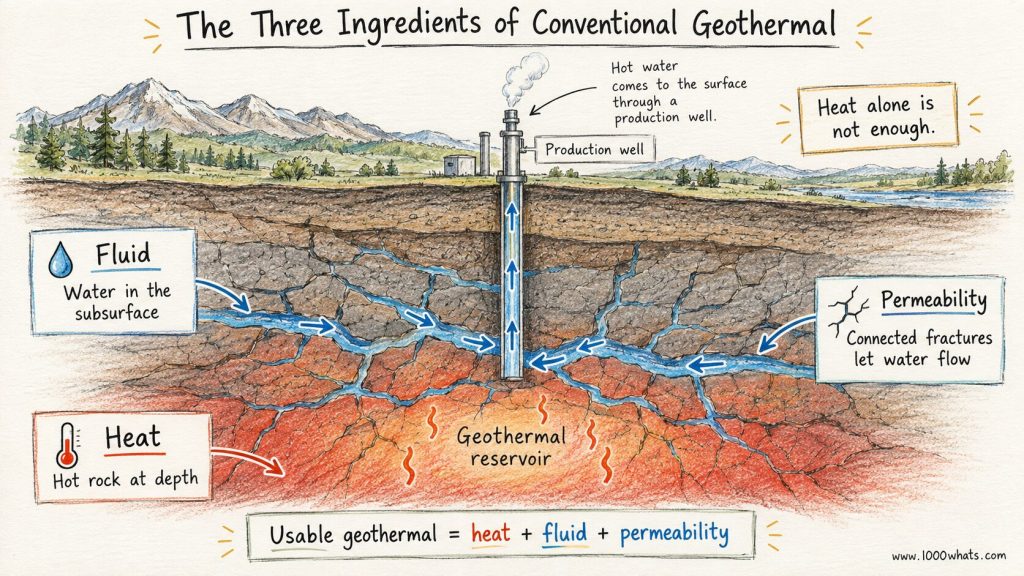
A conventional geothermal resource usually needs three important things:
| Ingredient | Why it matters |
|---|---|
| Heat | Provides the thermal energy |
| Fluid | Carries the heat toward the surface |
| Permeability | Allows that fluid to move through the rock |
The U.S. Department of Energy describes these same three ingredients as the basis of a conventional hydrothermal geothermal system.
You can therefore have hot rock and still have a disappointing project.
Maybe there is not enough underground water.
Maybe the rock is too impermeable.
Maybe the reservoir is too deep.
Maybe drilling costs destroy the economics.
Maybe the resource temperature is useful for heating but not attractive for electricity generation.
This is why traditional geothermal power developed in unusually favorable places.
Nature had already assembled most of the system.
Engineers mainly had to find it and connect the pipes.
This is why volcanoes keep entering the conversation
Look at major conventional geothermal regions and you begin noticing a geological pattern.
Iceland.
Indonesia.
The Philippines.
New Zealand.
Kenya.
Parts of Italy.
Western United States.
Many sit near tectonically active regions where hot material lies relatively close to the surface.
The EIA notes that many major geothermal resources occur near tectonic plate boundaries, including the Pacific Ring of Fire.
This is convenient because drilling is expensive.
If useful heat is relatively shallow, the project becomes much easier.
But please remove one popular mental image.
A geothermal plant does not normally drill a pipe directly into glowing magma like somebody installing a straw into a volcano.
We are usually interested in:
hot rock,
hot underground water,
steam,
and engineered fluid circulation.
The volcano is evidence of heat.
It is not the equipment.
So how does a geothermal power plant make electricity?
Surprisingly conventionally.
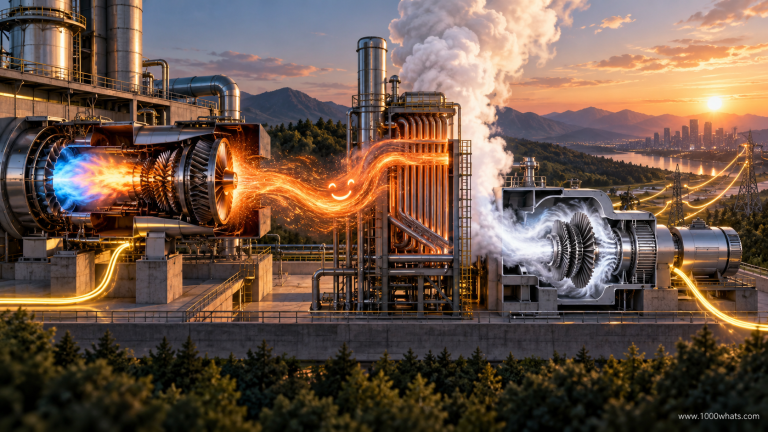
Once you get the heat above ground, geothermal electricity starts looking suspiciously like many other thermal power plants.
You need something that eventually spins a turbine.
The basic chain is:
Earth’s heat → hot fluid or steam → turbine → generator → electricity
That is not wildly different from:
coal → heat → steam → turbine → electricity
or:
nuclear fission → heat → steam → turbine → electricity.
The difference is where the heat came from.
Geothermal skips the combustion step.
No coal train.
No gas pipeline.
No reactor.
The boiler, in a sense, is underground.
⚡ “A geothermal plant is a thermal power plant whose fuel supplier happens to be geology.”
There are three classic types of geothermal power plant
The EIA divides conventional geothermal electricity plants into three main designs:
dry steam, flash steam, and binary cycle.
They all use underground heat.
They handle it differently.
Dry steam: geology did almost everything for you
This is the wonderfully straightforward version.
Steam already exists underground.
Bring it through a production well.
Send it through a turbine.
Spin the generator.
Condense the steam.
Manage or reinject the fluid.
Done.
The famous Larderello field in Italy, where geothermal electricity was first demonstrated in the early twentieth century, developed around naturally available steam.
Dry-steam resources are useful.
They are also rare.
Nature does not usually prepare power-plant-grade steam simply because humans have financing available.
Flash steam: hot water discovers lower pressure
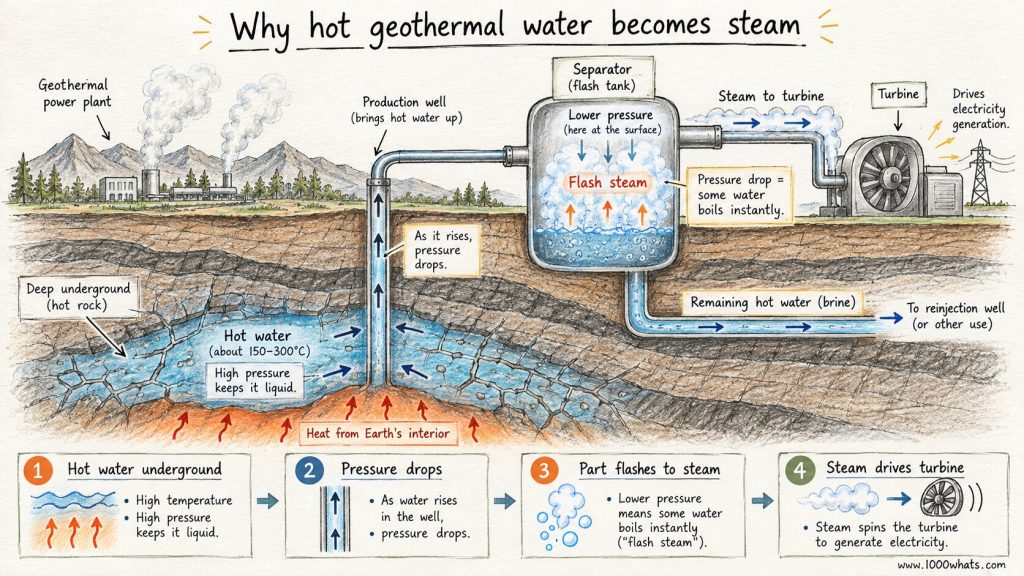
More commonly, a geothermal reservoir contains very hot water under pressure.
Underground, pressure keeps that water liquid even at temperatures where water at atmospheric pressure would boil.
Bring the water toward the surface.
Pressure drops.
Part of the hot water rapidly turns into steam.
It flashes.
That steam drives the turbine.
Hence:
flash-steam plant.
The remaining water can be reinjected underground.
The mechanism is beautifully simple once you see it:
| Underground | At lower surface pressure |
|---|---|
| Very hot pressurized water | Pressure drops |
| Water remains liquid | Part of water flashes into steam |
| Heat is stored in fluid | Steam can drive turbine |
Binary cycle is where geothermal gets clever
Now suppose the geothermal water is hot…
but not hot enough to produce useful steam efficiently.
You could give up.
Or you could find another liquid that boils at a lower temperature than water.
Engineers chose option two.
In a binary-cycle plant, geothermal water transfers heat through a heat exchanger into a second fluid with a lower boiling point.
The two fluids remain separate.
The secondary working fluid vaporizes.
That vapor spins the turbine.
Then it condenses and circulates again.
So instead of:
geothermal steam → turbine
we get:
geothermal water → heat exchanger → second fluid vapor → turbine
This allows electricity generation from lower-temperature resources than would otherwise be practical.
The underground water does not even have to enter the turbine.
It merely lends its heat.
Then we send it back underground.
That is a rather elegant arrangement.
Wait. Do we use up geothermal energy?
Yes and no.
Welcome to renewable-energy terminology, where one-word answers eventually get punished.
The Earth’s internal heat reservoir is enormous and continuously replenished over geological timescales.
That is why geothermal is classified as renewable.
But an individual geothermal reservoir can still be mismanaged.
Extract heat or fluid faster than the local resource can recover and production can decline.
Pressure can fall.
Temperatures can decline.
Flow can deteriorate.
That is why many geothermal projects reinject cooled water back underground.
Reinjection can help:
maintain reservoir pressure,
support circulation,
manage fluids,
and allow the water to pick up heat again.
So geothermal is renewable.
That does not mean every well contains a magical infinite espresso machine of steam.
The planet’s heat is enormous. The productive capacity of a particular reservoir is not.
Here is geothermal’s superpower: it does not wait for weather
Solar output follows sunlight.
Wind follows atmospheric conditions.
Hydro can depend on precipitation and reservoir conditions.
Geothermal heat underground is generally much steadier.
That gives geothermal an unusual characteristic for renewable generation:
high utilization.
The IEA’s Future of Geothermal Energy reports that global geothermal capacity had an average utilization rate above 75% in 2023, compared with below 30% for wind and below 15% for solar PV.
DOE notes that geothermal power plants can achieve capacity factors around 90% in favorable applications.
This connects directly to my existing article on capacity factor.
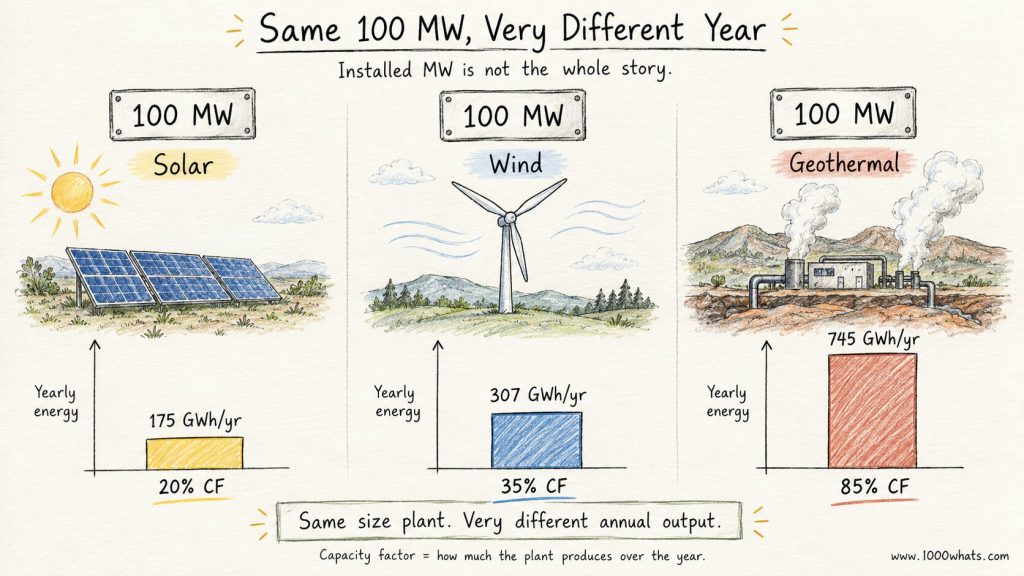
A simple illustration:
| 100 MW plant | Illustrative capacity factor | Annual electricity |
|---|---|---|
| Solar PV | 20% | ~175 GWh |
| Wind | 35% | ~307 GWh |
| Geothermal | 85% | ~745 GWh |
Illustrative comparison only. Actual capacity factors depend heavily on technology, location, resource, curtailment, and operating strategy.
The point is not that geothermal is automatically “better.”
Solar may be far cheaper and easier to build.
Wind resources can be enormous.
But a megawatt of geothermal capacity can produce electricity during far more hours of the year.
That can become increasingly valuable in a system containing lots of variable renewables.
So why aren’t we covering the planet in geothermal plants?
This is where the story becomes interesting.
In 2025 the world added:
511.2 GW of solar
158.7 GW of wind
and only:
0.3 GW of geothermal.
Those are current IRENA Renewable Capacity Statistics 2026 figures.
Solar is racing.
Geothermal is jogging while carrying drilling equipment.
Why?
Because solar development largely asks:
Is there enough sunlight and somewhere to put the panels?
Conventional geothermal asks something closer to:
What exactly is happening three kilometers underground, and how much money would you like to spend finding out?
That is not a trivial question.
The uncomfortable word is exploration
Before drilling a geothermal well, you do not know the underground resource perfectly.
Geologists can use:
surface geology,
geochemistry,
seismic data,
temperature gradients,
magnetotelluric surveys,
existing wells,
and other exploration techniques.
Eventually, however, geology retains one particularly expensive way to reveal whether you were right:
drill the hole.
The EIA rather beautifully states that the most reliable way to determine underground geothermal conditions is to drill a well and measure them.
Excellent.
Also expensive.
This creates exploration risk.
Imagine spending millions before discovering:
the temperature is lower than expected,
flow is poor,
permeability is insufficient,
or the reservoir is commercially disappointing.
Solar developers can measure irradiation without drilling several kilometers into the Sun.
Geothermal does not enjoy that luxury.
Drilling is both the problem and possibly the breakthrough
This is where geothermal suddenly becomes one of the more interesting energy stories of the next decade.
Traditional geothermal waits for nature to provide:
heat,
fluid,
and permeability
in a convenient combination.
But what if the rock is hot and the permeability is missing?
Can we engineer it?
That is the idea behind an Enhanced Geothermal System, or EGS.
The DOE describes EGS as essentially human-made geothermal energy. Engineers drill into hot rock and create or reopen fractures so fluid can circulate through the rock, absorb heat, and return to the surface.
The loop becomes:
inject water → hot fractured rock → water absorbs heat → production well → surface power plant → reinjection
Now geology still provides the heat.
But humans help create the underground heat exchanger.
That is a very different proposition from simply hunting for perfect natural reservoirs.
Conventional vs. enhanced geothermal
| Conventional geothermal | Enhanced Geothermal System | |
|---|---|---|
| Heat | Naturally available | Naturally available |
| Underground fluid | Usually naturally present | Can be injected |
| Permeability | Naturally favorable | Engineered or enhanced |
| Best locations | Geologically favorable regions | Potentially much broader |
| Core challenge | Finding a suitable reservoir | Creating an economic engineered reservoir |
This distinction may be the most important thing happening in geothermal technology.
Because the heat was never particularly rare.
Accessible geothermal reservoirs were.
EGS attacks that limitation directly.
⚡ “Next-generation geothermal is not trying to create heat. It is trying to make more of Earth’s existing heat reachable.”
And then the oil industry walks into the room
This is where energy transitions become less tidy than slogans.
Who is really good at:
drilling deep wells,
steering wells horizontally,
understanding underground rock,
managing high-pressure fluids,
building subsurface models,
and completing technically difficult drilling projects?
Oil and gas companies.
Oops.
The IEA estimates that up to 80% of the investment required in a geothermal project involves capabilities and skills that overlap with the oil and gas industry.
That includes:
- drilling technology;
- subsurface expertise;
- geoscience;
- project execution;
- well services;
- supply chains.
Technologies refined during the shale revolution—particularly horizontal drilling and hydraulic stimulation—may therefore become tools for expanding clean geothermal energy.
The same drilling expertise that helped unlock enormous quantities of hydrocarbons may help unlock underground heat.
Energy transitions have a sense of humor.
Next-generation geothermal could change the map
Conventional geothermal has historically been geographically picky.
EGS potentially changes that.
The IEA estimates that next-generation geothermal’s technical electricity potential is second only to solar PV among renewable technologies.
At progressively greater drilling depths, suitable hot rock becomes much more widespread.
Its analysis finds that geothermal resources at depths below 8 km could theoretically support almost 600 TW of geothermal capacity over a multi-decade operating period.
Please read that number correctly.
It does not mean we are about to build 600 TW of geothermal plants.
Technical potential is not:
economic potential,
permitted potential,
financeable potential,
or likely deployment.
It means the heat resource itself is spectacularly large.
The engineering and economics decide how much becomes useful.
That is the real frontier.
A useful mental model: the geothermal ladder
Think of geothermal as a ladder.
| Depth / resource | Typical opportunity |
|---|---|
| Near surface | Ground-source heat pumps |
| Shallow hot water | Direct heating / district heating |
| High-quality hydrothermal reservoir | Conventional geothermal electricity |
| Deep hot rock without ideal permeability | Enhanced geothermal systems |
| Deeper / hotter resources | Potential future next-generation geothermal |
The deeper we can drill economically, the more geography becomes available.
But deeper wells also mean:
higher drilling costs,
greater technical difficulty,
higher temperature materials,
more complex well construction,
and more risk.
The geothermal revolution therefore depends not on discovering that Earth is hot.
We solved that one quite some time ago.
It depends on making deep heat cheap enough to reach.
But geothermal is not only about electricity
This deserves far more attention.
Making electricity from heat requires relatively high temperatures because thermal-to-electric conversion has efficiency limits.
But buildings do not need electricity to provide every unit of heat.
Sometimes they simply need:
hot water.
That means lower-temperature geothermal resources can be useful for:
district heating,
greenhouses,
industrial processes,
aquaculture,
bathing,
and building heat.
Reykjavík is the famous example.
Much of Icelandic space heating uses geothermal resources directly.
Notice how elegant this is.
Suppose you have underground water at a useful heating temperature.
You could:
convert heat → electricity → send electricity through grid → turn electricity back into heat.
Or, where geography allows:
use the heat as heat.
Sometimes energy systems become clever by refusing to perform unnecessary conversions.
And geothermal heat pumps are another thing again
This distinction gets muddled constantly.
A geothermal power plant accesses substantial underground heat to produce electricity or useful thermal energy.
A ground-source heat pump typically uses relatively stable shallow ground temperatures as a heat source in winter and heat sink in summer.
It still needs electricity to operate the heat pump.
It does not usually require some volcanic inferno underneath your lawn.
That is why our heat-pump explainer is conceptually connected but technologically different.
Think of it like this:
| Technology | What does it use underground for? |
|---|---|
| Geothermal power plant | Source of substantial thermal energy |
| Direct geothermal heating | Source of useful hot water/heat |
| Ground-source heat pump | Stable temperature reservoir for moving heat |
Calling all three simply “geothermal” is understandable.
It is also a reliable way to confuse almost everyone.
Does geothermal produce emissions?
Much less than fossil-fuel generation, but “renewable” does not automatically mean physically emissionless.
Some natural geothermal reservoirs contain dissolved gases.
When geothermal fluids reach the surface, gases such as:
carbon dioxide,
hydrogen sulfide,
and traces of other compounds
may be released depending on the resource and technology.
Binary-cycle systems can keep geothermal fluid in a closed loop and reinject it, reducing direct releases substantially.
There are also environmental considerations around:
water management,
land disturbance,
drilling,
noise,
subsurface fluid movement,
and induced seismicity.
That last one becomes especially relevant for EGS.
Creating or reopening fractures underground can trigger small earthquakes.
Most are tiny.
But poorly managed projects have demonstrated that induced seismicity can become a legitimate public concern.
Engineering underground does not mean engineering somewhere irrelevant.
People still live above it.
What about earthquakes?
This deserves nuance.
Conventional geothermal fields can experience induced seismic activity because extracting and reinjecting fluid changes underground pressures.
EGS adds another mechanism because operators deliberately create or stimulate fluid pathways in hot rock.
That does not mean:
EGS causes giant earthquakes.
Nor does it mean:
there is nothing to worry about.
Projects need:
geological characterization,
seismic monitoring,
careful injection management,
operating protocols,
and site-specific risk assessment.
This is one of those energy topics where both the promotional slogan and the apocalypse headline are usually less useful than the engineering.
Geothermal has a cost problem before it has a fuel problem
Once operating, geothermal plants benefit from something rather attractive:
no annual coal purchase,
no natural-gas price,
no uranium refueling,
no sunlight invoice.
But construction can be capital intensive.
Especially drilling.
The IEA noted in early 2026 that well and drilling expenditure can represent up to 80% of costs in some next-generation geothermal projects.
And drilling comes before revenue.
That creates a familiar project-development problem:
spend substantial money now to learn whether the resource will produce enough money later.
This is precisely why technology learning matters so much.
Faster drilling.
Better bits.
Better subsurface imaging.
More accurate targeting.
Standardized designs.
Higher success rates.
Each improvement attacks cost and risk simultaneously.
Could geothermal become cheap?
Potentially.
The numbers are ambitious.
The IEA estimates that with sufficient innovation and deployment, next-generation geothermal costs could fall by as much as 80% by 2035, potentially reaching around $50/MWh in favorable future cases.
That would put geothermal into a very interesting position.
Not necessarily the absolute cheapest raw MWh.
Solar and wind are brutally competitive.
But geothermal offers something different:
low-emissions electricity that can run around the clock and potentially operate flexibly.
Comparing only LCOE can therefore miss some system value—something worth remembering from our existing LCOE explainer.
A 3 a.m. geothermal megawatt-hour and a noon solar megawatt-hour are both MWh.
The power system may not value them identically.
Timing exists.
Electricity has that annoying habit.
A real-world paradox: tiny industry, enormous potential
Here is geothermal in one table.
| Geothermal today | Geothermal potential |
|---|---|
| Around 15 GW globally at end-2024 | Vast next-generation technical resource |
| Only 0.3 GW added in 2025 | Potential becomes far wider with deeper drilling |
| Concentrated in favorable geology | EGS could expand usable geography |
| High utilization | Potential source of firm low-emissions power |
| Drilling-intensive and risky | Oil & gas expertise may reduce costs |
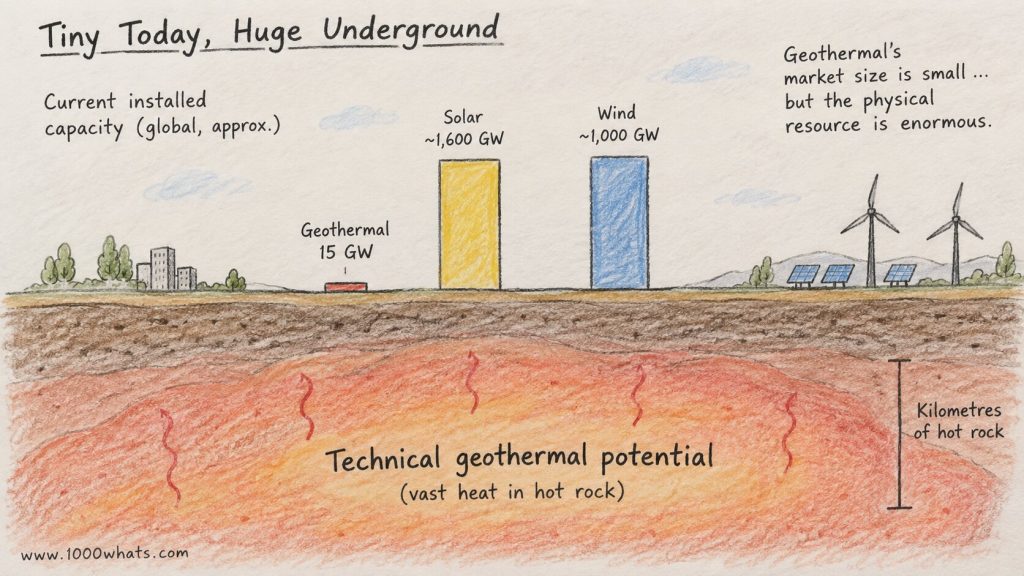
IRENA’s 2025 statistics put global geothermal capacity at roughly 15 GW at the end of 2024.
Compare that with:
solar: roughly 1,865 GW
wind: roughly 1,133 GW.
Geothermal is tiny.
Yet the IEA’s resource analysis says next-generation geothermal’s technical potential could meet today’s global electricity demand many times over.
That gap is the entire geothermal story.
The resource is huge. The economically accessible part is still small.
Why geothermal matters in a wind-and-solar world
This is perhaps the strongest strategic argument.
Imagine a grid with:
lots of solar,
lots of wind,
batteries,
hydropower,
demand response,
strong interconnectors,
and geothermal.
Solar produces when sunlight exists.
Wind produces when wind exists.
Batteries shift electricity through time.
Demand response moves consumption.
Transmission moves electricity through geography.
Geothermal provides another type of resource:
continuous low-emissions energy that does not depend on current weather.
That does not mean every system requires geothermal.
Nor does it mean geothermal somehow defeats wind and solar.
This endless attempt to turn technologies into rival football clubs does not help much.
Energy systems work through portfolios.
The interesting question is:
What useful system characteristic does each resource bring?
Geothermal brings:
- high utilization;
- low fuel-price exposure;
- relatively small physical footprint;
- dispatchable or firm generation potential;
- direct heat;
- potential long-duration thermal storage;
- domestic energy supply.
Those attributes can complement variable renewables rather than compete with them.
There is an energy-security angle too
A geothermal plant does not wait for:
an LNG tanker,
a coal train,
a uranium shipment,
or an international pipeline.
Its energy source is local.
Very local.
Several kilometers local.
Once built, that can reduce exposure to international fuel-price shocks.
Of course, project equipment, drilling services, financing, and supply chains still have international dependencies.
No serious energy technology is magically geopolitics-free.
But the fuel itself does not need to cross a border every day.
That matters.
Especially for countries sitting above useful geothermal resources.
Energy independence does not get much more literal than drilling vertically.
What could stop geothermal?
Quite a few things.
Drilling remains expensive
If drilling costs do not fall, much of the theoretical resource remains theoretical.
Exploration risk is real
A poor well can destroy project economics before electricity production begins.
Conventional resources remain geographically limited
Not every country has convenient shallow hydrothermal resources.
EGS still needs commercial proof at scale
The technical promise is enormous.
Large-scale repeatable economics are not yet guaranteed.
Permitting can be painfully slow
The IEA notes that geothermal projects can take up to a decade to commission in some jurisdictions because of permitting and development processes.
Induced seismicity needs serious management
Public acceptance can disappear remarkably quickly when buildings start shaking.
Cheap solar and batteries have changed the competition
Geothermal is not entering an empty clean-energy market.
It has to compete with technologies whose costs have already collapsed.
That is a high bar.
Then why is geothermal suddenly getting attention again?
Because several things are converging.
Electricity demand is rising.
Solar and wind penetration is increasing.
Power systems increasingly value firm clean electricity.
Data centers want large amounts of reliable low-carbon power.
Oil and gas drilling technology has improved dramatically.
Investors are financing next-generation geothermal companies.
And EGS may expand the addressable resource beyond the traditional volcanic hotspots.
The IEA reported in February 2026 that investment interest in next-generation geothermal had risen sharply, helped by improving drilling performance and new electricity-supply agreements, including demand from data centers.
None of that proves geothermal will become the next solar.
Energy history is filled with technologies that were definitely about to transform everything.
But it does make geothermal worth watching again for a better reason than hype:
the constraint itself may be changing.
Traditional geothermal was constrained by geology.
Next-generation geothermal is trying to replace part of that geological luck with engineering.
That is a much more interesting proposition.
So, what is geothermal energy in one sentence?
Geothermal energy is useful heat extracted from the Earth and used directly for heating or converted into electricity, usually by circulating naturally occurring or engineered underground fluids through hot rock.
At the simplest level:
Earth → heat → useful energy.
But underneath that sentence sits the whole industry:
geology,
drilling,
reservoir engineering,
thermodynamics,
turbines,
heat exchangers,
project finance,
and increasingly technologies borrowed from oil and gas.
For something named after heat in the ground, geothermal has become remarkably multidisciplinary.
Final thoughts
Geothermal energy suffers from a visibility problem.
Solar announces itself with acres of panels.
Wind turbines stand 200 meters high.
Hydropower occasionally rearranges a valley.
Geothermal’s most important asset is buried underground.
That makes it easy to overlook.
And historically, there was a good reason geothermal remained relatively niche.
Useful underground heat exists almost everywhere.
Economically accessible geothermal reservoirs do not.
That may now be changing.
If better drilling and reservoir engineering allow us to reach deeper hot rock economically, geothermal stops being simply:
a clever renewable technology for Iceland, Kenya, Indonesia, California, and a few other lucky places.
It becomes something more interesting:
a drilling technology for turning Earth’s enormous underground heat reservoir into controllable energy.
That transformation is not guaranteed.
Costs have to fall.
Projects have to scale.
Reservoirs have to behave.
Seismic risks have to be controlled.
Permitting has to improve.
And the technology has to compete with some very cheap solar panels.
But the underlying idea is almost absurdly attractive.
We live on a hot planet.
We need enormous amounts of low-carbon energy.
And after spending decades becoming extremely good at drilling holes in the ground to extract things we burn…
we may discover that sometimes the hole itself is enough.
Until next time, stay curious! 😎
Discover more from 1000whats
Subscribe to get the latest posts sent to your email.