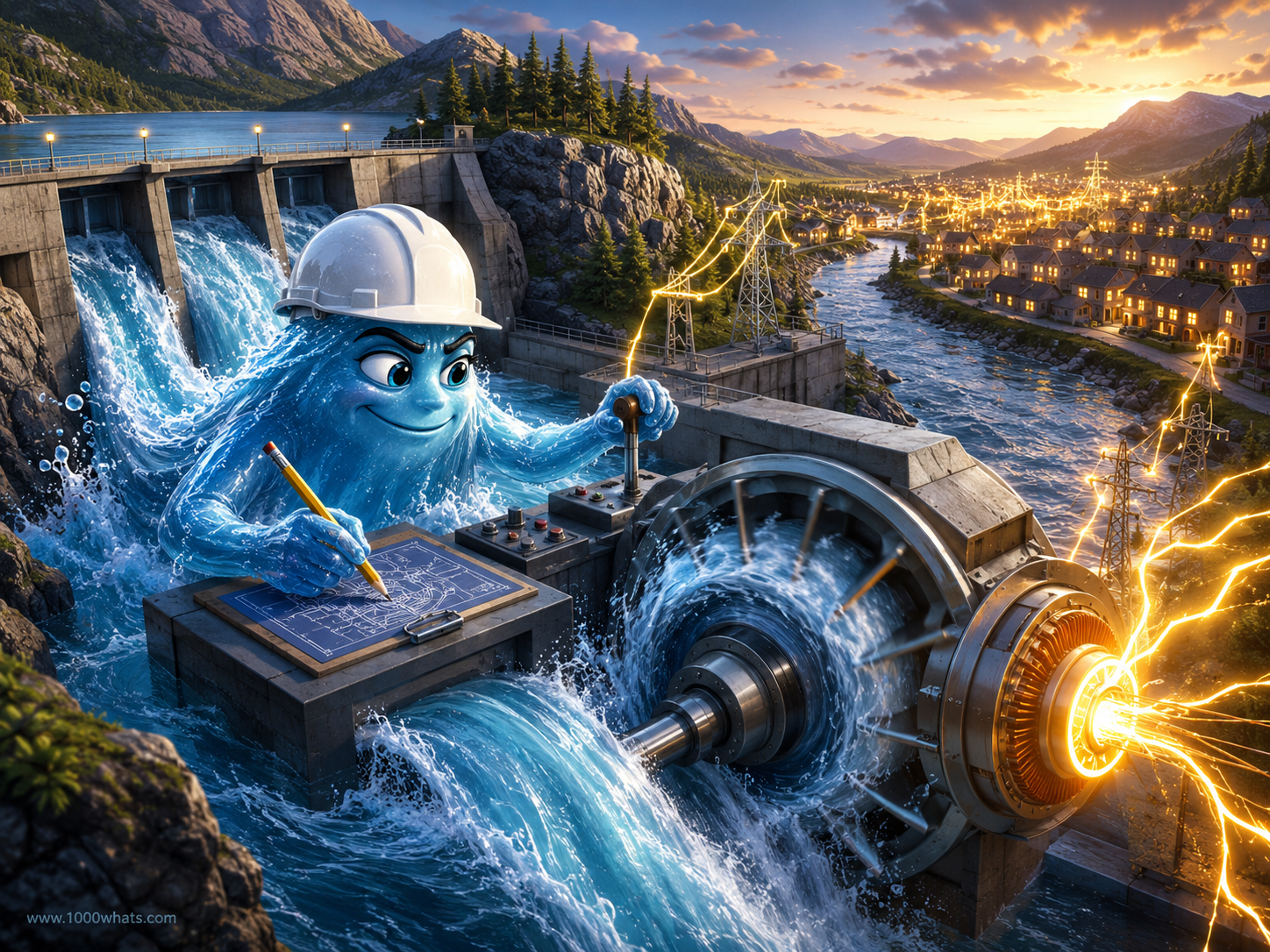
Imagine standing at the edge of a wild river thousands of years ago.
No grid. No wires. No turbines. No physics textbook in sight.
Just water — loud, fast, relentless — tearing at roots, dragging branches away, reshaping the land like it owns the place.
Because it does.
That moment matters.
Not because ancient people understood electromagnetic induction. They obviously did not. But because they understood something simpler first: moving water is powerful. You can see it. You can hear it. You can watch it tear through soil, push rocks, and carry entire trees downstream. Long before humans learned how to wire a generator, they already knew rivers were doing serious work.
And that, in a way, is where hydropower begins.
Not with a dam. Not with a turbine. Not even with electricity.
It begins with a simple truth: water in motion carries energy. If you can control that motion, you can make it move something useful. First, that “something” was a water wheel grinding grain. Later, it became a turbine spinning a generator. Today, it helps power cities.
⚡ “Hydropower is really just an ancient river doing a modern job.”
Welcome to 1000whats — where I turn a flood of energy terms into a steady stream of understanding.
What is hydropower?
Hydropower is the process of using the energy of moving water to generate electricity. More specifically, it uses the kinetic energy of flowing water to spin a turbine, and that turbine drives a generator that produces electric current through electromagnetic induction.
That definition matters, because people often mix up hydro energy and hydropower.
- Hydro energy is the broader idea: energy associated with water in general.
- Hydropower is the electricity-making part: using moving water to produce electrical power.
So when someone asks, “What is hydropower?” the clean answer is this:
Hydropower is electricity generated by converting the energy of moving water into mechanical motion, and then converting that motion into electrical energy.
Simple sentence. Big chain of events.
Why do rivers have energy in the first place?
Here is the part that people often skip too quickly.
A river has kinetic energy because it is moving.
And why is it moving?
Because water naturally flows from higher elevation to lower elevation under the pull of gravity. As it moves downhill, it gains speed and force. That motion gives it kinetic energy — the energy of movement.
If you want the plain-English version, here it is:
- Water high up has the ability to fall.
- Gravity pulls it downward.
- As it flows, it starts moving.
- Once it is moving, it carries kinetic energy.
That is why rivers can erode land, move sediment, knock over trees, and carve valleys over time. They are not just “wet scenery.” They are flowing systems full of energy.
In practice, this is the whole logic of hydropower: if moving water can move rocks, soil, branches, and old water wheels, it can also move a turbine.
⚡ “A river is gravity made visible.”
Kinetic energy vs. potential energy: the part that makes dams make sense
To understand hydropower properly, you need both of these ideas:
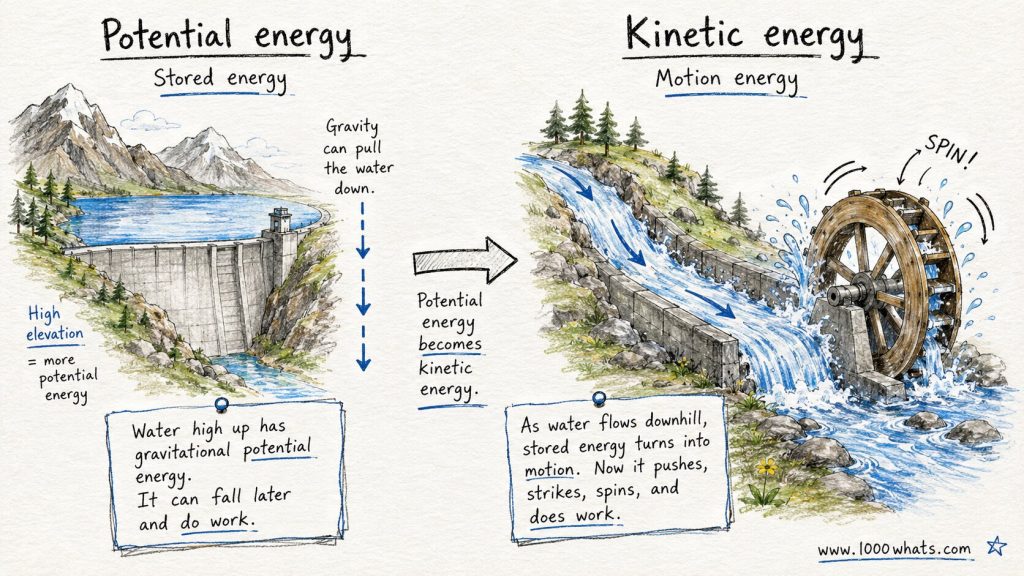
Potential energy
This is stored energy.
Water sitting at a higher elevation has gravitational potential energy because gravity can pull it downward later. It has not done the work yet, but it has the ability to do work.
Kinetic energy
This is motion energy.
Once that water starts flowing downhill, some of that stored potential energy turns into kinetic energy. Now the water is moving, pushing, striking, spinning, and doing real mechanical work.
This is the trick behind most hydropower plants:
Store water high. Release it lower. Let gravity turn stored energy into moving energy. Then harvest that motion.
So what do dams actually do?
A lot, actually.
A dam is not there just to look big and dramatic. In hydropower, a dam helps by holding back water and creating a reservoir. That reservoir stores a huge amount of water at an elevated level, which means it stores a huge amount of gravitational potential energy.
Then, when needed, operators release water in a controlled way.
That control is everything.
Without a dam, a river may still have kinetic energy, but it is not always strong enough, steady enough, or predictable enough for efficient electricity generation. A dam lets us:
- store water
- control the flow
- increase pressure and speed
- release water when electricity is needed
So the dam does not generate electricity by itself. What it really does is set the stage.
It turns a random river into a manageable energy system.
From a practical perspective, the dam is like loading a spring. The water in the reservoir is the stored force. When released, that stored energy becomes fast-moving water that can spin turbines efficiently.
How hydropower works, step by step
Now for the full chain.
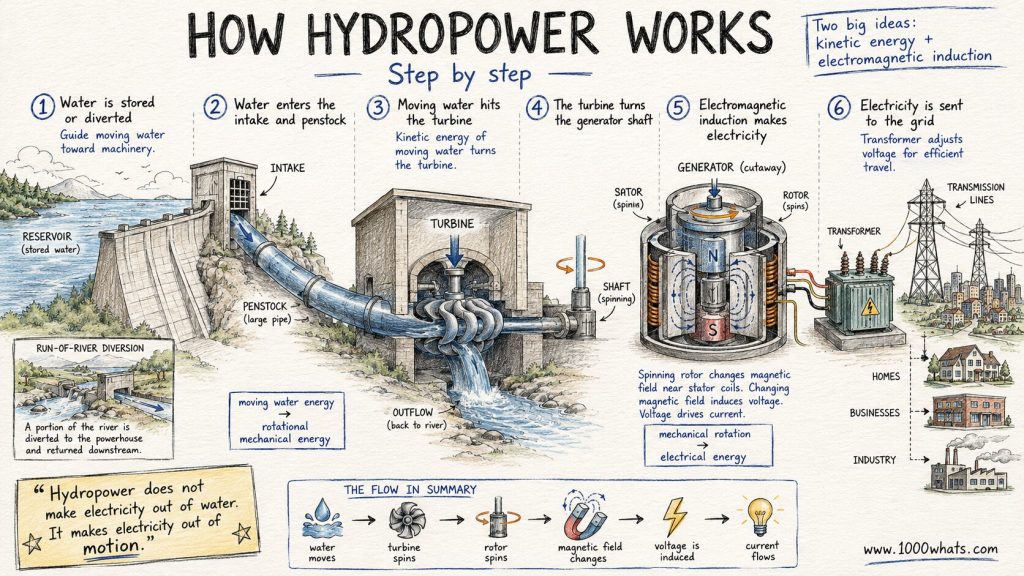
Hydropower relies on two big physical ideas:
- kinetic energy
- electromagnetic induction
Here is the sequence.
1. Water is stored or diverted
In a storage hydropower plant, water sits behind a dam in a reservoir. In a run-of-river plant, the flow is diverted from the river without major storage. Either way, the goal is to guide moving water toward machinery.
2. Water enters the intake and penstock
The intake structure channels water into the system. Then the water moves through a penstock, which is basically a large pipe or conduit carrying water toward the turbine.
3. Moving water hits the turbine
As the water flows through the penstock and strikes the turbine blades, it transfers its kinetic energy to the turbine. That makes the turbine rotate.
This is the first big conversion:
energy of moving water → rotational mechanical energy
That is basically the modern version of the old water wheel. Same idea. Better hardware.
4. The turbine turns the generator shaft
The turbine is connected to a generator by a rotating shaft. So when the turbine spins, the shaft spins too. And once that happens, we leave the world of rivers and enter the world of electricity.
5. Electromagnetic induction does the real electrical magic
Inside the generator, a rotating part called the rotor moves relative to stationary coils of wire called the stator. As the rotor spins, it changes the magnetic field around those coils. That changing magnetic field induces a voltage in the coils. That is Faraday’s law of electromagnetic induction.
This is the second big conversion:
mechanical rotation → electrical energy
That is the heart of the whole thing.
Not “water becomes electricity” in some magical direct sense.
It is more like this:
- water moves
- water spins turbine
- turbine spins rotor
- spinning rotor changes magnetic field
- changing magnetic field induces voltage
- voltage drives electric current
That is hydropower.
Neat, physical, and honestly kind of beautiful.
⚡ “Hydropower does not make electricity out of water. It makes electricity out of motion.”
6. The electricity is sent to the grid
Once the generator produces electricity, a transformer adjusts the voltage so the power can travel efficiently over long distances through transmission lines. Then it heads off to homes, businesses, and industry.
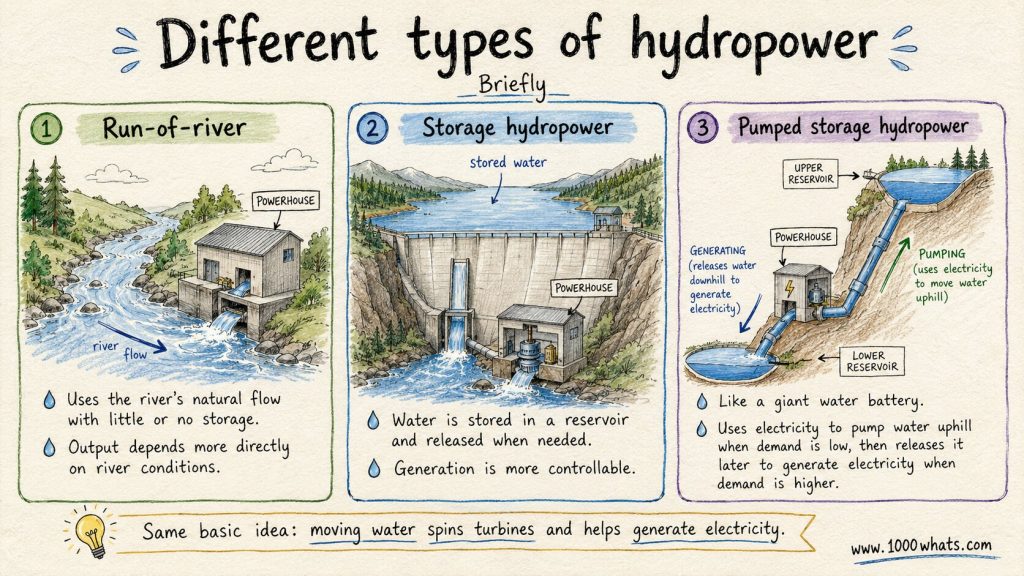
Different types of hydropower, briefly
Since this article is mainly about what hydropower is, I will keep this part tight.
Run-of-river
This type uses the natural flow of the river with little or no storage. It is simpler, but output depends more directly on river conditions.
Storage hydropower
This is the classic dam-and-reservoir model. Water is stored and released when needed, which makes generation much more controllable.
Pumped storage hydropower
This one is like a giant water battery. Electricity is used to pump water uphill when demand is low, and later that water is released to generate electricity when demand is higher.
Why hydropower matters
Hydropower matters because it is not just renewable. It is also mechanical, controllable, and deeply rooted in physical reality.
That sounds obvious, but it matters more than people think.
Solar depends on sunlight. Wind depends on wind. Hydropower depends on water movement and elevation. In the right geography, that gives it a kind of stubborn usefulness. It can be stored, directed, accelerated, and converted through machinery we understand very well.
What most people do not see is that hydropower is one of the clearest examples of energy conversion you will ever find:
- gravitational potential energy
- becomes kinetic energy
- becomes mechanical energy
- becomes electrical energy
That is why it is such a great energy topic. It is not just useful. It is teachable.
Final thoughts
Hydropower is the art of making a river do engineering.
At its core, it is not mysterious at all. Water flows downhill because gravity pulls it. That moving water carries kinetic energy. A turbine captures that motion. A generator turns that rotation into electricity through electromagnetic induction. Dams help by storing water, controlling flow, and making the whole process stronger and more reliable.
And that is why hydropower is so elegant.
It takes one of the oldest forces humans ever feared and turns it into one of the most useful forms of energy we have.
What do you think — is hydropower the most intuitive form of renewable energy, or the most underrated one?
Until next time, stay curious! 😎
Discover more from 1000whats
Subscribe to get the latest posts sent to your email.