Imagine electricity has just become commercially useful.
You can generate it.
You can make lamps glow.
People stare at them like Victorian moths.
Investors smell money.
Historically, this means everybody should hide the lawyers.
There is just one tiny problem.
Nobody agrees what the electrical system should actually look like.
Should electricity flow in one direction?
Should it reverse direction dozens of times each second?
Should every neighborhood have its own power station?
Or should giant plants send electricity across entire regions?
How high should the voltage be?
Who owns the patents?
And because those questions apparently lacked drama:
Which type of electricity is better at killing people?
Welcome to 1000whats.
Today, an engineering disagreement becomes corporate warfare.
We get propaganda, patent battles, electrocuted animals, public executions, and one aggressively illuminated world’s fair.
Eventually, the fight helps determine the architecture of modern civilization.
It became known as:
the War of Currents.
And history saved its best joke for last.
After all that fighting, modern electrical systems use both.
⚡ “The real fight was not AC versus DC. It was over which system could grow into a grid.”
First, meet the contestants
Before Edison, Tesla, and Westinghouse start throwing metaphorical chairs, we need the actual technical disagreement.
Electric current means moving electric charge.
My article on electric current explains that part in detail.
Current can behave in two basic ways.
With:
direct current — DC
the direction stays the same.
A battery offers the obvious modern example.
Its terminals keep fixed polarity.
Current through a connected circuit consistently travels one way.
With:
alternating current — AC
the direction repeatedly reverses.
In today’s European grid, that happens at:
50 Hz.
In North America:
60 Hz.
Neither type contains premium electricity.
Neither violates physics.
Neither is electricity’s evil twin.
They simply behave differently.
Unfortunately, humanity discovered those differences shortly after discovering industrial capitalism.
Things escalated quickly.
⚡ “Two useful electrical systems entered. Several extremely annoyed businessmen followed.”
Edison gets there early
Thomas Edison often gets introduced as:
the guy who invented the light bulb.
That description is famous.
It is also about as complete as calling NASA “the moon people.”
Electric lighting already existed in several forms.
Edison and his team achieved something more commercially important.
They built:
an electrical system.
A useful lamp needs more than a bulb.
It needs:
- generators,
- wires,
- switches,
- fuses,
- meters,
- distribution equipment,
- and somebody who eventually receives an unpleasant bill.
The U.S. National Park Service’s Edison history explains this broader achievement.
Edison spent years building the machinery around practical incandescent lighting.
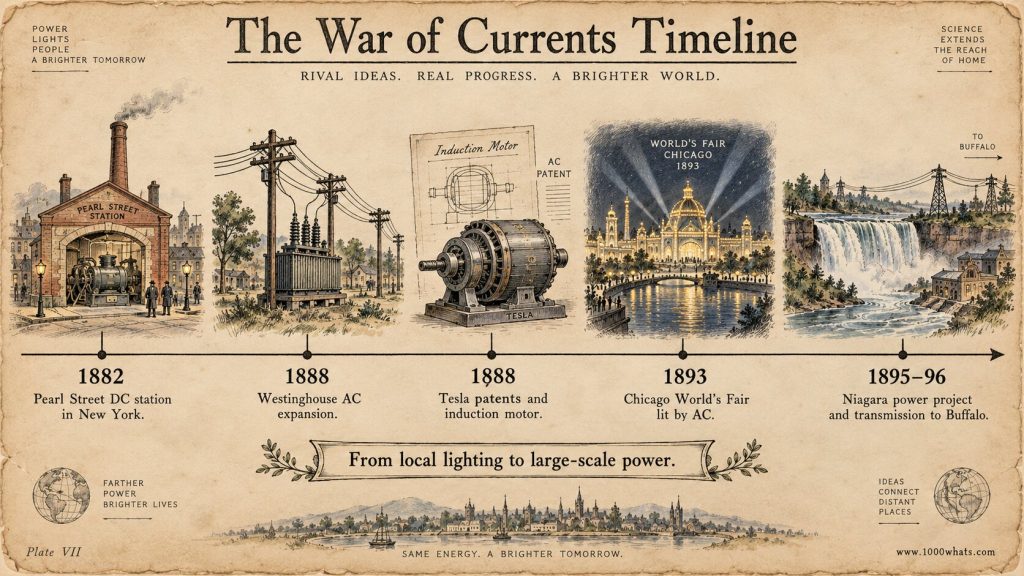
Then, on September 4, 1882, Pearl Street Station began commercial operation in lower Manhattan.
The electric utility had arrived.
And it ran on:
DC.
⚡ “Edison did not merely sell a lamp. He built the subscription service around the lamp.”
Pearl Street was genuinely impressive
Steam engines drove enormous Edison generators.
Underground conductors carried electricity through lower Manhattan.
Customers switched on lamps without burning gas inside their buildings.
This qualified as progress.
Electricity was becoming:
infrastructure.
Generate it centrally.
Distribute it through wires.
Meter it.
Sell it.
Send a bill.
Humanity had discovered another monthly expense.
The Smithsonian’s history of Pearl Street describes a system operating around 100 volts DC.
There was one catch.
Customers practically needed to live within about:
half a mile of the generator.
Half a mile.
That is not quite a grid.
That is a power station with attachment issues.
⚡ “Pearl Street could power a neighborhood beautifully, provided the neighborhood remained emotionally close.”
Why couldn’t Edison just send DC farther?
He could.
Physics never installed a sign saying:
DIRECT CURRENT MUST REMAIN IN MANHATTAN.
The problem involved economics.
We need one tiny equation:
Power = Voltage × Current
Suppose you want lots of power at low voltage.
You need lots of current.
Unfortunately, large currents create large resistive losses.
Those losses scale approximately with:
I²R
Notice the square.
Current does not merely increase losses.
It becomes ambitious.
Double the current.
With the same resistance, losses become roughly four times larger.
So efficient transmission benefits from a useful trick:
raise the voltage.
Higher voltage moves the same power with less current.
Less current means lower resistive losses.
Wonderful.
Edison had one annoying problem.
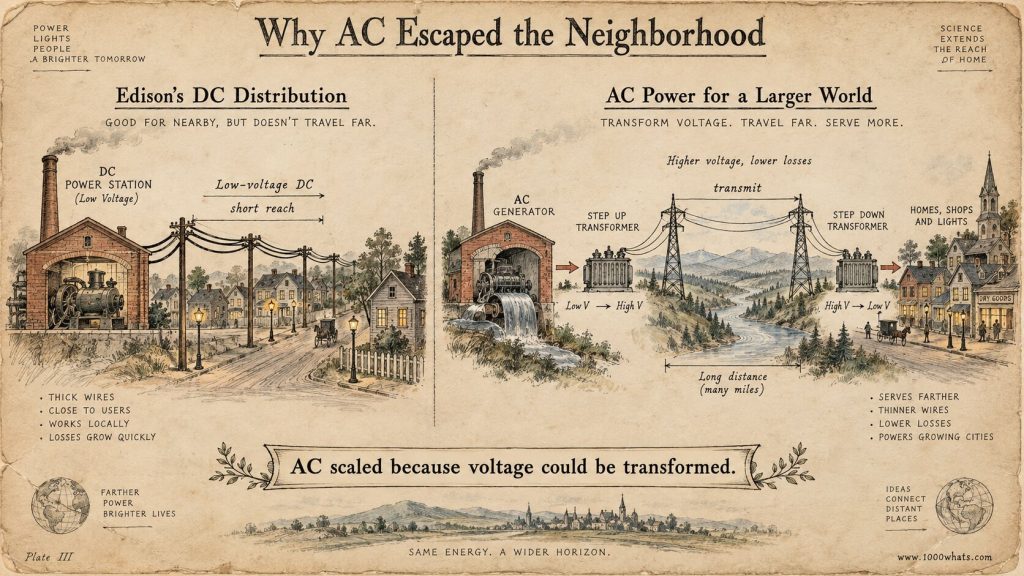
His DC system lacked a simple, efficient way to change voltage levels at large scale.
That became awkward very quickly.
⚡ “The problem was not that DC refused to travel. It simply demanded expensive accommodations.”
The awkward city-planning problem
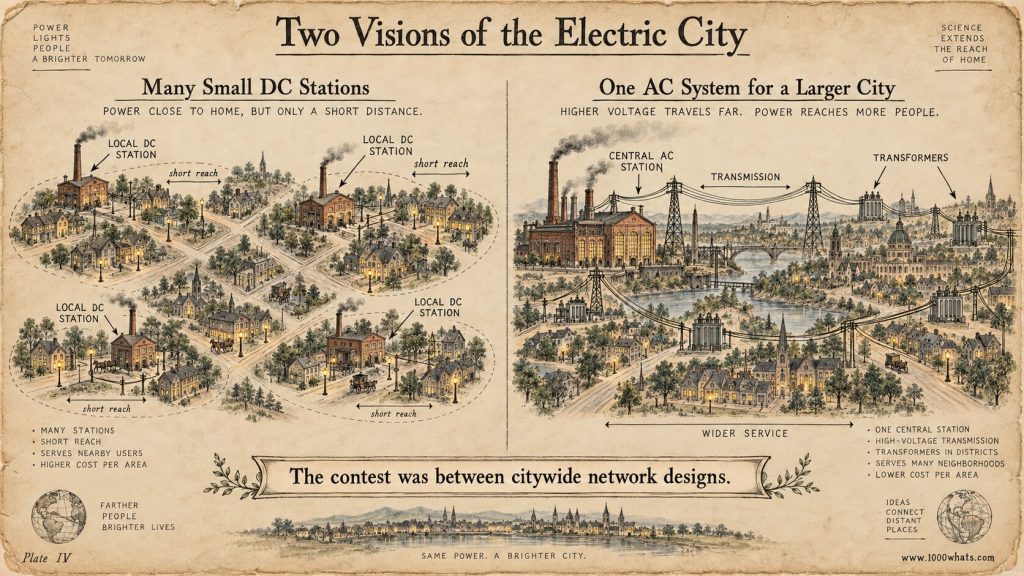
Suppose customers need roughly 100 volts.
Suppose electricity cannot economically travel far at that voltage.
What do you do?
Easy.
Build another generating station.
Then another.
Then another.
Then start checking real estate prices with increasing anxiety.
Want to electrify another neighborhood?
Congratulations.
You may need another power plant.
Edison’s system could electrify cities.
It simply imagined cities as collections of small electrical islands.
Each island needed generation nearby.
Copper manufacturers presumably considered this a visionary urban strategy.
Then AC acquired something resembling a superpower.
⚡ “DC could expand. It just expanded like a coffee chain that needed a refinery behind every branch.”
Enter the transformer
A transformer can change AC voltage using electromagnetic induction.
No pistons.
No combustion.
No tiny electrical employee turns a wheel labeled MORE VOLTS.
Just coils, magnetic fields, and physics.
Our article on electromagnetic induction explains the mechanism.
For the grid, however, the consequence mattered more.
Generate AC electricity.
Use a transformer to:
step the voltage up.
Transmit electricity at high voltage and low current.
Near the customer:
step it down again.
Suddenly electricity can travel much farther.
You need less copper.
You lose less energy.
Your generating station no longer needs to stalk its customers.
The transformer looks like ordinary electrical equipment.
Historically, it also functioned as a geographical machine.
It allowed generation and consumption to live farther apart.
⚡ “The transformer changed voltage. More importantly, it changed the size of the possible world.”
George Westinghouse notices something
George Westinghouse was already a successful inventor and industrialist.
He saw AC’s potential.
More importantly, he did not own an empire already married to DC.
That helps when evaluating disruptive technology.
Westinghouse acquired and developed AC technologies.
Then he began building competing electrical systems.
The disagreement stopped being academic.
Now two infrastructures competed for cities, customers, patents, and money.
Edison’s model favored:
local DC generation + local distribution.
Westinghouse increasingly offered:
generation → transformer → transmission → transformer → distribution.
One architecture could stretch much farther.
Edison responded with calm professional curiosity.
Not remotely.
⚡ “Technological neutrality becomes harder when your factories already manufacture one answer.”
Then Nikola Tesla enters
Popular history usually simplifies everything into:
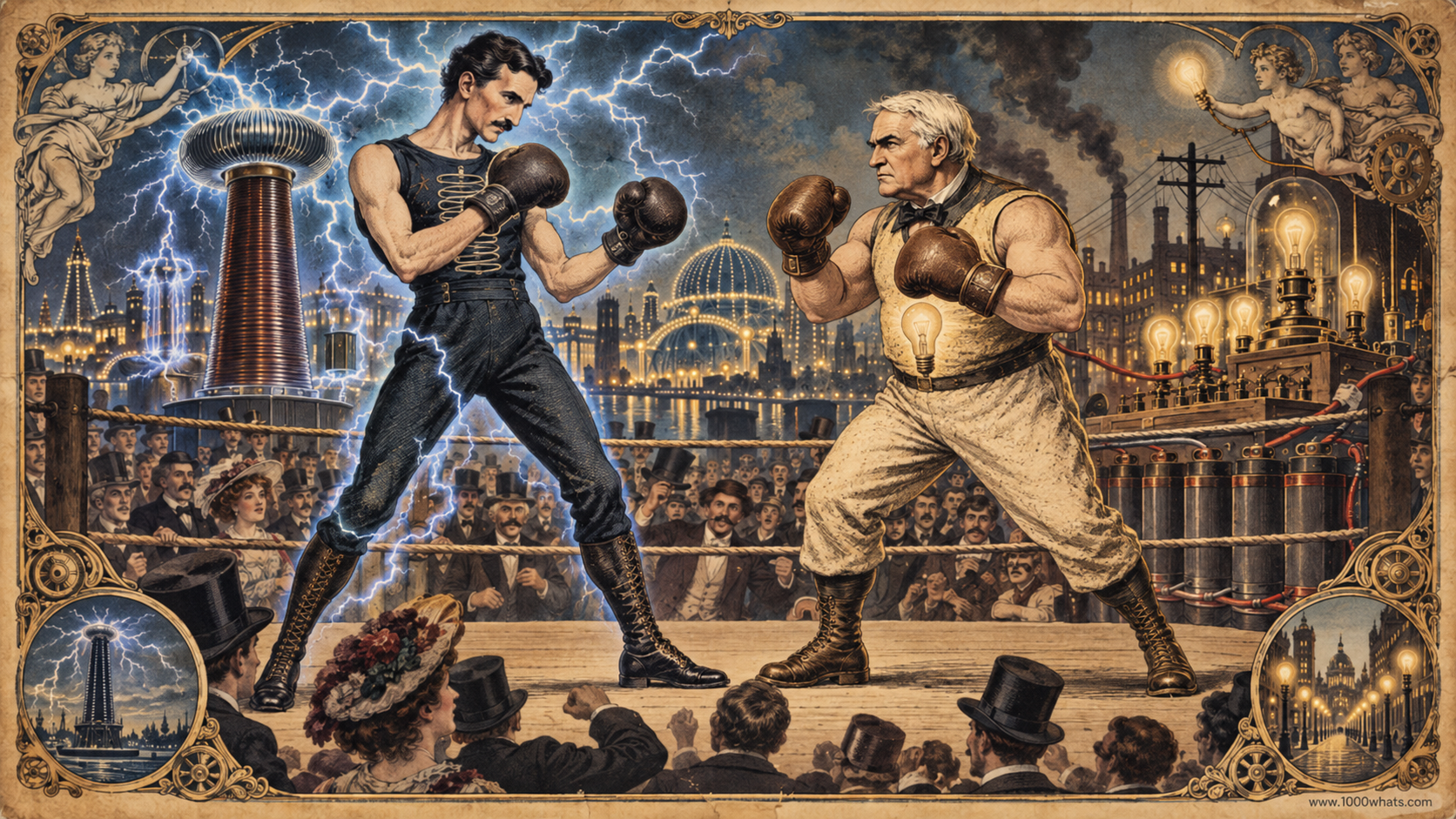
EDISON VS. TESLA
Ideally, lightning shoots between their eyes.
Reality had the bad manners to be more complicated.
Tesla did not invent AC.
Alternating-current systems existed before him.
The commercial conflict mainly involved Edison, Westinghouse, their companies, and competing systems.
Tesla contributed something different.
And enormously important.
He developed key elements of a practical:
polyphase AC system
and an elegant:
AC induction motor.
In 1888, Westinghouse acquired rights to Tesla’s AC patents.
IEEE’s history of Tesla’s induction-motor patents explains their importance.
Tesla’s polyphase design created a rotating magnetic field.
That field could drive a motor without many earlier commutator arrangements.
Now AC could do more than light buildings.
It could run machinery beautifully.
Team DC probably requested another meeting.
⚡ “Tesla did not invent AC. He helped turn AC into something industry desperately wanted.”
Why the induction motor mattered
Lighting was revolutionary.
Industry was larger.
Factories need motors.
Pumps need motors.
Fans need motors.
Compressors need motors.
Machine tools need motors.
Eventually, humanity looked around and decided nearly everything should spin.
Tesla’s polyphase work helped unite two crucial jobs.
First:
move electrical energy over distance.
Then:
turn electrical energy into mechanical motion.
Several technologies suddenly formed one powerful chain:
generator,
transformer,
transmission line,
polyphase AC,
induction motor.
That combination mattered more than any single device.
It created:
a system.
Energy history often works this way.
One brilliant machine makes a demonstration.
Several compatible machines reorganize civilization.
⚡ “One invention can impress a crowd. A working system can change the economy.”
Why didn’t Edison simply switch sides?
Because this was not a university seminar.
Edison had:
DC patents,
DC equipment,
DC generating stations,
DC customers,
DC manufacturing,
and companies built around DC.
Changing sides would not mean updating an opinion.
It would mean announcing:
Wonderful work, everyone. We appear to have industrialized the wrong architecture.
Corporations rarely send that memo enthusiastically.
This is why energy transitions never stay purely technical.
New technologies do not arrive on empty spreadsheets.
They enter a world filled with:
assets,
contracts,
factories,
employees,
standards,
investors,
regulators,
and executives who approved last year’s strategy.
Suddenly, the 1880s feel suspiciously modern.
⚡ “Old technology rarely survives because nobody sees the new idea. Often, somebody owns the old idea.”
Then everybody behaved sensibly
By which I mean:
people started electrocuting animals.
A real safety issue existed underneath the spectacle.
High-voltage electricity is dangerous.
Early electrical installations could also become chaotic.
People died from electric shocks.
Overhead wiring sometimes resembled spaghetti designed by a nervous octopus.
So concern about high-voltage AC did not appear from nowhere.
However, legitimate concern soon became competitive marketing material.
Edison and others in the DC camp emphasized AC’s dangers.
Engineer Harold Brown publicly demonstrated AC’s lethal effects.
Dogs and other animals died in electrical demonstrations.
The marketing message required little subtlety:
Our competitor’s electricity may kill you.
Advertising has become more sophisticated since then.
Mostly.
⚡ “When your engineering brochure starts requiring dead animals, the sales meeting has taken a turn.”
Then came the electric chair
New York wanted a new execution method.
Electricity entered the conversation.
Somehow, the waveform became politically relevant.
If executions used AC, the public might associate alternating current with:
death.
Westinghouse had not requested that brand partnership.
The first electric-chair execution killed William Kemmler in 1890.
The chair used AC.
The execution went badly.
Officials had to apply current again.
At this point, an argument about distribution architecture had entered criminal justice.
Nobody had successfully kept the meeting on agenda.
⚡ “The War of Currents briefly became history’s darkest product-comparison campaign.”
No, Edison did not kill Topsy to defeat Tesla
Now we must address the elephant in the article.
Literally.
A famous internet story claims Edison electrocuted an elephant named Topsy.
Supposedly, he wanted to prove Tesla’s AC system was dangerous.
It makes fantastic internet content.
It also gets the history wrong.
Topsy died at Coney Island in 1903.
That happened more than a decade after the main War of Currents.
The Edison Manufacturing Company filmed the event.
That connection helped attach Edison’s name to the story.
However, the Thomas Edison Papers at Rutgers found no evidence Edison ordered it.
They also found no evidence that he participated or attended.
Contemporary newspaper reports did not mention him.
So the accurate version looks like this:
Edison and his associates did use animal electrocutions during the anti-AC campaign.
But:
Topsy was not one of those demonstrations.
History already contained corporate propaganda, dead animals, and an electric chair.
The internet apparently reviewed the script and requested an elephant.
⚡ “Topsy belonged to a later tragedy, not Edison’s anti-AC campaign.”
Meanwhile, AC kept committing the ultimate offense
It worked.
You can run an impressive propaganda campaign against a technology.
But useful technology has an irritating habit.
Eventually, customers notice.
AC could transmit electricity efficiently across greater distances.
Transformers could change voltages conveniently.
AC motors became increasingly practical.
Networks could grow.
Now imagine electrifying a large city using low-voltage DC.
You need generating stations near customers.
That means more sites.
More boilers.
More generators.
More workers.
More fuel deliveries.
More copper.
More opportunities for accountants to develop facial twitches.
AC offered another model:
large generator.
Step up.
Transmit.
Step down.
Distribute.
Electric infrastructure remained expensive and complicated.
Humanity has preserved that tradition.
But AC changed the possible scale.
⚡ “Propaganda can beat a brochure. It struggles against infrastructure that keeps working.”
Then Chicago turned electricity into theatre
In 1893, Chicago hosted the World’s Columbian Exposition.
Somebody needed to power it.
General Electric proposed one system.
Westinghouse proposed another.
The organizers chose Westinghouse’s AC proposal.
The Bureau International des Expositions describes it as cheaper and more efficient.
Then the story became delightfully petty.
General Electric controlled rights involving Edison’s lamp.
It would not let Westinghouse use that design.
So Westinghouse developed another lamp.
Apparently, electrifying civilization did not provide enough administrative complexity.
The entire 190-hectare exposition glowed.
Buildings shone at night.
Electric motors drove machinery.
Visitors saw enormous demonstrations of electrical technology.
According to the BIE, the fair consumed staggering amounts of electricity.
It reportedly used around three times Chicago’s consumption at the time.
Imagine arriving in 1893.
Night falls.
An enormous white city suddenly glows electrically.
The future has arrived.
It runs on AC.
Good luck countering that with a pamphlet.
⚡ “Chicago gave AC the Victorian equivalent of a billion-dollar product launch.”
Did Chicago mean AC had officially won?
Not exactly.
History loves clean endings.
Infrastructure prefers paperwork.
Nobody rang a bell in 1893 and announced:
DC HAS BEEN DEFEATED. PLEASE COLLECT YOUR COAT.
DC systems kept operating.
Companies merged.
Technology changed.
Standards evolved.
Markets shifted.
In 1892, Edison General Electric merged with Thomson-Houston.
The new company became General Electric.
Even the corporate map had started outgrowing the original rivalry.
Still, Chicago mattered enormously.
It showed that AC could operate successfully at huge scale.
Then Niagara Falls made the argument even harder to ignore.
⚡ “Technological wars rarely end with surrender. Usually, purchasing departments just stop ordering one system.”
Niagara Falls had one logistical problem
Niagara Falls contains enormous usable energy.
Excellent.
Buffalo contained electricity customers.
Also excellent.
Unfortunately, the waterfall refused to relocate.
This represents exactly the problem transmission solves.
The Niagara project adopted polyphase AC technology.
Eventually, electricity traveled from Niagara toward Buffalo.
The project demonstrated something bigger than hydroelectric power.
It separated two ideas:
where energy exists
and:
where people want electricity.
That distinction sits at the heart of the modern grid.
Build wind where wind blows.
Build hydro where water falls.
Build solar where sunlight works.
Build thermal plants where fuel and cooling make sense.
Build nuclear plants where a geological, political, and regulatory miracle occurs.
Then:
transmit the electricity.
Generation no longer needed to sit beside consumption.
Electricity could travel.
That idea changed everything.
⚡ “Transmission turned geography from a command into a negotiation.”
So AC won
For the traditional electricity grid:
yes.
AC became dominant.
Transformers made voltage conversion straightforward.
AC generators became enormously successful.
AC motors spread everywhere.
Large synchronized AC networks expanded across regions and countries.
Your household wall socket supplies:
AC.
Game over.
Edison lost.
Westinghouse and Tesla won.
Roll credits.
Except DC ignored the ending.
⚡ “AC won the grid. DC responded by quietly occupying nearly every electronic device you own.”
Look around your house
Your phone?
DC internally.
Laptop?
DC internally.
LED electronics?
DC.
Battery?
Obviously:
DC.
Solar panel?
DC output.
Electric vehicle battery?
DC.
Modern electronics absolutely adore direct current.
So humanity built an enormous AC network.
Then we invented billions of devices that promptly convert electricity back into DC.
Somewhere in the historical afterlife, Edison clears his throat.
“I have several comments.”
⚡ “The victorious AC grid now spends much of its day feeding devices that immediately ask for DC.”
Then DC returned to transmission
DC’s original weakness was never some cosmic flaw in direct current.
The practical problem largely involved:
voltage conversion.
AC had transformers.
Nineteenth-century DC lacked an equally convenient tool for large grids.
Then power electronics arrived.
Semiconductor converters can now control enormous amounts of electrical power.
Suddenly:
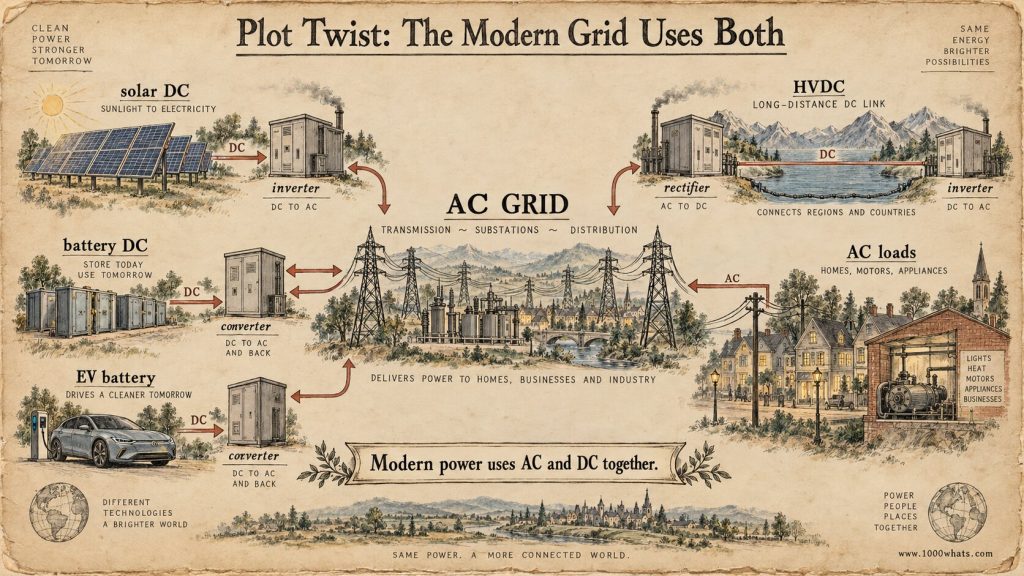
high-voltage direct current — HVDC
became extremely useful.
Today, HVDC works particularly well for applications including:
- very long-distance bulk transmission,
- long submarine cables,
- links between asynchronous AC systems,
- and large transfers between distant regions.
After a century of AC dominance, DC returned wearing semiconductors and excellent sunglasses.
Awkward.
⚡ “AC won the first grid. Power electronics gave DC a spectacular second career.”
Offshore wind makes the joke obvious
Imagine a huge offshore wind farm.
It sits far from shore.
The turbines generate electricity offshore.
Now engineers must move several gigawatts to land.
For some projects, AC transmission works perfectly well.
Over sufficiently long submarine distances, HVDC can become more attractive.
So the system may look like this:
wind turbines
↓
AC collection grid
↓
converter
↓
DC transmission
↓
converter
↓
AC grid
Study that arrangement.
After one of history’s most famous technology rivalries, the modern engineer says:
“We’ll use both.”
No duel required.
No dead animals.
Barely even a press conference.
⚡ “Engineering eventually solved AC versus DC with the most annoying possible answer: yes.”
Batteries make it even better
A battery fundamentally stores electricity as:
DC.
The grid operates mainly with:
AC.
So grid batteries need power electronics between them.
Charging:
AC → DC
Discharging:
DC → AC
My article on battery storage explains the grid services involved.
Electrically, the inverter has a simpler diplomatic mission:
Please make Edison and Westinghouse cooperate.
Then repeat that process thousands of times each second.
⚡ “Modern inverters spend their lives negotiating a peace treaty signed roughly nowhere.”
Solar does the same thing
A photovoltaic module produces:
DC.
The grid wants:
AC.
Therefore:
inverter.
DC becomes AC.
Modern inverters can also do far more than simple conversion.
My article on reactive power explains some of those functions.
Inverters can support voltage.
They can provide reactive power.
They increasingly help shape grid behavior.
This creates a wonderful historical loop.
The original AC victory relied heavily on transformers and rotating machines.
The modern grid increasingly relies on semiconductor converters.
Those devices manipulate AC and DC almost at will.
Physics stayed the same.
Technology expanded the menu.
⚡ “The laws of physics did not change. Engineers simply unlocked more buttons.”
Was Edison wrong?
Yes.
And no.
Annoying answers often contain the useful part.
Edison’s low-voltage DC architecture poorly matched the huge interconnected grids that later emerged.
With nineteenth-century technology, AC scaled far better.
On that strategic question:
AC won decisively.
But Edison was not an idiot defending imaginary technology.
His system worked.
Pearl Street supplied electricity to actual paying customers.
The Smithsonian describes the station as technically successful.
Its early financial performance proved less spectacular.
Still, Edison built:
a functioning electricity business.
That matters.
It is easy to stand in 2026 and explain Edison’s obvious mistakes.
We possess one small advantage.
About 144 years of spoilers.
⚡ “Hindsight remains history’s cheapest engineering consultant.”
Tesla did not single-handedly defeat Edison
The internet prefers this version:
Edison: villain.
Tesla: genius.
Tesla invents AC.
Tesla defeats Edison.
Dramatic lightning. Roll credits.
Reality refuses to fit comfortably inside a meme.
Tesla was unquestionably brilliant.
His polyphase work and induction motor mattered enormously.
However, modern electricity emerged from many people’s work.
Lucien Gaulard.
John Dixon Gibbs.
William Stanley.
Galileo Ferraris.
Nikola Tesla.
George Westinghouse.
Thomas Edison.
Charles Steinmetz.
Mikhail Dolivo-Dobrovolsky.
And many others.
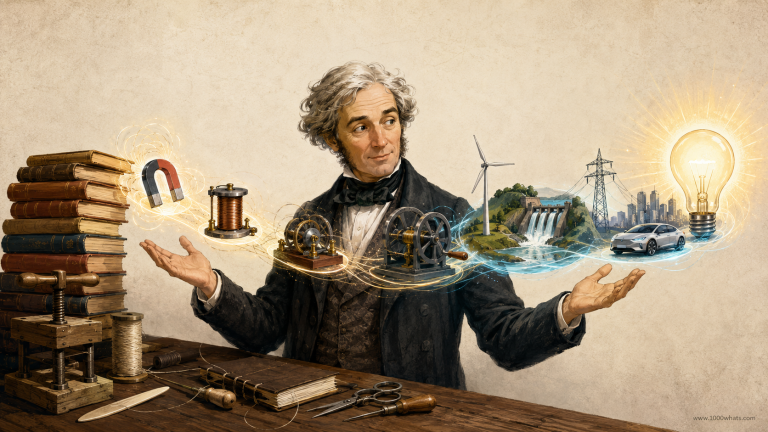
My article on Michael Faraday offers a perfect example.
Faraday discovered electromagnetic induction decades before modern grids existed.
That principle later became essential to:
transformers,
generators,
motors,
and power systems.
No single inventor created the electrical grid.
Energy infrastructure rarely works like:
“Eureka!”
It works more like:
“Eureka! Now find financing, standards, copper, seventeen suppliers, and a permit.”
⚡ “Civilization rarely changes because one genius invents a machine. It changes when thousands of pieces finally cooperate.”
The real lesson of the War of Currents
The story sounds like:
AC versus DC.
The deeper story concerns:
systems.
A technology does not transform society because one component looks clever.
It needs an ecosystem.
Generation.
Conversion.
Transmission.
Distribution.
End-use equipment.
Standards.
Manufacturing.
Safety.
Financing.
Customers.
AC became dominant because a complete technical and commercial architecture formed around it.
That lesson aged extremely well.
Hydrogen is not merely an electrolyzer.
EVs are not merely batteries.
Offshore wind is not merely turbines.
Solar is not merely panels.
A technology becomes transformative when the whole chain works.
The War of Currents happened more than a century ago.
The energy industry still relearns this lesson.
Usually through PowerPoint.
⚡ “A breakthrough component gets headlines. A working system gets infrastructure.”
So, what was the War of Currents?
The War of Currents was a late-nineteenth-century battle over competing electrical systems.
Edison backed a direct-current architecture.
Westinghouse commercialized alternating-current systems.
Tesla contributed major polyphase AC technologies.
But that definition misses the interesting question.
The better question is:
What electrical system could grow into a grid?
With 1880s and 1890s technology:
AC had the stronger answer.
Transformers enabled practical high-voltage transmission.
Polyphase systems supported powerful motors.
Large networks became possible.
AC became dominant.
Then semiconductors arrived.
Batteries arrived.
Solar arrived.
HVDC arrived.
Engineering eventually revised the nineteenth-century verdict.
The new answer became:
“It’s complicated.”
Which, in engineering, usually means everyone can finally stop shouting.
⚡ “AC won history’s first round. Modern power systems quietly scheduled a rematch.”
Final thoughts
Walk to the nearest wall socket.
It looks boring.
Two holes.
Maybe three.
Behind it sits the outcome of one strange industrial battle.
Edison built a functioning DC electricity business.
Westinghouse backed AC.
Tesla helped make polyphase AC extraordinarily useful.
Companies fought.
Patents flew.
Animals died.
Criminal execution somehow entered an electricity-marketing campaign.
Chicago lit up.
Niagara sent electricity toward distant customers.
Slowly, local electrical islands became enormous interconnected networks.
AC became the grid’s backbone.
DC apparently accepted defeat.
Then it disappeared for several decades and learned semiconductor technology.
It returned through electronics, batteries, solar, electric vehicles, and HVDC.
Today, the electrical system casually converts between AC and DC.
Constantly.
The great AC-versus-DC war ended with modern engineering interviewing both candidates.
Engineering looked at AC.
Then it looked at DC.
Then it said:
“You’re both hired.”
After all that drama, electricity itself never cared.
It just followed Maxwell’s equations and watched the humans make it weird.
Until next time, stay curious! 😎
Discover more from 1000whats
Subscribe to get the latest posts sent to your email.