

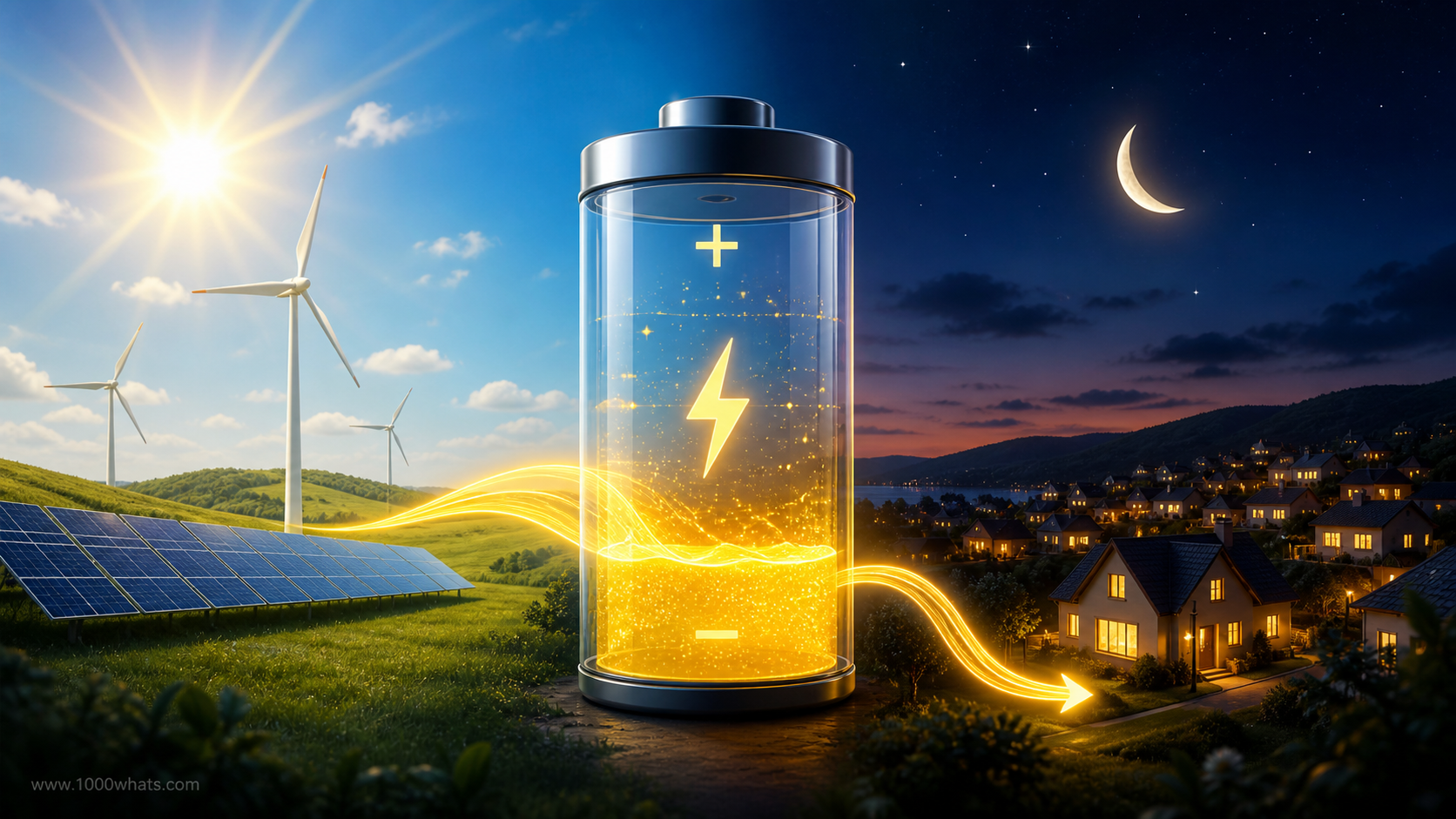
Electricity has a strange personality.
You must use it almost the exact moment you make it. That is a ridiculous way to run a civilization.
Imagine a bakery where every loaf explodes if nobody buys it in half a second. That is basically the power grid. Generate too little, and people curse at the air conditioner. Generate too much, and operators start throwing away perfectly good energy.
So along comes battery storage, looking almost too obvious.
“Why not just save the electricity and use it later?”
Exactly. That is the right question.
⚡ “Battery storage does not make electricity. It teaches electricity how to wait.”
The timing problem matters more now because grids carry more solar, more wind, more EV charging, more heat pumps, and more big concentrated loads like data centers. Batteries have exploded because they attack that problem directly: global battery storage deployments hit 108 GW in 2025, up 40% from 2024, and the IEA now calls battery storage the fastest-growing power technology.
Welcome to 1000whats — where I break down energy like a battery pack: cell by cell.
What is battery storage?
Here is the plain-English version.
Battery storage means you take electricity from somewhere, store it in a battery, and send it back out later when you actually need it. The battery does not create electricity. It borrows it from the grid or from a generator like a solar plant, then returns part of it later. That is why the EIA classifies storage as a secondary source, not a primary one.
That little distinction matters.
A battery is not a tiny power plant hiding in a box. It is more like a time machine for electricity. A very imperfect time machine, sure. You lose some energy on the trip. Still, the trick works well enough that the entire grid has started paying attention.
Why does battery storage exist?
Because the grid does not really have an energy problem all the time.
Most days, it has a timing problem.
Solar loves noon. People love 7 p.m.
Those two schedules do not match.
Wind also wanders around like it has no calendar. Demand spikes when people come home, crank the AC, start dinner, plug in the car, and expect everything to work at once. Battery storage sits in the middle of that mess and says, “Fine, I’ll hold onto this for a bit.” Energy storage systems already support grids by balancing supply and demand, shifting energy away from peak periods, smoothing renewable output, and providing fast-response grid services.
What most people don’t see is that a lot of renewable-energy frustration has nothing to do with whether solar and wind can make electricity. They can. The headache comes from whether the system can use that electricity at the right hour. In California, CAISO curtailed 3.4 million MWh of utility-scale wind and solar in 2024, up 29% from 2023, and 93% of that curtailment came from solar. That is a giant blinking sign that says: we need more flexibility.
⚡ “The grid’s real problem is not only making power. It is making power at the right moment.”
How does battery storage work, simply?
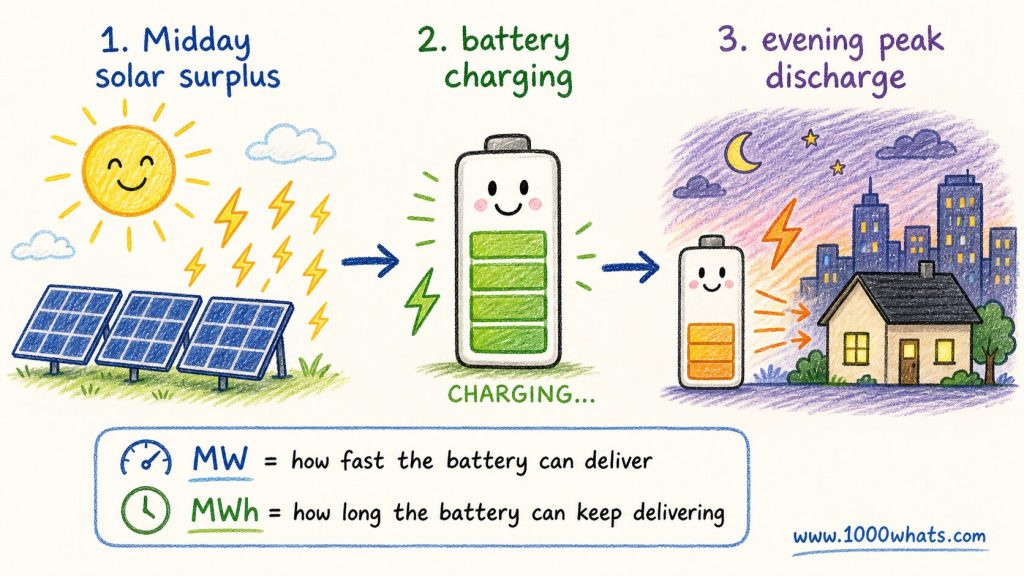
Strip away the jargon and the thing works like this:
- Charge: the battery takes in electricity when supply is available or cheap.
- Store: chemistry inside the battery holds that energy for later.
- Discharge: the battery sends electricity back when prices rise, demand jumps, or renewable output falls.
Two numbers matter:
- MW (megawatts) tells you how hard the battery can push right now.
- MWh (megawatt-hours) tells you how much total energy it can deliver before it runs out.
If that still sounds abstract, think of a water tank.
MW is the size of the pipe. MWh is the size of the tank.
A big pipe with a tiny tank blasts hard, then quits.
A smaller pipe with a huge tank keeps going for hours.
That is why a 100 MW battery and a 100 MW / 400 MWh battery are not the same beast. One can help briefly. The other can carry you through a serious evening ramp. Current battery projects still cluster around short durations, though more four-hour-plus projects are showing up as grids value flexibility more.
What kind of batteries are we talking about?
Right now, lithium-ion dominates, and within that family, lithium-iron-phosphate, or LFP, has become the workhorse for grid batteries. The IEA says LFP accounted for around 90% of battery storage deployments in 2025 because it is typically cheaper and better suited to frequent cycling, even if it stores less energy per kilogram than some EV-focused chemistries.
That does not mean lithium solves every storage problem forever.
From a market perspective, lithium-ion wins the short-duration race today. Yet DOE’s long-duration storage work covers lithium-ion, flow batteries, zinc batteries, sodium batteries, and other options because the industry knows one chemistry probably will not fit every job. The minute you start asking for 10-plus hours, or backup through ugly multi-day weather, the conversation changes.
A stupidly simple example
Suppose you have rooftop solar.
At noon, the roof cranks out more electricity than your house needs. Your battery charges.
At 8 p.m., the sun has gone home, but your lights, stove, Wi-Fi, and television suddenly behave like spoiled royalty. The battery discharges and covers that gap.
Nothing magical happened. You just moved noon to nighttime.
Utility-scale batteries do the same trick on a much bigger stage. The EIA notes that storage can shift electricity away from expensive peak periods and pair with wind and solar so operators can use that power later when direct generation is unavailable or limited.
Are we finally close?
Here is the honest answer.
Yes for some jobs. No for others.
We are close — actually, more than close — when the job looks like this:
- shift solar from afternoon into evening
- smooth short-term wind and solar swings
- provide fast grid support
- shave peaks
- help defer some network upgrades
- support backup power for limited periods
We are not close if you mean this:
- store a week of renewable energy for a whole region
- sail through multi-day low-wind, low-sun events on batteries alone
- solve seasonal balancing with today’s mainstream battery fleet
That split matters.
Battery storage has already crossed from “promising” into “real.” In 2025, about 80% of new battery capacity worldwide came from utility-scale projects. In the United States, cumulative utility-scale battery capacity topped 26 GW in 2024, then developers added a record 15 GW in 2025 and planned another 24 GW for 2026. That is not lab-coat fantasy. That is construction equipment.
But the same data also tells you where the ceiling sits. Most projects still cluster around two hours, even though four-hour systems are growing. DOE still treats 10+ hour storage as a separate challenge and wants a 90% cost reduction by 2030 for that category. Translation: we are close to daily balancing, not to all-weather, all-season storage.
⚡ “We are close to batteries as grid shock absorbers. We are not close to batteries as universal miracles.”
Real-world example: California stopped joking around
California gives us the cleanest example because it has so much solar that the grid sometimes gets too much of a good thing.
By 2024, CAISO had 28.2 GW of wind and solar on the system, and it curtailed 3.4 million MWh of utility-scale wind and solar that year, mostly solar. At the same time, the IEA says installed utility-scale battery storage in California reached almost 25% of peak load in 2024. That is huge. It tells you batteries have moved from “pilot project” to “serious system tool.”
In practice, that means batteries soak up some of the daytime solar flood and push it back into the evening when California actually needs it. The batteries do not eliminate the whole problem. They do make the system a lot less absurd.
Pros of battery storage
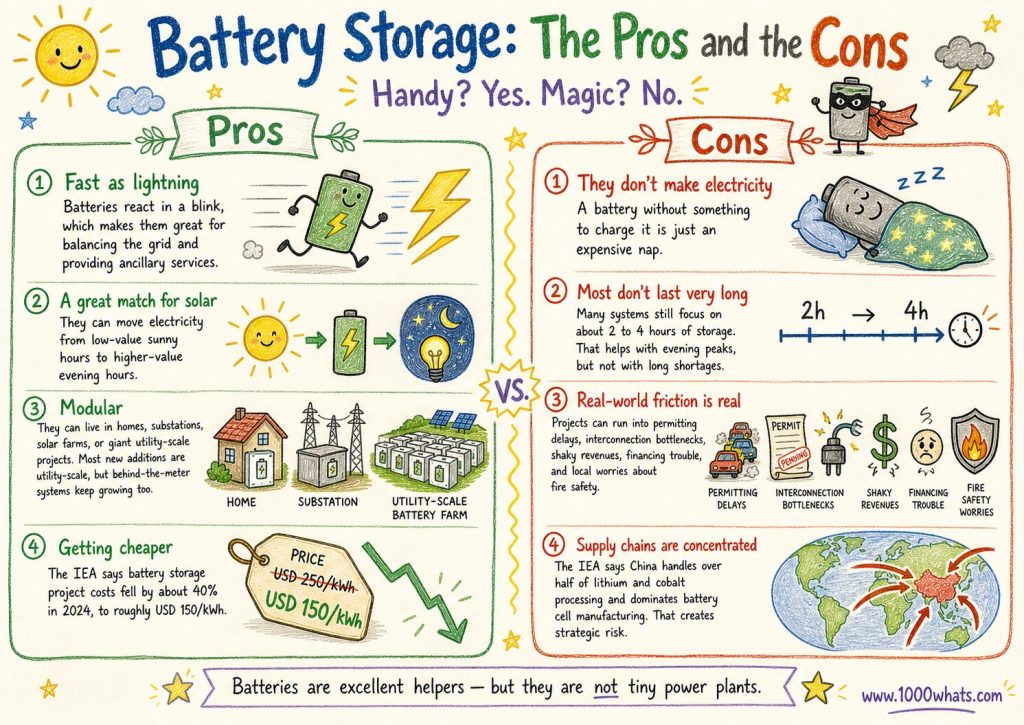
- Fast as lightning. Batteries respond quickly, which makes them excellent for balancing and ancillary services.
- Great match for solar-heavy grids. They move power from low-value hours to high-value hours.
- Modular. You can build them at homes, substations, solar farms, or utility scale. Around 80% of new battery capacity in 2025 was utility-scale, but behind-the-meter use also keeps growing.
- Growing cheaper. The IEA says battery storage project costs fell about 40% in 2024 to around USD 150/kWh.
Cons of battery storage
- They do not generate electricity. A battery without a charging source is just an expensive nap.
- Most current systems do not last very long. Many projects still center on roughly two to four hours, which helps with evening peaks but not with long shortages.
- Projects still hit real-world friction. Developers face permitting delays, interconnection bottlenecks, volatile revenue streams, financing problems, and local concern about fire safety.
- Supply chains remain concentrated. The IEA says China handles well over half of global lithium and cobalt processing and has almost 85% of battery cell production capacity. That creates obvious strategic risk.
Why battery storage matters today
Because we just entered the awkward phase of the energy transition.
Solar and wind got cheap enough to scale fast. Great. Now the system needs flexibility to catch up. At the same time, electricity demand rises from EVs, heat pumps, and data centers. Batteries sit right in the middle of that collision between clean generation and fussy real-world demand.
One more honest point: battery storage is not the whole storage story. Pumped hydro still holds the largest share of installed storage globally, while hydrogen and other technologies may matter more for seasonal storage. Batteries win today because they scale quickly and solve urgent short-duration problems. That is enough to make them a big deal, but not enough to make them the only deal.
Final thoughts
Battery storage looks boring until you notice what it really does.
It lets a power system cheat time.
That sounds small. It is not small at all. It may turn out to be one of the key tricks that makes a renewable-heavy grid workable without constant panic.
My view? We are finally close if the question is daily grid balancing. We are not finally close if the question is total energy independence from time, weather, and season. The first problem already has a market. The second still needs breakthroughs.
That is not disappointing. That is how technology usually works. First it solves one annoying problem. Then it earns the right to attack a bigger one.
Got a favorite battery myth, hope, or complaint? Throw it in. This topic gets more interesting the moment people stop treating batteries like magic boxes.
Until next time, stay curious! 😎
Discover more from 1000whats
Subscribe to get the latest posts sent to your email.