There is a machine spinning somewhere right now.
Maybe steam is turning it inside a nuclear power plant.
Maybe falling water is turning it inside a hydro plant.
Maybe a giant wind turbine is doing the job.
Different fuel.
Different technology.
Different century.
But somewhere inside the process, magnets and conductors are moving relative to one another and electricity is appearing.
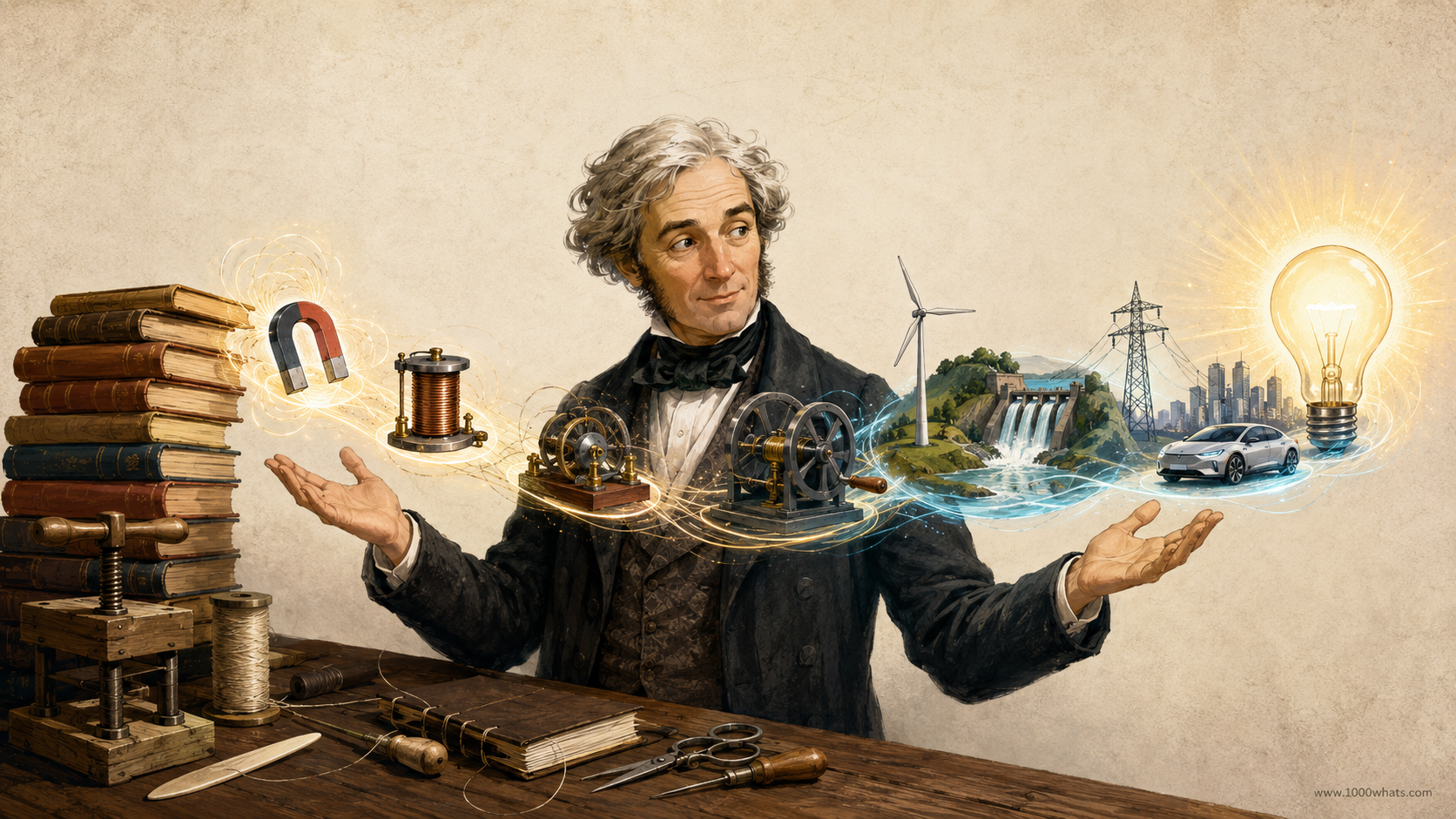
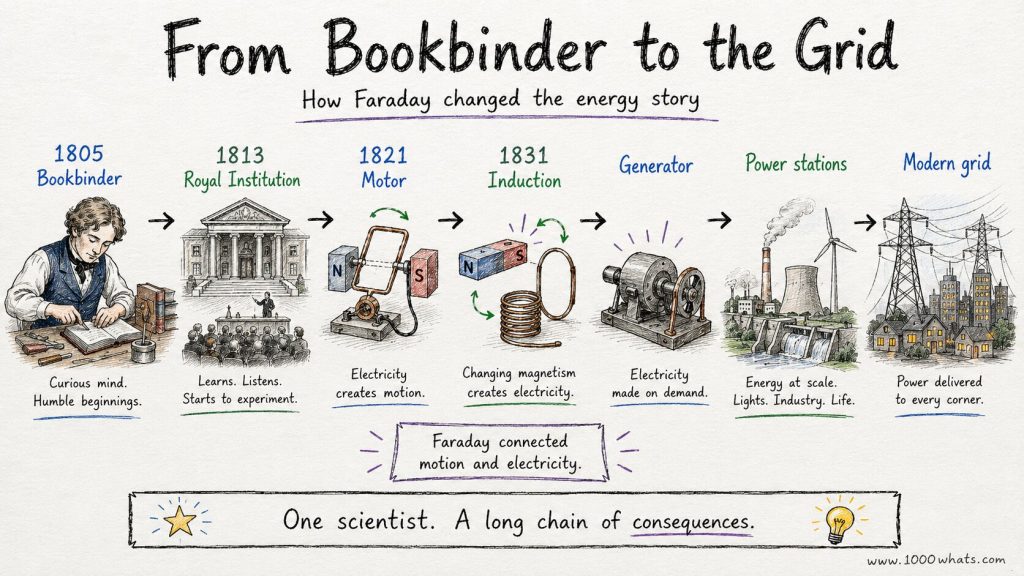
And hiding behind that very modern machine is a man born in 1791, into a poor London family, with little formal education, who spent his teenage years binding books.
Not writing them.
Binding them.
Which is a slightly ridiculous origin story for one of the people most responsible for the electrified world.
Welcome to 1000whats — where today we’re going back to a time when electricity was still mostly a laboratory curiosity and meeting the man who helped turn it into a machine.
His name was Michael Faraday.
⚡ “Faraday did not invent electricity. He did something arguably more useful: he helped humanity figure out how to make it on demand.”
Before Faraday, electricity was impressive. But not particularly useful.
People knew electricity existed long before Faraday.
They could create static charge.
They could make sparks.
Luigi Galvani had watched dead frog legs twitch.
Alessandro Volta had built the voltaic pile—the ancestor of the battery.
And in 1820, Hans Christian Ørsted showed that an electric current could affect a compass needle, revealing that electricity and magnetism were somehow connected.
This was fantastic science.
But humanity still had a rather important problem.
We knew how to get electricity to create magnetism.
Could we make the trick run backward?
Could magnetism create electricity?
Today the answer seems almost embarrassingly obvious.
In 1820, it was not.
And the person who eventually cracked it had not exactly followed the standard career path toward becoming one of history’s great experimental physicists.
Step one: Become a bookbinder
Faraday was born in London in 1791, the son of a blacksmith.
His formal education was, by his own later description, extremely basic: reading, writing and arithmetic.
No elite university.
No grand mathematical education.
No carefully designed path into science.
At around 14, he became an apprentice bookbinder.
And this is where the story gets good.
Faraday had access to books.
Lots of books.
And apparently nobody had explained to him that the person binding them was supposed to stop there.
So he read them.
Science books in particular.
He copied things.
He made notes.
He drew apparatus.
He attended public lectures when he could afford to.
The Royal Institution still holds some of the notebooks he made during those years. They are wonderfully obsessive objects: carefully written explanations, diagrams, indexes, observations.
Basically:
Faraday built himself a university out of whatever passed through the bookshop.
There is something beautifully unfair about this.
Somebody buys an expensive science book.
Faraday binds it.
Faraday reads it.
Faraday changes civilization.
Then he went to see a celebrity scientist
In 1812, Faraday got tickets to lectures given at London’s Royal Institution by Humphry Davy, one of the most famous scientists in Britain.
Davy was already a star.
Faraday was still a bookbinder.
So Faraday did what Faraday apparently did with everything.
He took absurdly good notes.
Then he bound those notes into a book and sent them to Davy, asking for work.
This is essentially the early-19th-century version of sending someone the world’s most aggressively prepared LinkedIn message.
At first, there was no position.
Then an opening appeared.
Davy remembered him.
In 1813, Faraday joined the Royal Institution as a laboratory assistant.
He had made it into the room.
What happened next is the important part.
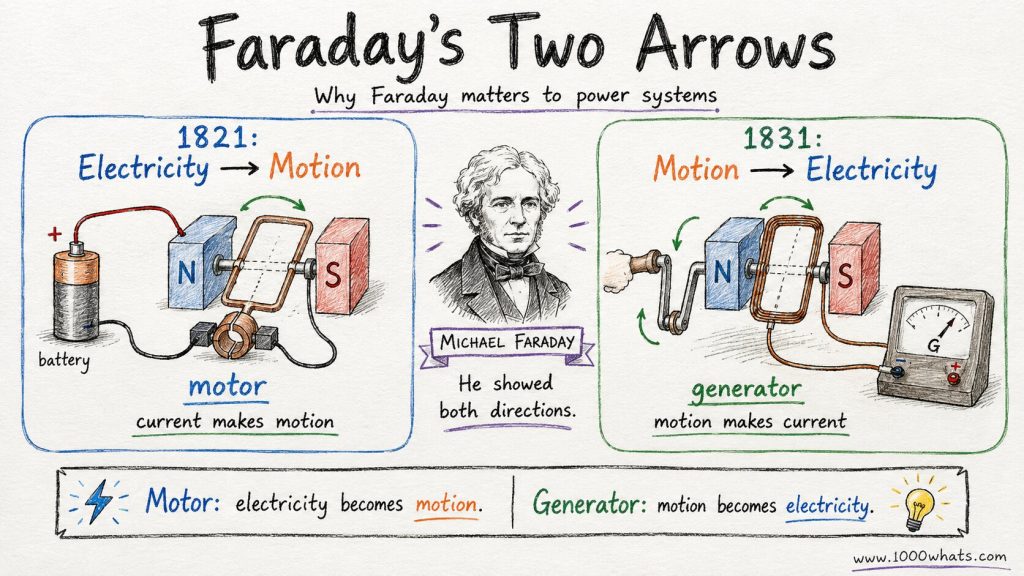
Electricity makes motion
In 1820, Ørsted’s discovery that electrical current creates a magnetic effect caused enormous excitement across Europe.
Faraday started experimenting with the relationship.
If electricity could push a magnet…
could you make something move continuously?
On September 3, 1821, in the basement laboratory of the Royal Institution, Faraday got a current-carrying wire to rotate around a magnet.
It looked tiny.
Primitive.
Almost silly.
But the Royal Institution describes the experiment as the first continuous conversion of electrical energy into mechanical motion.
In other words:
an electric motor.
Not the motor in your EV.
Not even remotely.
Faraday’s apparatus involved wire, magnets, a battery and—because this was 1821—a bath of mercury.
Health and safety departments had not yet reached full strength.
But conceptually, something enormous had happened.
Electricity could create continuous motion.
⚡ “In 1821, Faraday turned electricity into movement. Ten years later, he would turn movement back into electricity.”
That symmetry is basically his greatest contribution to the energy world.
Then Faraday spent ten years chasing the trick backward
This was the big question.
If an electric current creates magnetism, surely magnetism should somehow be able to create an electric current.
Faraday suspected it could.
The problem was persuading nature to agree.
For years, experiments gave frustrating results.
Put magnets near wires.
Nothing useful.
Put current-carrying wires near other wires.
Still not the effect he wanted.
The missing idea was subtle.
It was not magnetism itself that mattered.
It was change.
In August 1831, Faraday finally demonstrated that a changing magnetic environment could induce an electric current.
The American Physical Society records his famous experiment using an iron ring wrapped with coils of wire. When current in one coil changed, a temporary current appeared in another.
Electricity.
Across a gap.
Created through changing magnetism.
Then Faraday pushed further.
Move a magnet through a coil.
Electric current appears.
Move the conductor through a magnetic field.
Electric current appears.
Rotate a copper disc between magnetic poles.
Electric current appears.
Humanity had found the generator.
And this is where the energy story gets enormous
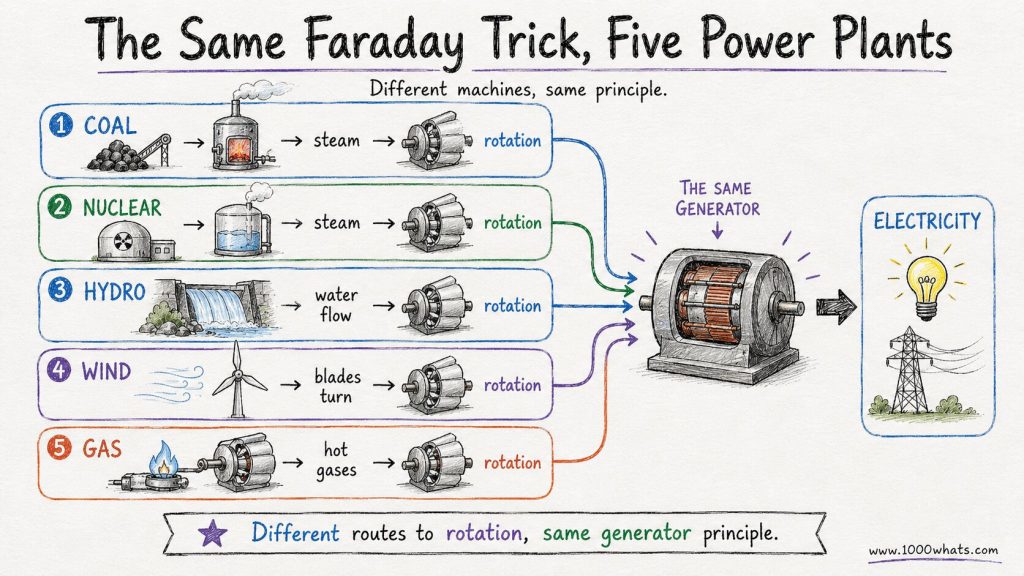
Think about how we generate electricity.
Coal plant?
Burn coal.
Make steam.
Spin turbine.
Spin generator.
Electricity.
Gas plant?
Burn gas.
Spin turbine.
Spin generator.
Electricity.
Nuclear plant?
Split atoms.
Make heat.
Make steam.
Spin turbine.
Spin generator.
Electricity.
Hydropower?
Drop water.
Spin turbine.
Spin generator.
Electricity.
Wind power?
Wind spins rotor.
Rotor spins generator.
Electricity.
Different technology.
Same last magic trick.
Move conductors through magnetic fields—or magnetic fields relative to conductors—and electrical voltage appears.
Faraday’s 1831 work on electromagnetic induction is sitting underneath an astonishing amount of modern electricity generation.
The Royal Institution still has Faraday’s 1831 generator apparatus. It is about as visually impressive as something you might find forgotten in the back of a school physics cupboard.
Wire.
Cotton.
Iron.
Copper.
A magnet.
That is the annoying thing about foundational discoveries.
They rarely look sufficiently dramatic afterward.
Faraday had discovered something bigger than a generator
It would be easy to end the story here.
Faraday invents the principle of the generator.
Electric civilization happens.
Roll credits.
But that undersells him.
Faraday gradually developed a different way of thinking about electricity and magnetism themselves.
Many scientists at the time imagined forces acting mysteriously across empty space.
Faraday thought in terms of fields and what he called lines of force.
Put a magnet under a sheet of paper.
Sprinkle iron filings.
You know those curved patterns that appear?
Faraday treated those patterns as clues to something physically meaningful about the space around magnets and charges.
The idea was deeply intuitive.
And Faraday was famous for being far stronger experimentally than mathematically.
This is one of the strange pleasures of his story.
One of the architects of modern electromagnetic physics did not arrive there by writing pages of elegant equations.
He saw the physics first.
Later, James Clerk Maxwell supplied the mathematical framework.
Maxwell’s equations eventually unified electricity, magnetism and light into one extraordinary theory of electromagnetism.
But Maxwell himself built on the physical picture Faraday had developed.
Faraday imagined the landscape.
Maxwell drew the map.
The man who changed electrical engineering was not really an electrical engineer
Faraday’s list of achievements starts becoming slightly unreasonable.
He discovered electromagnetic rotation.
Electromagnetic induction.
He built an early generator.
His induction experiments contained the principle behind the transformer.
He discovered benzene.
He formulated laws of electrolysis.
He introduced or helped establish terms including electrode, cathode, anode and ion.
He discovered diamagnetism and the magneto-optical effect.
He developed the field concept that became central to later physics.
Apparently one career was considered inefficient.
And yet Faraday was not sitting around thinking:
Excellent. This should increase global installed generating capacity.
Much of his work was fundamental science.
He wanted to understand how nature behaved.
The industrial consequences arrived later.
That lag matters
Faraday demonstrated electromagnetic induction in 1831.
The world did not wake up in 1832 covered in power stations.
Early generators were weak.
Engineers had to develop better magnets, dynamos, machines, insulation, transmission systems and commercial applications.
The Smithsonian notes that instrument maker Hippolyte Pixii built an early magneto-electric generator soon after Faraday’s discovery, while much more powerful dynamo designs emerged decades later.
Then came large-scale electrical systems.
Lighting.
Motors.
Power stations.
Transmission.
Factories.
Household appliances.
Modern grids.
One experiment in a laboratory does not create an industry.
It creates a possibility.
Engineers spend the next fifty years arguing with cost, materials and reality.
That pattern has not changed much.
Faraday basically gave us both directions of electrification
There is an elegant way to think about his two famous electrical breakthroughs.
1821
Electricity → motion
That is the motor.
1831
Motion → electricity
That is the generator.
Look around modern energy and transportation and those two arrows are everywhere.
A wind turbine:
motion → electricity
An EV:
electricity → motion
A pumped-hydro plant generating:
motion → electricity
A pump sending the water back uphill:
electricity → motion
A refrigerator compressor:
electricity → motion
A thermal power plant generator:
motion → electricity
Human civilization spends a frankly ridiculous amount of time moving between those two states.
And Faraday helped open both doors.
Your EV and a power plant are doing opposite Faraday tricks
This might be the most satisfying connection.
Take an electric car.
Electricity enters the motor.
Electromagnetic forces create torque.
The wheels move.
That is one side of the story.
Now take regenerative braking.
The wheels are already moving.
Instead of using electricity to create motion, the motor operates as a generator.
Motion creates electricity.
The battery charges.
Same machine.
Opposite direction of energy conversion.
Motor ↔ generator.
Faraday would recognize the basic relationship immediately.
He might have some questions about the touchscreen.
And wind turbines are giant monuments to an experiment from 1831
Modern wind turbines are magnificent pieces of engineering.
Composite blades tens of meters long.
Advanced aerodynamics.
Power electronics.
Control systems.
Gearboxes—or direct-drive designs.
Sensors.
SCADA.
Pitch control.
Converters.
Complex grid-code compliance.
Then, buried inside all that sophistication:
electromagnetic induction.
Wind moves blade.
Blade rotates shaft.
Generator converts mechanical energy into electrical energy.
We can make the turbine bigger.
Smarter.
Lighter.
More efficient.
Connected to increasingly sophisticated power electronics.
But we have not escaped Faraday.
We have industrialized him.
⚡ “A modern wind turbine may contain some of the most advanced engineering on Earth. At its heart, it is still performing a trick discovered in a London basement in 1831.”
Faraday also happened to be very good at explaining things
This part feels particularly appropriate for 1000whats.
Faraday did not only discover science.
He cared about communicating it.
He helped establish the Royal Institution’s Friday Evening Discourses and became one of the great scientific lecturers of his age.
He also played a major role in the famous Christmas Lectures, a tradition that continues today.
His lectures were known for demonstrations.
Show the thing.
Make it move.
Make it spark.
Then explain why.
There is probably a lesson in that.
Especially in energy.
We have an industry remarkably skilled at turning perfectly understandable concepts into slide decks containing 14 acronyms and a waterfall chart.
Faraday was operating in the opposite direction.
Make people see it.
Then give them the concept.
The bookbinder part of the story is more than a cute anecdote
It is tempting to turn Faraday’s beginnings into the usual inspirational story.
Poor boy reads books.
Works hard.
Becomes genius.
Everyone claps.
Reality is more interesting.
Faraday lived in a scientific world deeply shaped by class and access.
He did not have the educational advantages of many contemporaries.
He also had extraordinary curiosity, experimental ability, discipline and eventually access to one of Britain’s most important scientific institutions.
Both things can be true.
What makes the bookbinding years fascinating is not that Faraday magically educated himself in isolation.
It is how aggressively he used every opening available to him.
A book entered the shop?
Read it.
A lecture was available?
Attend it.
Learn something?
Take notes.
Meet Humphry Davy?
Send him a bound volume demonstrating exactly what you can do.
Get a laboratory job?
Start experimenting.
It is difficult not to admire the efficiency of the process.
Faraday did not wait until somebody declared him qualified to be curious.
Did Faraday know what he had started?
Not really.
How could he?
When he made a wire rotate around a magnet in 1821, there was no electrical grid.
No electric car.
No household refrigerator.
No wind farm.
No subway traction motor.
No gigantic synchronous generator.
No power electronics.
No global electricity system.
The total chain from Faraday’s experiments to modern electrification required work from thousands of scientists, inventors, engineers and companies.
Pixii.
Siemens.
Wheatstone.
Maxwell.
Tesla.
Westinghouse.
Edison.
And many, many people whose names never became units.
History becomes misleading when we pretend one heroic genius invented the modern world on Tuesday afternoon.
Faraday did not.
But he discovered one of the physical mechanisms without which that world becomes extremely difficult to imagine.
That is more interesting anyway.
There is a Faraday hiding inside almost every power station
Look at the world’s electricity system from far enough away.
Coal.
Gas.
Nuclear.
Hydro.
Wind.
Biomass.
Geothermal.
Very different primary energy sources.
Very different politics.
Very different emissions.
Very different economics.
But many eventually arrive at the same step:
something rotates a generator.
Coal heats water to create steam.
Nuclear fission heats water to create steam.
Gas expands through turbines.
Water falls through hydro turbines.
Wind turns blades.
Different ways of obtaining mechanical motion.
Then Faraday takes over.
This is one of those wonderful moments where an obscure piece of 19th-century physics turns out to be hiding underneath a significant chunk of modern civilization.
The electricity grid is enormously complicated.
The foundational trick is almost insultingly simple:
change the magnetic field around a conductor and you can create voltage.
We explain the physics in detail in our article on electromagnetic induction.
Faraday spent decades discovering what that sentence actually meant.
Final thoughts
Michael Faraday died in 1867.
By then, practical electrical machines were beginning to emerge.
But the enormous power systems we associate with electricity came afterward.
Central power stations.
AC networks.
Long-distance transmission.
Electrified factories.
Subways.
Appliances.
Computers.
Wind turbines.
Electric cars.
None of those things were Faraday’s invention.
That distinction matters.
History is more interesting when we stop pretending every great scientist single-handedly invented the future.
Faraday did something different.
He discovered a door.
Then humanity spent the next two centuries seeing how much equipment it could push through it.
And perhaps the strangest part of his story is still the beginning.
A teenager with very little formal schooling starts binding books.
He reads the books.
He takes obsessive notes.
He gets into a laboratory.
He makes a wire spin around a magnet.
Ten years later, he moves a magnet near a wire and electricity appears.
Today, generators across the planet are still doing versions of that experiment at industrial scale.
Not bad for a bookbinder.
Until next time, stay curious! 😎
Discover more from 1000whats
Subscribe to get the latest posts sent to your email.