Imagine building a wind farm.
The turbines generate electricity.
Excellent.
Now instead of sending that electricity directly into an electric motor, you use it to split water.
Then take the hydrogen you just made.
Find some carbon dioxide.
Combine the two through another industrial process.
Refine the result.
Transport it.
Put it inside an airplane.
Then finally burn it.
At first glance, this sounds like somebody looked at the beautifully simple idea of electrification and asked:
Could we add several expensive steps?
Yes.
And strangely, there are situations where that may make sense.
Welcome to 1000whats — where today renewable electricity changes its mind and becomes fuel.
These fuels are called e-fuels, short for electrofuels.
⚡ “An e-fuel is electricity wearing a fuel costume.”
And that silly-sounding description gets surprisingly close to the engineering.
First, why would anyone turn electricity into fuel?
Because electricity is wonderful.
And also inconvenient.
Electrons work brilliantly when you have:
wires,
batteries,
motors,
and somewhere sensible to plug in.
That describes increasingly large parts of modern life.
Cars?
Very electrifiable.
Buildings?
Often electrifiable.
A lot of industrial equipment?
Also increasingly electrifiable.
But now consider:
a long-haul aircraft carrying hundreds of passengers across an ocean,
a container ship crossing the Pacific,
or certain industrial processes that need energy-dense chemical fuels.
A battery capable of doing the same job may become:
too heavy,
too large,
or operationally impractical.
The IEA’s e-fuels analysis makes this distinction directly: road transport has large electrification opportunities, while aviation and shipping remain much more dependent on fuel-based solutions.
So e-fuels do not really compete with electricity everywhere.
Their most interesting job is:
take renewable electricity and convert it into molecules for places where electrons are awkward.
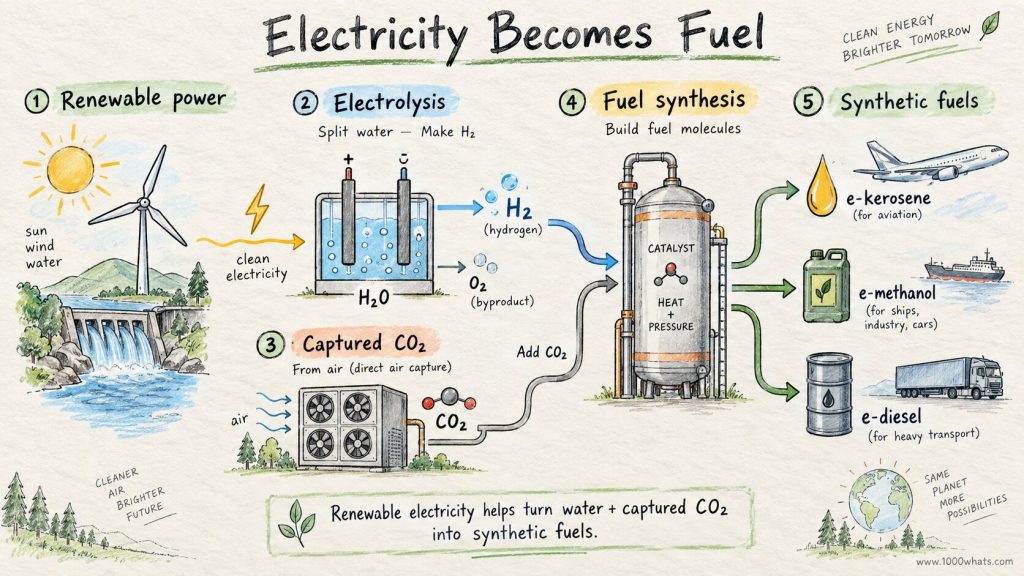
Step one: make hydrogen
The story starts with electricity.
Preferably renewable electricity from:
wind,
solar,
hydropower,
or another low-carbon source.
That electricity powers an electrolyzer.
Inside it, water is split:
H₂O → hydrogen + oxygen
I already explained this mechanism in my green hydrogen article.
The important part here is that hydrogen becomes the first bridge between:
electricity
and:
fuel chemistry.
Renewable electricity is no longer electricity.
Some of its energy is now stored in hydrogen molecules.
Already, we have losses.
Keep that thought.
We will return to it.
Step two: find carbon
Hydrogen alone is useful.
But if you want to manufacture something resembling:
gasoline,
diesel,
kerosene,
methanol,
or methane,
you usually need carbon too.
That carbon can come from captured CO₂.
Possible sources include:
industrial processes,
biogenic CO₂,
or ultimately direct air capture.
This connects directly to my existing carbon capture explainer.
Now we have:
hydrogen + carbon dioxide
The ingredients required to start rebuilding hydrocarbons.
There is something deeply odd about this.
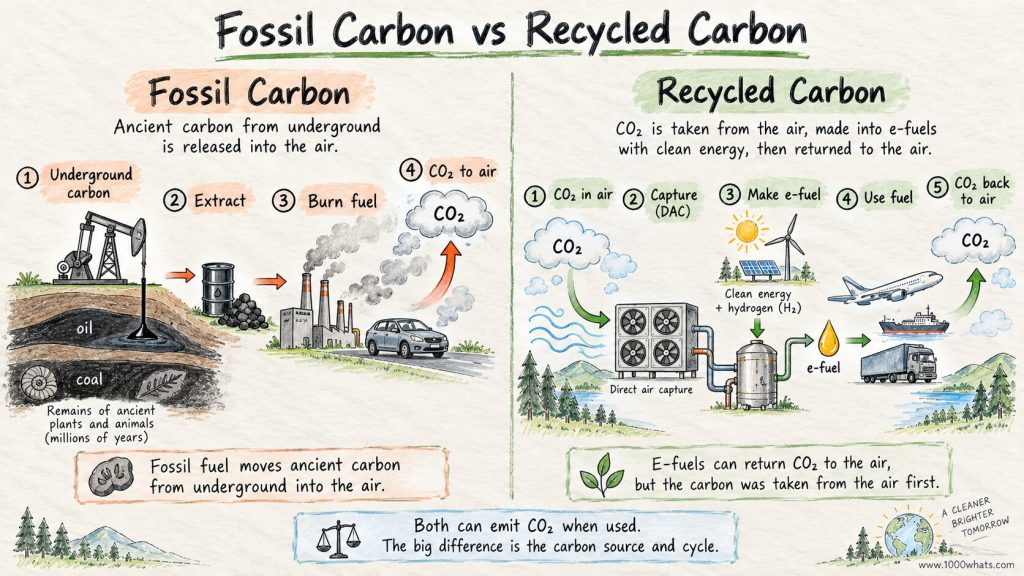
For more than a century, we have mostly done:
hydrocarbon → burn it → CO₂
E-fuels attempt part of the reverse journey:
CO₂ + hydrogen + energy → hydrocarbon
Then, later:
hydrocarbon → burn it → CO₂
We have built a carbon round trip.
⚡ “Fossil fuels dig carbon out of geology. E-fuels try to borrow carbon already circulating above ground.”
Step three: rebuild the fuel
Hydrogen and CO₂ can be converted through different chemical pathways into useful fuels.
The exact process depends on what you want to make.
Possible products include:
- synthetic methane;
- e-methanol;
- e-diesel;
- synthetic gasoline;
- synthetic kerosene or e-SAF;
- other hydrogen-derived fuels.
One famous route uses Fischer–Tropsch synthesis, where hydrogen and carbon-containing gases are converted into longer hydrocarbon molecules.
Another route produces methanol.
The chemistry differs.
The conceptual structure does not:
renewable electricity → hydrogen → synthetic fuel
with captured carbon added where a carbon-based fuel is required.
The European Commission classifies renewable hydrogen and many of these derivative fuels as renewable fuels of non-biological origin, or RFNBOs, when they meet the relevant renewable-energy and emissions rules.
Energy policy does occasionally produce acronyms even less friendly than the chemistry.
Wait. Are e-fuels actually renewable?
Potentially.
Not automatically.
This distinction matters enormously.
Suppose you make hydrogen using electricity from:
coal.
Then combine it with CO₂.
Congratulations.
You have created a very technologically sophisticated way to produce a carbon-intensive fuel.
The climate benefit depends heavily on:
- where the electricity came from;
- how the hydrogen was produced;
- where the carbon came from;
- how much energy the synthesis process consumed;
- transportation and processing;
- what happens when the fuel is finally used.
That is why the EU does not simply say:
synthetic = renewable.
Its RFNBO rules require renewable-energy sourcing and greenhouse-gas criteria; qualifying RFNBOs must achieve substantial lifecycle emissions savings relative to fossil alternatives.
The fuel molecule does not know whether it is green.
The supply chain does.
But they still emit CO₂ when burned, right?
Yes.
This is where e-fuels are often explained badly.
Put synthetic kerosene inside a jet engine and burn it.
CO₂ comes out.
The engine does not look at the molecule and say:
Ah, renewable carbon. Please proceed without emissions.
Combustion still produces carbon dioxide.
The climate argument is instead about where that carbon came from.
Fossil kerosene
Carbon comes from:
underground fossil deposits
Then:
burn → atmosphere
We have moved additional geological carbon into the active carbon cycle.
Renewable e-kerosene
Ideally:
CO₂ captured from air or sustainable biogenic source → fuel → burn → CO₂ returned
The goal is a much more circular carbon flow.
| Fuel route | Carbon source | What combustion does |
|---|---|---|
| Fossil jet fuel | Geological fossil carbon | Adds fossil carbon to atmosphere |
| E-fuel using captured atmospheric CO₂ | Existing atmospheric carbon | Returns previously captured carbon |
| E-fuel using fossil-process CO₂ | Fossil-derived carbon | Climate benefit depends heavily on accounting and lifecycle |
That final row is why e-fuel carbon accounting gets complicated quickly.
Not all captured CO₂ is equivalent.
Why direct air capture is conceptually attractive
Suppose we pull CO₂ directly from ambient air.
Then use renewable electricity to make hydrogen.
Combine them.
Produce e-kerosene.
Fly the airplane.
CO₂ returns to the atmosphere.
In the idealized carbon loop:
air → CO₂ capture → fuel → airplane → air
We borrowed the carbon.
Then returned it.
That is much closer to carbon recycling than fossil extraction.
But direct air capture itself requires energy.
A lot of air needs to be processed because atmospheric CO₂ is dilute.
Then hydrogen production requires energy.
Then fuel synthesis requires energy.
Which brings us to the elephant in the refinery.
E-fuels are energetically expensive
Imagine you start with:
100 units of renewable electricity.
If you send those units directly into an EV battery and electric motor, a large share can eventually become useful motion.
Now take the e-fuel route.
You need to:
produce hydrogen,
compress or process it,
capture or supply CO₂,
synthesize fuel,
refine it,
transport it,
and finally burn it inside an engine whose thermodynamic efficiency is far from 100%.
At every stage:
energy leaves the useful chain.
That does not make e-fuels stupid.
It means they should be used where their other advantages justify the losses.
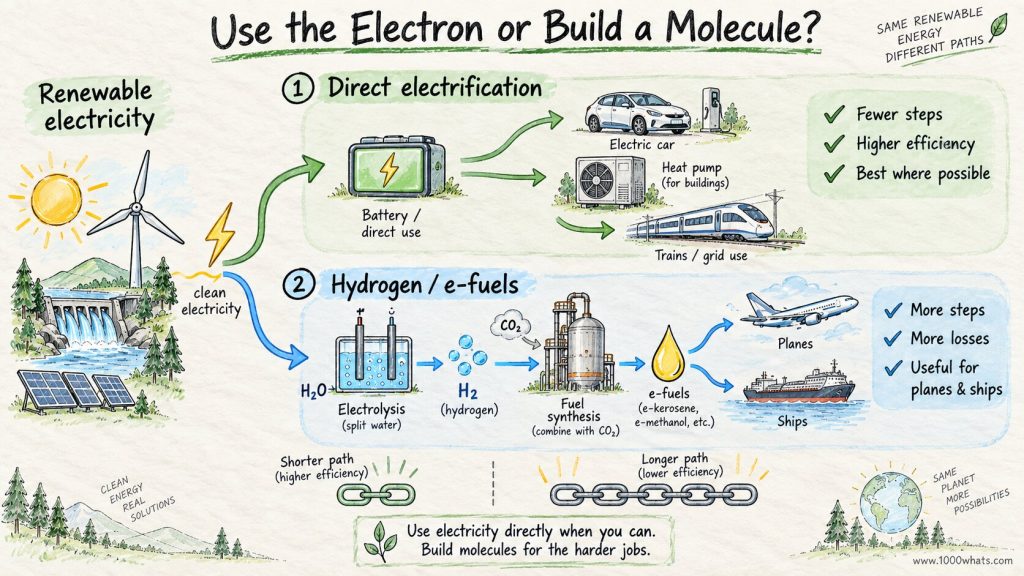
This is the key strategic distinction:
If direct electrification works well, it usually makes more energetic sense to use electricity directly.
If batteries are impractical, the calculation changes.
A simple comparison
Suppose renewable electricity is available.
| Route | Main advantage | Main disadvantage |
|---|---|---|
| Electricity → battery → electric motor | High conversion efficiency | Batteries add weight and require charging infrastructure |
| Electricity → H₂ → fuel → combustion engine | Existing liquid-fuel logistics; high energy density | Many conversion losses |
| Fossil fuel → combustion | Mature, convenient infrastructure | Adds fossil CO₂ |
For a city car, the first route is extremely attractive.
For a transatlantic aircraft?
Battery weight becomes a much bigger argument.
That is why e-fuels should not be treated as a universal replacement for fossil fuels.
They are potentially a specialized decarbonization tool.
Why airplanes are the obvious target
Aircraft are obsessed with weight.
Every kilogram carried into the air requires energy.
Jet fuel is popular partly because it stores enormous amounts of energy per kilogram.
Batteries are improving rapidly.
But for long-haul aviation, replacing jet fuel with enough battery mass remains extremely difficult.
So aviation faces a peculiar decarbonization problem:
The jet turbine itself works very well.
The fuel is the climate problem.
What if we keep:
the aircraft,
the engines,
the airports,
the tanks,
the refueling infrastructure,
but change where the fuel came from?
That is the attraction of synthetic aviation fuel.
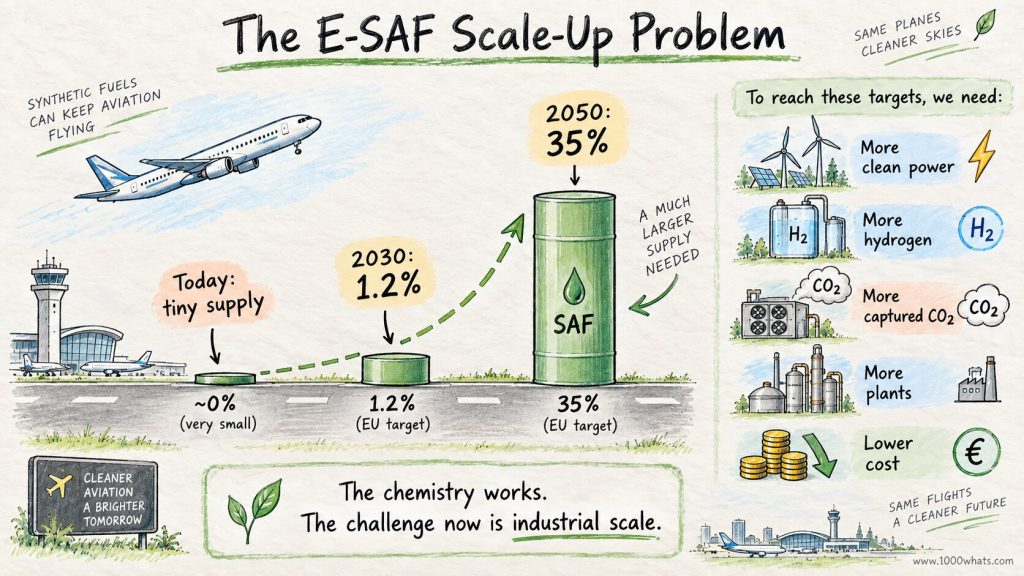
Under ReFuelEU Aviation, synthetic aviation fuels must reach 1.2% of fuel supplied at EU airports by 2030, with the requirement rising progressively to 35% by 2050.
That is a very small share initially.
But it turns e-SAF from a laboratory curiosity into something airlines and fuel suppliers increasingly have to plan around.
Shipping has a similar problem—with more options
Ships do not care about weight as brutally as airplanes do.
But long ocean voyages still require enormous amounts of stored energy.
Possible maritime decarbonization routes include:
batteries for short routes,
hydrogen,
ammonia,
methanol,
biofuels,
synthetic methane,
and combinations.
The EU’s FuelEU Maritime framework requires the lifecycle greenhouse-gas intensity of energy used by large ships calling at EU ports to decline progressively, reaching an 80% reduction by 2050 relative to the 2020 reference.
Notice that the regulation targets:
emissions intensity
rather than dictating one winning fuel.
That is sensible.
Ships are not all the same.
Neither are their routes.
What about e-fuels for cars?
Technically?
Yes.
You can manufacture synthetic gasoline or diesel compatible with combustion engines.
Commercially and energetically?
Much more controversial.
Imagine having renewable electricity.
Option A:
charge an EV.
Option B:
electrolyze water → make hydrogen → capture CO₂ → synthesize gasoline → transport gasoline → burn it inside an internal-combustion engine.
Option B solves one major problem:
existing combustion vehicles can potentially use familiar fuel infrastructure.
It also creates several new ones.
For new passenger vehicles, direct electrification is generally far more energy-efficient.
That does not make synthetic gasoline useless.
Potential niches could include:
existing legacy vehicles,
specialized applications,
motorsport,
classic cars,
or regions where electrification is unusually difficult.
But “e-fuels can run cars” and “e-fuels are the best way to decarbonize cars” are very different claims.
Energy debates benefit enormously from keeping those sentences separate.
The existing infrastructure argument is real
Liquid fuels have something electricity does not:
a century of infrastructure built around them.
Tanks.
Ships.
Pipelines.
Refineries.
Fuel depots.
Airport storage.
Truck delivery.
Engines.
E-fuels can potentially use parts of this existing system.
That matters enormously in difficult sectors.
A synthetic kerosene molecule can look chemically similar enough to conventional kerosene that it can be blended into aviation fuel without reinventing the airplane.
The Commission notes that qualifying sustainable aviation fuels are designed as drop-in fuels compatible with existing aircraft and fueling technology within certification limits.
This is one reason e-fuels remain interesting despite poor conversion efficiency.
Infrastructure has value.
Sometimes enormous value.
⚡ “Efficiency asks how much energy survives the conversion. Infrastructure asks how much of civilization you have to rebuild.”
Then there is energy geography
Here is where e-fuels become more interesting from an energy-market perspective.
Suppose Country A has:
excellent solar resources,
huge amounts of land,
low renewable-power costs,
but modest domestic energy demand.
Country B has:
airlines,
shipping,
heavy industry,
and expensive renewable electricity.
Instead of transmitting electricity thousands of kilometers, Country A could potentially convert electricity into:
hydrogen,
ammonia,
methanol,
or synthetic hydrocarbons
and ship the molecules.
We already do something similar with fossil energy.
The difference is that the original energy source becomes renewable electricity.
This creates the possibility of entirely new global energy trade routes.
Sunlight in one country.
Jet fuel in another.
Energy geography does not disappear.
It gets rewritten.
E-fuels can also absorb renewable electricity—but be careful
You will often hear this argument:
When wind and solar produce excess electricity, use that electricity to make hydrogen and e-fuels.
Conceptually, yes.
Electrolyzers can be flexible loads.
This can help integrate renewable generation.
But large industrial fuel plants are expensive.
Expensive equipment generally likes operating.
Building a billion-euro facility and running it only during a few hours of “free electricity” may not produce cheap fuel.
In practice, the challenge is more subtle:
find sufficiently cheap, low-carbon electricity for enough hours to keep the plant economic without simply stealing clean electricity from another valuable use.
This is why e-fuel economics are intimately connected to:
renewable buildout,
power prices,
electrolyzer utilization,
grid constraints,
and additionality rules.
The fuel plant may look like chemistry.
Underneath it sits an electricity-market problem.
The carbon source creates another paradox
Suppose a cement plant emits concentrated CO₂.
Capture it.
Use that CO₂ to make e-fuel.
Later burn the fuel.
CO₂ enters the atmosphere.
Did we eliminate the carbon?
No.
We used it twice before it reached the atmosphere.
That may still reduce emissions compared with extracting additional fossil carbon.
But it is not the same climate story as:
capture CO₂ from ambient air → make fuel → return same carbon to air.
So the source matters.
| CO₂ source | Advantage | Limitation |
|---|---|---|
| Concentrated industrial stream | Easier and cheaper to capture | May still originate from fossil carbon |
| Biogenic CO₂ | Potentially renewable carbon cycle | Limited sustainable supply |
| Direct air capture | Strong circular-carbon logic | Energy-intensive and currently expensive |
There is no useful discussion of e-fuels without discussing carbon origin.
The molecule alone cannot tell you its climate history.
Are e-fuels carbon neutral?
That phrase should trigger caution.
Potentially very low-carbon?
Yes.
Automatically carbon-neutral?
No.
You need lifecycle accounting.
Ask:
How was the electricity generated?
How was hydrogen made?
Where did the CO₂ come from?
How much energy did capture require?
How was fuel transported?
Were methane or other greenhouse gases involved?
What happened during combustion?
This is why European rules use lifecycle greenhouse-gas criteria rather than simply labeling anything synthetic as clean.
“Made with electricity” is not an environmental certificate.
Neither is “captured carbon.”
The whole chain matters.
Why are e-fuels so expensive?
Because the factory is doing something nature previously did for us.
Oil represents solar energy and biological material processed through geological time.
We drill it.
Refine it.
Use it.
E-fuels attempt to manufacture energy-rich molecules ourselves.
That requires:
renewable-power plants,
electrolyzers,
hydrogen infrastructure,
CO₂ capture,
chemical synthesis,
refining,
storage,
and logistics.
Each costs money.
Each consumes energy.
And much of the industry is still early.
The IEA says substantial reductions in renewable-electricity and electrolyzer costs would be required for large-scale e-fuel deployment.
Europe is therefore supporting scale-up through mandates and investment policy rather than waiting for synthetic fuel to spontaneously undercut petroleum.
Germany alone has earmarked €1.9 billion through 2026 for the development of e-fuels and advanced biofuels.
That tells you something.
This is not yet cheap fuel.
A real-world example: European aviation
The EU requires airlines and fuel suppliers to begin moving toward SAF.
The overall SAF requirement starts at:
2% in 2025
and rises toward:
70% in 2050.
Within that, synthetic aviation fuels receive their own sub-target:
1.2% in 2030
rising to:
35% in 2050.
Yet the Commission reported that almost all SAF consumed in the EU in 2024 came from bio-based feedstocks such as used cooking oil and animal fats.
Synthetic aviation fuel remained in its early stages.
That produces an interesting gap:
| Policy direction | Current reality |
|---|---|
| Synthetic aviation fuel becomes mandatory from 2030 | Commercial supply remains tiny |
| Long-term synthetic share reaches 35% by 2050 | Plants still need investment and scale |
| Airlines need low-carbon liquid fuel | E-fuel production requires huge amounts of renewable electricity |
This is precisely why e-fuels matter now.
Not because they already dominate.
Because policy is beginning to require a market that barely exists.
E-fuel vs. biofuel: same tank, different origin
These concepts are often mixed together.
Both can potentially replace fossil fuels.
But they begin differently.
Biofuel
Energy and carbon ultimately come from:
biomass
Plants, residues, oils, waste.
E-fuel
Energy comes primarily from:
electricity
with hydrogen produced electrolytically and carbon supplied separately when needed.
| Biofuel | E-fuel | |
|---|---|---|
| Main energy origin | Biomass | Electricity |
| Carbon source | Biomass | Captured CO₂ |
| Land/feedstock constraint | Potentially significant | Lower biomass dependence |
| Electricity requirement | Usually lower | Very high |
| Main attraction | Existing biological carbon cycle | Converts renewable power into fuel |
Neither is automatically sustainable.
Biofuels can create land-use problems.
E-fuels can devour renewable electricity.
Energy transitions rarely offer free lunch.
Mostly they offer different menus of inconvenience.
Why not just use hydrogen?
Sometimes we should.
But hydrogen is a difficult molecule to handle.
It has low volumetric energy density.
It requires compression, liquefaction, pipelines, tanks, or conversion.
Synthetic fuels allow hydrogen’s energy to be repackaged into molecules that are easier to:
store,
transport,
ship,
and use inside existing equipment.
That convenience costs energy.
Again, we are buying something with those conversion losses.
The relevant question is not:
Is e-fuel more efficient than hydrogen?
It is:
Which energy carrier best fits the actual job?
A steel mill may want hydrogen itself.
An airplane wants something much closer to kerosene.
Different machine.
Different molecule.
The biggest mistake: treating every sector the same
E-fuels make little sense if the question is:
What should replace all fossil fuel?
Nothing should.
There will probably be multiple answers.
For many passenger cars:
electricity.
For building heating:
heat pumps and district systems.
For steel:
electrification and hydrogen.
For long-haul aviation:
SAF, including potentially large volumes of e-fuels.
For shipping:
multiple fuel pathways.
The energy transition is not replacing one giant fossil-fuel pipe with one giant green pipe.
It is unbundling jobs that fossil fuels happened to do very conveniently.
Electricity wins some.
Hydrogen wins some.
Bioenergy wins some.
Synthetic fuels may win others.
That is a much more useful way to think about the problem.
So, what are e-fuels in one sentence?
E-fuels are synthetic fuels produced using electricity—typically by making hydrogen through electrolysis and combining it with captured carbon or other molecules to create usable gaseous or liquid fuels.
The important thing is not the final liquid.
Synthetic kerosene looks like fuel.
The unusual part is where its energy came from.
Instead of:
underground fossil carbon
we begin with:
electricity.
Final thoughts
For most of modern history, fuel meant finding an energy-rich molecule that nature had already made.
Coal.
Oil.
Natural gas.
Dig it up.
Refine it.
Burn it.
E-fuels propose something almost backward.
Start with electricity.
Use electricity to make hydrogen.
Use hydrogen and carbon chemistry to reconstruct the molecule.
Then transport and burn it almost like the fossil fuel it replaces.
Energetically, this is not elegant.
If you can simply plug the machine into electricity, you probably should.
But energy systems are not judged only by conversion efficiency.
Airplanes need light, energy-dense fuel.
Ships need enormous amounts of portable energy.
Existing infrastructure has economic value.
Some industrial processes need molecules, not electrons.
That is where e-fuels become interesting.
Not as:
the fuel of the future.
That phrase is usually where nuance goes to die.
But as something more specific:
a way to carry renewable electricity into places where electricity itself struggles to go.
And perhaps that is the right way to think about them.
E-fuels are not an alternative to electrification.
They are what happens when electrification reaches the edge of what it can conveniently do—and decides to manufacture a molecule instead.
Until next time, stay curious! 😎
Discover more from 1000whats
Subscribe to get the latest posts sent to your email.