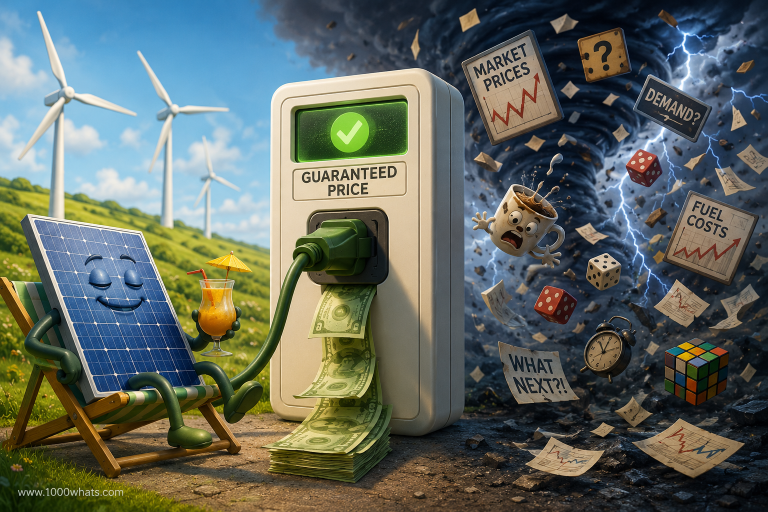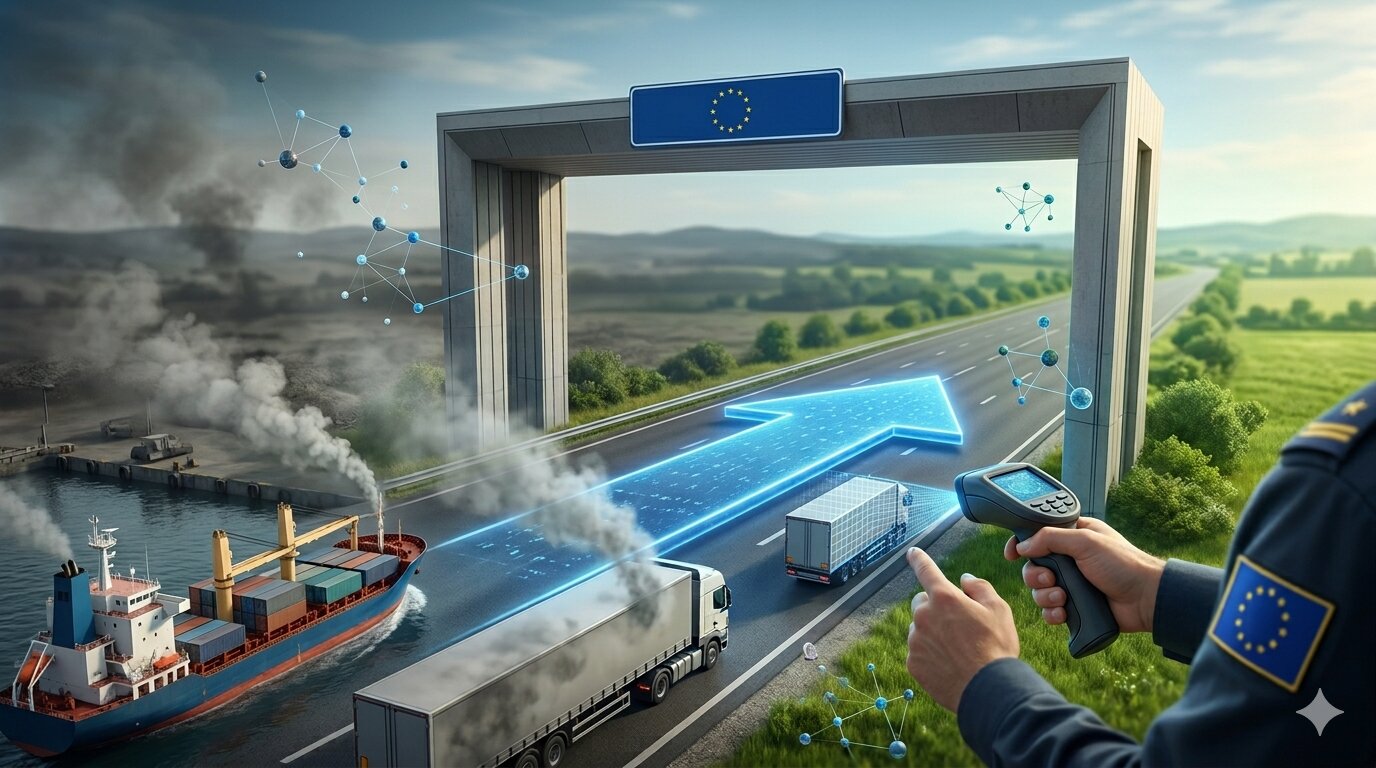
Here’s the uncomfortable truth: free pollution at the border was never going to survive Europe’s climate agenda.
For years, the EU made domestic producers pay for carbon through the ETS, while many imported goods could arrive carrying heavy emissions with no equivalent carbon cost attached. That gap was always going to close. Now it has a name: CBAM. 🔍
And this is why the topic matters right now. CBAM is not just climate policy anymore. It is trade policy, industrial policy, and power-market policy rolled into one. Since January 1, 2026, the mechanism has entered its definitive regime.
⚡ “CBAM doesn’t tax dirtiness in theory. It prices it at the border.”
Welcome to 1000what.com, where I ask the questions you did not know you needed answered.
What is CBAM?
CBAM stands for Carbon Border Adjustment Mechanism.
In plain English, it is the EU’s way of saying this:
If you want to sell certain carbon-intensive goods into the European Union, the carbon embedded in those goods cannot stay economically invisible forever.
The European Commission describes CBAM as a tool to put a fair price on carbon emitted during the production of carbon-intensive goods entering the EU, while encouraging cleaner production in non-EU countries. It is also designed to reduce the risk of carbon leakage—the classic problem where production shifts to jurisdictions with weaker carbon constraints.
Why does CBAM exist?
Because the EU realized something obvious that energy people have been watching for years:
You cannot decarbonize industry at home while importing emissions from abroad and pretending that counts as progress.
From a market perspective, that was the contradiction at the heart of the old system. EU producers were facing carbon costs under the ETS. Foreign producers selling into the same market often were not. CBAM is the border correction to that imbalance.
In practice, CBAM tries to do three things at once:
- Protect against carbon leakage
- Preserve the credibility of EU climate policy
- Push producers outside the EU to measure and reduce embedded emissions
⚡ “What most people don’t see is that CBAM is not only about climate. It’s about who gets to compete in Europe, and on what terms.”
How does CBAM work?
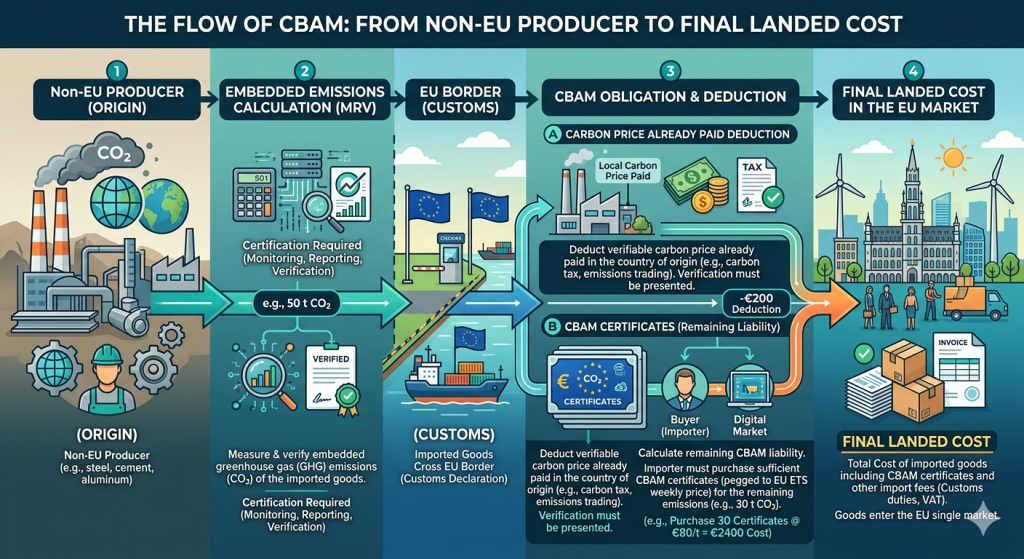
The short version: import, measure, price, adjust.
Here’s the mechanism in plain language:
- The EU currently applies CBAM to six sectors: cement, aluminium, fertilisers, iron and steel, hydrogen, and electricity.
- The transitional phase ran from October 1, 2023 through December 31, 2025, mainly as a reporting period.
- The definitive regime started on January 1, 2026.
- Importers in scope must become authorized CBAM declarants, report embedded emissions, and buy/surrender CBAM certificates.
- The certificate price is linked to the EU ETS allowance price.
- If a carbon price was already paid in the country of origin, that amount can be deducted from the CBAM charge.
There is also an important simplification now in force: a 50-tonne annual threshold for CBAM goods, aimed at excluding many small importers while still covering the overwhelming majority of emissions in scope. At the same time, the Commission warned that all importers of electricity or hydrogen need authorization at import, which makes those sectors especially sensitive.
A simple real-world example
Imagine a steel producer outside the EU selling into the European market.
If that steel was made with high embedded emissions, and if the producer did not already face an equivalent carbon price at home, the EU importer will face a CBAM obligation tied to those emissions. That changes the landed cost of the product.
Suddenly, carbon intensity becomes commercial intelligence.
That is the shift. CBAM turns emissions data into a trade variable. Not a sustainability footnote. A pricing variable.
Why CBAM matters more than people think
The easy explanation is that CBAM affects customs compliance.
The real explanation is bigger.
CBAM changes investment signals. It rewards cleaner production, penalizes opaque emissions, and raises pressure on neighboring countries to align with EU-style carbon pricing, MRV systems, and electricity-market integration.
This is why CBAM matters today:
- Industrial exporters now need credible emissions data, not vague ESG talking points.
- Electricity traders need to understand how carbon exposure reshapes cross-border trade.
- Renewable developers need to think harder about market design, PPAs, and bankability.
- Governments can no longer postpone carbon-pricing decisions without economic consequences.
⚡ “CBAM is where climate ambition stops being abstract and starts showing up on invoices.”
The Western Balkans angle: why this hits close to home
This part matters to me more than the average explainer can capture.
I’ve spent more than 20 years working across electricity markets, market liberalization, renewable integration, pricing methodologies, guarantees of origin, prosumer frameworks, and PPAs in Serbia and the wider regional context. I’ve worked both on the regulated-to-competitive market transition and on the commercial side of renewable offtake. That experience shapes how I read CBAM.
And here’s my view:
CBAM is not just another EU rule for the Western Balkans. It is a stress test for the region’s entire energy transition.
The Energy Community has been blunt about the direction of travel. It says the full implementation of CBAM in 2026 affects exports from the region, including electricity, and it is explicitly monitoring market coupling as a precondition for a possible time-limited exemption for electricity under Article 2(7).
That matters because the Western Balkans are not entering this era from a neutral position.
A lot of the region still carries the legacy of:
- coal-heavy generation
- unfinished market reform
- limited liquidity
- delayed carbon pricing
- fragile investment conditions for renewables
What most people don’t see is that CBAM exposes all of those weaknesses at once.
In the Western Balkans, this is not merely about whether someone can fill in a reporting template correctly. It is about whether the region can build a system that is credible enough for Europe, financeable enough for investors, and liquid enough for modern power markets.
And from a practical market perspective, that means a few hard truths:
- Carbon pricing can no longer be treated as tomorrow’s problem
- Market coupling is no longer a nice-to-have
- Renewable bankability depends on better offtake structures and cleaner market signals
- Electricity exports to the EU will increasingly live or die by alignment, not geography
There is another uncomfortable wrinkle here. A 2025 Energy Community presentation flagged that, under current design, renewable electricity from the Western Balkans can still face awkward CBAM economics unless the regulatory and market framework catches up. In other words, even green electrons need a serious market architecture behind them.
Pros and cons of CBAM
The upside
- Creates a more level playing field between EU producers and foreign competitors facing different carbon rules.
- Pushes transparency, because embedded emissions now matter commercially.
- Encourages decarbonization beyond the EU, not just within it.
- Raises pressure for domestic carbon pricing in neighboring countries.
The downside
- It is administratively heavy, especially for companies and institutions that are not ready.
- Data quality becomes a bottleneck fast.
- Smaller or reform-lagging economies can get squeezed if policy alignment lags behind trade exposure.
- Electricity is especially messy, because physical flows, market coupling, congestion, and emissions accounting do not fit neatly into a political slogan.
Final thoughts
CBAM is not glamorous. It is technical, procedural, and full of regulatory texture.
But underneath all that bureaucracy sits a very simple idea: Europe is trying to make carbon cost harder to escape.
For the Western Balkans, that is not just a policy trend to watch from the sidelines. It is a warning shot and, potentially, a strategic opportunity. The countries and companies that adapt early could use CBAM as a catalyst for cleaner industry, stronger market reform, and more bankable renewable growth. The ones that don’t may discover that the border has become the place where old energy habits finally get priced.
My own take? CBAM will be messy, controversial, and imperfect. But it is directionally irreversible. The real question now is not whether it matters. The real question is who is prepared to turn it into advantage.
What’s your view: smart climate correction, bureaucratic overreach, or both?
Until next time, stay curious!
Discover more from 1000whats
Subscribe to get the latest posts sent to your email.