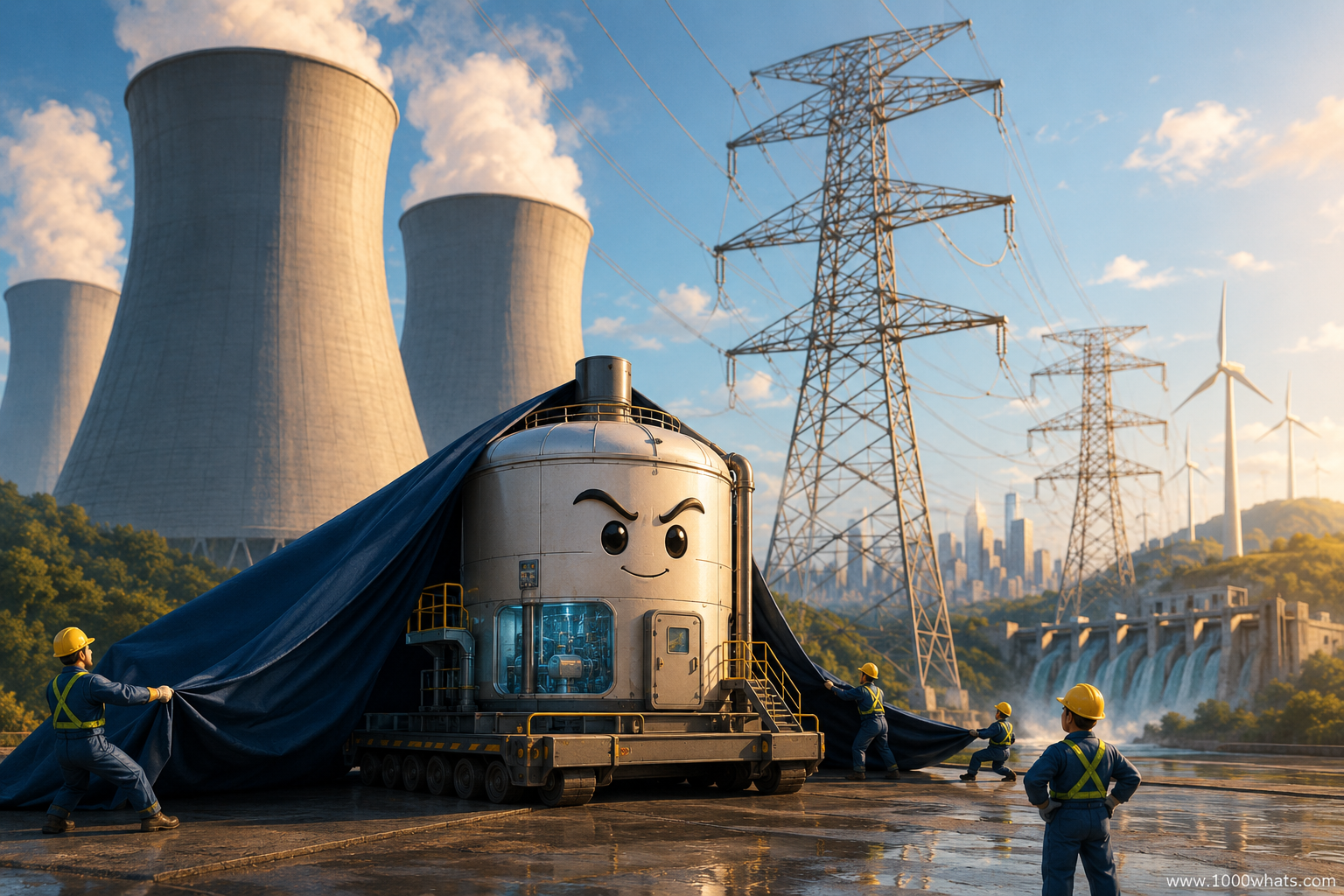
Here’s the funny part: for decades, nuclear power kept acting like bigger was always better.
Bigger reactor. Bigger site. Bigger bill. Bigger headache.
Now the industry has looked in the mirror and gone, “What if… less?” And that, more or less, is where the small modular reactor comes in.
Instead of building one colossal nuclear plant the size of a concrete kingdom, the idea is to build something smaller, simpler, and more repeatable. Think less cathedral, more kit car. Less “once-in-a-generation mega-project,” more “let’s build the same thing well, several times.” That’s the sales pitch, anyway.
Welcome to 1000whats — where I crack open energy terms without causing a meltdown.
What is a small modular reactor (SMR)?
A small modular reactor (SMR) is a nuclear reactor that usually produces up to 300 megawatts of electricity per unit, much less than a traditional large reactor, which is often around 1,000 MWe or more.
The “small” part is about output and physical size.
The “modular” part means major pieces can be built in factories and shipped to the site for assembly.
That last bit matters more than it sounds.
A normal large reactor is like deciding to build a cruise ship in your backyard, during winter, with paperwork. An SMR is supposed to be more like building standardized chunks in a factory, then snapping them together on site without the usual circus. In practice, that standardization is the whole dream: better quality control, shorter construction, and lower upfront cost. Whether the dream behaves itself in the real world is a separate question.
⚡ “An SMR is basically nuclear power trying to learn from Lego instead of cathedrals.”
Why do SMRs exist?
Because the old model is brutal.
Large nuclear plants can deliver huge amounts of low-carbon power, but they also demand enormous capital, long build times, highly specific sites, and a grid big enough to swallow all that electricity without choking. SMRs are being pushed as a way to make nuclear fit places where giant reactors do not: smaller grids, remote communities, industrial sites, aging fossil-fuel locations, and multi-unit phased buildouts.
From a market perspective, this is the key move. You are not just selling electricity. You are selling optional nuclear.
Need 300 MW instead of 1,400 MW? Fine.
Need process heat for industry? Also fine.
Need power plus desalination? Weird, but yes.
Need something that can sit where a giant plant would be absurd? That is exactly the lane SMRs are trying to drive in. The U.S. Department of Energy says advanced SMRs may be used not just for electricity, but also for process heat, desalination, and other industrial uses, and some designs use light water while others use gas, molten salt, or liquid metal coolants.
How does a small modular reactor work?
At the physics level, SMRs are not wizardry. They still use nuclear fission.
You split heavy atoms, release heat, boil water or heat another working fluid, spin a turbine, and make electricity. The trick is not the basic science. The trick is the engineering package around it.
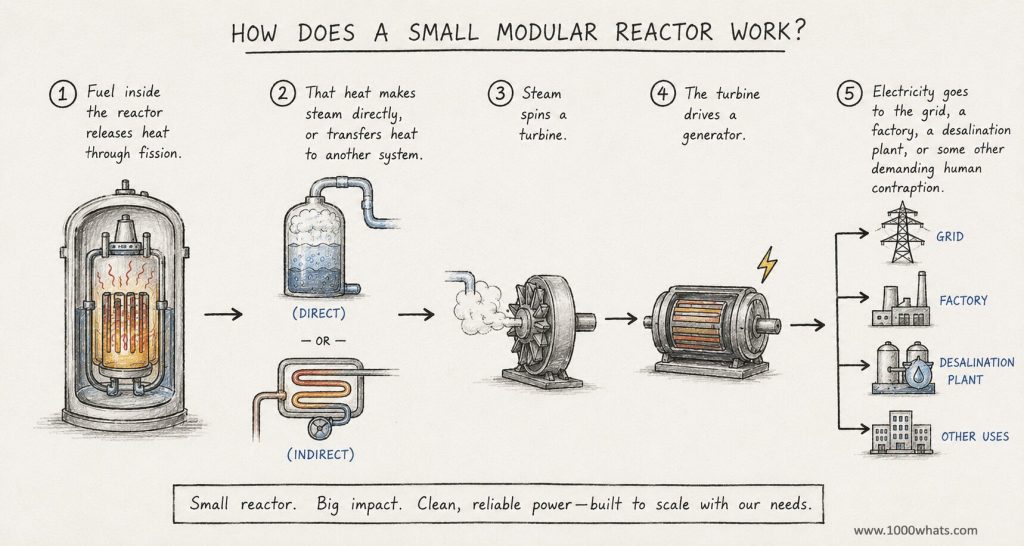
Here’s the simple version:
- Fuel inside the reactor releases heat through fission
- That heat makes steam directly, or transfers heat to another system
- Steam spins a turbine
- The turbine drives a generator
- Electricity goes to the grid, a factory, a desalination plant, or some other demanding human contraption
What most people don’t see is that SMR designs are not all the same animal wearing different hats.
Some are basically smaller light-water reactors, which feel like cousins of today’s commercial nuclear plants. Others are far more adventurous: high-temperature gas-cooled reactors, molten salt designs, or liquid-metal-cooled reactors. So when people say “SMR,” they are naming a category, not one machine.
And yes, safety is a huge part of the pitch. Many SMR concepts lean on passive safety features, meaning they are designed so cooling and shutdown functions can happen through natural forces like gravity, convection, and pressure differences, not just pumps, operator heroics, and crossed fingers.
⚡ “The clever part of an SMR isn’t that it breaks physics. It’s that it tries to make physics do more of the babysitting.”
Why “modular” is the magic word
Because nuclear’s historic weakness has not been the reactor’s brain. It has been the construction site.
Factory fabrication is attractive for the same reason you would rather buy a car from a factory than assemble one in a muddy field while accountants scream nearby. Controlled environments can improve consistency. Repeating the same design can, in theory, cut delays and reduce cost. DOE and the IAEA both point to lower initial capital investment, incremental deployment, and factory-built modules as major SMR advantages.
But there’s a catch, because of course there is.
The economic case depends heavily on actually building enough units to get the factory-learning effect. One small reactor built once is not automatically cheap. The IAEA has been pretty plain about this: SMRs may have lower upfront capital cost per unit, but their full economic competitiveness still has to be proven in practice.
That is a polite nuclear-industry way of saying: “The spreadsheet looks nice. Reality has not signed yet.”
Real-world SMR examples
Let’s leave the brochure and look at actual stuff.
1. Akademik Lomonosov, Russia
This floating nuclear plant is one of the most famous real-world SMR examples. It showed that a small reactor can be deployed in unusual settings, especially where geography laughs at normal infrastructure. The IAEA’s 2024 SMR update says SMR units are already deployed in China and the Russian Federation.
2. HTR-PM, China
China’s HTR-PM entered commercial operation in December 2023, according to the IAEA. It is a high-temperature gas-cooled design, which is interesting because it shows SMRs are not just tiny copies of today’s standard reactors. World Nuclear Association describes the Shidaowan HTR-PM as two small reactors driving a single 210 MWe steam turbine.
3. BWRX-300 at Darlington, Canada
This is one of the most watched Western SMR projects. World Nuclear Association says Ontario approved construction of the first 300 MWe BWRX-300 at Darlington in May 2025, and that by March 2026 regulators had cleared the start of civil construction, with first operation expected in 2030.
These examples matter because they separate SMRs into three buckets:
- Already operating
- Actually under construction
- Still mostly PowerPoint with excellent branding
And that distinction is doing a lot of work.
What are the advantages of small modular reactors?
Let’s be fair. The excitement is not fake.
Why people like SMRs:
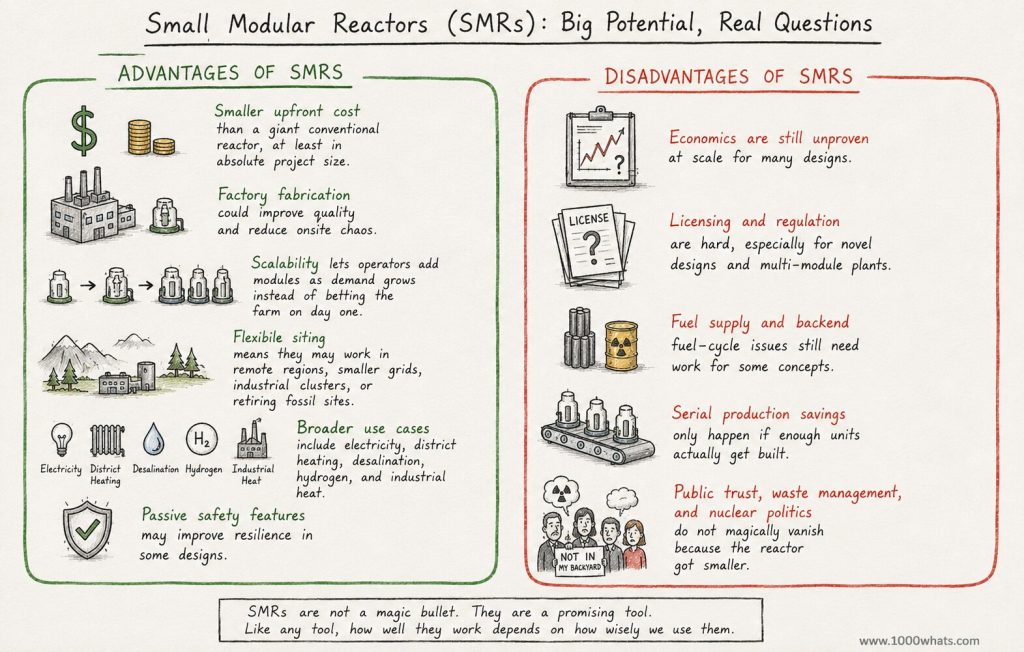
- Smaller upfront cost than a giant conventional reactor, at least in absolute project size
- Factory fabrication could improve quality and reduce onsite chaos
- Scalability lets operators add modules as demand grows instead of betting the farm on day one
- Flexible siting means they may work in remote regions, smaller grids, industrial clusters, or retiring fossil sites
- Broader use cases include electricity, district heating, desalination, hydrogen, and industrial heat
- Passive safety features may improve resilience in some designs
In practice, the most interesting thing about SMRs is not that they are small. It is that they could make nuclear more flexible.
That word sounds boring. It is not boring. Flexibility is the whole game in modern energy systems. A giant plant is useful. A plant that can fit a smaller grid, support an industrial site, pair with renewables, or replace an old coal unit without demanding an empire-sized project? That gets attention.
What are the disadvantages of SMRs?
Now for the part the hype deck tries to scoot past.
The problems are real:
- Economics are still unproven at scale for many designs
- Licensing and regulation are hard, especially for novel designs and multi-module plants
- Fuel supply and backend fuel-cycle issues still need work for some concepts
- Serial production savings only happen if enough units actually get built
- Public trust, waste management, and nuclear politics do not magically vanish because the reactor got smaller
Here’s the mischievous truth: an SMR is not “cheap nuclear.” It is a bet that nuclear can become repeatable enough to get cheaper.
That is a very different sentence.
And it means the first few projects may still be expensive, awkward, delayed, and politically messy. New energy tech has a bad habit of arriving with a TED Talk before it arrives with a timetable.
⚡ “SMRs may be small, but their biggest problem is still the same old giant: cost.”
Why small modular reactors matter today
Because the grid is getting stranger.
We need more low-carbon electricity. We also need reliable power for industry, remote areas, and infrastructure that does not appreciate blackouts. At the same time, plenty of countries have grids too small for huge conventional reactors, while others want replacements for aging coal plants without building another fossil lock-in machine. The IAEA says global interest in SMRs is rising partly because they can help with flexible power generation, replacing aging fossil-fired units, smaller grids, remote sites, and industrial decarbonization.
There is also a newer twist: big tech and data centers.
The IAEA’s 2024 SMR publication notes that technology companies are already making deals with SMR developers as they search for cleaner power for increasingly energy-hungry data centers. That does not mean the SMR boom has arrived. It does mean the demand story is broadening beyond the old utility playbook.
So why does this matter now?
Because SMRs sit right in the middle of today’s energy argument:
- We want clean power
- We want reliable power
- We want it faster
- We want it without bankrupting ourselves
- We would also like the laws of finance and physics to cooperate for once
That last request remains under review.
Simple example: the factory-town use case
Imagine a steel plant in a region with a modest grid.
A giant conventional reactor is overkill. Gas is familiar but dirty. Wind and solar are helpful but may not cover constant high-temperature industrial demand on their own. An SMR could, in theory, provide steady electricity plus useful heat, close to the site, without needing a monster transmission buildout. That is exactly why policymakers keep bringing SMRs into conversations about industrial decarbonization.
This is where the idea stops being abstract.
An SMR is not really “a smaller nuclear plant.” It is more like a nuclear tool built for awkward jobs that big plants and weather-dependent systems do not always solve neatly by themselves.
Final thoughts
Small modular reactors are fascinating because they are not trying to invent a new sun. They are trying to make nuclear power less gigantic, less bespoke, and maybe a little less financially terrifying.
That is smart.
It is also not guaranteed.
My take? SMRs are worth taking seriously, but not worshipping. The technology is promising. The use cases are real. The need for firm low-carbon power is obvious. Still, the only thing more dangerous than blind anti-nuclear panic is blind pro-nuclear cheerleading. Build a few. Watch the numbers. Learn from the mess. Then decide whether the revolution is real or just wearing a hard hat.
Got a favorite SMR design? Think they’re the future, or just nuclear’s latest rebrand with better packaging?
Drop your take.
Until next time, stay curious! 😎
Discover more from 1000whats
Subscribe to get the latest posts sent to your email.