Do you know what powers stars?
Not “fire,” at least not the ordinary kind. No logs. No oxygen. No matchstick the size of Jupiter.
A star does something much stranger.
It takes the smallest little nuclei — mostly hydrogen — bangs them together under such ridiculous conditions that they merge, and out comes energy. Mountains of it. Oceans of it. Enough to light the sky, warm the Earth, and make life possible for every squirrel, oak tree, and overconfident beachgoer.
That trick is called nuclear fusion.
People have talked about fusion for so long that it started to sound like one of those inventions that’s always “coming soon,” like jetpacks or honest airline seat sizes. Yet now the story is getting more interesting. The science is no longer the embarrassing part. The engineering is.
That’s a big change.
⚡ “Fusion is no longer a fairy tale. It’s a very expensive engineering problem.”
Welcome to 1000whats — where energy terms become simple enough to explain over coffee.
What is nuclear fusion?
Here’s the plain-English version.
Nuclear fusion is when two light atomic nuclei crash together, stick, and release energy.
That’s it.
Stars do this all day, which is a pretty decent recommendation. On Earth, the usual fuel choice is deuterium and tritium, two forms of hydrogen, because they fuse more easily than the other options engineers have on the menu.
Now, why does that release energy?
Because nature is sneaky. The fused nucleus weighs a tiny bit less than the two original nuclei put together, and that missing mass comes out as energy. Einstein gave us the bookkeeping rule for this with E = mc². Tiny mass. Huge payoff.
A simple way to picture it: imagine two little steel balls that hate each other electrically. You shove them together anyway. If you push hard enough to get them absurdly close, the strong nuclear force suddenly takes over and says, “Fine, now you two stick.” When that happens, energy comes flying out.
That’s fusion.
Why does fusion exist at all?
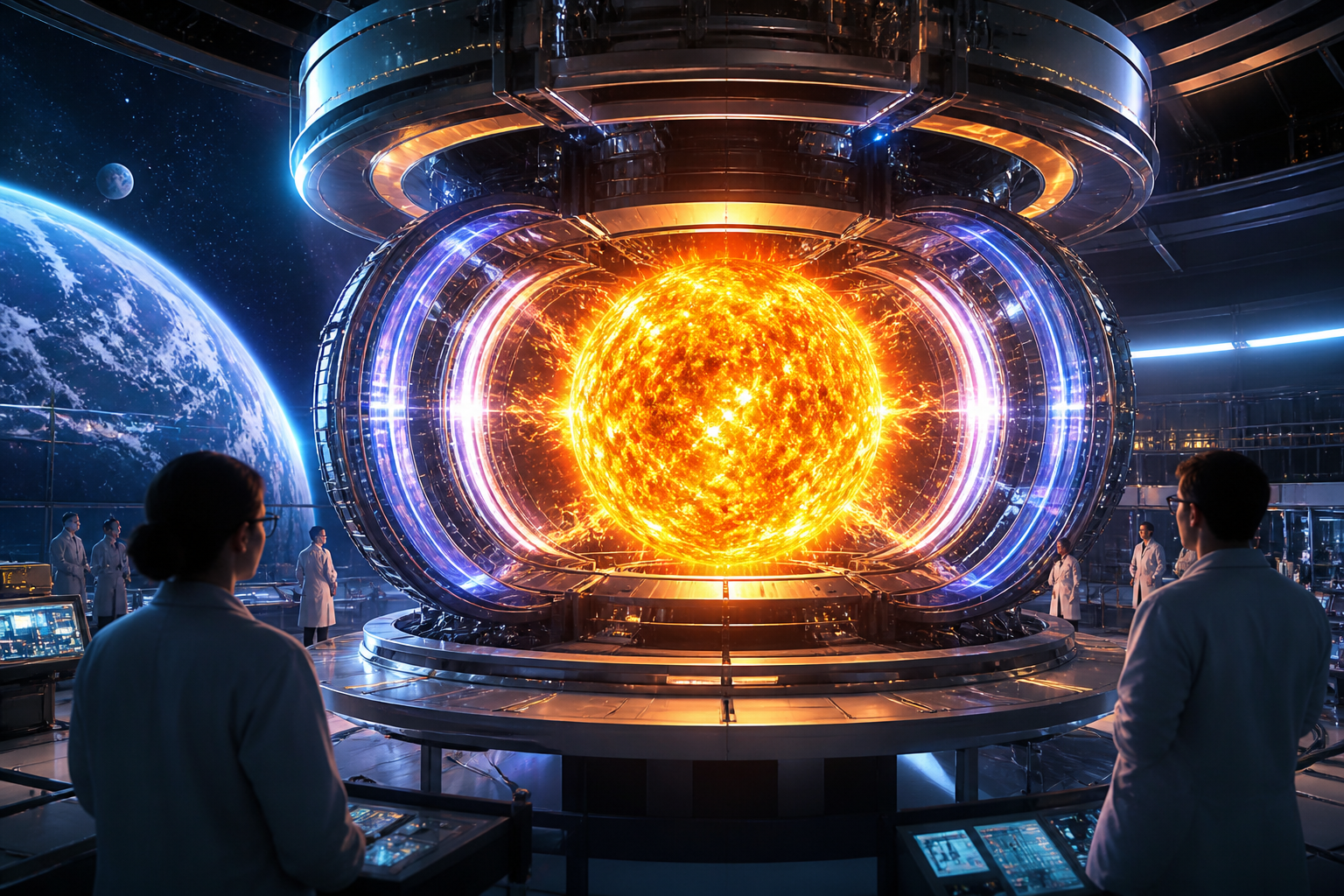
In a star, gravity does the squeezing.
Down here, we don’t have a spare star-sized gravitational field lying around, so we cheat. We heat fuel to over 100 million degrees Celsius, turning it into a plasma, and then we try to keep that plasma hot, dense enough, and confined long enough for fusion reactions to happen faster than the whole thing falls apart. Those are basically the three conditions: heat it, crowd it, hold it.
Scientists usually chase fusion in two big ways:
- Magnetic confinement, where magnets hold a superhot plasma in a donut-shaped machine called a tokamak or in a twisted machine called a stellarator.
- Inertial confinement, where powerful lasers blast a tiny fuel capsule so fast and so hard that it implodes and fuses before it can blow apart. That’s the basic idea behind the National Ignition Facility, or NIF.
Think of magnetic fusion as trying to hold jelly with invisible rubber bands.
Think of laser fusion as punching a peppercorn from every side at once and hoping it briefly becomes a star.
Both approaches are gloriously unreasonable. That’s why they’re interesting.
⚡ “The miracle is not that fusion is hard. The miracle is that the laws of physics allow it at all.”
How does nuclear fusion work, simply?
Let’s do this with almost no jargon.
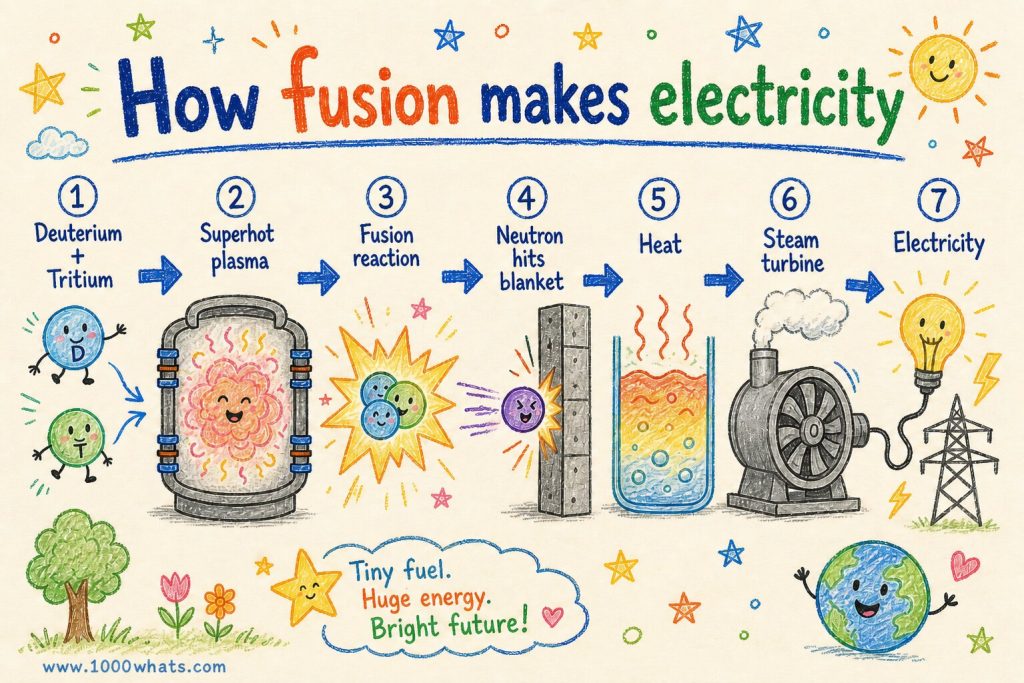
- Start with hydrogen fuel
Deuterium and tritium are the usual pair because they fuse at lower temperatures than other practical choices and give off a lot of energy. Deuterium is plentiful in water; tritium is rarer and future plants are expected to breed it from lithium. - Heat it until atoms fall apart
At extreme temperatures, electrons separate from nuclei and you get a plasma. This is not an ordinary gas. It’s a charged, twitchy, difficult beast. - Force collisions
The nuclei need enough energy to overcome their electrical repulsion, sometimes called the Coulomb barrier. - Catch the energy
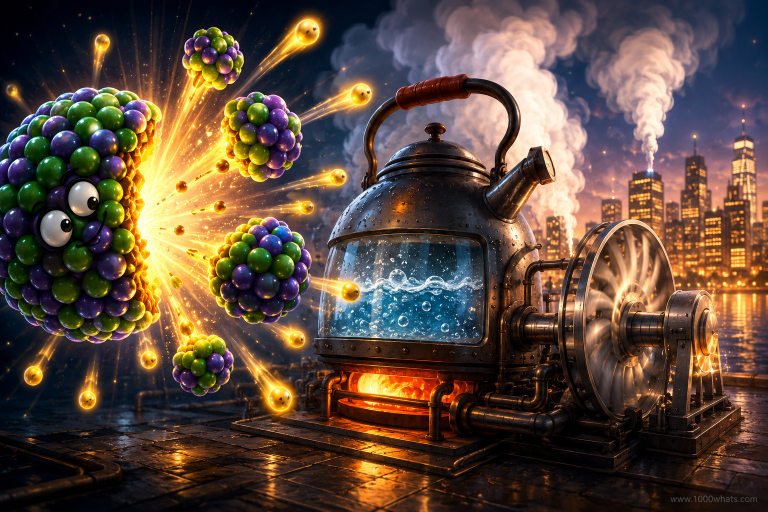
In the deuterium-tritium reaction, you get helium plus a fast neutron. The neutron shoots out, slams into surrounding material, and its energy becomes heat. In a future power plant, that heat would make steam and spin a turbine.
That last bit matters.
Fusion doesn’t give you electricity straight out of the plasma like some magical glowing battery. It still has to become heat, then steam, then turbine motion, then electricity, just like many ordinary power plants.
Why is fusion so hard?
Because the universe is not handing out stars in a box.
Here’s what most people don’t see:
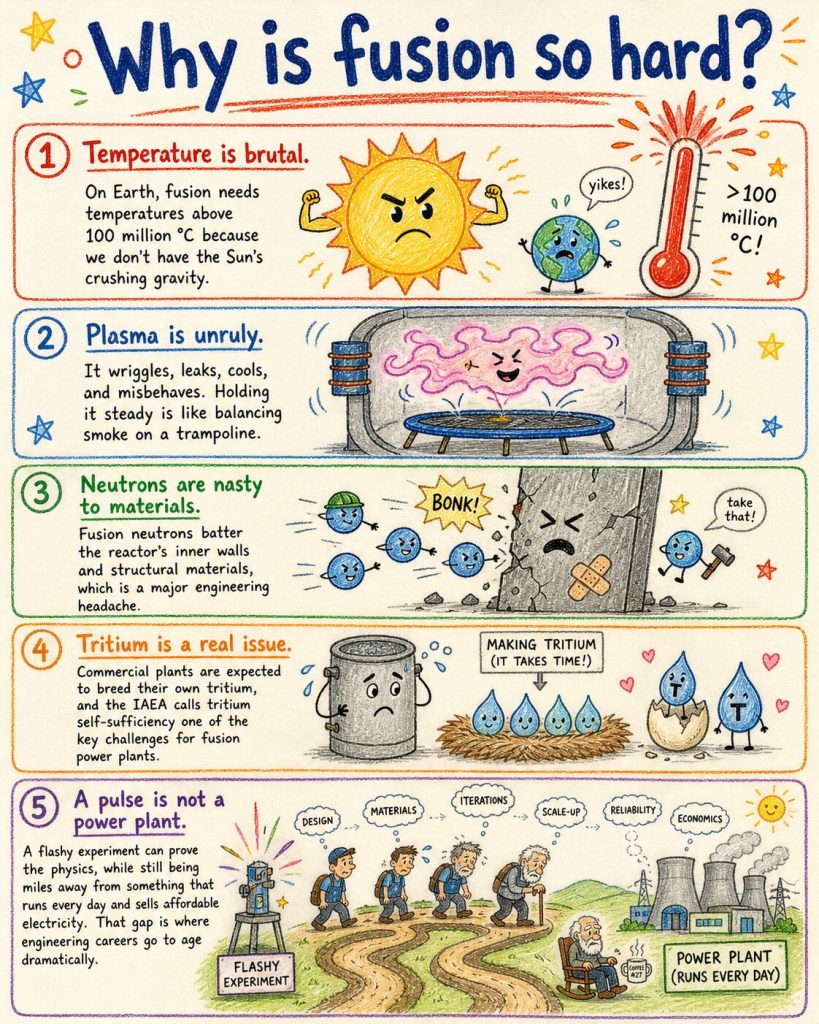
- Temperature is brutal. On Earth, fusion needs temperatures above 100 million °C because we don’t have the Sun’s crushing gravity.
- Plasma is unruly. It wriggles, leaks, cools, and misbehaves. Holding it steady is like balancing smoke on a trampoline.
- Neutrons are nasty to materials. Fusion neutrons batter the reactor’s inner walls and structural materials, which is a major engineering headache.
- Tritium is a real issue. Commercial plants are expected to breed their own tritium, and the IAEA calls tritium self-sufficiency one of the key challenges for fusion power plants.
- A pulse is not a power plant. A flashy experiment can prove the physics, while still being miles away from something that runs every day and sells affordable electricity. That gap is where engineering careers go to age dramatically.
From a market perspective, this is the heart of the matter: fusion has moved from “Can the physics work?” toward “Can the machine work every day, for years, at a tolerable cost?” That is a very different question.
Are we finally close?
Yes and no.
That sounds slippery, but it’s the honest answer.
We are close to proving some really big things in the lab
At Lawrence Livermore’s National Ignition Facility, researchers first achieved fusion ignition in late 2022. Since then, NIF has repeated ignition multiple times. In April 2025, one experiment put 2.08 megajoules of laser energy onto the target and got 8.6 megajoules of fusion yield out, the lab’s best target result so far. That is a genuine milestone.
A tokamak example tells a different but equally important story. Europe’s JET facility set a world record of 69 megajoules of fusion energy in sustained, controlled experiments announced in 2024. That matters because it gives scientists confidence that larger magnetic systems can behave in more reactor-relevant ways.
We are not close to plugging cheap fusion into every neighborhood
NIF’s record is target gain, not “the whole facility became a power station.” LLNL materials note that NIF uses hundreds of megajoules of stored electrical energy to create a shot delivering a few megajoules of laser energy to the target. So the experiment proves crucial physics, but it is not a ready-made blueprint for a commercial electric plant. That’s an inference from the official numbers, and it’s an important one.
ITER, the giant international tokamak under construction in France, is even more revealing. Its updated baseline was approved in 2024, with cryostat closure targeted for 2033, deuterium-deuterium operation for 2035, and the start of deuterium-tritium operation for 2039. Also, ITER will not produce electricity; it is meant to demonstrate burning plasma and key reactor-scale technologies, not to run your toaster.
So if by “close” you mean:
- Close to undeniable scientific progress? Yes. Absolutely.
- Close to serious pilot plants in the 2030s? Plausibly, yes, and that is exactly why governments and investors are leaning in.
- Close to fusion becoming normal grid power this decade? No. That is still too rosy.
⚡ “Fusion is close the way the summit is close when you’ve finally reached the mountain.”
Real-world examples: what “close” looks like in practice
1) NIF: the laser route
NIF has shown that fusion ignition can be achieved and repeated in the laboratory. That is the “the physics is not fantasy” proof. It is a huge deal. Still, NIF is not an electricity-generating plant. It is a scientific facility.
2) ITER: the giant magnet route
ITER’s job is to create a burning plasma at reactor scale and test technologies future plants will need. It aims for 500 MW of fusion power from 50 MW of plasma-heating input, which is the famous Q = 10 goal. Yet even here, no electricity goes to the grid. ITER is the bridge, not the destination.
3) The startup surge
Private fusion is no longer a science-fiction side hustle. The IAEA says global private fusion investment has surpassed $10 billion. Commonwealth Fusion Systems says its SPARC demonstration machine is expected to operate in 2027, and Reuters reported today that the company plans to begin construction on a commercial plant in Virginia by 2027, with commercial ambitions in the early 2030s. Those are company and industry targets, not finished facts, but they show how seriously the field is now being treated.
Pros and cons of nuclear fusion
The upside
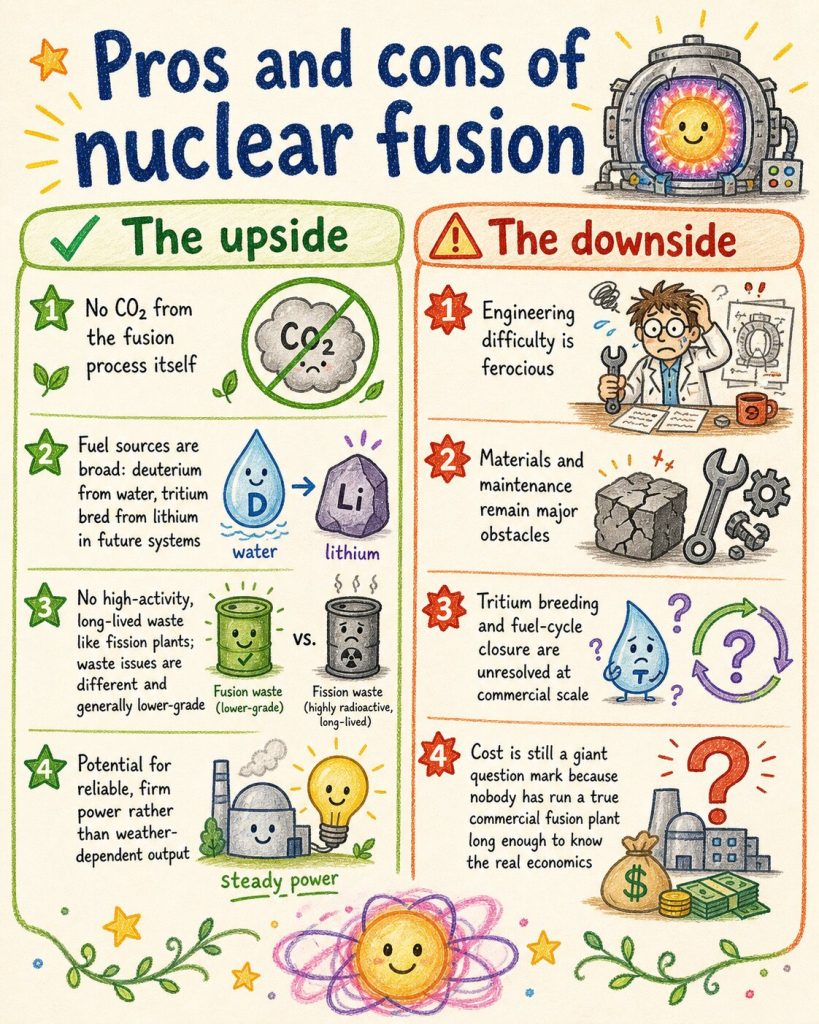
- No CO₂ from the fusion process itself
- Fuel sources are broad: deuterium from water, tritium bred from lithium in future systems
- No high-activity, long-lived waste like fission plants; waste issues are different and generally lower-grade
- Potential for reliable, firm power rather than weather-dependent output
The downside
- Engineering difficulty is ferocious
- Materials and maintenance remain major obstacles
- Tritium breeding and fuel-cycle closure are unresolved at commercial scale
- Cost is still a giant question mark because nobody has run a true commercial fusion plant long enough to know the real economics
Why fusion matters today
Because the energy world has a nasty problem: we don’t just need clean power, we need a lot of it, and not only when the sun cooperates or the wind feels generous.
Fusion matters because it promises something rare: firm, low-carbon power with tiny fuel amounts and no smokestack. That promise is why governments are publishing fusion strategies, why the IAEA is tracking the sector more aggressively, and why investors keep writing checks even though the machines are not yet paying customers back.
In practice, fusion also matters because it sharpens everything around it. To chase fusion, you improve superconducting magnets, plasma control, high-heat materials, fuel-cycle engineering, robotics, diagnostics, and regulation. Even before it becomes a power source, it becomes an innovation engine.
Final thoughts
So, what is nuclear fusion?
It’s the attempt to run a star trick here on Earth without borrowing the star.
And are we finally close?
Closer than we’ve ever been, yes. Close enough to declare victory, no. The science has crossed a psychological border. The engineering still has to cross a mountain range. Anyone telling you fusion is fake hasn’t looked lately. Anyone telling you it’s basically done is selling theater tickets.
That, to me, is what makes fusion so fascinating. It’s not magic. It’s not fraud. It’s a real machine problem at the edge of human skill, which is exactly the sort of problem people are dumb enough and brilliant enough to eventually solve.
What do you think: breakthrough in the 2030s, or still another long detour?
Until next time, stay curious! 😎
Discover more from 1000whats
Subscribe to get the latest posts sent to your email.