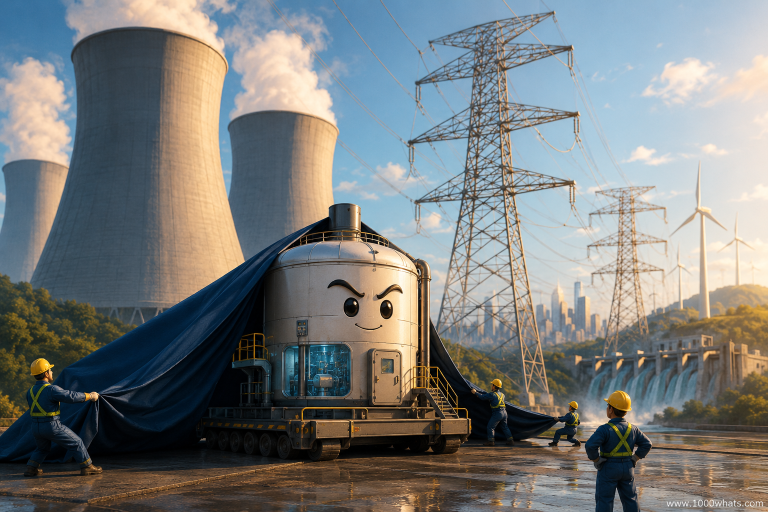
Most people think nuclear energy must be terribly complicated, because the people explaining it often look terribly pleased with themselves.
But the central idea is not complicated at all.
In fact, the odd part is how simple it is.
You take matter. Not a lot of matter, just a little. Then you poke at the center of the atom in the right way, and out comes an absurd amount of energy. That energy turns into heat, the heat boils water, the steam spins a turbine, and now your toaster is working because something happened deep inside uranium.
That’s a ridiculous story.
It also happens to be true.
Nuclear energy has this strange reputation for being mysterious, almost magical. Yet the real thing is more interesting than magic, because it actually makes sense once you stop wrapping it in ceremonial language.
So let’s strip it down and look at the machine without the costume.
Welcome to 1000whats, where curiosity runs the show.
What is nuclear energy?
Nuclear energy is energy stored in the nucleus of an atom.
That’s it.
An atom has a center called the nucleus. You can think of that center as a cramped little bundle of particles held together under peculiar conditions. In some atoms, especially big heavy ones like uranium, that bundle is a bit unstable.
Not unstable in the sense that it explodes because you looked at it wrong. More like unstable in the sense that nature would be happier if it were arranged differently.
So when the nucleus splits, or in other cases joins with another nucleus, energy can be released.
That released energy is what we call nuclear energy.
⚡ “The atom looks peaceful from the outside, but the nucleus is where nature hides the good stuff.”
Why does nuclear energy exist?
Because nature allows it.
That may sound like a wise-guy answer, but it’s the right one.
Human beings did not invent nuclear energy any more than they invented waterfalls. People discovered that certain atomic nuclei store enormous amounts of energy, and then figured out ways to release some of it usefully.
The practical reason we care is obvious enough: a very small amount of nuclear fuel can produce a very large amount of energy.
That gets attention.
Burn a log, and you get heat from chemical bonds. Split certain atoms, and you get heat from the nucleus itself. Those are two very different levels of the game.
One is like collecting coins from a piggy bank.
The other is like discovering the house has a vault in the basement.
How does nuclear energy work?
Now we come to the part that frightens people mostly because of the vocabulary.
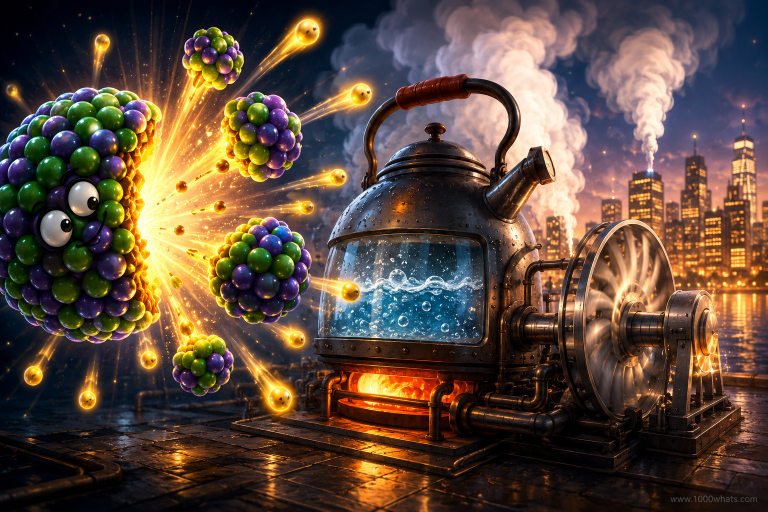
The main process used in nuclear power plants is called fission.
Fission simply means splitting a heavy atom.
Usually, the atom is uranium.
Here’s the basic idea:
- A neutron hits the nucleus of a uranium atom.
- The nucleus becomes unstable.
- It splits into smaller pieces.
- Energy is released as heat.
- More neutrons fly out.
- Those neutrons can split other uranium atoms.
That last part matters, because it creates a chain reaction.
The phrase sounds dramatic, and that’s unfortunate, because it makes people imagine a lunatic machine running wild. In a nuclear power plant, the whole trick is to keep the reaction under control.
Think of it like fire.
A fire in a stove is useful.
A fire in your curtains is not.
Same phenomenon. Different level of control.
A nuclear power plant, explained simply
Once the fission happens, the rest is almost boring.
And I mean that as praise.
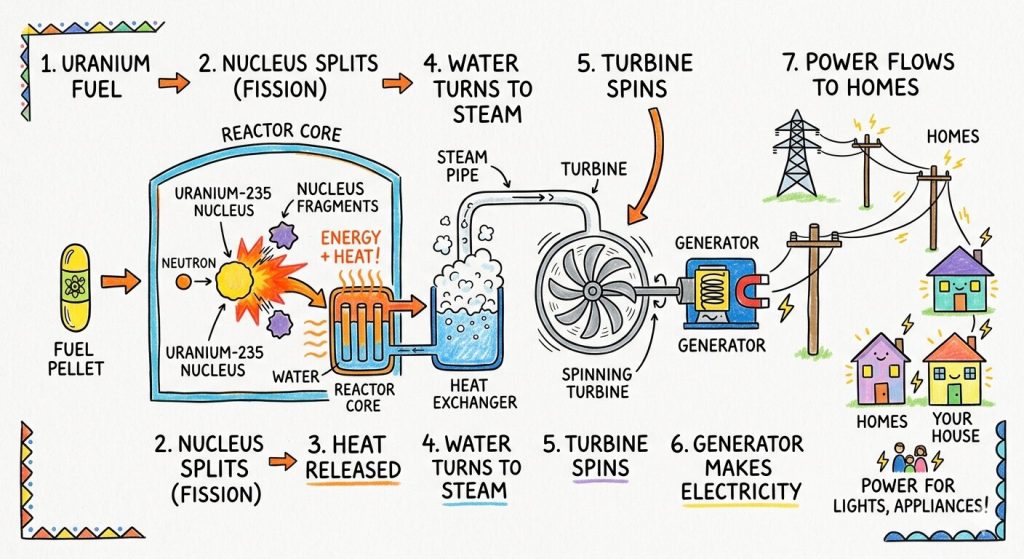
A nuclear power plant usually works like this:
- uranium fuel releases heat through fission
- that heat warms water
- the water makes steam
- the steam spins a turbine
- the turbine turns a generator
- the generator makes electricity
So after all the exotic atomic business, the plant ends up doing something very old-fashioned.
It boils water.
That surprises people. They expect lasers, glowing spheres, maybe a chamber with ominous humming. Instead, much of the plant is a glorified steam system attached to some very serious engineering.
⚡ “Nuclear power is astonishing at the atomic level and strangely ordinary at the mechanical level.”
Where does the energy actually come from?
This is the question worth asking.
You are told that energy comes out when the nucleus splits. Fine. Why?
Because the pieces after the split have slightly less mass than the original setup.
Not a lot less. Just a tiny amount.
That tiny amount of missing mass shows up as energy.
This is where Einstein enters the story, looking annoyingly correct.
Mass and energy are related. Under the right conditions, a small amount of mass corresponds to a very large amount of energy. That is why nuclear energy is so powerful. You are not dealing with the usual chemical rearrangements. You are dipping into the energy bound up in the structure of the nucleus itself.
What most people don’t see is that the fuel is not “creating” energy from nothing. The energy was already there, stored in how the nucleus was put together.
The reaction just opens the box.
Real-world examples of nuclear energy
People hear “nuclear” and often think only of giant power stations. Those matter, of course, but they’re not the whole story.
Here are some real-world uses:
- Electricity generation: Nuclear plants supply steady power to homes, businesses, and industry.
- Submarines and aircraft carriers: Some naval vessels use nuclear reactors because they can operate for very long periods without refueling.
- Medicine: Nuclear science is used in imaging, diagnosis, and cancer treatment.
- Research: Reactors and radioactive materials help scientists study materials, biology, and physics.
The most familiar example is still electricity.
You flick on a light switch, and somewhere far away a turbine may be spinning because heat came from atomic nuclei splitting in a controlled reactor.
That’s the whole miracle, reduced to something you barely notice while looking for your coffee mug.
What are the main types of nuclear energy?
There are really two big categories people talk about.
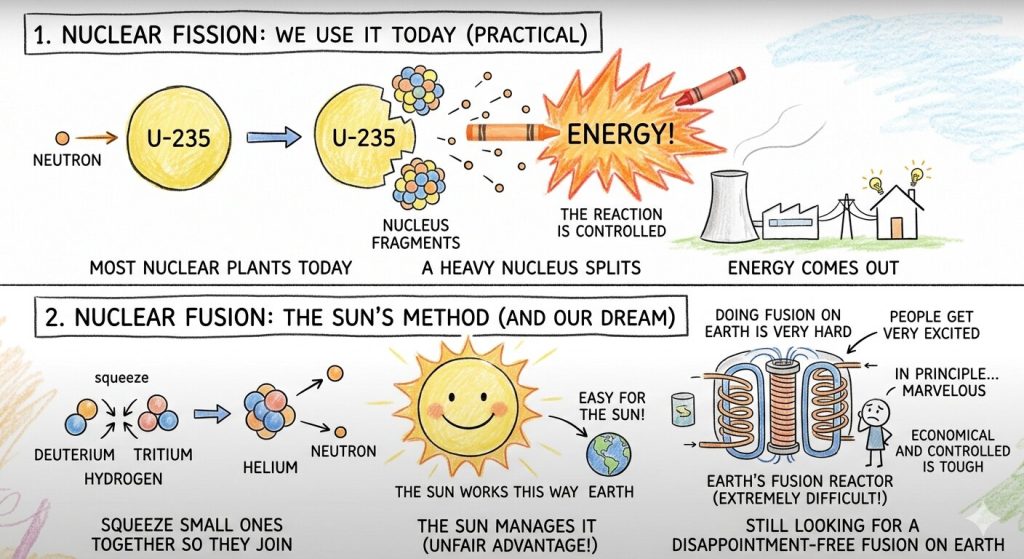
1. Nuclear fission
This is the one we actually use in most nuclear power plants today.
A heavy nucleus splits.
Energy comes out.
The reaction is controlled.
That’s the practical business.
2. Nuclear fusion
Fusion is different.
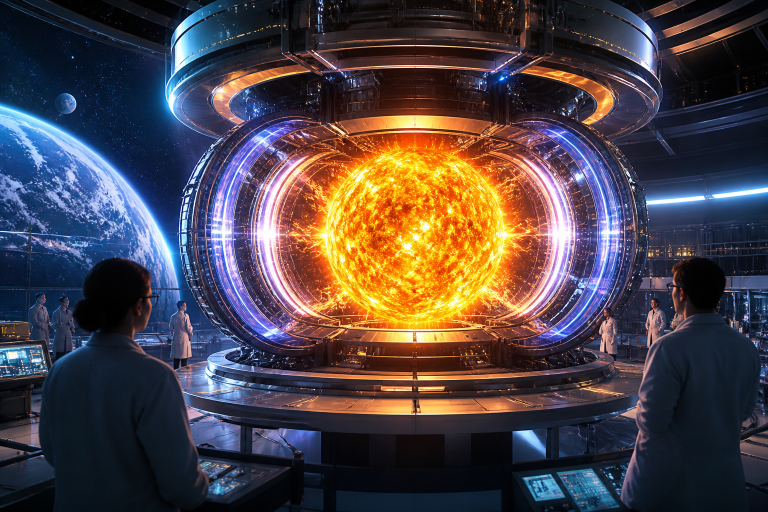
Instead of splitting big atoms, you squeeze small ones together so they join.
That’s how the Sun works.
People get very excited about fusion because, in principle, it could be a marvelous energy source. Unfortunately, the phrase “in principle” has caused a great many disappointments in science and engineering. Doing fusion on Earth in a controlled, economical way is extremely difficult.
The Sun manages it quite nicely because it is the Sun.
That is an unfair advantage.
Pros of nuclear energy
Nuclear energy has real strengths, which is why it refuses to leave the conversation.
Here are the big ones:
- Huge energy density
A little fuel can go a long way. - Reliable output
Nuclear plants can run day and night. - Low direct carbon emissions during operation
That makes nuclear attractive in a world trying to cut emissions. - Strong grid support
Large plants can provide steady electricity for cities and industry. - Fuel efficiency
You do not need endless mountains of fuel arriving every day.
From a market perspective, that steady output is a serious advantage. Wind and solar are valuable, but they depend on weather. Nuclear gives you firm power, and grids like firm power very much.
Cons of nuclear energy
Now the difficulties.
And there are difficulties.
- Radioactive waste
Some of the byproducts remain hazardous for a long time and must be managed carefully. - High construction costs
Nuclear plants are expensive to build. - Long project timelines
You do not decide on Tuesday and open the plant by Christmas. - Accident risk
Serious accidents are rare, but when they happen, they shape public memory for decades. - Security and regulation
Nuclear systems require extraordinary discipline, oversight, and engineering care.
What most people don’t see is that nuclear energy is not defeated mainly by physics. Physics is hard, yes, but physics is at least honest. The deeper problem is social: cost, trust, politics, regulation, and whether institutions can reliably do complicated things without getting sloppy.
That is a much scarier question than splitting atoms.
⚡ “The nucleus is difficult. Human beings are often more difficult.”
Is nuclear energy renewable?
Not usually, no.
Nuclear energy is often called clean or low-carbon, but it is generally not classified as renewable in the same way solar, wind, or hydropower are.
Why?
Because it relies on mined fuels like uranium, and those are finite.
So if someone says nuclear is renewable, they are usually blurring categories. It may be low-carbon in operation, but that is not the same thing as renewable.
Why does nuclear energy matter today?
Because modern civilization is greedy.
It wants electricity all the time.
Society also wants cleaner air, lower emissions, stable grids, electric vehicles, data centers, factories, trains, air conditioning, heating, and probably a hundred other things all humming along at once.
That is a tall order.
Renewables are growing fast, and rightly so. Storage matters too. Better grids matter. Efficiency matters. Everything matters. But nuclear remains in the discussion because it offers something many systems need: large-scale, steady electricity without burning fossil fuels during operation.
In practice, energy systems are built from trade-offs, not slogans.
No serious engineer gets to say, “I like this one source, so let’s use only that.” Real systems are mixtures. They balance cost, reliability, emissions, geography, politics, fuel availability, and public tolerance.
That’s why nuclear still matters.
Not because it is perfect.
Because the problem is difficult.
A simple way to explain nuclear energy to a kid
Here’s the plainest version:
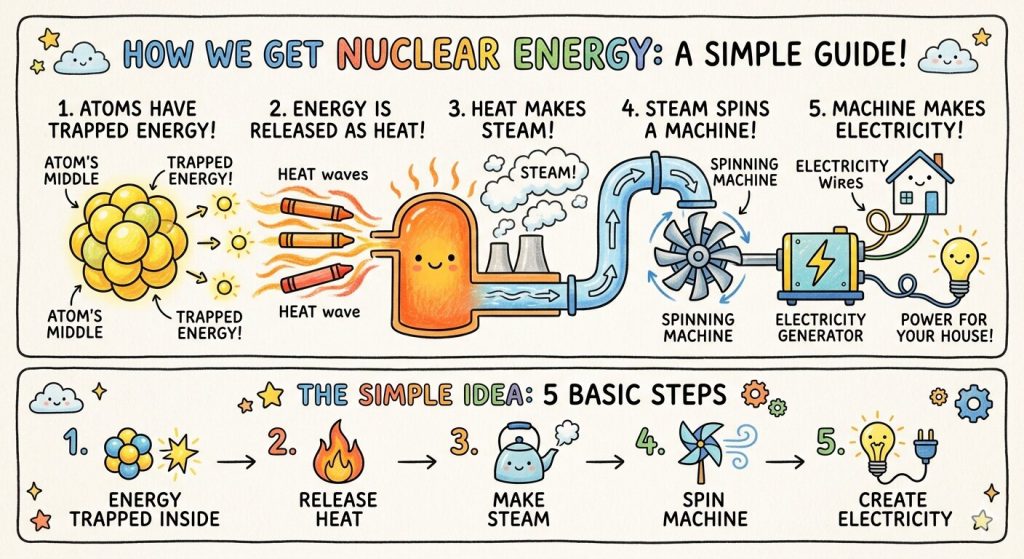
Nuclear energy is the energy trapped inside the middle of atoms.
Scientists can release some of that energy as heat.
That heat makes steam.
Steam spins a machine.
The machine makes electricity.
That is not a childish explanation.
It is the explanation.
Final thoughts
Nuclear energy is one of those subjects that reveals something funny about people. 😉
Many are comfortable using it.
Fewer are comfortable understanding it.
The truth is that nuclear energy is neither a miracle cure nor a doomsday machine. It is a tool — an astonishing one — with unusual strengths and very real complications. Used well, it can provide enormous amounts of electricity with low operational carbon emissions. Used badly, or managed carelessly, it becomes a long and expensive lesson in human overconfidence.
My own view is simple: nuclear energy deserves neither blind worship nor reflexive fear. It deserves clear thinking.
That means looking at the physics honestly, the risks honestly, the costs honestly, and the alternatives honestly too.
Because nature does not care what story we prefer. It only cares whether we understand the rules.
What do you think — is nuclear energy an essential part of the future, or a technology with too much baggage?
Until next time, stay curious!
Discover more from 1000whats
Subscribe to get the latest posts sent to your email.