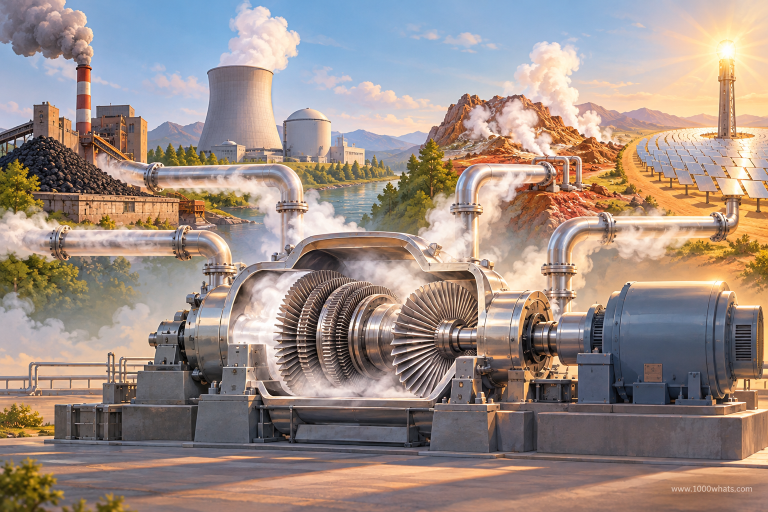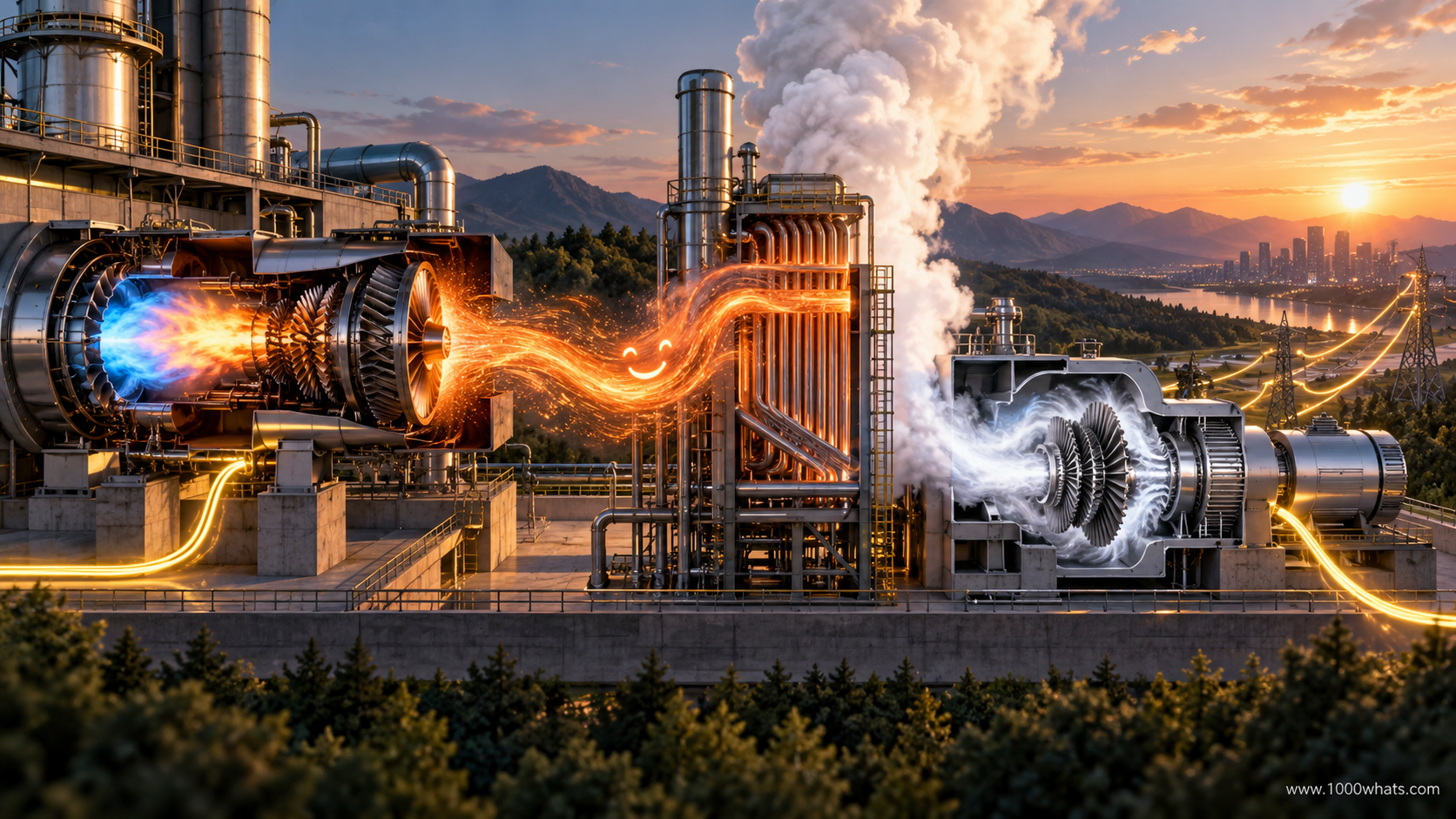
Imagine buying natural gas, burning it in a power plant, spinning a turbine, making electricity…
…and then noticing that the exhaust leaving the turbine is still extremely hot.
You have two choices.
Choice A:
throw the heat away.
Choice B:
look at several hundred degrees of hot exhaust and ask whether it might have one more electricity bill hidden inside it.
Combined-cycle power plants choose B.
They burn fuel once.
Then they run two different power cycles from that one combustion process.
First:
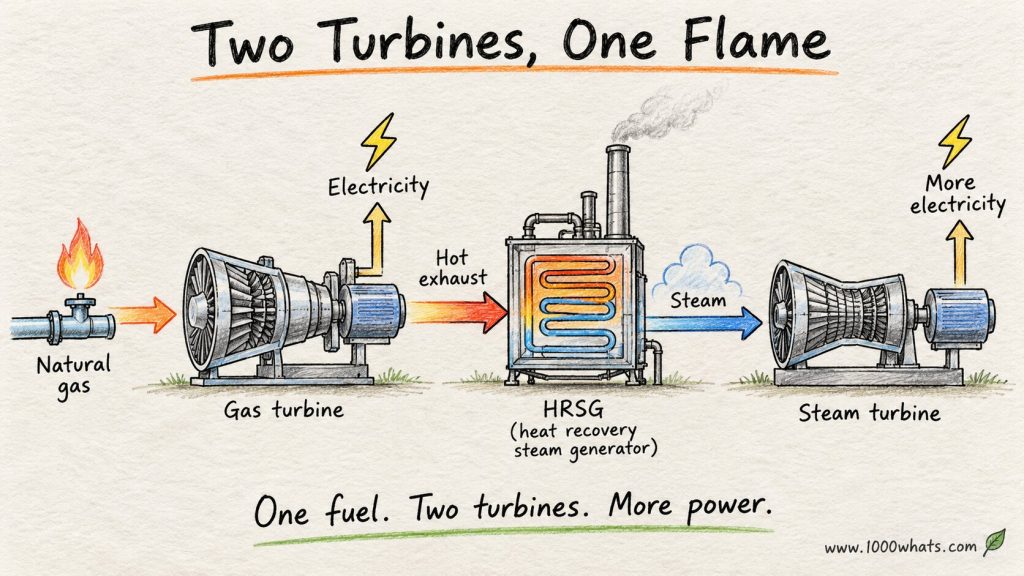
hot gas → gas turbine → electricity
Then:
hot exhaust → steam → steam turbine → more electricity
Welcome to 1000whats — where today a power plant discovers that its exhaust has a second job.
This is the combined-cycle gas turbine, usually shortened to:
CCGT.
And its entire personality can be summarized as:
Why waste perfectly good heat?
⚡ “A CCGT gets its efficiency advantage by refusing to accept that the first turbine gets the last word.”
First, meet the gas turbine
Forget the steam turbine for a moment.
A gas turbine is essentially an industrial cousin of a jet engine.
Air enters.
A compressor squeezes it.
Fuel is added.
The mixture burns.
The hot, high-pressure combustion gases expand through turbine blades.
The turbine spins.
A generator converts that rotation into electricity.
The basic chain is:
air → compression → combustion → expansion → rotation → electricity
The U.S. Department of Energy describes the same core process: compressed air enters the combustor, fuel is burned, and the hot gases expand through the turbine to produce mechanical power.
This is already a perfectly usable power plant.
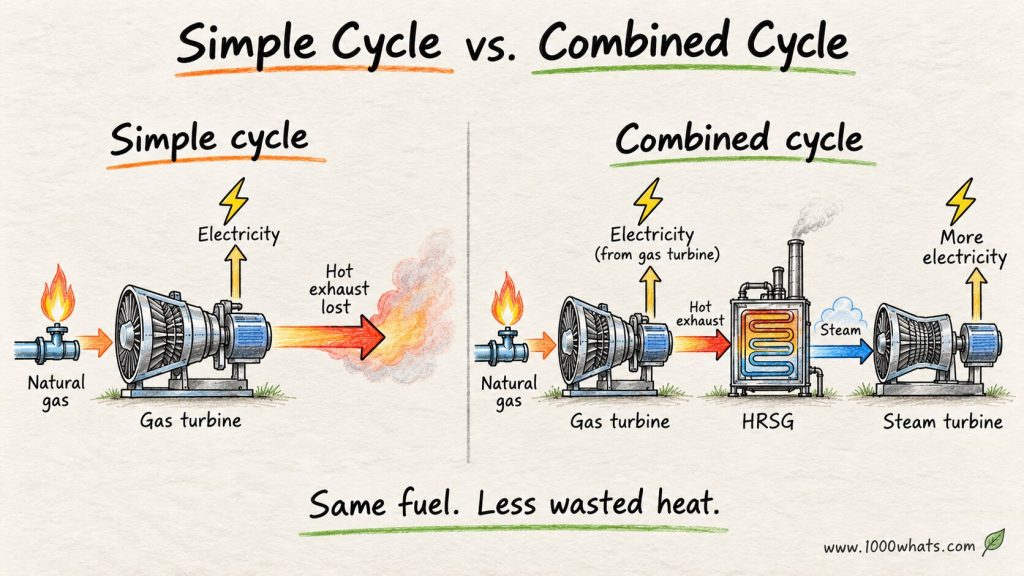
It is generally called a simple-cycle or open-cycle gas turbine.
Start it.
Burn gas.
Make electricity.
Done.
Except thermodynamically, it is leaving quite a lot on the table.
The exhaust is the clue
After passing through the gas turbine, the combustion gases have already done useful work.
But they are still hot.
Very hot.
In a simple-cycle plant, much of that thermal energy leaves through the exhaust.
From an engineering perspective, this is slightly painful.
You paid for the fuel.
You created the heat.
You extracted some useful work.
And then a large chunk of energy heads toward the atmosphere looking suspiciously employable.
So engineers added another machine behind the first one.
Not another gas turbine.
A steam power plant.
That is where the “combined” part begins.
What exactly is being combined?
A CCGT combines two thermodynamic cycles.
The first is the gas-turbine cycle, commonly associated with the Brayton cycle.
The second is the steam cycle, associated with the Rankine cycle.
You do not need those names to understand the plant, but energy engineers enjoy naming cycles after dead men, so there they are.
The IEA glossary definition of a combined-cycle gas turbine describes it as a plant using a gas-turbine topping cycle and a steam-turbine bottoming cycle, with the steam raised using high-temperature waste heat from the gas turbine.
In plain English:
Turbine 1 uses the flame.
Turbine 2 uses what Turbine 1 leaves behind.
That is the whole idea.
Step 1: Compress the air
A large compressor pulls atmospheric air into the gas turbine.
Then it squeezes it.
Why?
Because gas turbines want high-pressure air before combustion.
Compression requires energy, and some of the turbine’s own mechanical output is used to drive the compressor.
This is an important detail.
Not every megawatt of energy passing through a turbine ends up at the electrical terminals.
Some of the machine’s work is spent keeping the machine itself alive.
Power plants are annoyingly realistic like that.
Step 2: Add natural gas and light the fire
Natural gas enters the combustor and mixes with the compressed air.
Ignition releases chemical energy from the fuel.
Temperatures rise dramatically.
The resulting hot gases want to expand.
So we give them a path through rows of turbine blades.
As the gas expands, the blades rotate.
The shaft turns.
The generator produces electricity.
At this point, a simple-cycle plant would be approaching the end of the story.
The CCGT is just getting greedy.
Step 3: Catch the hot exhaust
Instead of sending the gas-turbine exhaust directly up the stack, a CCGT routes it through something with one of the energy industry’s finest collections of words:
Heat Recovery Steam Generator.
Or:
HRSG.
It sounds like a generator.
It is basically an elaborate boiler that uses hot exhaust instead of directly burning another batch of fuel.
Water flows through tubes inside the HRSG.
Hot exhaust passes around them.
Heat transfers into the water.
Water becomes steam.
So we now have:
gas turbine exhaust → steam
No second main flame required.
The DOE describes exactly this arrangement: an HRSG captures energy from gas-turbine exhaust, produces steam, and sends that steam to a steam turbine for additional electricity generation.
The waste stream from Cycle One has become the input to Cycle Two.
That is the magic trick.
Step 4: Make electricity again
The steam produced in the HRSG enters a steam turbine.
It expands.
The turbine rotates.
Another generator produces electricity.
Depending on plant configuration, the gas and steam turbines may drive separate generators or be arranged in other shaft configurations.
But conceptually:
one combustion process has now powered two stages of electricity generation.
Gas turbine first.
Steam turbine second.
Then the steam is condensed back into water and circulated again.
The hot exhaust finally leaves the system considerably cooler than when it left the gas turbine.
At that point even the engineers have to let it go.
So why is combined cycle so much more efficient?
Because efficiency is largely a story about how much useful work you extract before the energy becomes too dispersed to bother with.
A simple-cycle gas turbine produces electricity and rejects hot exhaust.
A combined-cycle plant says:
Hang on. That exhaust can still boil water.
So the same fuel input produces more electrical output.
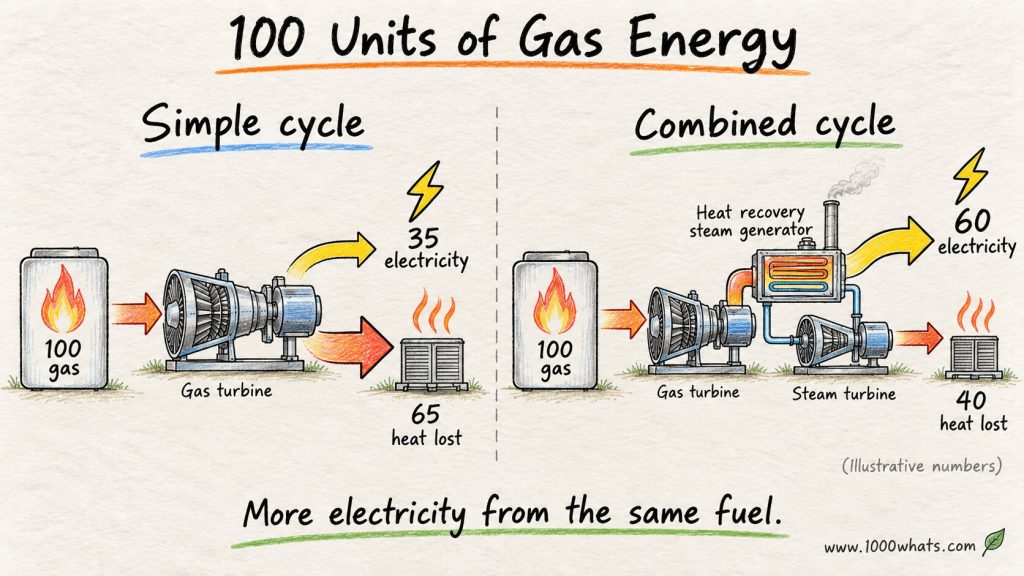
DOE puts simple-cycle gas-turbine efficiencies roughly in the 20–35% range for older/basic configurations and notes that combined-cycle systems can reach around 60% or more. Modern advanced designs are higher still, with DOE/NETL research targeting combined-cycle efficiencies above 65% on a lower-heating-value basis.
That is a huge difference.
Suppose two hypothetical plants each receive:
100 units of fuel energy.
Plant A converts:
35 units → electricity
Plant B converts:
60 units → electricity
Same amount of fuel energy.
Much more electricity.
That means:
less fuel per MWh,
lower fuel cost per MWh,
and lower combustion emissions per MWh.
Efficiency is not just an engineering trophy.
It changes the economics of every hour the plant runs.
⚡ “A more efficient gas plant does not make natural gas cheaper. It needs less of it to make the same MWh.”
Heat rate: The number traders actually care about
Engineers often talk about efficiency.
Electricity traders frequently encounter the same idea upside down:
heat rate.
Heat rate tells us how much fuel energy a power plant needs to produce one unit of electricity.
Lower is better.
Imagine Plant A needs:
10 units of fuel energy
to make one unit of electricity.
Plant B needs:
7.
Plant B has the lower heat rate.
It is more efficient.
This becomes immediately commercial because the fuel bill is basically:
gas price × gas required per MWh
The EIA’s explanation of the spark spread uses exactly this relationship: electricity price minus the gas cost implied by the plant’s heat rate.
Suppose gas costs:
€30/MWhth
Plant A needs:
2 MWhth of gas per MWh of electricity
Fuel cost:
€60/MWh
Plant B needs:
1.67 MWhth
Fuel cost:
roughly:
€50/MWh
Ten euros of difference.
Every MWh.
Every operating hour.
Across a large power plant, efficiency becomes money very quickly.
And that is why CCGTs matter in the merit order
We already explained the merit order as the queue that ranks available generation according to marginal economics.
Gas plants have an obvious problem in that queue:
they need gas.
And sometimes gas is expensive.
A more efficient CCGT needs less gas per MWh than a less efficient gas unit.
So its short-run generation cost is lower.
That generally puts it ahead of a less efficient gas plant, all else equal.
Imagine:
CCGT: €70/MWh marginal cost
older gas turbine: €110/MWh
Demand rises.
The CCGT enters first.
Only when the system needs still more generation does the more expensive unit get called.
This is one reason talking about “gas plants” as though they are one technology is misleading.
A 30-year-old open-cycle unit and a modern CCGT both burn gas.
Their electricity economics can look very different.
Wait—why not make every gas plant combined cycle?
Because power systems care about more than efficiency.
A large CCGT is optimized to extract a lot of electricity from each unit of fuel.
That introduces more equipment:
gas turbine,
HRSG,
steam turbine,
condenser,
water/steam system,
additional controls,
more balance-of-plant equipment.
An open-cycle gas turbine is simpler.
That can matter when you want a plant that:
starts quickly,
operates only occasionally,
covers sharp demand peaks,
or provides backup capacity.
Think of two vehicles.
One is optimized for fuel economy on a long journey.
The other exists because sometimes you need to move now.
Efficiency is valuable.
So is speed.
Historically, open-cycle gas turbines have therefore often served peaking roles, while CCGTs have been better suited to longer operating periods.
Modern CCGTs have also become considerably more flexible, which is where the story gets interesting.
The old CCGT wanted to run. The modern CCGT gets interrupted.
A conventional thermal plant likes stability.
Start it.
Bring it to an efficient operating point.
Leave it there.
Plants generally do not become happier because the system operator asks them to:
up,
down,
up,
stop,
start,
down,
up again.
Yet that is increasingly the job.
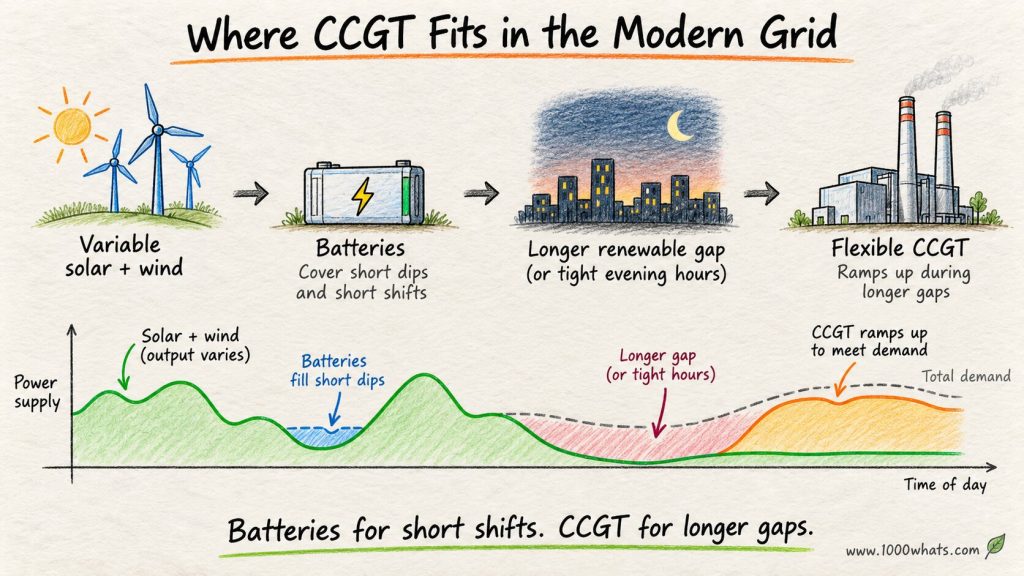
Solar output rises quickly in the morning.
Gas generation gets pushed down.
Solar fades in the evening.
Gas plants may need to ramp back up.
Wind changes.
Demand changes.
Electricity prices change.
Batteries appear.
Then everybody changes again.
ACER’s 2026 monitoring report shows this shift clearly in Europe. Average daily starts of gas-fired generating units rose from around 57 in 2019 to 88 in 2025, while the ratio of operating hours per start fell markedly.
In other words:
gas plants are being asked to cycle more and sit still less.
This matters because starts and partial-load operation can increase costs, reduce efficiency, and stress equipment.
The CCGT is evolving from:
efficient bulk electricity machine
toward:
efficient bulk electricity machine that also needs to dance.
Gas plants and renewables have a complicated relationship
You will sometimes hear two very clean stories.
Story One:
Renewables replace gas.
Story Two:
Renewables need gas.
Reality is irritatingly capable of holding parts of both.
As wind and solar produce more electricity over the year, fossil generation can decline.
But variable renewable production also increases the value of resources capable of changing output when weather-dependent generation changes.
Globally, the picture is different again: the IEA expects gas-fired generation to continue growing in several regions through 2030 even as renewable generation expands rapidly.
So:
more renewables does not imply the same gas story everywhere.
In one market, CCGTs may run fewer hours but become more valuable during scarcity.
In another, they may still provide growing quantities of electricity.
In another, batteries, interconnectors, hydro, demand response, and storage may progressively take over flexibility duties.
Power systems rarely respect universal slogans.
Why can CCGTs set electricity prices so often?
Because they frequently sit near the expensive end of the dispatch stack.
Wind and solar have essentially no fuel cost.
Nuclear fuel costs per additional MWh are relatively low.
Hydro economics vary.
Coal and gas must continuously buy fuel.
Gas plants also face carbon costs in markets such as the EU ETS.
So during hours when cheaper generation cannot meet all demand, a CCGT may become the marginal plant.
Then gas economics matter to the electricity price.
This is exactly the mechanism discussed in our article on the merit order.
Gas does not need to generate most of the electricity to have a large influence on price.
It only needs to be the final necessary plant often enough.
That distinction caused approximately twelve billion European arguments during the energy crisis.
Possibly more.
CCGT vs. coal: cleaner does not mean clean
Natural gas contains more hydrogen and less carbon per unit of energy than coal.
According to the EIA, burning natural gas produces roughly half as much CO₂ as coal for the same amount of fuel energy released.
Then the CCGT adds another advantage:
higher conversion efficiency.
If you need less fuel to produce each MWh, you emit less combustion CO₂ per MWh.
This is why switching from coal generation to efficient CCGTs can significantly reduce direct power-sector CO₂ emissions.
But the word reduce matters.
A CCGT still burns a fossil fuel.
CO₂ still leaves the stack.
Natural-gas production and transport can also release methane, a powerful greenhouse gas.
So describing CCGT electricity as “clean” is doing a lot of work with one adjective.
A more useful description is:
lower-carbon than coal-fired generation, but not zero-carbon generation.
If you want to explore why two identical kWh can carry different emissions, that is exactly what our article on carbon intensity is for.
The efficiency advantage has another consequence: fuel security
Imagine a power system needs:
10 TWh of gas-fired electricity.
A less efficient fleet needs more natural gas to produce it.
A more efficient CCGT fleet needs less.
That can matter far beyond the power plant.
Less gas consumption means:
less pipeline capacity required,
less LNG purchased,
less exposure to gas-price shocks,
less pressure on storage,
and less competition with industrial or heating demand.
The IEA has highlighted this effect in gas-producing regions too: replacing inefficient gas-fired plants with combined-cycle plants can free significant gas volumes because the same electricity output requires less fuel.
Efficiency is therefore not merely about emissions.
It can also be energy security.
The most strategically useful cubic meter of gas may occasionally be the one your power plant no longer needs.
Does a CCGT help resource adequacy?
Potentially, yes.
But not simply because its nameplate says 500 MW.
Our recent article on resource adequacy made the important distinction:
installed capacity is not guaranteed available capacity.
A CCGT can provide dispatchable power when needed.
That makes it potentially valuable during:
low-wind periods,
winter peaks,
evening demand,
prolonged renewable shortages,
or other tight system conditions.
But it still has dependencies.
The plant must be technically available.
The gas must exist.
The pipeline must deliver it.
The grid must be able to transport the electricity.
Extreme events can hit several of those things simultaneously.
The IEA explicitly warns that power systems relying on gas for adequacy create a link between electricity security and gas-system deliverability.
The gas turbine may be ready.
That does not help much if the fuel is somewhere else.
What about hydrogen?
Modern gas-turbine manufacturers increasingly discuss equipment capable of burning hydrogen blends, with ambitions for higher hydrogen shares over time.
Technically, gas turbines can be adapted for alternative gaseous fuels.
But “hydrogen-ready” deserves caution.
Hydrogen behaves differently from methane.
Combustion characteristics change.
NOx control matters.
Fuel infrastructure matters.
And most importantly:
a turbine capable of burning hydrogen does not create hydrogen.
Someone still has to produce it.
Transport it.
Store it.
Deliver it.
And make the economics work.
DOE’s advanced-turbine research explicitly includes high-hydrogen combustion systems among future turbine-development pathways.
So hydrogen may change the fuel story.
It does not make the engineering, infrastructure, or economics disappear.
Energy transition marketing occasionally skips that middle paragraph.
Could carbon capture make CCGTs low-carbon?
Potentially lower-carbon.
Not magically carbon-free.
Carbon capture systems can remove a large share of CO₂ from power-plant exhaust before it reaches the atmosphere.
But capture equipment needs energy.
That reduces net plant efficiency.
It adds capital cost.
It requires CO₂ transport and permanent storage infrastructure.
And the upstream methane story remains relevant.
The IEA nevertheless sees dispatchable thermal generation with carbon capture as one possible source of flexibility in low-carbon electricity systems.
Again, the useful question is not:
Is CCGT good or bad?
It is:
What service does the system need, what alternatives exist, what emissions are acceptable, and what does each option cost?
Energy becomes considerably more useful when technologies stop being football teams.
Why not just use batteries instead?
Sometimes we should.
For fast, short-duration flexibility, batteries are extraordinarily good.
They respond rapidly.
They do not need combustion.
They can absorb surplus electricity and release it later.
The IEA describes utility-scale batteries as one of the most versatile tools for short-term power-system flexibility.
But a four-hour battery and a gas plant are not identical resources.
Suppose the system needs extra power for:
two hours.
Battery?
Excellent.
Now suppose low wind and high demand persist for:
three days.
The energy requirement becomes much larger.
A gas plant can continue operating as long as fuel is delivered.
A battery can continue only as long as stored energy remains—or it can recharge.
This is why future electricity systems are unlikely to be explained by one triumphant technology replacing everything else.
Different resources solve different timescales.
Batteries.
Hydro.
Interconnection.
Demand response.
Thermal generation.
Long-duration storage.
The system is a portfolio.
⚡ “Power-system flexibility is not one technology. It is a collection of ways to avoid being surprised by Tuesday evening.”
The wonderfully clever part is still the exhaust
Strip away the market design.
The gas prices.
The carbon costs.
The flexibility debate.
The hydrogen plans.
The capacity mechanisms.
At its heart, the CCGT is based on an almost embarrassingly sensible engineering thought:
That exhaust is still hot.
Use it.
The gas turbine extracts useful work at very high temperatures.
The remaining heat is still valuable enough to raise steam.
The steam turbine extracts more useful work at lower temperatures.
Two machines.
Different temperature ranges.
Same original fuel input.
That is why the “combined” part matters.
It is not two fuels.
Not two plants accidentally parked beside each other.
It is two thermodynamic cycles arranged so that the waste from the first becomes useful input to the second.
That is elegant engineering.
Even if the fuel itself remains part of a much more complicated climate argument.
So, what is a combined-cycle gas turbine in one sentence?
A combined-cycle gas turbine is a power plant that generates electricity first with a gas turbine and then uses the gas turbine’s hot exhaust to produce steam and generate additional electricity in a steam turbine.
That second stage is why CCGTs can convert a much larger share of natural gas energy into electricity than simple-cycle plants.
Remember:
gas turbine → electricity
then:
hot exhaust → steam → more electricity
One flame.
Two turbines.
Less wasted heat.
That is combined cycle.
Final thoughts
There is a revealing habit in the way we talk about power plants.
We classify them by fuel.
Coal plant.
Gas plant.
Nuclear plant.
Hydro plant.
Solar plant.
Useful.
But incomplete.
Because two plants burning the same fuel can use that fuel very differently.
A simple-cycle gas turbine sees hot exhaust and says:
We’re done.
A combined-cycle plant sees the same exhaust and says:
Are we, though?
That difference can turn a machine converting perhaps a third of its fuel energy into electricity into one converting around three-fifths.
Same basic fuel.
Very different engineering.
And that engineering explains why CCGTs became such important machines in modern electricity systems.
They can produce large quantities of dispatchable electricity.
They can be highly efficient for fossil generation.
Their flexibility is increasingly valuable as wind and solar reshape hourly generation patterns.
They can also influence market prices far beyond their share of annual output.
But none of that turns them into zero-carbon power.
The plant may be clever about heat.
The carbon still knows where the chimney is.
That tension—high efficiency, useful flexibility, continuing fossil emissions—is exactly why CCGTs remain so interesting during the energy transition.
They are neither yesterday’s machine nor automatically tomorrow’s solution.
They are a very efficient answer to a very specific question:
If we are going to burn this gas, how much electricity can we squeeze out of it before letting the heat escape?
Quite a lot, as it turns out.
Until next time, stay curious! 😎
Discover more from 1000whats
Subscribe to get the latest posts sent to your email.