Coal and nuclear power have a complicated relationship.
One burns ancient carbon.
The other splits atomic nuclei.
Their fuels are different.
Their emissions are different.
Their safety systems are very different.
Their political arguments could probably fill several libraries.
And yet, after all that disagreement, both technologies often end up doing something remarkably similar.
They heat water.
The water becomes steam.
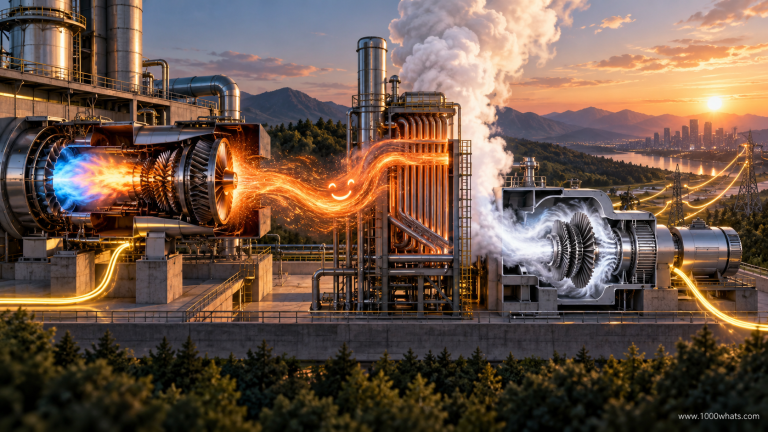
The steam spins a turbine.
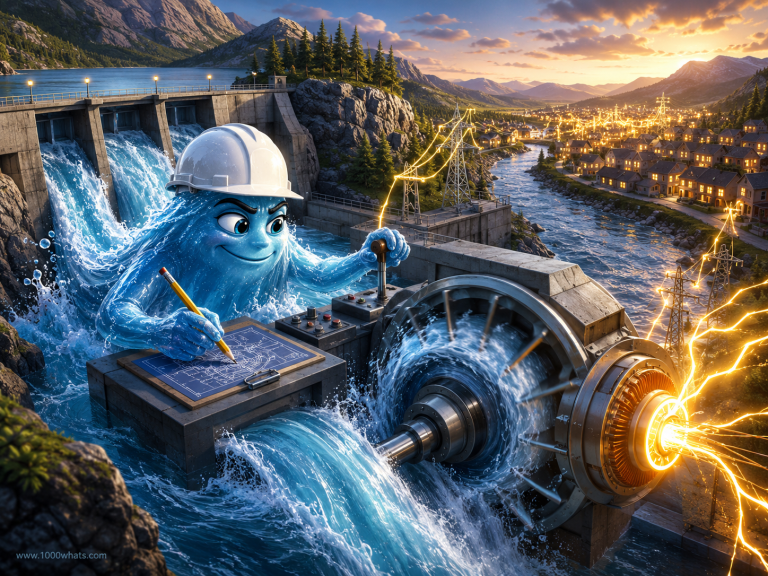
The turbine drives a generator.
Electricity comes out.
Somewhere between the nuclear physics and the coal dust, the two industries quietly agreed on the same machine.
Welcome to 1000whats – where today we discover why one of electricity’s most important machines is remarkably indifferent to how its heat was produced.
It is called a steam turbine.
And once you understand how it works, a surprising amount of power-plant engineering begins to make sense.
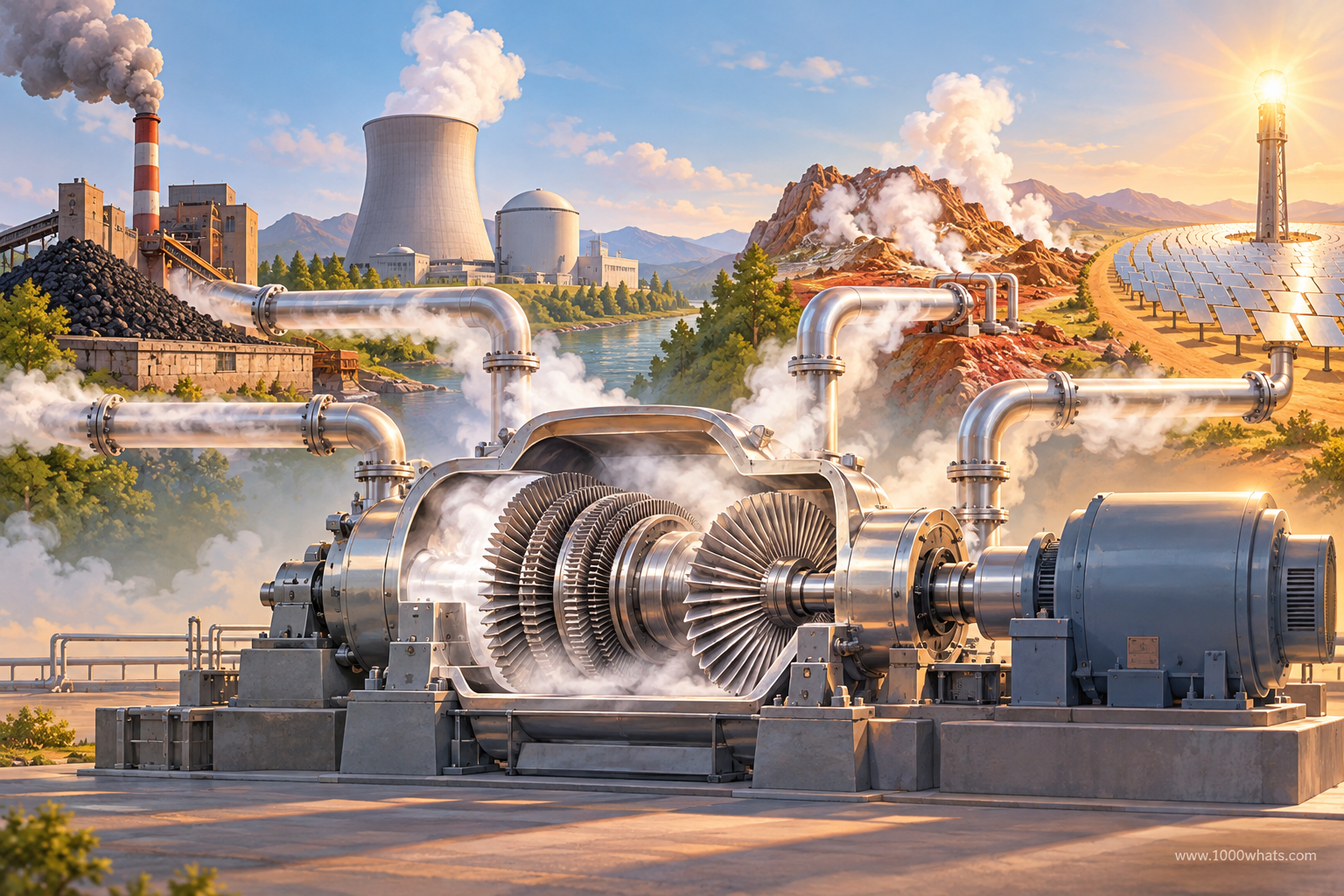
⚡ “Coal, nuclear, geothermal and solar thermal disagree about where heat should come from. The steam turbine just wants that heat delivered under the right conditions.”
First, forget the electricity
Imagine a machine with a long metal shaft.
Attached to that shaft are rows of carefully shaped blades.
The shaft can rotate.
At one end, we introduce steam at high pressure and temperature.
At the other, steam leaves at much lower pressure.
As the steam moves through the machine, it expands.
During that expansion, some of its available energy is transferred to the rotating shaft.
The shaft turns.
That is the fundamental job of a steam turbine.
It converts energy carried by steam into mechanical work.
Not electricity.
Not directly.
Mechanical work.
To produce electricity, we connect that rotating shaft to a generator.
The generator converts mechanical power into electrical power through electromagnetic induction.
So the conversion chain is:
Heat → Steam → Mechanical rotation → Electricity
The U.S. Energy Information Administration describes steam turbines as one of the principal technologies used in electricity generation, alongside gas, hydro and wind turbines.
But why does expanding steam make the shaft rotate?
That is where the interesting physics begins.
The secret is not steam. It is the pressure drop.
Imagine a pressure vessel containing steam.
Inside, the steam is at high pressure.
Outside, the pressure is lower.
Open a suitable passage and steam flows from the higher-pressure region toward the lower-pressure region.
As it expands, its thermodynamic state changes.
Pressure falls.
Temperature generally falls.
And some of the steam’s available energy can be converted into useful work.
A steam turbine is designed to extract that work efficiently.
It does this using rows of blades.
But not all blades do the same job.
Some are stationary.
Others rotate with the shaft.
Stationary blades
These guide the steam toward the moving blades.
In many turbine stages, they also act as nozzles, converting part of the steam’s available energy into velocity.
Moving blades
These are attached to the rotor.
As steam flows through them and changes direction and momentum, it exerts a force on the blades.
That force creates torque.
The shaft rotates.
Different turbine designs divide the pressure drop and energy conversion differently between stationary and moving blade rows.
Engineers distinguish between impulse and reaction stages.
We do not need a full turbomachinery course today.
The essential mechanism is:
Steam expands, transfers momentum to the rotor, and produces shaft work.
The turbine is not simply a windmill with steam instead of wind.
Its performance depends on carefully controlled pressure, temperature, flow and blade geometry.
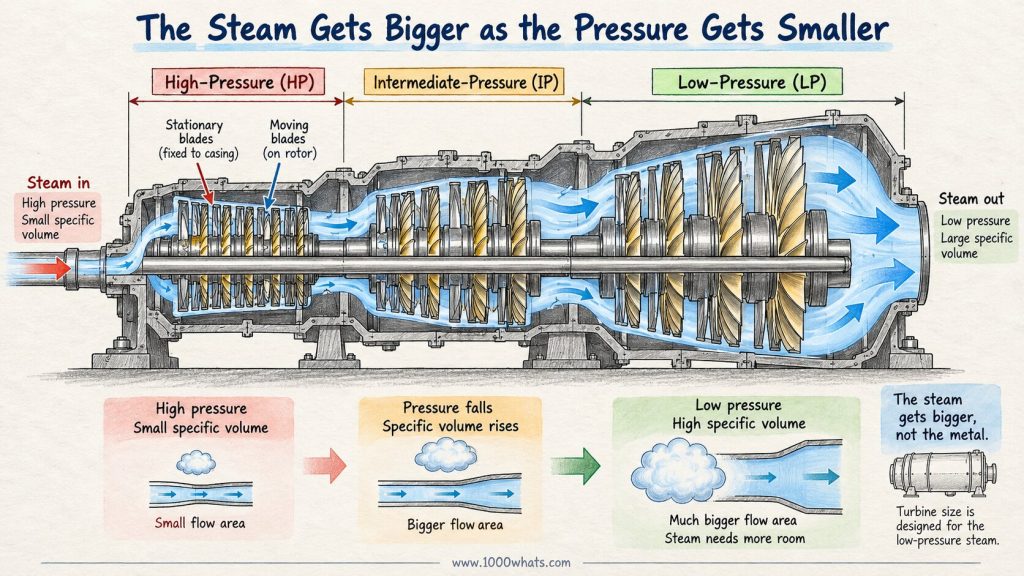
Why does a turbine have so many blades?
A large steam turbine is not normally one enormous propeller.
It contains many stages.
Steam enters at relatively high pressure.
It passes through one stage.
Expands.
Loses some of its available energy.
Then enters another stage.
Expands again.
And again.
Each stage extracts another portion of the available work.
This is why large turbine assemblies can have:
high-pressure sections,
intermediate-pressure sections,
and low-pressure sections.
As steam expands, its density generally decreases.
For a given mass flow, the steam occupies a larger volume at lower pressure.
That is why low-pressure turbine sections often need much larger flow passages and longer blades.
The steam is becoming less dense.
The machine must accommodate that increasing volume flow.
A turbine is therefore not simply a collection of identical blades.
It is a carefully designed path through changing thermodynamic conditions.
Now we need the rest of the power plant
Here is an important distinction.
A steam turbine is not a complete power plant.
It is one component of a thermodynamic system.
The turbine needs steam.
And after the steam has done its work, something must happen to it.
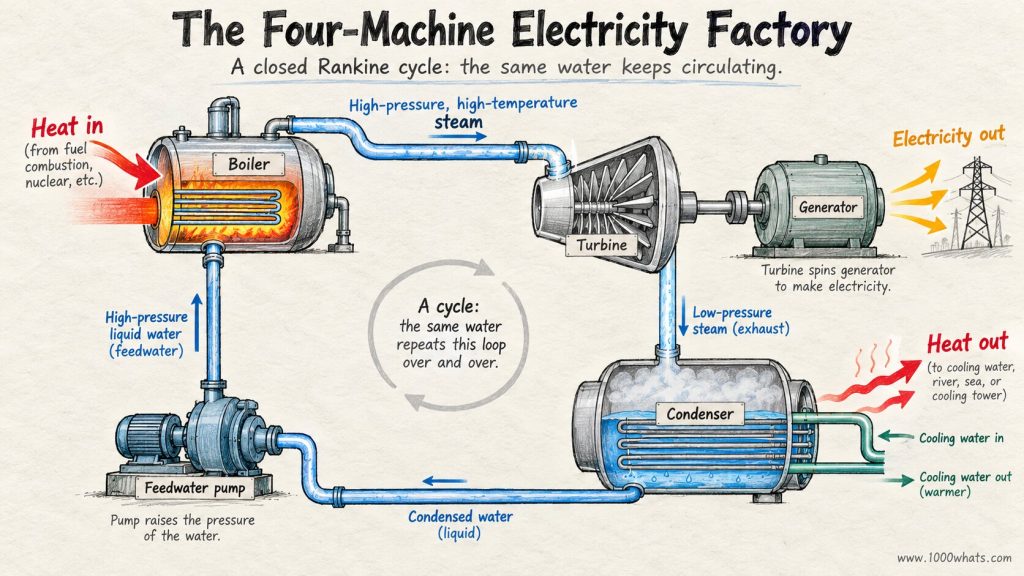
In a conventional condensing steam power plant, the process forms a loop.
The basic components are:
- A boiler or steam generator.
- A steam turbine.
- A condenser.
- A feedwater pump.
This arrangement is commonly called the Rankine cycle.
The U.S. Department of Energy’s steam turbine technical guidance describes this basic cycle and its industrial variations.
Let’s follow one kilogram of water through the system.
Step 1: Give the water some heat
Water enters a boiler or steam generator.
Heat is transferred into it.
Depending on the design, the water is heated, evaporated and possibly superheated.
The result is steam suitable for the turbine.
Where did the heat come from?
That depends on the power plant.
Coal combustion.
Natural gas combustion.
Nuclear fission.
Concentrated sunlight.
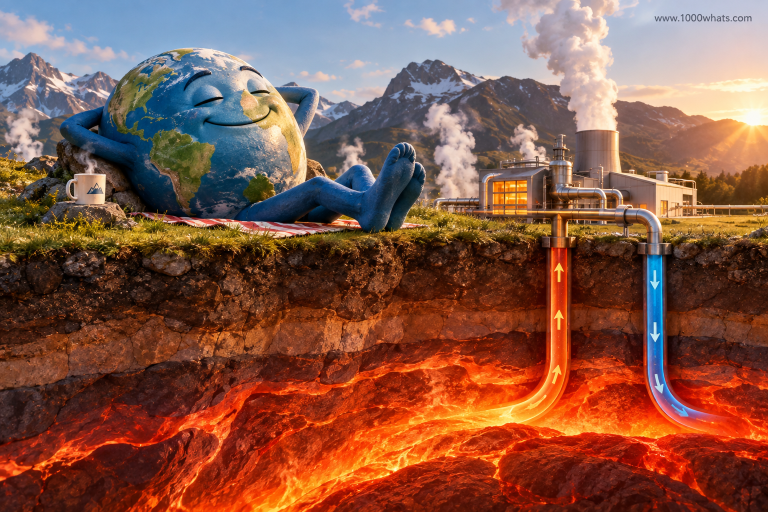
Geothermal energy.
Biomass.
Or recovered heat from another industrial process.
The steam turbine does not care about the original source.
It cares about the steam conditions arriving at its inlet.
Those conditions include:
- Pressure.
- Temperature.
- Mass flow.
- Steam quality.
- Chemical purity.
And that last point matters.
Steam turbines are expensive precision machines.
Sending contaminated steam into one is an excellent way to become unpopular with the maintenance department.
Step 2: Let the steam expand
The steam enters the turbine.
It expands through successive stages.
As its pressure and available energy decrease, it transfers mechanical work to the rotor.
The shaft drives a generator.
Electricity is produced.
The useful work extracted depends strongly on the steam conditions entering and leaving the turbine.
In simplified thermodynamic terms:
More available energy extracted per kilogram of steam means more mechanical work.
Engineers often express this using a quantity called specific enthalpy.
Without turning this article into a thermodynamics exam, imagine that each kilogram of steam loses 1,000 kilojoules of enthalpy while passing through a turbine.
If the mass flow is:
100 kilograms per second
then the corresponding energy-transfer rate is:
100 × 1,000 = 100,000 kilojoules per second.
Or:
100 MW.
That is a simplified illustration of the relationship between steam flow, enthalpy change and power.
It is not a prediction of a particular turbine’s output.
Real turbine performance depends on losses, inlet and outlet conditions, and how efficiently the expansion occurs.
But the underlying idea is useful.
Steam turbines produce power by processing a flow of steam and extracting part of its available energy.
More steam can mean more power.
A larger useful enthalpy drop can mean more power.
Better turbine efficiency can mean more power from the same steam conditions.
And that leads to the next question.
What happens after the steam leaves?
Step 3: Cool the steam down
This sounds suspicious.
We spent money heating water.
We turned it into steam.
We sent it through an enormous turbine.
And now we deliberately cool it?
Yes.
Welcome to thermodynamics.
In a conventional condensing power plant, the exhaust steam enters a condenser.
There, it transfers heat to a cooling medium and becomes liquid water again.
Why bother?
Two reasons.
First, liquid water can be pumped back to high pressure using much less work than would be required to compress the same mass as low-density vapor.
Second, and crucially, condensing the exhaust steam helps maintain a very low pressure at the turbine outlet.
That increases the pressure range over which the steam can expand.
And a larger useful expansion can allow the turbine to extract more work.
The condenser is not merely cleaning up after the turbine. It helps make the turbine more productive.
⚡ “A steam power plant needs a hot side to supply energy and a cold side to reject it. The cold side is not an embarrassing engineering afterthought.”
This is a fundamental feature of heat engines.
They convert part of the heat supplied into work.
The remainder must be rejected somewhere.
The colder the available heat sink, within practical and design limits, the more favorable the potential thermodynamic efficiency can become.
That does not mean we can simply make everything infinitely cold.
Physics, materials, cooling availability and economics all have opinions.
But it explains why cooling systems matter so much.
The cooling tower is not the turbine
This distinction is worth making because the two are constantly confused.
A cooling tower is not where electricity is generated.
The steam turbine generates mechanical power.
The condenser removes heat from the exhaust steam.
The cooling system then disposes of that heat into the environment.
A cooling tower is one possible part of that cooling system.
It is not mandatory for every steam power plant.
Some facilities use water from rivers, lakes or the sea.
Others use recirculating cooling towers.
Some use dry cooling systems that reject heat to air.
The EIA’s overview of power-plant cooling systems explains these different arrangements.
And one popular misconception deserves retirement.
The large white plume rising from a wet cooling tower is primarily condensed water vapor.
It is not automatically smoke from fuel combustion.
A nuclear plant may have a cooling tower.
A coal plant may have one.
A gas-fired plant may have one.
The tower tells you something about the cooling system.
Not necessarily about the fuel.
Step 4: Send the water back
Once the exhaust steam has condensed, the working fluid is liquid again.
A feedwater pump raises its pressure.
The water returns toward the boiler or steam generator.
More heat is added.
The cycle repeats.
The basic loop is:
Pump → Boiler → Turbine → Condenser → Pump
And around it, two things are happening.
Heat enters from a high-temperature source.
Heat leaves through a lower-temperature sink.
Between them, some of the energy becomes mechanical work.
That is the Rankine cycle.
The surprising part: one turbine, many energy sources
Now we can return to the question from the beginning.
Why do so many power plants use steam turbines?
Because they are an effective way to convert high-temperature thermal energy into mechanical power.
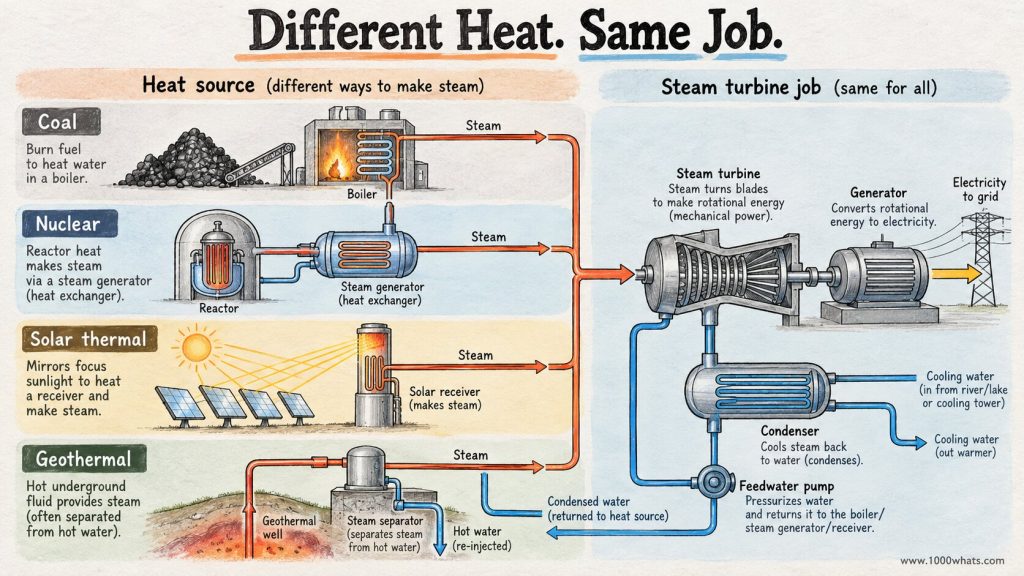
And many energy sources can provide that heat.
Consider these examples.
| Energy source | How heat is obtained | What drives the turbine? |
|---|---|---|
| Coal | Coal combustion heats boiler water | Steam |
| Nuclear | Fission heats reactor coolant and ultimately produces steam | Steam |
| Biomass | Biomass combustion supplies boiler heat | Steam |
| Combined-cycle gas | Gas-turbine exhaust heats water in an HRSG | Steam |
| Concentrated solar thermal | Mirrors concentrate sunlight to provide heat | Steam in conventional steam-cycle designs |
| Geothermal | Underground heat provides steam directly or through a suitable process | Steam in dry- and flash-steam plants |
There is one important geothermal qualification.
Some geothermal plants use binary cycles, where the working fluid is not water.
Instead, geothermal heat vaporizes another fluid with a lower boiling point.
That vapor drives a turbine designed for the alternative working fluid.
My geothermal energy explainer examines that distinction.
But the larger lesson remains.
The turbine is a conversion technology. The heat source is a separate decision.
This is why classifying power plants only by fuel can hide important similarities.
A coal plant and a nuclear plant may have very different upstream systems.
But their turbine halls can look surprisingly familiar.
A nuclear reactor is still a thermal power plant
This is one of my favorite examples.
A nuclear reactor contains controlled nuclear reactions.
Inside the fuel, enormous amounts of energy are released.
That energy becomes heat.
And then?
We use the heat to produce steam.
The steam drives a turbine.
The turbine drives a generator.
The U.S. Department of Energy’s nuclear reactor explanation describes the two common light-water reactor arrangements.
In a pressurized-water reactor, heat from the reactor’s primary coolant is transferred through a steam generator to a separate water circuit.
The steam in that secondary circuit drives the turbine.
In a boiling-water reactor, steam is produced in the reactor vessel and routed to the turbine system.
Different arrangements.
Same broad conversion principle.
Nuclear fission supplies the heat.
The turbine extracts mechanical work from steam.
The generator produces electricity.
That is why my article on nuclear fission ends up talking about boilers and turbines.
The nuclear physics is extraordinary.
The electricity-generation machinery is wonderfully conventional.
A real-world example: North Anna Nuclear Power Station
Consider North Anna Nuclear Power Station in Virginia.
The station uses nuclear reactors to produce heat and steam turbines to generate electricity.
But its cooling system is equally important to the overall process.
The EIA’s description of North Anna explains how water from Lake Anna passes through the condenser to remove heat from the exhaust steam.
The cooling water and the steam-cycle water do not mix.
Heat passes between them.
The condensed steam-cycle water returns to the steam generator.
The lake water eventually returns through the station’s cooling arrangement.
This is a useful example because it shows the entire chain.
The reactor produces heat.
The steam turbine produces mechanical power.
The generator produces electricity.
And the condenser and cooling system allow the thermodynamic cycle to continue.
Remove the cooling system, and you have not merely removed an accessory.
You have interfered with the power plant’s ability to operate.
Why isn’t a steam turbine 100% efficient?
Now we reach the unavoidable question.
If steam contains energy, why not convert all of it into electricity?
Because a steam turbine operates within a heat engine.
And heat engines have thermodynamic limits.
A conventional steam cycle requires heat input at a higher temperature and heat rejection at a lower temperature.
Not all the supplied heat can become useful work.
There are also real engineering losses.
Steam experiences friction and other irreversibilities.
Blades are not perfect.
Seals leak.
Bearings have losses.
Generators have losses.
Pumps consume power.
And the cooling system needs energy too.
But there is an important distinction here.
Turbine efficiency and overall power-plant efficiency are not the same number.
A turbine can convert a high percentage of the work theoretically available from its steam expansion while the entire plant converts a much smaller percentage of the original heat input into electricity.
Those statements are not contradictory.
They measure different boundaries.
Consider a simplified power plant receiving:
1,000 MW of thermal energy.
Suppose it produces:
350 MW of net electricity.
Its net electrical efficiency is:
350 / 1,000 = 35%.
The remaining 650 MW is not necessarily one single loss.
It includes rejected heat and other energy losses across the plant.
This is an illustrative calculation, not a universal steam-plant efficiency.
Actual efficiency depends on the technology, steam conditions, cooling system, plant design and operating conditions.
The key point is that the turbine’s performance is only one part of the overall conversion process.
Hotter steam can help. But there is a catch.
One way to improve thermal power-plant efficiency is to increase the temperature at which heat enters the power cycle.
Another is to improve the expansion process.
Engineers can also use:
higher steam pressures,
superheating where appropriate,
reheating,
feedwater heating,
and better turbine designs.
The U.S. Department of Energy’s overview of thermal power cycles explains why higher-temperature power cycles are attractive for converting heat into electricity.
But hotter is not automatically easier.
Materials must withstand temperature and pressure.
Turbine blades must resist mechanical stress.
Seals and casings must tolerate thermal expansion.
The plant must manage fatigue.
And operating conditions must remain compatible with the heat source.
That last point matters.
A coal plant can be designed around very high steam temperatures.
A conventional nuclear plant may operate with different steam conditions because its reactor and steam-generation systems have different requirements.
The same basic turbine principle does not mean every turbine is interchangeable.
A steam turbine is heat-source flexible as a technology, but a particular turbine is designed for specific steam conditions.
That distinction keeps us out of trouble.
Steam quality matters more than it sounds
Steam is not always completely dry.
Depending on pressure and temperature, it may contain suspended liquid droplets.
That becomes important inside a turbine.
High-speed droplets can damage blades.
Moisture can contribute to erosion and reduce efficiency.
So turbine systems may include equipment and operating arrangements designed to control moisture.
In some large steam cycles, steam is reheated between turbine sections.
This can improve cycle performance and help maintain acceptable conditions during later expansion.
The point is not that every turbine needs the same steam treatment.
It is that:
Steam quality is an engineering requirement, not a decorative specification.
The turbine wants the right working fluid.
At the right pressure.
At the right temperature.
With the right quality.
And preferably without unexpected droplets trying to sandblast the expensive parts.
Steam turbines can also make useful heat
So far, we have mostly discussed condensing steam turbines.
These are designed to extract substantial mechanical work from steam before it enters a condenser.
But what if a factory needs steam for industrial processes?
Or a city needs heat for district heating?
Then extracting as much electricity as possible may not be the only objective.
A plant can use a back-pressure turbine or extract steam from an intermediate stage.
That steam can then supply useful thermal energy.
For example:
high-pressure steam enters the turbine;
some of its energy becomes electricity;
lower-pressure steam leaves;
the factory uses that steam for heating or processing.
This is one application of combined heat and power, or CHP.
My cogeneration explainer introduces the broader idea.
The Department of Energy’s CHP guidance also explains how producing useful heat and electricity together can improve overall fuel utilization.
Notice the trade-off.
If steam leaves the turbine at a pressure and temperature suitable for industrial use, it may still contain energy that could otherwise have contributed to additional electricity generation.
But that remaining thermal energy is not necessarily wasted.
The factory needs it.
So the economically sensible answer may be:
less electricity, more useful heat.
This is why the best turbine arrangement depends on the purpose of the entire energy system.
Not simply on maximizing generator output.
Can steam turbines respond quickly to electricity prices?
Yes, within limits.
Steam turbines can change output by adjusting steam flow and other operating conditions.
But the turbine is only one part of the plant.
The boiler or reactor must provide suitable steam.
The condenser must handle the exhaust.
The generator and auxiliary systems must remain within operating limits.
And the plant must manage thermal stress.
Starting a cold turbine is not the same as increasing output from an already warm, synchronized unit.
Metal temperatures matter.
Thermal expansion matters.
The rotor and casing do not necessarily heat at the same rate.
Rapid changes can create mechanical stress and fatigue.
That is why a steam turbine’s operating flexibility depends on its design and the surrounding plant.
A modern combined-cycle unit may be engineered for relatively flexible operation.
A large conventional thermal plant may have different startup and ramping characteristics.
A nuclear unit operates under additional reactor-specific constraints.
The turbine does not make those differences disappear.
From an electricity-market perspective, this is important.
A generator’s ability to respond to a price signal depends on more than the price itself.
It depends on the physical machine and the system around it.
My CCGT explainer explores that commercial relationship in more detail.
Does the steam turbine have a future?
Very much so.
But its future may look different from its past.
Historically, steam turbines became closely associated with large fossil-fuel power stations.
Coal plants in particular.
That association makes it tempting to classify the turbine itself as an old fossil-fuel technology.
But that confuses the heat source with the conversion equipment.
Steam turbines can operate in low-carbon energy systems.
Nuclear power uses them.
Some geothermal plants use them.
Concentrated solar-thermal plants use them.
Biomass and suitable waste-heat applications can use them.
And advanced thermal systems continue exploring improved power cycles.
Meanwhile, researchers are also investigating alternatives.
One example is the supercritical carbon dioxide power cycle.
Instead of using water and steam as the working fluid, these systems use carbon dioxide under supercritical conditions.
The objective is to achieve attractive efficiencies and more compact turbomachinery in suitable applications.
DOE identifies supercritical CO₂ cycles as a potential alternative to conventional steam-based cycles for several types of heat source.
That does not mean steam turbines are about to disappear.
It means the technology continues to face competition from other ways of converting heat into work.
Which is healthy.
The real engineering question remains:
Given this heat source, what is the most efficient and economical way to turn its energy into useful output?
Sometimes the answer is a steam turbine.
Sometimes it may be another technology.
The fuel is not the machine
This is the distinction I would remember.
A coal plant is not simply a steam turbine.
A nuclear plant is not simply a steam turbine.
A geothermal plant is not simply a steam turbine.
Each contains a heat source, a conversion system and supporting infrastructure.
The heat source determines where the thermal energy comes from.
The steam cycle determines how some of that thermal energy becomes mechanical work.
The generator converts that work into electricity.
The cooling system rejects the remaining heat.
And the wider power plant determines how efficiently, safely and flexibly everything operates together.
Once you separate those functions, many apparently unrelated energy technologies become easier to understand.
You stop seeing:
coal versus nuclear versus geothermal.
And start seeing:
different heat sources feeding different versions of a familiar conversion process.
That is a much more useful mental model.
What is a steam turbine in one sentence?
A steam turbine is a rotating machine that converts part of the energy available in expanding steam into mechanical shaft power, which can drive an electricity generator or other equipment.
But the more memorable version is:
A steam turbine is the machine that turns a temperature-and-pressure difference into a spinning shaft.
Where the heat came from is somebody else’s department.
Final thoughts
Steam turbines are one of those technologies that quietly explain far more of the energy world than their name suggests.
They sit behind coal combustion.
Nuclear fission.
Geothermal heat.
Solar thermal energy.
Industrial cogeneration.
And the second stage of combined-cycle gas plants.
Different fuels.
Different economics.
Different environmental consequences.
Yet a remarkably similar physical process.
Make suitable steam.
Let it expand.
Extract mechanical work.
Turn a generator.
Then cool the working fluid and repeat.
Simple in principle.
Extraordinarily sophisticated in execution.
And that is the important lesson.
The energy source and the machine that converts its energy into electricity are not the same thing.
Understanding that distinction makes it easier to compare power plants, understand efficiency, evaluate new technologies and recognize where genuine innovation is happening.
Sometimes the breakthrough is a new way of producing heat.
Sometimes it is a better way of using the heat we already have.
And sometimes, after an astonishing amount of scientific progress, we still ask water to spin a very expensive piece of metal.
It has been doing a remarkably good job.
Until next time, stay curious! 😎
Discover more from 1000whats
Subscribe to get the latest posts sent to your email.