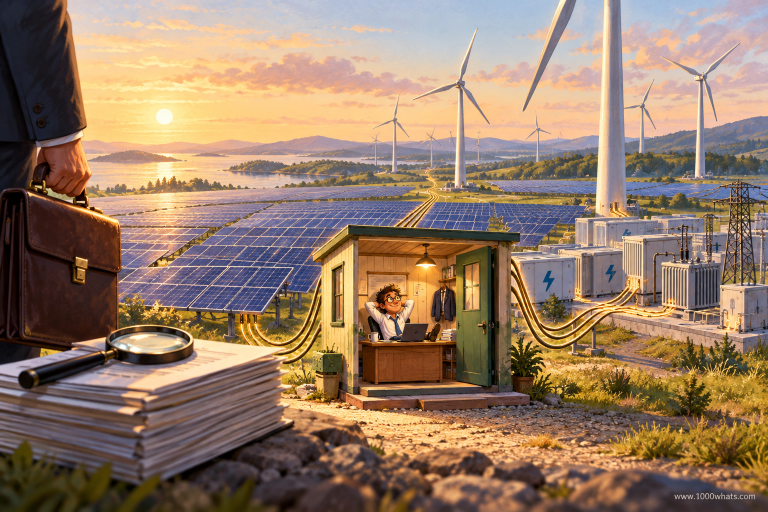
Suppose you wanted to build a power plant a hundred years ago.
Not a cute little rooftop solar setup. I mean a real one. Big boilers, tall stacks, spinning machines, wires stretching over the horizon — the whole industrial circus.
Who could do it?
Well, almost nobody.
You needed mountains of money, political blessing, engineering muscle, and the kind of institutional confidence normally associated with governments, armies, and very large utility companies with very serious stationery.
So for a long time, electricity was built the old-fashioned way: big, centralized, slow, and controlled by a small club of giants.
Then along comes a funny idea.
What if you did not need the whole giant utility to build the power plant?
What if a private company could build just the generation part, sell the electricity under contract, and leave the rest of the system to other players?
That little question cracked open a very big door.
And out of that door came the Independent Power Project, which sounds about as exciting as a tax form but is actually one of the most important changes in the modern energy business.
⚡ “An Independent Power Project is what happens when someone realizes the power plant and the power system do not have to be married forever.”
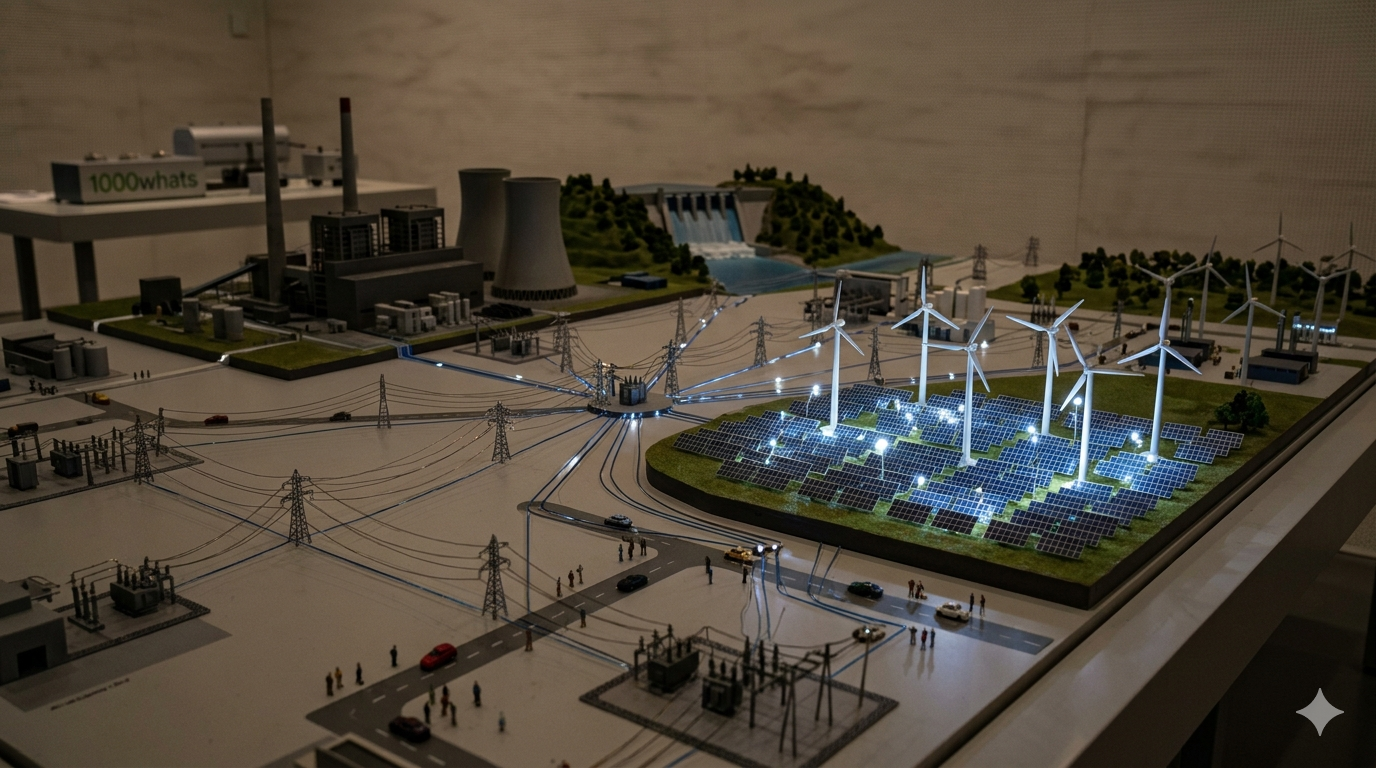
This is the part most people miss. Electricity feels like one big thing. You flip a switch, the light comes on, end of story. But underneath that simple act is an elaborate arrangement of physics, contracts, finance, regulation, and risk.
The IPP sits right in the middle of that arrangement.
And once you understand it, you start to see why so much of today’s solar, wind, and even conventional generation gets built this way.
Welcome to 1000whats, where big questions, odd ideas, and sharp answers come together.
What is an Independent Power Project?
Let’s not make this more mystical than it needs to be.
An Independent Power Project (IPP) is a power generation facility built and owned by a private entity rather than by the traditional state utility or vertically integrated monopoly.
That is the official-sounding answer.
Here is the human answer:
An IPP is a private company saying, “We’ll build the plant, you buy the electricity.”
That’s it.
Of course, hidden inside that innocent sentence is a jungle of permits, land rights, interconnection studies, financing documents, engineering contracts, political risk, weather assumptions, and spreadsheets dense enough to frighten a horse. But at the conceptual level, it is simple.
The company does not usually own the entire grid.
It does not necessarily sell directly to households.
It builds generation and sells the output to a utility, a government buyer, a corporate customer, or into a market.
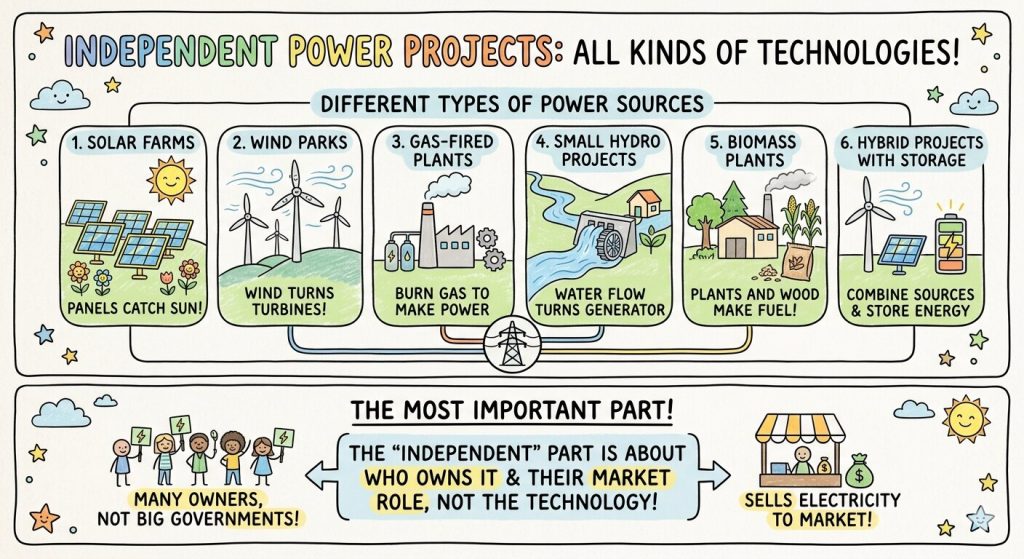
IPPs can take many forms:
- Solar farms
- Wind parks
- Gas-fired plants
- Small hydro projects
- Biomass plants
- Hybrid projects with storage
The important point is this: the “independent” part refers to ownership and market role, not the technology itself.📌
A solar farm can be an IPP. A gas plant can be an IPP. Even a diesel plant in a remote grid can be an IPP.
The machine may differ. The business model is the real story.
Why do IPPs exist at all?
Because the old model, useful as it was, had a problem. 😐
Actually, several problems.
If the whole power system depends on one giant utility to do everything — generation, transmission, distribution, customer billing, planning, financing — then the pace of expansion depends on how fast that one institution can move.
Sometimes that works beautifully.
Sometimes it moves with the agility of a refrigerator.
What most people don’t see is that building power is not just an engineering problem. It is also a capital allocation problem.
Who is going to put up the money?
Governments do not have infinite budgets. Utilities do not have infinite borrowing capacity. And the need for new electricity has grown much faster in many places than the traditional model can comfortably handle.
So the system evolved.
Instead of saying, “Only the utility may build generation,” policymakers in many markets started saying, “Fine. Let others build generation too, provided the rules are clear.”
That opened the door to private developers, project finance, and long-term contracts.
And just like that, electricity generation stopped being only a public monument and became, at least partly, a competitive business.
How does an IPP actually work?
Now we get to the fun part.
Because an IPP is one of those things that looks like steel and concrete on the outside, but is really made of cash flow logic.
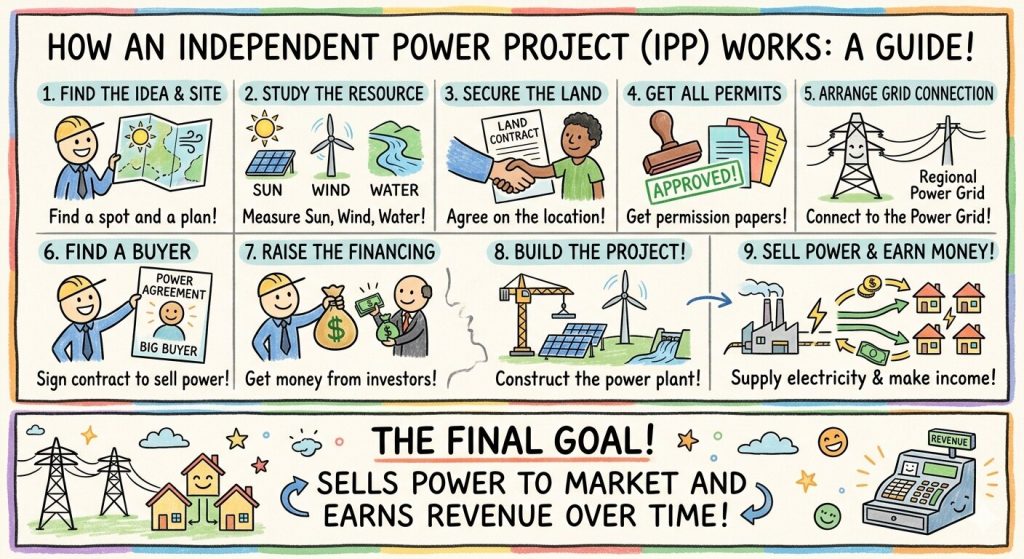
Here is the basic mechanism:
- A developer identifies a site and a project idea
- The resource is studied: sun, wind, gas supply, water, whatever matters
- Land is secured
- Permits are obtained
- A grid connection is negotiated
- A buyer agrees to purchase the electricity
- Financing is raised
- The project is built
- The project sells power and earns revenue over time
Simple enough.
But the beating heart of the whole thing is usually the power purchase agreement, or PPA.
That contract is the difference between “interesting idea” and “bankable project.”
If you are a lender, you do not care how poetic the sunrise looks over the solar farm. You want to know one thing: who is paying for the electrons, for how long, and under what terms?
That is why the contract matters so much.
⚡ “Banks do not finance sunshine. They finance predictable revenue attached to sunshine.”
In practice, the IPP model works because it converts a physical asset into a financial story that investors can understand.
That is the trick.
How are IPPs different from traditional power plants?
This is where people often get tangled up.
They imagine an IPP must be some exotic new kind of power plant.
Nope.
The turbine does not know who owns it.
The panel does not care whether the shareholder is a state utility, a pension fund, or a guy in a suit who says “infrastructure platform” too often.
The real difference is not what the machine is.
The difference is how the project is owned, financed, and paid for.
Traditional utility-owned model
In the traditional system, the utility often:
- Owns the plant
- Owns or controls the network
- Supplies the customer
- Recovers costs through regulated tariffs
IPP model
In the IPP model, the developer usually:
- Builds and owns the plant
- Sells electricity under contract or market rules
- Takes on specific project risks
- Depends on project finance or private capital
So the shift is subtle, but profound.
You go from one giant institution doing everything to a system where different pieces can be handled by different players.
That may not sound romantic, but it is revolutionary in a very practical way.
Why are IPPs important in the modern energy market?
Because they let the system do something it badly needs to do:
grow faster without asking one institution to carry the whole burden. 📌
That matters for several reasons.
| They unlock private capital | Power plants are expensive. Transmission lines are expensive. Everything in energy seems to require either concrete, copper, lawyers, or all three. IPPs bring in private investment, which means governments do not have to fund every megawatt themselves. |
| They increase competition | When multiple developers compete to supply electricity, prices can improve, project quality can rise, and complacency gets less room to nap. |
| They help scale renewables | This is one of the biggest stories in energy today. Solar and wind fit the IPP model beautifully because they can be developed as discrete projects and supported by long-term contracts. |
| They expand access | In some countries, IPPs have helped bring electricity online faster than the traditional public system could manage alone. |
| They spread risk | Instead of loading all generation risk onto the public balance sheet, the system distributes parts of that risk to private investors, lenders, contractors, and offtakers. From a market perspective, this is one reason IPPs became so influential: they are not just a technical alternative. They are a risk-organization tool. |
A simple real-world example
Imagine a company wants to build a 200 MW solar plant.
Now, here is the thing. The panels are not the first problem.
The first problem is money.
The company needs land, studies, permits, equipment, construction contracts, and a path to the grid. All of that costs real money before the project earns a single cent.
So how do they make the leap?
They sign a long-term PPA with a utility, government agency, or large corporation. That agreement says, in effect, “If you build this thing, we will buy the electricity under these terms.”
Suddenly the project stops looking like a gamble and starts looking like infrastructure.
Lenders step in. Investors step in. Construction begins.
That is the IPP model at work: turning future electricity sales into present-day finance.
If you want to understand why so many renewable projects exist today, this is one of the biggest clues.
What challenges do IPPs face?
Now let’s spoil the fairy tale slightly.
Because IPPs are powerful, but they are not magic.
Financing risk
These projects live or die by capital costs. If interest rates rise or investor confidence sours, economics can unravel quickly.
Regulatory uncertainty
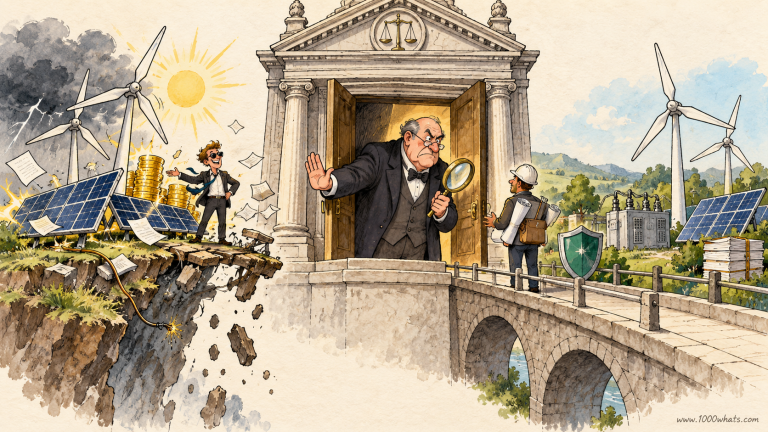
An IPP can handle many difficulties. What it cannot tolerate for long is chaos in the rulebook.
If the tariff system changes suddenly, permits drag forever, or contract enforcement looks shaky, the project becomes much harder to finance.
Grid connection bottlenecks
This is the hidden villain in many power markets.
People think the challenge is generating electricity. Often it is not. Often the real challenge is getting permission and infrastructure to deliver it.
Community opposition
Land use is never just a technical matter. It is social, political, and emotional too.
Offtaker risk
A contract is only as good as the buyer behind it. If the utility or government buyer has weak credit, the whole financing structure gets nervous.
⚡ “The hard part of an energy project is not usually the panel, the turbine, or the generator. It is getting the money, the permits, the grid, and the contract to behave at the same time.”
How do IPPs affect energy prices and accessibility?
Careful here.
People love broad slogans like “competition lowers prices,” and sometimes that is true. But energy is more mischievous than slogans.
IPPs can reduce electricity costs by encouraging efficient procurement and forcing bidders to compete.
But good results do not happen automatically.
A badly designed tender can lock in overpriced contracts.
A weak regulator can create perverse incentives.
A congested grid can erase the economic advantages of a cheap project.
So the honest answer is this:
IPPs can lower prices and improve access when the market design around them is competent.
That last part matters.
An IPP is not a miracle in a hard hat. It is a tool. And tools work only when used intelligently.
What role do IPPs play in renewable energy adoption?
A huge one. ⭐
Renewables have an unusual economic profile. They often cost a lot upfront, but once they are built, the fuel is free or close to it.
That changes the whole game.
A solar project does not worry about buying truckloads of sunshine. A wind farm does not receive invoices from the atmosphere. So if the upfront cost can be financed, the long-term economics become very attractive.
That is why the IPP model became such a natural vehicle for renewable deployment.
It provides:
- A structure for long-term revenue
- A way to attract private capital
- A mechanism for risk sharing
- A path to scale projects quickly
What most people don’t see is that the energy transition is not being built only by giant slogans like “net zero” and “decarbonization.”
It is being built through very specific contracts signed by very specific people for very specific projects on very specific pieces of land.
The IPP is one of the main vehicles that turns climate ambition into actual steel in the ground.
Independent Power Projects vs. Independent Power Producers
This part annoys people because the acronym gets reused.
- Independent Power Project = the project itself
- Independent Power Producer = the company that owns or operates one or more such projects
So one is the thing.
The other is the entity behind the thing.
A producer can own several projects. A project belongs to a producer.
The distinction is small, but useful.
Why IPPs matter right now
Because electricity demand is climbing, public budgets are strained, and clean energy deployment needs to move faster than old institutions often do on their own.
At the same time:
- Data centers are growing
- Transport is electrifying
- Industry is under pressure to decarbonize
- Utilities need more capacity
- Governments want private capital involved
That combination makes IPPs not just relevant, but central.
They are one of the practical answers to a very modern question:
How do you build a lot more electricity, quickly, without asking the state to do absolutely everything?
Final thoughts
Independent Power Projects are one of those ideas that sound technical and dry right up until you realize they changed the architecture of the power sector.
They took generation — once the exclusive territory of giant monopolies and state utilities — and turned it into something private capital could build, contract, finance, and scale.
That does not mean IPPs solve everything.
They do not replace good regulation.
They do not eliminate the need for grid planning.
They do not magically fix politics, permitting, or bad institutions.
But they do something enormously important:
They make it possible for money, engineering, and demand to meet in one place and produce actual power.
And in the end, that is what matters.
Not speeches.
Not strategy decks.
Not glossy energy-transition manifestos.
Electricity.
Real electricity. Delivered.
What do you think — are IPPs one of the smartest inventions in modern energy markets, or just a clever workaround for a system that still has deeper flaws?
Until next time, stay curious!
Discover more from 1000whats
Subscribe to get the latest posts sent to your email.