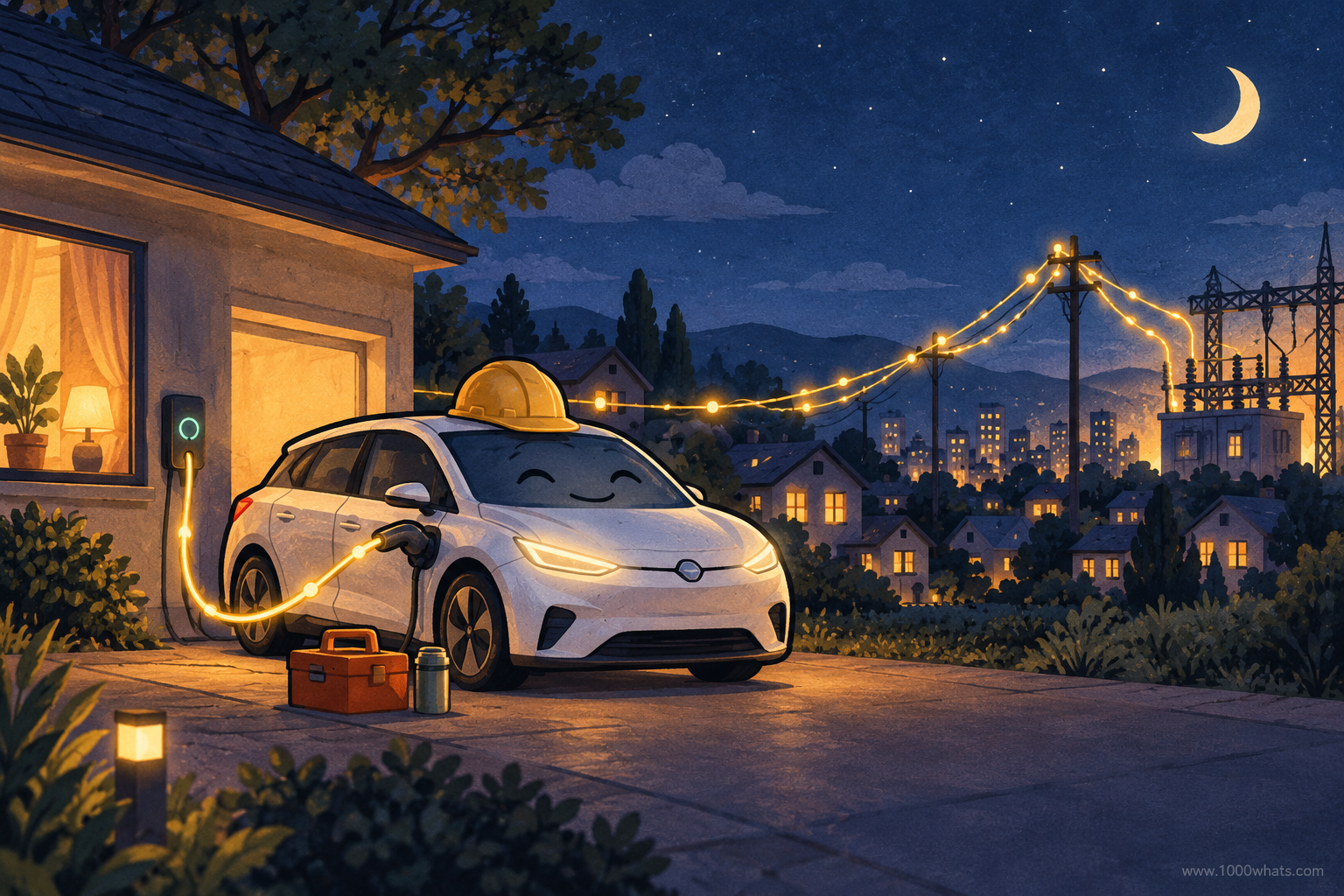
Your car has a strange career.
You drive it to work.
Park it.
Leave it there for eight hours.
Drive home.
Park it again.
Leave it there all night.
For something that costs tens of thousands of dollars, cars spend an impressive amount of time doing:
absolutely nothing.
An electric car makes this even more interesting because while it is sitting there, it may contain a battery storing 50, 70 or 100 kWh of electricity.
Enough energy to run an average household for quite a while.
And yet the battery sits in the driveway.
Waiting for Tuesday.
Welcome to 1000whats – where today your parked car gets a second job.
It is called:
vehicle-to-grid.
Or:
V2G.
And the idea is wonderfully simple.
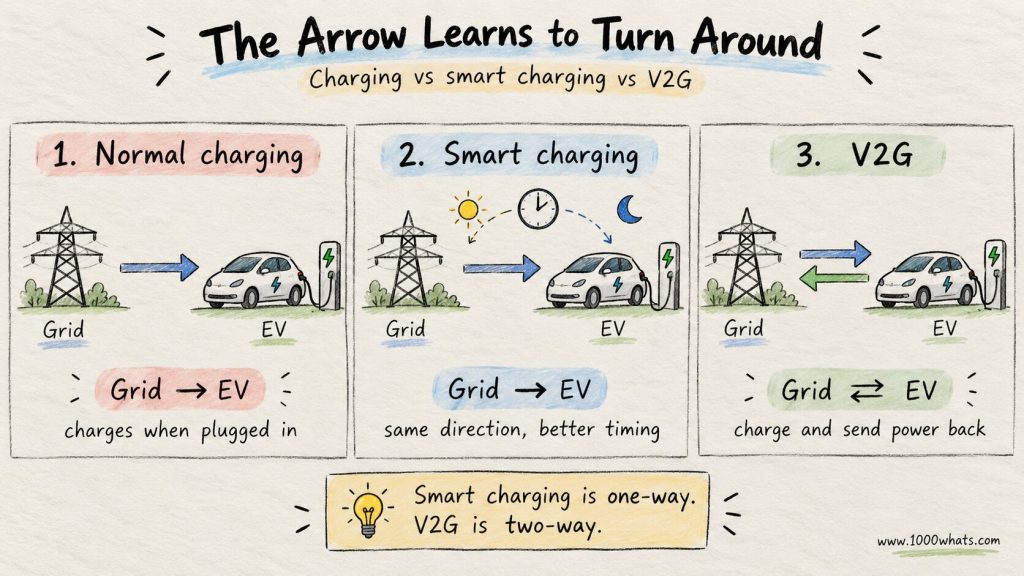
If electricity can flow:
grid → car
why not occasionally let it flow:
car → grid?
⚡ “An electric car is a vehicle when you drive it. When you park it, the power system sees something else: a battery with wheels.”
First, forget vehicle-to-grid
Before sending electricity back from the car, there is a much simpler thing we can do.
Choose when the car charges.
Suppose you arrive home at:
18:00.
You plug in your EV.
You need it again at:
07:00.
The simplest charger starts immediately.
Perhaps it draws:
7 kW.
That is unfortunate if 18:00 is already one of the busiest hours on the local electricity network.
People arrive home.
Cooking starts.
Heating or cooling is running.
Lights come on.
Then thousands of cars arrive and announce:
We would also like several kilowatts each, please.
The grid appreciates the enthusiasm.
But your car does not actually need electricity at 18:01.
It needs enough electricity by:
07:00 tomorrow.
That creates flexibility.
Instead of charging immediately, software can wait.
Perhaps electricity is cheaper at 02:00.
Perhaps wind production is high overnight.
Perhaps local demand is low.
Perhaps the distribution transformer has much more spare capacity after midnight.
So the car charges later.
Nothing has flowed from the car back into the grid.
We simply changed:
when electricity flowed into the car.
That is usually called:
smart charging
or:
V1G.
And it is already powerful.
The International Energy Agency’s 2026 V2G analysis makes this hierarchy explicit: controlled unidirectional charging can shift EV demand away from congested periods or toward periods with abundant electricity.
This is also a form of the flexibility we discussed in article on demand response.
But V2G goes one step further.
Now reverse the arrow
Imagine the same car.
You arrive home with:
60 kWh
in the battery.
You tell the charging system:
“I need at least 40 kWh when I leave at 07:00.”
That means 20 kWh is potentially flexible.
At 18:00, the electricity system is tight.
Prices are high.
Demand is high.
Solar production is disappearing.
Instead of charging, your car could temporarily discharge:
5 kW
back into the grid.
Later that night, conditions change.
Demand falls.
Electricity becomes cheaper.
Wind output increases.
The car charges again.
By 07:00:
you still have the 40 kWh you requested.
From the driver’s perspective:
the car is ready.
From the grid’s perspective:
something much more interesting happened.
The car behaved like a tiny storage plant.
The battery does not know it is inside a car
This sounds flippant, but it gets us surprisingly close to the engineering truth.
A battery stores energy chemically.
It does not care whether it lives inside:
a home battery,
a grid-scale battery,
or:
a car.
The important differences come from how that battery is designed, controlled, connected and used.
A parked EV already contains the basic ingredient needed for electricity storage:
a large rechargeable battery.
What V2G adds is the ability to connect that battery safely and intelligently to the electricity system in both directions.
That requires more than a cable.
The car, charger and grid need to know things such as:
- how much energy is in the battery;
- how much the owner wants available later;
- how fast the battery may charge or discharge;
- whether the grid currently needs flexibility;
- what electricity costs;
- whether exporting is allowed;
- and who gets paid.
The electrons are the easy part.
Then software, standards, metering, regulation and contracts arrive.
Energy has become normal again.
Wait. EV batteries store DC. The grid uses AC.
Correct.
The traction battery in an EV stores:
DC electricity.
Most electricity grids distribute:
AC electricity.
So power has to be converted.
During ordinary AC charging:
AC from the grid is converted into DC for the battery.
During V2G discharge:
DC from the battery must become grid-compatible AC.
Where that conversion happens depends on the architecture.
In an AC bidirectional system, the vehicle contains the power electronics needed to export grid-compatible AC.
In a DC bidirectional system, DC leaves the battery and an external bidirectional charger performs the conversion.
The IEA notes that this distinction affects where responsibilities such as grid-frequency measurement and grid-code compliance sit. In AC V2G, much of that functionality sits inside the vehicle. In DC V2G, more sits inside the external charger.
Either way, the important point is:
you cannot simply run an extension cord from the battery to the national grid and wish everyone good luck.
A resource exporting electricity has to behave properly.
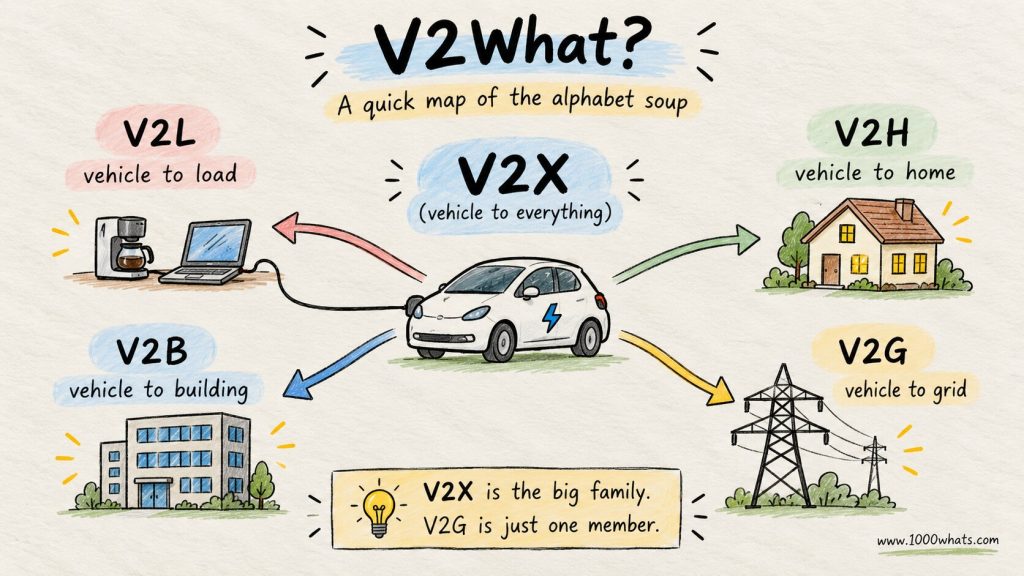
Vehicle-to-grid is actually one member of a family
This is where the alphabet starts breeding.
You may see:
V1G
V2L
V2H
V2B
V2G
and:
V2X
They describe related but different things.
| Term | What the EV does |
|---|---|
| V1G | Charges intelligently, but electricity flows only into the car |
| V2L | Powers an appliance or external load |
| V2H | Supplies electricity to a home |
| V2B | Supplies electricity to a building |
| V2G | Exports electricity into the power grid |
| V2X | Umbrella term for the wider family of bidirectional uses |
The U.S. Department of Energy describes bidirectional EVs as mobile storage capable of supporting buildings, microgrids and the wider grid.
The distinctions matter.
If your EV keeps your refrigerator running during a blackout:
that is not necessarily V2G.
It may be:
V2H.
If you plug a power tool into the vehicle at a campsite:
V2L.
If thousands of cars respond to a grid signal and export power through their chargers:
now we are talking about:
V2G.
Marketing departments occasionally place all of this under one enormous V2X umbrella.
Engineers then spend the next meeting unpacking the umbrella.
One car is not particularly exciting
Suppose your EV can export:
7 kW.
Nice.
The electricity system is dealing in:
megawatts
and:
gigawatts.
Your heroic little 7 kW is not going to rescue the national grid.
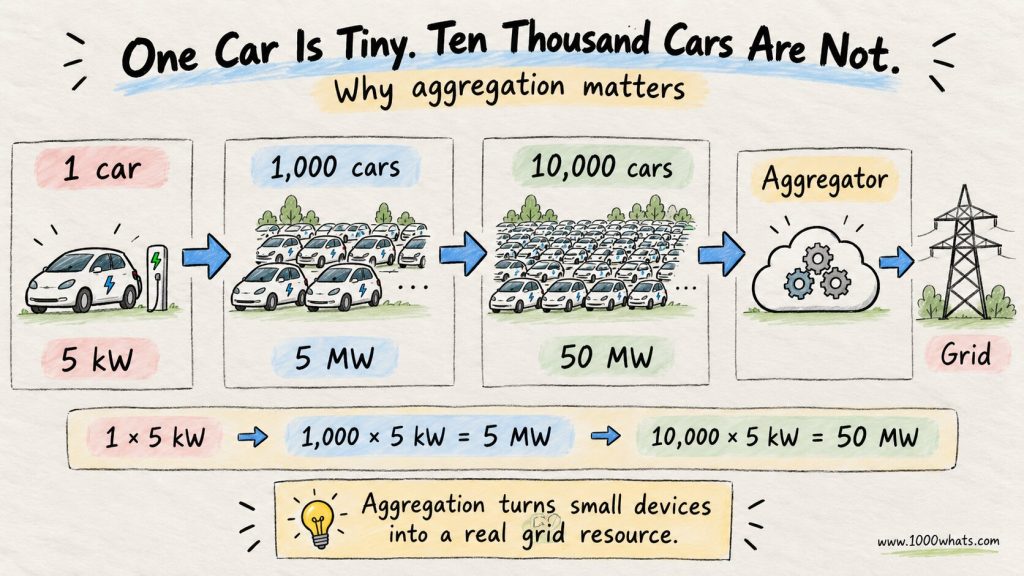
But now imagine:
10,000 cars.
Each can provide:
5 kW.
Together:
50 MW.
Now imagine:
100,000 cars.
At 5 kW each:
500 MW.
We have suddenly stopped talking about a quirky charger feature.
We are talking about:
power-system flexibility.
This is where V2G connects naturally to the idea of a Virtual Power Plant.
Thousands of individually insignificant devices can be coordinated by software and an aggregator.
One car:
tiny.
A fleet:
interesting.
A million connected cars:
now the TSO may return your call.
⚡ “V2G becomes a power-system resource not when one car can discharge, but when thousands of cars can be coordinated.”
The aggregator is the person who stops this becoming ridiculous
Imagine a grid operator calling individual EV owners.
“Hello, Bratislav. Lovely evening. Could we have 3.7 kW from your car for the next 17 minutes?”
This does not scale particularly well.
Instead, an aggregator can coordinate a portfolio.
The owner provides constraints:
I leave at 07:00.
I want at least 70% state of charge.
Do not discharge below 40%.
The grid or market provides signals:
electricity price,
network congestion,
balancing need,
capacity requirement,
or another flexibility request.
Software then optimizes the fleet.
Car 1 may charge.
Car 2 may wait.
Car 3 may discharge.
Car 4 may do nothing because its owner is leaving in 20 minutes.
The grid does not need to care which particular Nissan, Renault, Hyundai or Volkswagen did what.
It cares about the aggregate response.
The IEA says current commercial V2G approaches commonly use backend systems run by aggregators to combine grid-side signals with vehicle information such as state of charge, cycling constraints and expected departure time.
This is what most people miss about V2G.
The interesting technology is not merely:
a reversible charger.
It is the coordination system around it.
So what can the grid actually use the cars for?
Several things.
Move electricity through time
Charge when electricity is abundant or cheap.
Discharge when it is scarce or expensive.
That is essentially energy arbitrage performed by a mobile battery.
Reduce peak demand
Instead of adding EV charging to an evening peak, V2G can potentially do the opposite and export during that peak.
Help with local network congestion
Smart charging can avoid making a constrained transformer or feeder worse.
In some settings, bidirectional operation may provide additional local flexibility.
Provide grid services
Aggregated EVs can potentially respond to frequency or other system-service requirements where market rules allow participation.
The IEA specifically identifies frequency regulation as one potential source of V2G revenue.
Increase renewable-energy utilization
Suppose solar production is enormous at 13:00.
Electricity is cheap.
Cars charge.
At 19:00:
solar disappears,
demand remains high,
cars discharge some of that energy.
The car has shifted electricity through time.
This is the same basic trick as stationary battery storage.
The difference is that tomorrow morning the battery may drive away.
Which is slightly inconvenient for the power-system planner.
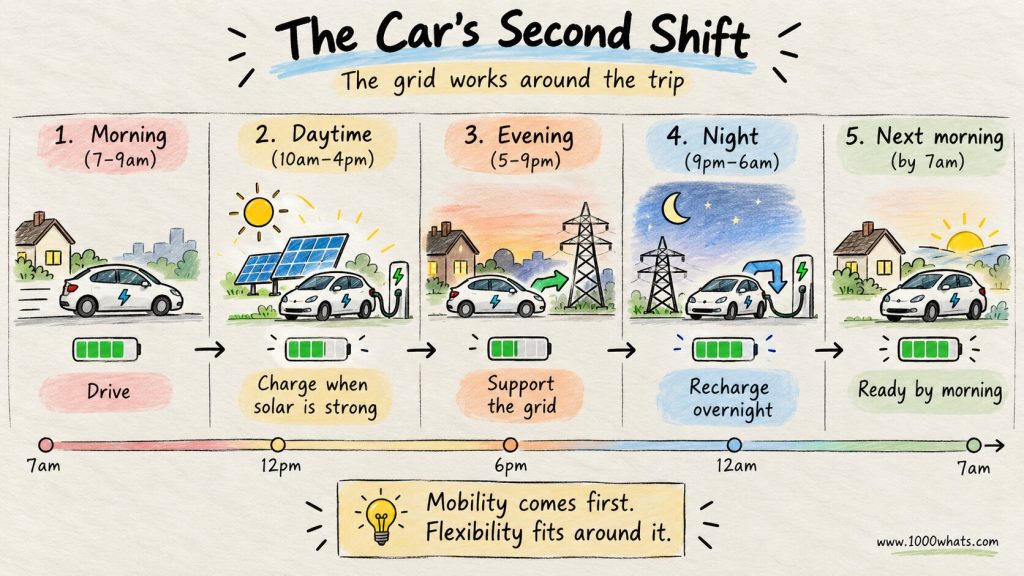
Let’s build one ridiculously simple day
Imagine an EV with:
70 kWh battery capacity.
The owner arrives at work at:
08:30
with:
45 kWh remaining.
The car will remain parked until:
17:00.
The owner wants:
at least 40 kWh
at departure.
Now look at the electricity system.
At 11:00:
solar production is rising.
At 13:00:
electricity is abundant.
At 18:30:
demand is high and solar has fallen sharply.
A smart charging strategy might charge the car from:
45 → 60 kWh
during the solar-rich period.
Fine.
V2G goes further.
Suppose the car arrives home around 18:00 and remains connected.
Between 18:30 and 20:00, it discharges:
10 kWh.
Later overnight, it recharges.
At 07:00:
the owner still has the requested energy.
The battery has performed two jobs:
transportation
and:
electricity flexibility.
The driver’s battery comes first
This deserves emphasis.
The purpose of an EV is still:
driving.
A V2G system that repeatedly leaves people with insufficient range will enjoy a very short commercial life.
So useful V2G control starts with mobility constraints.
The owner may specify:
departure time,
minimum state of charge,
desired range,
minimum battery reserve,
or whether the vehicle can participate at all.
Only the remaining flexibility is available to the power system.
This changes the mental model.
The grid does not receive:
the battery.
It receives:
whatever part of the battery’s flexibility the owner does not currently need.
That may be a lot.
It may be nothing.
At 03:00 with the car parked until morning:
potentially useful.
Five minutes before a 400 km road trip:
please leave the battery alone.
But doesn’t V2G destroy the battery?
Now we reach the question everybody asks approximately nine seconds after hearing about V2G.
Battery degradation is real.
Lithium-ion batteries age through:
calendar aging
and:
cycling.
Charging and discharging create wear.
Temperature matters.
State of charge matters.
Depth of discharge matters.
Charging rate matters.
Battery chemistry matters.
So yes:
additional V2G cycling can contribute to battery degradation.
That means any sensible V2G business case has to ask:
Is the value created by using the battery greater than the additional degradation cost?
But the answer is not automatically:
“V2G kills batteries.”
The control strategy matters enormously.
A system might use only a narrow state-of-charge range.
It may avoid deep cycling.
It may reserve V2G for high-value events.
It may optimize around battery temperature and manufacturer limits.
The IEA notes that battery-management systems in V2G applications need to enforce state-of-charge and temperature constraints specifically to limit degradation from additional cycling.
This is one reason V2G is not simply:
plug car in, sell battery until empty, repeat until warranty department develops chest pain.
And who gets paid?
Excellent question.
If your €40,000 car helps the electricity system, you will probably want more than a thank-you email.
Potential value can come from:
avoiding expensive charging periods,
selling electricity during higher-priced periods,
providing grid services,
reducing building demand charges,
supporting local network flexibility,
or participating through an aggregator.
The exact revenue depends enormously on:
market design,
tariffs,
taxes,
network charges,
connection rules,
available services,
battery costs,
and how often the vehicle is actually plugged in.
The IEA estimates that early V2G offerings can produce benefits to owners on the order of hundreds of dollars per year in some cases, while the economics of bidirectional chargers vary significantly between lower-cost AC systems and more expensive DC systems.
That last point matters.
A €500 annual opportunity does not justify a €10,000 hardware problem particularly elegantly.
Economics remains stubbornly involved.
There is also an awkward electricity-pricing problem
Suppose you charge your car with:
10 kWh.
You pay:
energy price,
network charges,
taxes,
levies,
and whatever else your tariff contains.
Then you export 5 kWh.
What exactly happens financially?
Are you paid the wholesale value?
Retail value?
A special flexibility tariff?
Do network charges apply twice?
How is exported energy metered?
Who is the supplier?
Who is the aggregator?
Who carries balancing responsibility?
Can a mobile battery participate in the relevant market?
These questions are not side details.
They can decide whether V2G is economically attractive at all.
Germany, for example, removed double grid fees for bidirectional charging at the end of 2025, according to the IEA. Commercial offers followed.
Sometimes the battery is ready before the tariff is.
Energy regulation appreciates tradition.
The car and charger also need to understand each other
This sounds obvious until you attempt it.
Imagine buying:
a V2G-capable car
and:
a V2G-capable charger
and discovering that they cannot perform V2G together.
Welcome to interoperability.
The car has to communicate information and instructions with the charger.
The charger has to communicate with backend systems.
The backend may need to communicate with:
aggregators,
utilities,
distribution operators,
market platforms,
or other actors.
A major technical foundation is the ISO 15118 family of standards, which covers communication between EVs and charging equipment and explicitly includes energy transfer from the EV battery back toward homes, loads or the grid.
The newer ISO 15118-20 framework provides standardized support for bidirectional power transfer through CCS.
But “there is a standard” and “everything interoperates beautifully” are not the same sentence.
The IEA reported in May 2026 that interoperability between available V2G cars and chargers remained extremely limited, partly because implementations still differ between manufacturers.
The standard exists.
Now everybody has to agree on how to use it.
Meetings will be held.
How common is V2G today?
Not very.
That is important because V2G is sometimes discussed as though millions of cars are already operating as one giant continental battery.
They are not.
The IEA counted 22 EV models with identified V2G capability in 2026, representing less than 1.5% of EV models. More vehicles support some broader form of bidirectional operation such as V2H or V2L, but full grid export remains relatively rare.
Chargers are similarly limited.
Commercial projects exist.
Pilots are multiplying.
Standards are improving.
But this is still an emerging system rather than ordinary household infrastructure.
China announced 30 V2G pilot projects across nine cities in 2025 and is targeting 5,000 V2G charging facilities by the end of 2027. Brazil authorized a V2G pilot in 2026, while pilots and early commercial arrangements are also appearing in Korea, Australia and Europe. IEA
So the interesting question is no longer:
Can V2G technically work?
It can.
The harder question is:
Can millions of cars, chargers, tariffs, standards, owners, aggregators and electricity markets be made to cooperate cheaply enough that normal people actually want to use it?
That is a considerably more energy-industry question.
Why not just build stationary batteries?
Sometimes we should.
A grid battery has one enormous advantage over your car:
it does not suddenly announce that it is going to Croatia.
Stationary batteries can be located where the grid needs them.
Their availability is easier to predict.
They can be optimized entirely around electricity-market opportunities.
Nobody needs them for the school run.
EVs have different advantages.
Their batteries have already been purchased primarily for:
transportation.
If millions of those batteries spend large portions of the day connected and underused, extracting some additional grid value from them may be attractive.
So V2G is not:
EVs instead of grid batteries.
The more interesting question is:
Why ignore useful flexibility sitting inside assets society is buying anyway?
The same logic sits behind demand response.
We do not always need to build another resource.
Sometimes we can use an existing one more intelligently.
⚡ “The most interesting V2G battery is not a battery the grid had to buy. It is a battery somebody already bought because they wanted a car.”
But availability is the catch
Suppose a power system theoretically contains:
10 million EVs
with:
60 kWh each.
Multiply those numbers and you get:
600 GWh.
That sounds enormous.
It is also misleading.
Not every vehicle is:
plugged in,
V2G capable,
available,
at a useful state of charge,
connected at sufficient power,
in the right location,
or willing to discharge.
Theoretical battery capacity is not the same thing as:
dispatchable grid capacity.
This is exactly the sort of distinction that matters in real power systems.
A million batteries driving down the motorway are impressive transportation assets.
As grid storage, they are currently:
busy.
So V2G potential depends as much on:
connection behavior
as on battery size.
Fleet vehicles can therefore be particularly interesting.
Buses.
Delivery vans.
Municipal vehicles.
Corporate fleets.
They often have:
predictable routes,
known parking locations,
centralized charging,
and relatively clear schedules.
A depot full of parked electric vans is easier to coordinate than 4,000 strangers whose Saturday plans remain confidential.
V2G could also help with resilience
Now move away from electricity markets.
Imagine a power outage.
A conventional EV may contain 60 kWh of stored energy.
Your house is dark.
The battery is sitting five meters away.
This arrangement begins to feel personally offensive.
With suitable bidirectional equipment, the vehicle can potentially supply:
a home,
a building,
or:
part of a microgrid.
The U.S. Department of Energy highlights this resilience role particularly for fleets and critical facilities, where mobile EV storage can supplement stationary resources or backup generation.
Strictly speaking, this may be V2H or V2B rather than V2G.
But it reveals something important about bidirectional charging.
The EV battery stops being useful only when the car is moving.
It becomes:
mobile energy infrastructure.
That is a much bigger idea.
The power system sees EVs very differently from drivers
A driver sees:
range.
Charging time.
Battery percentage.
Where is the nearest charger?
Can I reach Vienna?
The electricity system sees:
MW.
MWh.
connection point.
availability.
ramp rate.
state of charge.
flexibility window.
These are two completely different views of the same machine.
And V2G has to satisfy both.
The driver must get:
mobility.
The grid wants:
flexibility.
If either side loses, the model fails.
A power system cannot treat cars as batteries that inconveniently contain humans.
And drivers will not volunteer their cars for grid support if participation is complicated, poorly paid or interferes with mobility.
The successful version of V2G will therefore probably feel:
boring.
Plug in.
Tell the car when you need it.
Software handles the rest.
Wake up.
Drive away.
Receive a lower bill or some revenue.
No control-room cosplay required.
So could millions of EVs become one giant battery?
Sort of.
But that phrase can also mislead.
They will never behave exactly like one stationary battery.
They are distributed across thousands of network locations.
Their owners have different schedules.
They connect and disconnect.
Their state of charge changes.
Some are available.
Some are driving.
Some owners participate.
Others do not.
The more accurate mental model is:
a giant population of small, mobile batteries whose available flexibility can be aggregated.
That is messier.
It is also potentially more powerful.
The IEA argues that smart charging and V2G can reduce peak demand and potentially reduce the need for some future grid investment, while creating opportunities for EV owners to be compensated for providing flexibility.
But the word:
potentially
is doing real work there.
The value appears only if the vehicles are connected:
at the right place,
at the right time,
with compatible hardware,
working communication,
sensible tariffs,
and market access.
That is a lot of “ifs.”
Energy transitions are built from “ifs.”
What is vehicle-to-grid in one sentence?
Vehicle-to-grid is a system that allows a connected electric vehicle to send electricity from its battery back into the power grid, usually under controlled conditions that protect the driver’s mobility needs.
But the better mental model is:
the parked car gets a second shift.
When you drive it:
transportation.
When you park it:
potential flexibility.
Sometimes it charges.
Sometimes it waits.
Sometimes it may discharge.
And sometimes the smartest thing it can do for the grid is:
absolutely nothing.
That is flexibility too.
Final thoughts
Electric vehicles are usually discussed as:
new electricity demand.
And that is true.
Millions of EVs will require enormous amounts of electricity.
Plug them all in at the wrong time and they can make local peaks, congestion and infrastructure requirements worse.
But that is only half the story.
EV demand is unusual because much of it is:
flexible.
The car may sit parked for ten hours while needing only three hours of charging.
Smart charging can exploit that gap.
Vehicle-to-grid goes further.
It says the battery does not always have to be the destination of electricity.
Sometimes it can become the source.
That does not turn every EV into a miniature power station.
Battery degradation matters.
Charger cost matters.
Standards matter.
Interoperability matters.
Tariffs matter.
Market access matters.
And above everything else:
the owner still needs a car.
But the basic idea is difficult to unsee once it clicks.
We are building millions of large batteries.
Then parking them for most of the day.
Perhaps the strangest outcome would be never asking whether the electricity system could occasionally borrow them.
After all, your car already has a day job.
V2G simply asks whether it wants a side hustle.
Until next time, stay curious! 😎
Discover more from 1000whats
Subscribe to get the latest posts sent to your email.