Suppose I tell you the grid is in trouble.
What do you picture?
Probably something dramatic. A giant turbine breaking. A smokestack coughing. Engineers running around with clipboards and worried faces.
But often the problem is much sillier than that.
The problem is that everybody wants electricity at the same time.
That’s it.
It’s a hot afternoon. Everyone turns on the AC. Then they plug in the car. Then they cook dinner. Then the water heater decides this is also a wonderful moment to wake up and do its thing.
The grid, poor beast, has to serve all of that at once.
So the old solution was: build another big power plant.
Fair enough.
But the newer solution is much more interesting. Instead of making one giant machine somewhere far away, you ask a question:
Could thousands of little machines, already sitting in homes and garages, work together instead?
That question gives you the virtual power plant.
⚡ “A VPP is what you get when a pile of ordinary gadgets stops behaving like a pile and starts behaving like a system.”
Welcome to 1000whats — where energy jargon gets stripped down, explained, and made so clear you can’t unsee it.
What is a virtual power plant?
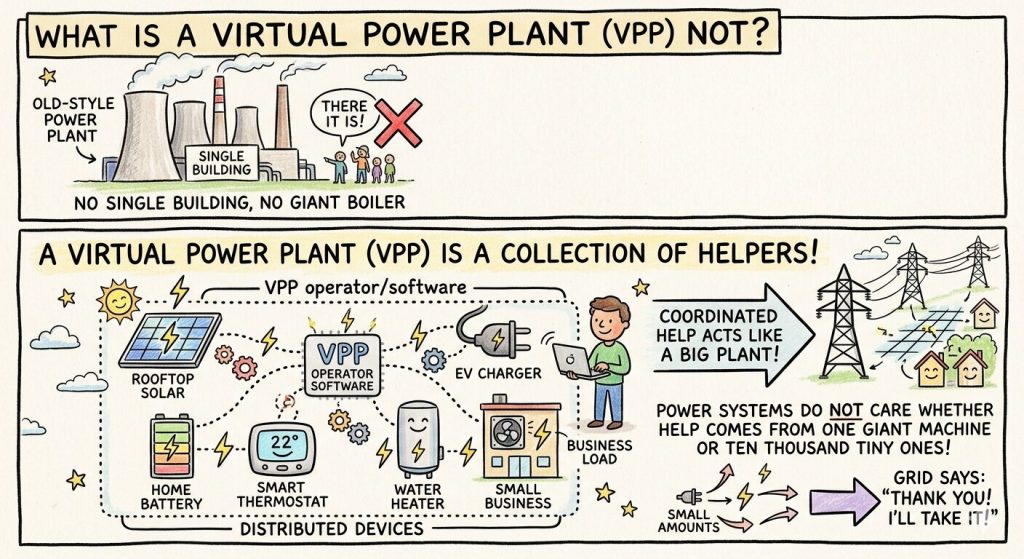
A virtual power plant is not a power plant in the usual sense.
You cannot drive out to it and point and say, “There it is.”
There’s no single building. No giant boiler. No fence with stern warnings.
Instead, a VPP is a collection of distributed devices:
- home batteries
- rooftop solar systems
- smart thermostats
- EV chargers
- water heaters
- sometimes business loads too
These things are connected and coordinated so they can act together like one power plant.
That’s the trick.
Any one of these devices by itself is small. Almost laughably small compared to a traditional plant.
But power systems do not care whether help comes from one giant machine or ten thousand tiny ones. If the total effect is the same, the grid says, “Thank you very much, I’ll take it.”
So a VPP is a power plant made out of coordination.
Why is it called virtual?
Now here’s where the name causes mischief.
People hear “virtual” and think: fake. Imaginary. Like a video game power station.
No.
It’s called virtual because it behaves like one power plant without existing as one physical object in one place.
That’s all.
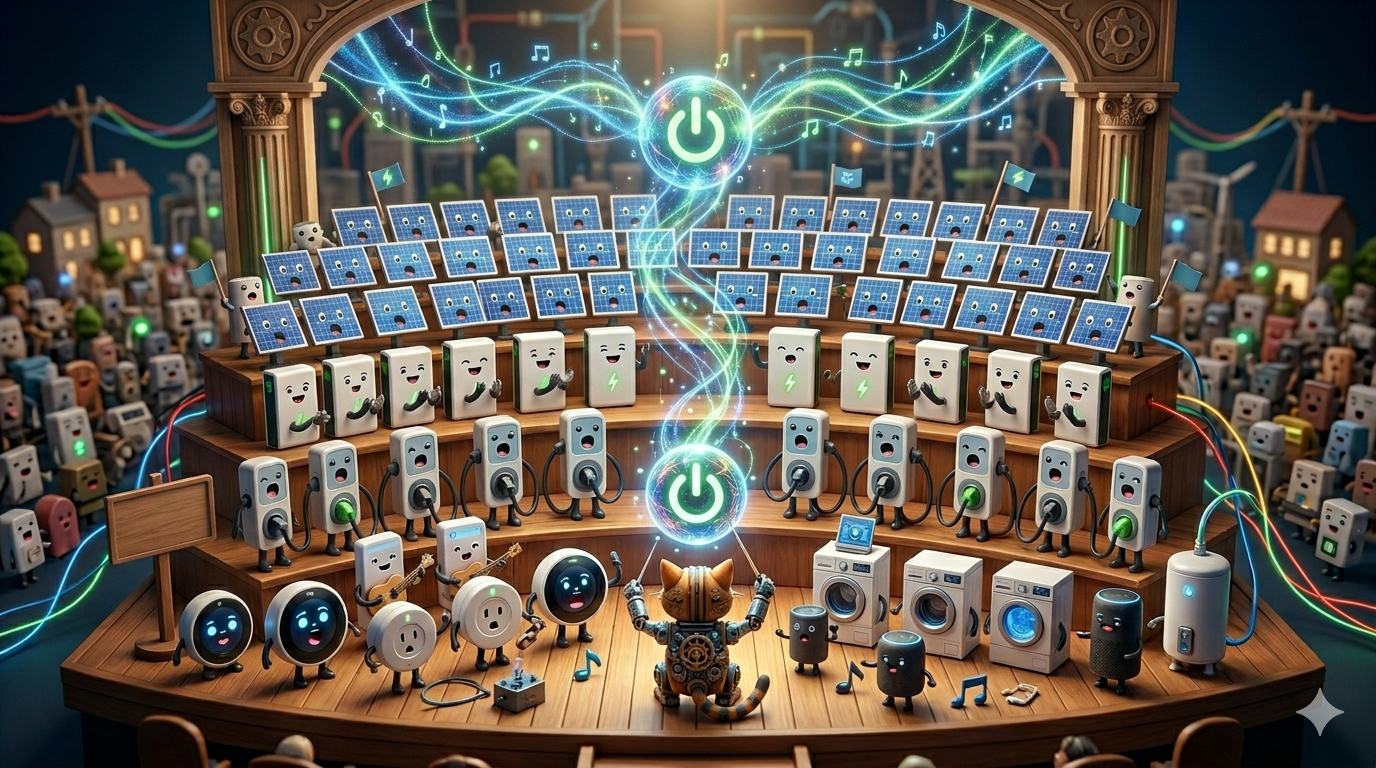
Think about a school orchestra.
The violin is in one chair. The flute is in another. The drummer is at the back making trouble. Each instrument is in a different place, making its own strange noises.
But when the conductor gets them all playing together, you no longer think of them as random individuals. You think of them as one orchestra.
A VPP is the same sort of thing.
One battery is in a garage.
One thermostat is in a hallway.
One EV charger is on a driveway.
One water heater is in a basement.
Scattered all over the place.
Yet, if they respond together, they can do the job of a power plant.
So the plant is real. The electricity is real. The savings are real. The only “virtual” part is that the machine is assembled by software instead of concrete.
⚡ “A virtual power plant is not fake power. It’s real power from devices that happen to live far apart.”
Why do we need such a thing?
Because electricity is a timing problem disguised as a machinery problem.
That’s what most people don’t see.
If everybody in a city uses a little electricity at different times, life is easy.
If everybody wants a lot of electricity at exactly 6:30 p.m., life gets expensive.
Now you need extra capacity for a few nasty hours. Maybe you fire up expensive plants. Maybe you overload local equipment. Maybe you start talking about billions in grid upgrades.
But suppose, instead, you could shave that peak a little.
Not with heroics. Just with many tiny adjustments.
One thermostat cools a home a bit earlier.
One EV waits an hour to charge.
One battery discharges during the rush.
One water heater stays quiet for a while.
Each action is small enough that the homeowner may hardly notice it.
But the grid notices.
And that’s the whole game: small changes, synchronized.
Who runs the show?
Now this is the part people are right to be suspicious about.
Because devices do not form committees.
Your thermostat does not gather the batteries and say, “Friends, today we serve civilization.”
Someone has to coordinate all this.
Usually that someone is a VPP operator, often called an aggregator.
That’s the entity running the software, watching grid conditions, and sending signals to devices.
So when demand rises or the grid gets stressed, the operator says, in effect:
- you batteries, discharge a bit
- you chargers, pause for now
- you thermostats, ease back slightly
- you flexible loads, wait until later
It’s not random. It’s organized.
Think of a conductor leading an orchestra, or maybe an air traffic controller keeping many planes from doing something regrettable.
The operator doesn’t create the electricity from scratch. It coordinates what already exists.
The cast of characters
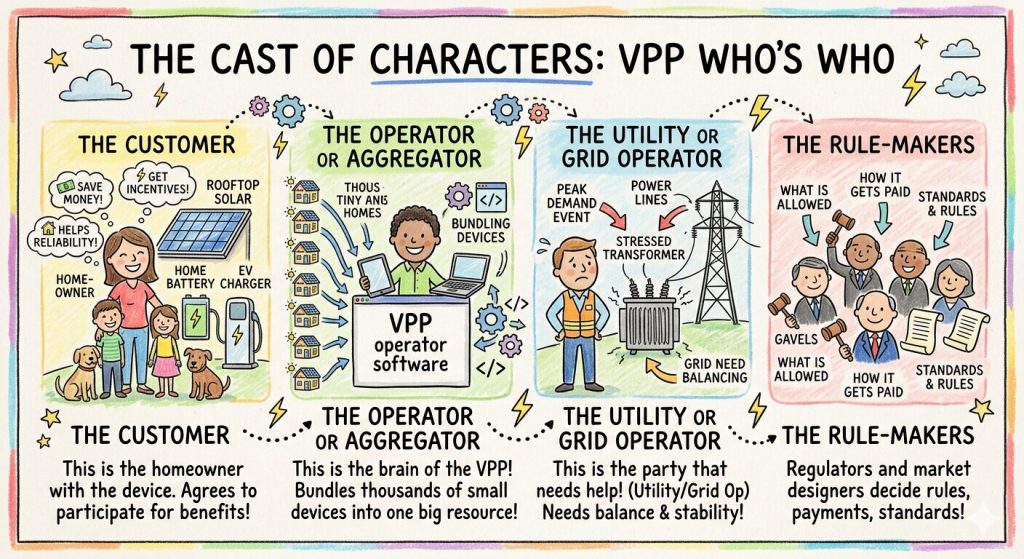
The customer
This is the homeowner or business with the device.
They agree to participate because they might save money, earn incentives, or support reliability.
The operator or aggregator
This is the brain of the VPP.
It bundles thousands of small devices into one useful resource.
The utility or grid operator
This is the party that needs help.
Maybe there’s a peak demand event. Maybe a local transformer is stressed. Maybe the grid needs balancing.
The rule-makers
Regulators and market designers decide what is allowed, how it gets paid, and what standards must be met.
So who runs the VPP?
Usually not the utility directly, not the device manufacturer alone, and certainly not the toaster.
It’s the operator coordinating the fleet.
⚡ “The intelligence of a VPP is not in any one gadget. It’s in the arrangement.”
How does a virtual power plant work?
Let’s make it embarrassingly simple.
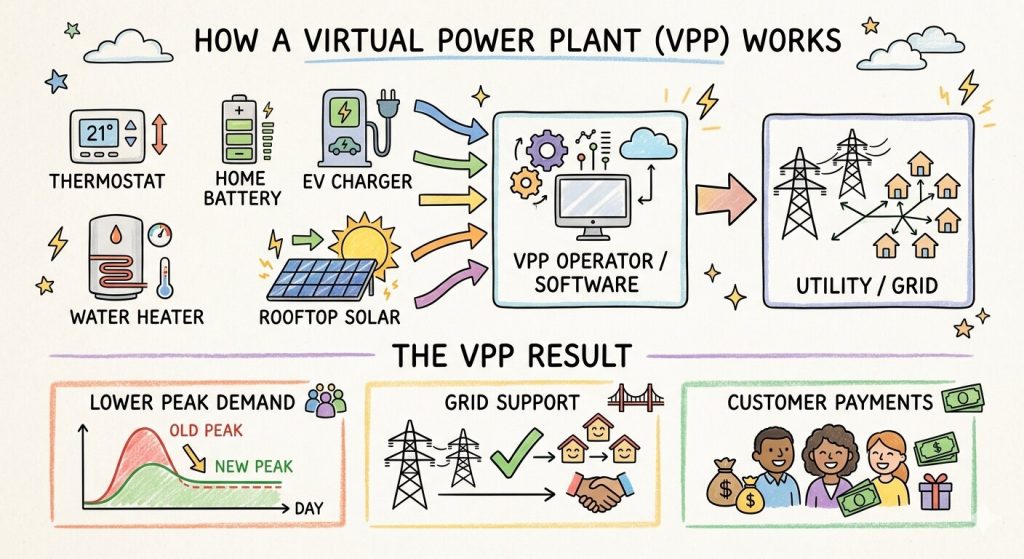
Step 1: Devices join the club
A homeowner signs up a battery, thermostat, EV charger, or another controllable device.
Step 2: The operator watches the grid
Demand, prices, weather, local constraints, all the things that make electricity either easy or troublesome.
Step 3: Trouble appears
Maybe it’s a hot evening. Maybe prices jump. Maybe the local network is getting crowded.
Step 4: The operator sends signals
Not dramatic signals. Tiny ones.
A few minutes here. A short pause there. A little discharge from batteries. A little delay in charging.
Step 5: The grid gets relief
Add up all those tiny actions and suddenly you have something useful at scale.
This is one of the most important ideas in energy:
the grid doesn’t care whether 20 megawatts comes from one machine or from twenty thousand smaller ones, if they arrive when needed.
That is the genius of the VPP.
A simple example
Suppose 10,000 homes each have a smart thermostat.
Now suppose each thermostat reduces air conditioning by just a smidge for fifteen minutes.
A smidge is not a technical term, but it should be.
Any one home barely changes.
But 10,000 homes changing a little at once can produce a very real drop in demand.
Now add batteries.
Now add EV chargers that wait until later.
Now add solar systems and water heaters.
At that point, you are no longer dealing with isolated gadgets. You are dealing with a coordinated machine made of many pieces.
Like marbles in a tube, each one doesn’t do much by itself. But when arranged properly, they transmit an effect.
Why this matters today
Because the grid is changing shape.
Homes are no longer just places that consume electricity. They are starting to generate it, store it, shift it, and respond to it.
That is new.
A house with rooftop solar and a battery is not just a hungry customer anymore. It is a tiny energy actor. Add software and coordination, and now it can participate in something bigger.
From a market perspective, this is a real change in the nature of the grid. It means flexibility can come from the edges, not only from the center.
And that matters because building giant infrastructure is slow, expensive, and sometimes necessary, but not always the first clever move.
Sometimes the clever move is to ask:
What useful things are already plugged in?
Pros and cons of virtual power plants
The good part
- They can reduce stress during peak demand
- They can make better use of devices people already have
- They can delay some expensive grid upgrades
- They can help integrate more solar, batteries, and EVs
- They can give customers a more active role in the energy system
The annoying part
- Coordination is complicated
- Different devices and brands must play nicely together
- Customers need clear savings and trustworthy control
- Rules and markets are still catching up
- A VPP helps the grid, but it does not replace the whole grid
This is worth emphasizing.
A VPP is not magic.
It does not abolish transmission lines. It does not make winter disappear. It does not repeal the laws of thermodynamics.
What it does is make the system less stupid.
And that is already a tremendous achievement.
⚡ “Much of engineering is not about doing the impossible. It’s about stopping the unnecessary.”
Final thoughts
A virtual power plant sounds like a buzzword cooked up by a committee in expensive shoes.
But underneath the silly name is a beautifully practical idea.
Don’t ask one giant machine to do everything.
Ask thousands of smaller machines to cooperate.
That’s all.
And once you see it that way, the thing becomes almost obvious.
The future grid may not just be bigger.
It may be smarter, more scattered, and better coordinated.
Which is, in a way, how many good systems work.
Not by brute force.
By arrangement.
Until next time, stay curious! 😎
Discover more from 1000whats
Subscribe to get the latest posts sent to your email.