

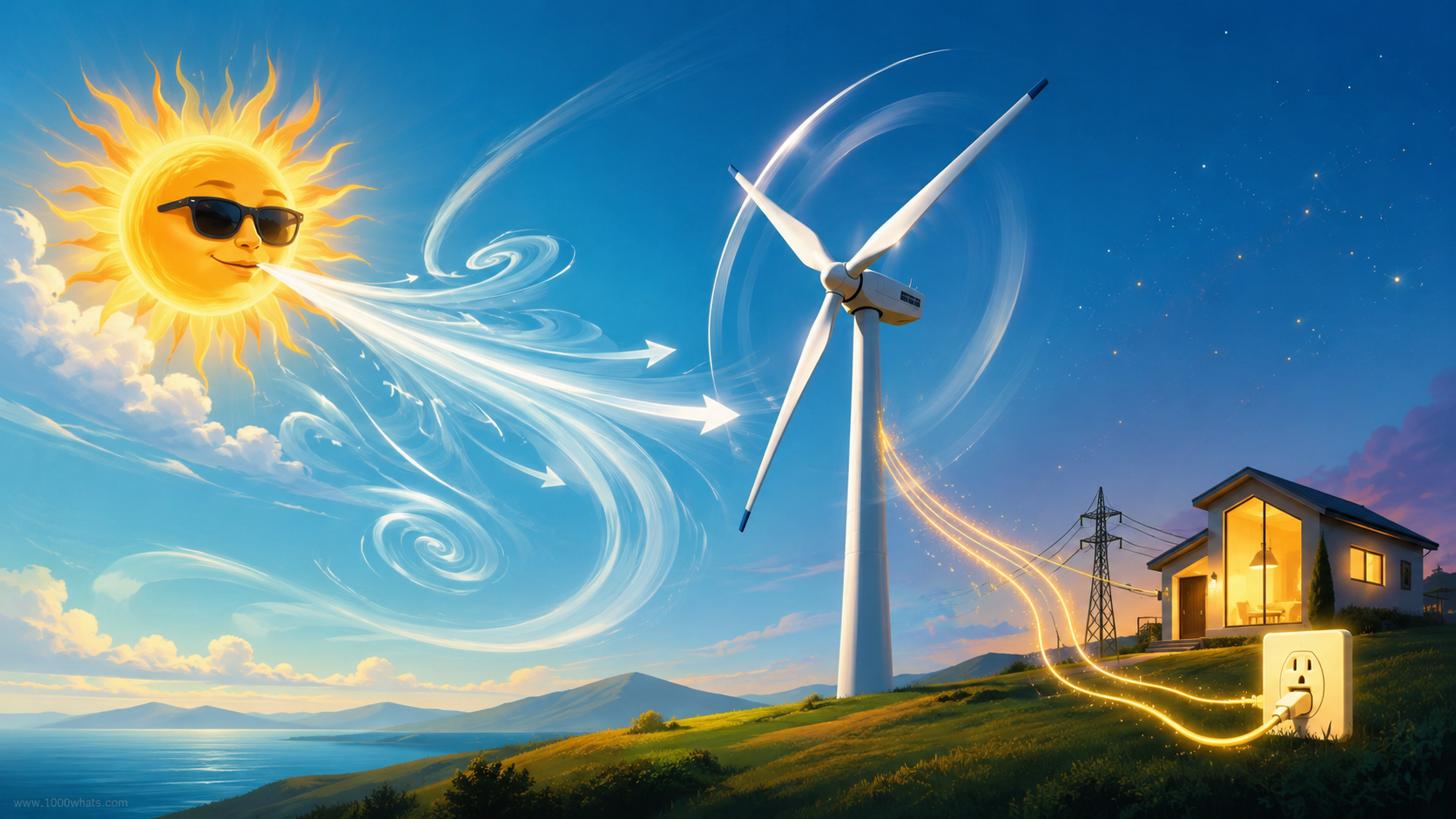
A wind turbine can look almost suspiciously simple.
Wind blows. Blades spin. Electricity appears.
But somewhere between those three steps, energy that originally came from the Sun travels through the atmosphere, pushes against carefully engineered blades, turns hundreds of tons of machinery, moves electrons inside a generator, and eventually arrives at the power grid.
That is a remarkable chain of energy conversion.
And there is an important twist: a wind turbine does not really collect wind. It extracts part of the kinetic energy carried by moving air, slowing that air down as it passes through the rotor.
⚡ “A wind turbine does not create energy from wind. It takes part of the energy already contained in moving air and converts it into electricity.”
So where does that energy come from in the first place?
Let’s follow it from sunlight to socket.
Welcome to 1000whats — where wind stops ruining your hair and starts powering your house.
What is wind power?
Wind power is the conversion of the kinetic energy of moving air into useful power, usually electricity.
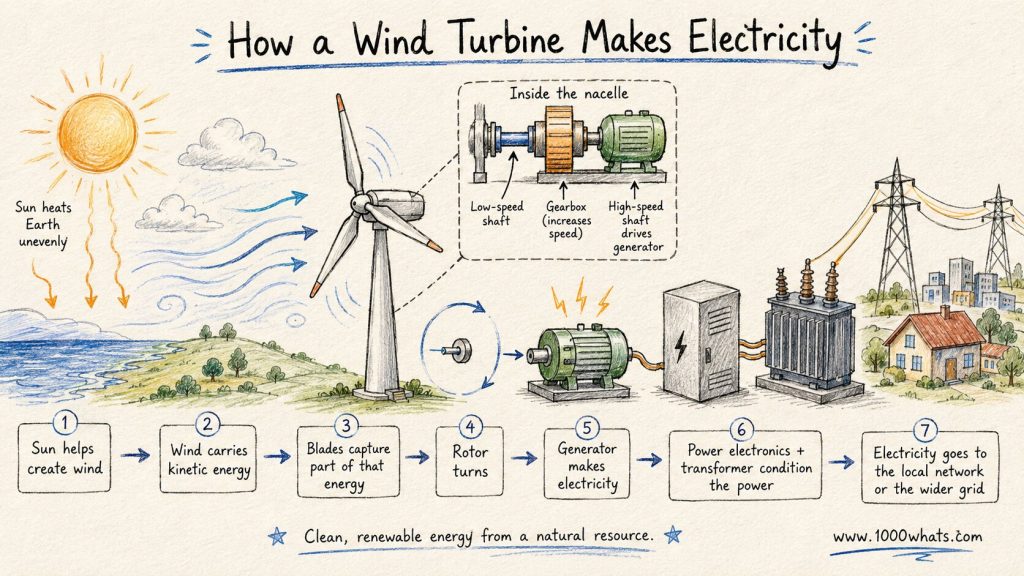
A modern wind turbine performs that conversion in several stages:
- Solar energy helps create wind.
- Wind carries kinetic energy.
- Turbine blades extract part of that energy.
- The rotor converts it into rotational mechanical energy.
- A generator converts mechanical energy into electrical energy.
- Power electronics and transformers condition the electricity.
- The electricity enters a local network or the wider power grid.
In other words:
Sun → wind → blade rotation → generator → electricity → grid
Simple enough on paper.
The physics inside each arrow is where things get interesting.
Why does wind exist in the first place?
Before understanding wind power, we need to understand wind.
And wind begins, indirectly, with the Sun.
The Sun does not heat Earth’s surface evenly.
Land heats differently from water. Dark surfaces absorb solar radiation differently from light ones. Equatorial regions receive more solar energy than polar regions. Mountains, valleys, forests, cities, oceans, and seasons complicate things even further.
That uneven heating creates temperature differences in the atmosphere.
Warm air generally becomes less dense and tends to rise. Cooler, denser air can move in to replace it.
At larger scales, these temperature differences help create differences in atmospheric pressure.
And air responds.
It moves from areas of higher pressure toward areas of lower pressure, although Earth’s rotation, terrain, friction, and other atmospheric forces bend and modify that movement.
That organized movement of air is what we call wind.
So wind energy is ultimately a form of transformed solar energy.
The chain begins something like this:
Solar radiation → uneven heating → pressure differences → air movement
Earth’s rotation and geography then shape that movement into the wind patterns we experience.
Why does wind have kinetic energy?
Because wind has two things that kinetic energy requires:
mass and motion.
Air may feel almost weightless, but it absolutely has mass.
A cubic meter of air near sea level weighs roughly a little over one kilogram, depending on temperature, pressure, and humidity.
When that mass moves, it possesses kinetic energy.
The familiar physics equation is:
Eₖ = ½mv²
Where:
- Eₖ = kinetic energy
- m = mass
- v = velocity
So a moving mass of air carries energy simply because it is moving.
There is an important distinction here.
Air molecules are always moving microscopically because of their temperature. But when discussing wind power, we are interested primarily in the organized bulk motion of the air mass in one general direction.
That organized motion is what the turbine can exploit.
⚡ “Wind is not an energy source because air exists. It is an energy source because enormous masses of air are moving.”
Why wind speed matters so much
This is where wind power becomes surprisingly unforgiving.
The energy of an individual moving mass depends on velocity squared, but a turbine continuously encounters new air flowing through its rotor.
The resulting power available in the wind can be approximated by:
P = ½ρAv³
Where:
- P = power available in the wind
- ρ = air density
- A = swept area of the rotor
- v = wind speed
That little v³ is enormously important.
Available wind power increases approximately with the cube of wind speed.
So, in idealized terms:
- Double the wind speed → about 8 times the available wind power.
- Triple the wind speed → about 27 times the available wind power.
This is one reason developers obsess over wind-resource measurements before building a wind farm.
A location that feels only moderately windier can have dramatically better energy potential.
In practice, wind speed is often more economically important than simply having a large piece of land.
Why are wind turbines so large?
Look at the equation again:
P = ½ρAv³
The A represents the area swept by the blades.
For a circular rotor:
A = πr²
Increase blade length and the swept area grows dramatically.
A turbine with longer blades can interact with a much larger column of moving air.
This is why modern wind turbines have become enormous.
They are not large merely because engineers enjoy building giant machines.
Bigger rotors provide access to more moving air—and therefore more available energy.
Taller towers also help because wind is often stronger and steadier farther above the ground, where friction from trees, buildings, and terrain has less influence.
How does a wind turbine actually “catches” wind energy?
Here is where one common mental picture becomes misleading.
A turbine blade does not simply behave like a flat paddle being pushed backward by the wind.
Modern turbine blades are much closer to aircraft wings.
Their carefully shaped aerodynamic profiles create forces as air flows around them.
The most important of these is lift.
The blades behave like rotating wings
As air moves over a turbine blade’s aerodynamic profile, differences in pressure develop around the blade.
The resulting aerodynamic force has a component that drives the blade around the rotor axis.
Instead of simply being pushed straight backward, the blade experiences a force that helps it move sideways around a circle.
With three blades connected to a central hub, that force produces torque.
Torque turns the rotor.
So the energy conversion has begun:
Kinetic energy of air → rotational mechanical energy
The turbine has extracted some energy from the wind.
And we can observe the consequence physically.
The air leaving the rotor is slower than the air approaching it.
That reduction in wind speed represents energy transferred from the moving air to the turbine.
What happens when the blades start turning?
The blades are connected to the hub, and together they form the rotor.
Once aerodynamic forces turn the rotor, the turbine now has mechanical rotational energy.
But your laptop cannot do much with a slowly rotating 100-meter blade.
Something has to convert that rotation into electricity.
That happens inside the nacelle—the large housing behind the rotor.
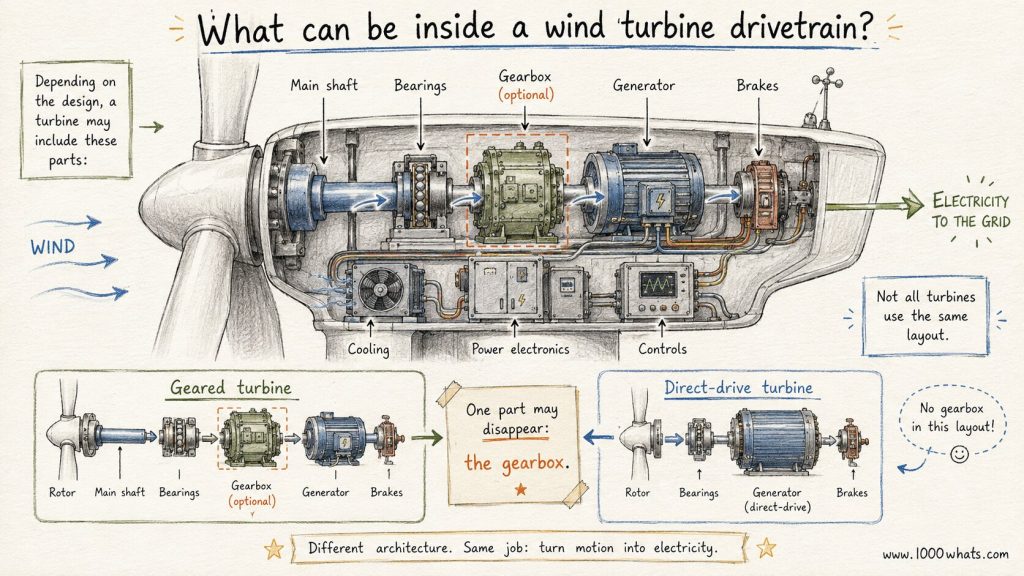
Depending on the turbine design, the drivetrain may include:
- Main shaft
- Bearings
- Gearbox
- Generator
- Braking systems
- Cooling equipment
- Power electronics
- Control systems
Not every turbine uses the same architecture.
And one component in particular may disappear entirely.
What does the gearbox do?
Large wind turbine rotors turn relatively slowly.
Many conventional electrical generators historically operated most effectively at much higher rotational speeds.
A gearbox can bridge that gap.
It accepts relatively slow, high-torque rotation from the rotor and increases the rotational speed delivered to the generator.
Think of the gearing on a bicycle—but operating inside a machine measured in megawatts rather than leg power.
However, not every modern turbine uses one.
Some turbines use direct-drive generators, where the rotor connects to a large generator without a traditional high-speed gearbox.
That can reduce the number of moving mechanical components, although it requires a different generator design.
From an engineering perspective, neither architecture is simply “the correct one.”
They represent different solutions to the same problem:
How do we efficiently turn a slow-moving giant rotor into electrical power?
How does the generator turn rotation into electricity?
Now we reach one of the most elegant steps in the process.
The generator uses electromagnetic induction.
At its core, a generator contains magnetic fields and electrical conductors arranged so that rotational motion causes a changing magnetic environment around the conductors.
According to Faraday’s law of electromagnetic induction, a changing magnetic flux through a conductor induces an electromotive force.
That electromotive force can drive electric current through a connected circuit.
So the generator performs another energy conversion:
Mechanical rotational energy → electrical energy
No electrons are created.
The turbine is not manufacturing electricity out of nothing.
Instead, mechanical energy supplied by the rotor causes electrical charges already present in conductive materials to behave in a way that allows electrical energy to be transferred through the circuit.
This distinction matters.
Energy moves through the system. The electrons are part of the mechanism carrying that energy.
What happens to the electricity after the generator?
The electricity coming directly from a wind generator is not necessarily ready to be dumped straight into the power grid.
Wind speed changes constantly.
Rotor speed may change.
Electrical grids, however, operate under tightly controlled requirements for characteristics such as voltage and frequency.
Modern turbines therefore use sophisticated power electronics and control systems to condition their electrical output.
Depending on turbine design, converters can transform variable generator output into electricity compatible with the grid.
The electricity then typically passes through a transformer, which increases the voltage.
Why increase it?
Because transmitting the same amount of power at a higher voltage allows lower current, which reduces resistive losses in cables.
The pathway now looks roughly like this:
Wind → blades → rotor → drivetrain → generator → power electronics → transformer → electrical network
How does electricity leave a wind farm?
One turbine is only part of the story.
In a wind farm, electricity from multiple turbines is usually collected through an internal network of cables.
These feeder circuits carry the power toward a substation.
At the substation, transformers and electrical equipment prepare the combined output for connection to the wider transmission or distribution network.
The simplified path becomes:
Turbines → collection cables → wind farm substation → transmission/distribution grid → consumers
Offshore wind adds another layer.
Electricity may travel through subsea cables to an offshore or onshore substation before entering the mainland grid.
Large offshore projects can require substantial transmission infrastructure simply to move the electricity from where the wind is good to where the demand is.
What are the advantages of wind power?
Wind power has several major strengths.
| Advantage | What it means |
|---|---|
| No fuel combustion during operation | A wind turbine does not need coal, natural gas, or oil delivered continuously to generate electricity. Its “fuel” arrives through the atmosphere. |
| Low operational greenhouse gas emissions | Wind turbines generate electricity without burning carbon-based fuels. Lifecycle emissions still come from manufacturing, construction, transport, maintenance, and decommissioning, but operational emissions are very low compared with fossil-fuel generation. |
| No fuel-price exposure | Once built, a wind project does not need to purchase wind. This removes a major source of operating-cost volatility. |
| Scalable technology | Wind power can range from a single turbine to very large onshore or offshore wind farms. |
| Land can often have multiple uses | Onshore turbines use land, but farming or grazing can often continue around them. |
What are the disadvantages of wind power?
There is no perfect electricity source, and wind has important limitations.
| Challenge | What it means | Why it matters |
|---|---|---|
| Wind is variable | Operators cannot command the atmosphere to blow harder when electricity demand rises. Generation depends on weather conditions. | Wind output does not necessarily match electricity demand, so the power system must manage fluctuations. |
| Good wind resources are location-specific | A technically perfect turbine placed at a poor site can still perform badly. | Resource quality has a major impact on energy production and project economics. |
| Grid integration is necessary | Power systems with substantial wind generation need flexibility from transmission, storage, demand response, other generators, or interconnected markets. | Flexibility helps balance variations in wind generation and maintain system reliability. |
| Transmission can become a bottleneck | Excellent wind resources are often far from major population centers and electricity demand. | Generating electricity is of little use if there is insufficient grid capacity to transport it. |
| Environmental and community impacts exist | Wind projects can raise concerns about landscapes, sound, wildlife, land use, offshore ecosystems, and local acceptance. | Careful siting and project design are needed to reduce impacts and improve community acceptance. |
Why wind power matters today
Wind power represents something bigger than a clever machine.
It demonstrates that electricity generation does not necessarily require digging a fuel out of the ground and burning it.
Instead, we can intercept an energy flow that already exists in the environment.
From a market perspective, that changes the economics of electricity generation.
Traditional thermal generators often combine large infrastructure investments with ongoing fuel purchases.
Wind projects generally concentrate much more of their economic burden upfront: development, turbines, foundations, construction, grid connection, financing, and maintenance.
Once operating, there is no wind invoice arriving every month.
That characteristic has helped make wind an important part of modern renewable-energy development.
But the turbine itself is only half the story.
A successful wind-power system also depends on:
- Good resource assessment
- Suitable land or seabed
- Permitting
- Financing
- Grid connections
- Transmission capacity
- Electricity markets
- Operations and maintenance
- Community acceptance
In practice, the physics of extracting wind energy is often easier than developing the infrastructure and market system required to use it.
Final thoughts
A wind turbine is best understood not as a giant fan running backward, but as an energy-conversion machine sitting inside a much larger planetary system.
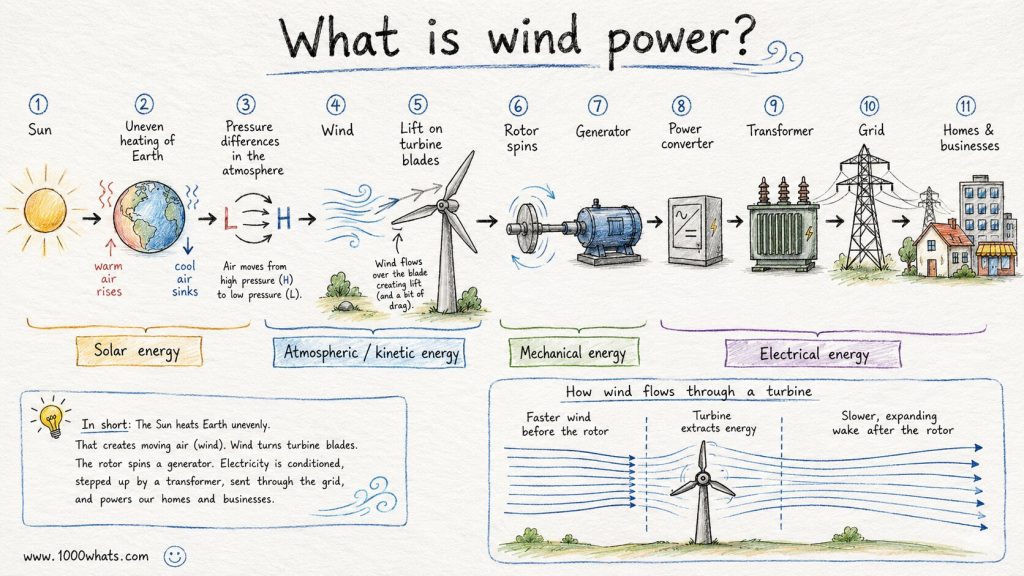
The Sun heats Earth unevenly.
The atmosphere responds.
Air moves.
That moving mass contains kinetic energy.
Aerodynamic blades remove part of it and convert it into rotational motion.
A generator converts that motion into electrical energy.
Power electronics, transformers, cables, and substations then turn that raw generation into something the grid can actually use.
And all of it begins with something as ordinary as air moving across the landscape.
That may be the most impressive thing about wind power: the turbine doesn’t need to create an energy source. It simply knows how to intercept one already passing by.
Next time you see a wind turbine turning on the horizon, don’t just see three blades going around in circles. See the chain: sunlight, atmosphere, motion, torque, magnetism, electricity.
Pretty impressive journey for a gust of wind.
What part of the wind-power chain surprises you most?
Until next time, stay curious!
Discover more from 1000whats
Subscribe to get the latest posts sent to your email.