What would Michael Faraday, the 19th-century science genius, and Jimi Hendrix, the electric guitar legend, have in common?
More than you’d think.
Faraday discovered one of the most important ideas in physics. Hendrix used that same idea every time his guitar turned vibrating strings into electric sound.
That idea is electromagnetic induction.
Sounds big. Sounds technical. Sounds like something designed to ruin a high school afternoon.
But the truth is, the core idea is beautifully simple.
A magnet changes near a wire.
The wire reacts.
Electricity appears.
That’s the basic trick.
And once you see it, you start seeing it everywhere: in power plants, wind turbines, chargers, transformers, motors, and guitar pickups.
⚡ “Electromagnetic induction is one of nature’s coolest tricks: movement turns into electricity.”
So let’s forget the heavy jargon for a minute and explain it the way a normal human would want to hear it.
Welcome to 1000whats — where I take the charge out of complicated energy terms.
What is electromagnetic induction?
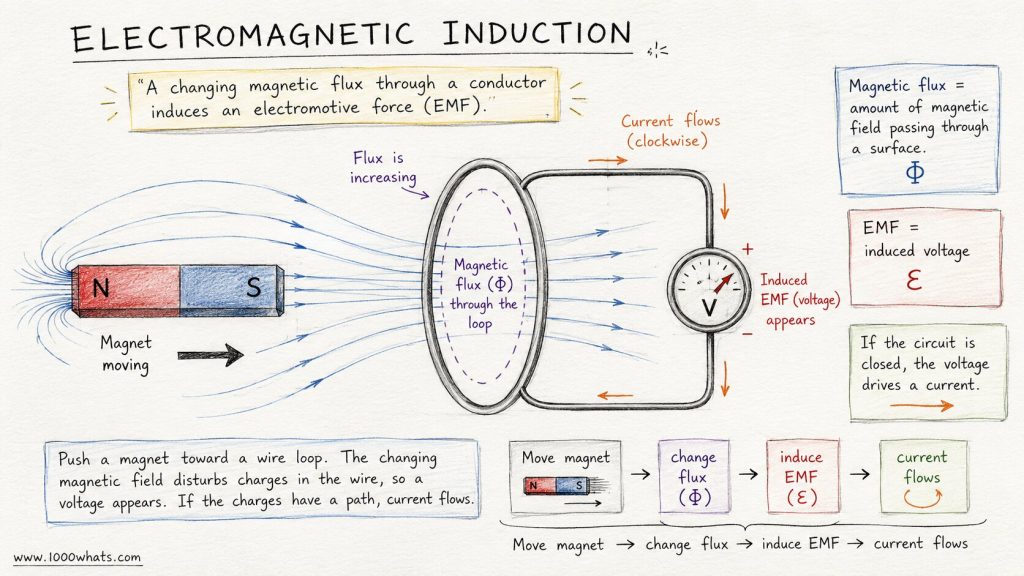
Electromagnetic induction is when a changing magnetic field creates voltage in a wire.
And if that wire is part of a complete loop, that voltage makes electric current flow.
That’s it.
That’s the heart of the whole thing.
Here’s the simplest way to picture it:
- You have a wire
- You have a magnet
- You move the magnet near the wire
- Suddenly, the wire “feels” something
- Electrons inside the wire get pushed
- That push becomes electricity
So electromagnetic induction is basically making electricity by changing magnetism.
Not by touching the wire with a battery.
Not by pouring electricity into it.
But by changing the magnetic field around it.
That is the weird, wonderful part.
Why does electromagnetic induction happen?
Let’s keep this intuitive.
A wire contains electrons. Those electrons can move.
A magnetic field is like an invisible condition in space. Usually, when nothing changes, the electrons stay more or less where they are.
But when the magnetic field changes, it disturbs the electrons.
It gives them a push.
That push is what we call voltage.
And if the electrons have a path to travel through, they start moving as a current.
So the whole story is really about this:
Changing magnetism can shove electrons around.
That is electromagnetic induction.
What most people don’t see is that this is not some rare physics party trick. It is one of the main ways humans generate electricity on purpose.
The easiest way to understand it
Forget the complicated definitions.
Try this mental picture instead.
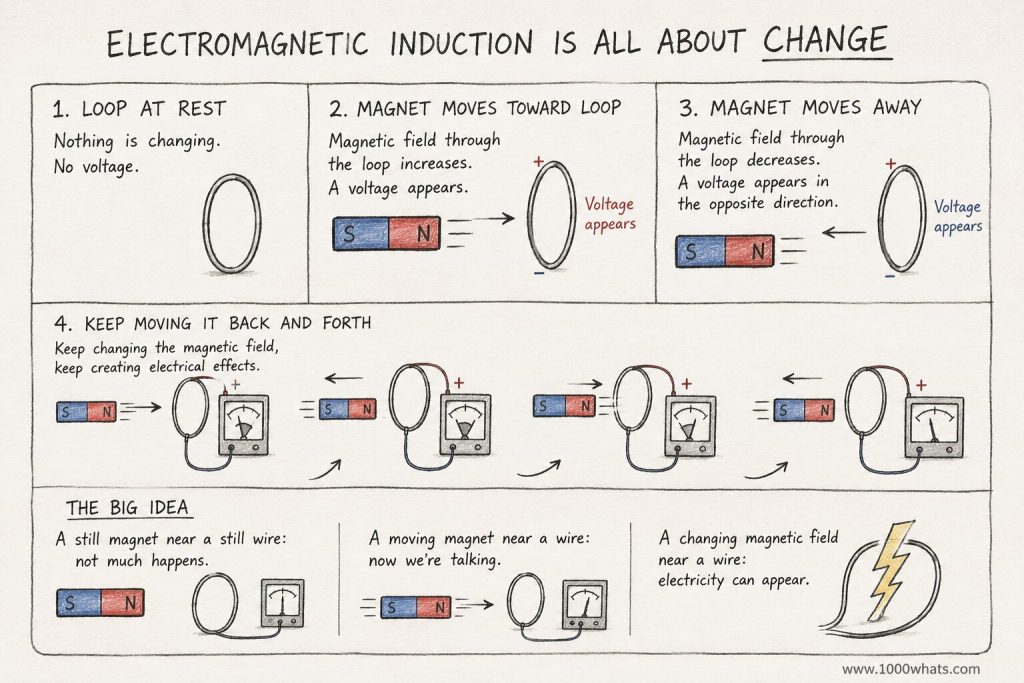
Imagine a loop of wire sitting there doing nothing.
Now take a magnet and move it toward the loop.
As the magnet gets closer, the magnetic field through the loop changes. The wire responds. A voltage appears.
Pull the magnet away, and the voltage appears again—but in the opposite direction.
Keep moving the magnet back and forth, and you keep creating electrical effects.
So electromagnetic induction is not about a magnet simply existing near a wire.
It is about change.
That word matters more than anything else.
- A still magnet near a still wire: not much happens
- A moving magnet near a wire: now we’re talking
- A changing magnetic field near a wire: electricity can appear
⚡ “No change, no induction. That’s the rule.”
What is the principle behind electromagnetic induction?
The principle is simple:
If the magnetic field through a wire changes, the wire produces voltage.
That is the whole principle in plain English.
Scientists often talk about “magnetic flux,” but you do not need that word to understand the main idea.
Just think:
- More magnetic field through the wire loop
- Then less magnetic field through the wire loop
- Or the field changes direction
- Or the wire moves through the field
Any of those changes can induce voltage.
So if someone asks what the principle behind electromagnetic induction is, the simple answer is:
Changing magnetic conditions create electrical effects.
What is Faraday’s Law of Induction?
Faraday’s Law is just the more formal version of the same idea.
It says:
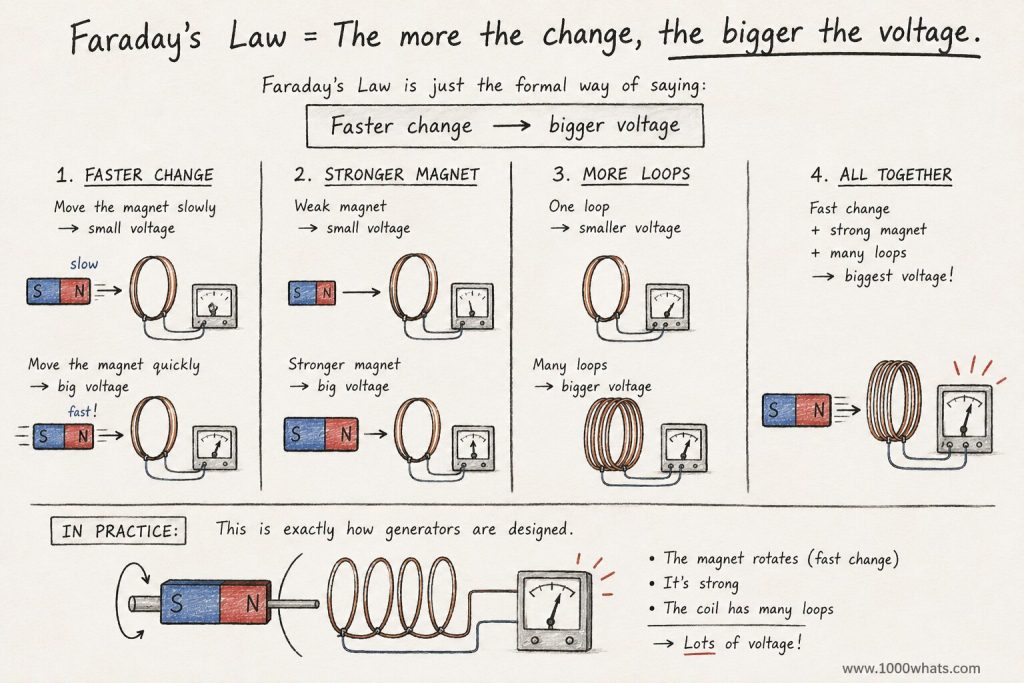
The faster the magnetic field changes, the bigger the induced voltage.
That’s a beautiful idea because it matches common sense.
If you move the magnet slowly, you get a weak effect.
If you move it quickly, you get a stronger effect.
If you use a stronger magnet, the effect gets bigger.
If you wrap the wire into many loops instead of one, the effect gets bigger too.
So Faraday’s Law is really just telling us what increases the electrical output:
- Faster change
- Stronger magnet
- More loops of wire
In practice, this is exactly how generators are designed.
What is Lenz’s Law?
Lenz’s Law sounds scary, but the idea is easy.
It says:
The electricity created by induction pushes back against the change that caused it.
That is a mouthful, so let’s make it human.
If you push a magnet toward a coil of wire, the coil responds in a way that tries to resist that push.
It is like the wire saying, “Hey, I noticed what you did, and I’m pushing back.”
Why?
Because nature is not handing out free energy.
If you want electricity, you have to do work.
That is why turning a generator under electrical load feels harder than turning it freely. The system resists because energy is being transferred.
What most people don’t see is that this “pushback” is not a bug. It is the reason energy is conserved.
Real-world example: a magnet and a coil
Here is the classic experiment.
You take:
- a coil of wire
- a magnet
- a meter to measure current or voltage
Now do this:
- Move the magnet toward the coil
The meter jumps - Hold the magnet still inside the coil
The meter drops back - Pull the magnet out
The meter jumps the other way
This tiny experiment teaches almost everything important about electromagnetic induction.
It shows that:
- motion matters
- change matters
- stillness does not do much
- direction matters too
That little tabletop demo is the same basic principle used in giant power plants.
Same physics. Bigger machine.
How does electromagnetic induction work in the real world?
This is where the idea becomes a superstar.
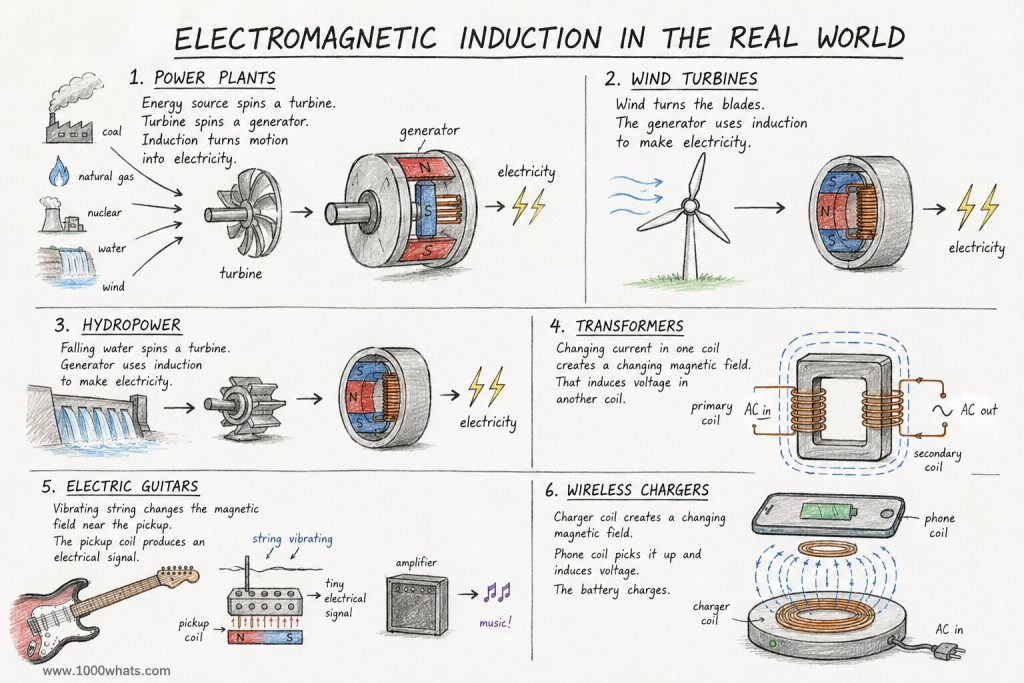
1. Power plants
Most power plants make electricity with electromagnetic induction.
Not with magic. Not by “creating power” out of nowhere.
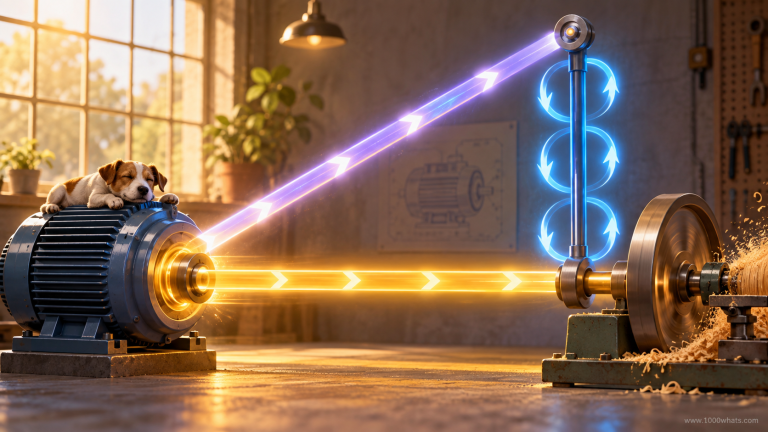
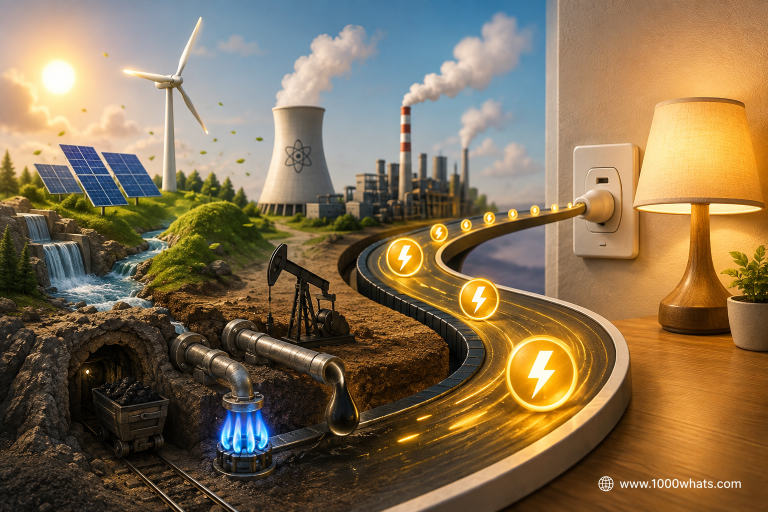
They use some energy source to spin a turbine. That turbine spins part of a generator. Inside the generator, magnets and coils move relative to each other. That changing magnetic field induces voltage.
Done.
The energy source could be:
- steam from coal
- steam from natural gas
- steam from nuclear heat
- falling water
- wind
Different source. Same electrical trick.
2. Wind turbines
Wind turns the blades.
The blades turn a shaft.
The shaft turns a generator.
Inside the generator, electromagnetic induction turns that motion into electricity.
So the wind is not the electricity itself. The wind provides the movement. Induction does the conversion.
3. Hydropower
Water falls and spins a turbine.
The turbine spins a generator.
The generator uses changing magnetism and coils of wire to make electricity.
Again, water gives the motion. Induction turns that motion into electrical energy.
4. Transformers
Transformers move electricity from one voltage level to another.
They do this using induction.
One coil gets alternating current. That current creates a changing magnetic field. That changing field induces voltage in another coil.
This is how power can travel long distances efficiently on the grid.
5. Electric guitars
This is the Hendrix part.
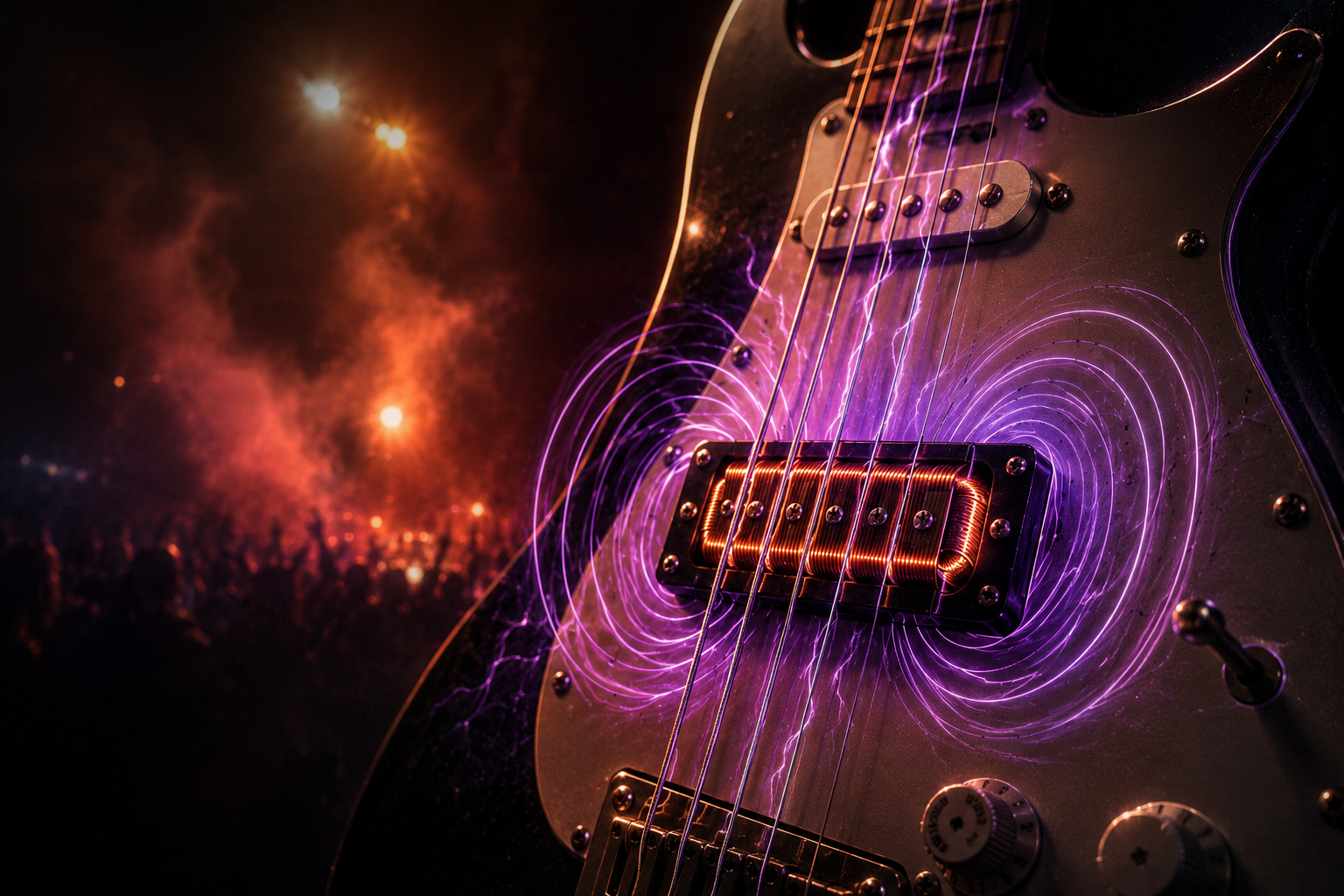
A guitar string vibrates over a magnetic pickup. That vibration changes the magnetic field near a coil. The coil produces a tiny electrical signal.
That signal gets amplified into music.
So yes, electromagnetic induction helps power rock and roll.
6. Wireless chargers
The charger makes a changing magnetic field.
The phone has a coil inside it.
That changing magnetic field induces voltage in the phone’s coil.
The battery charges.
It feels futuristic, but the idea is old and elegant.
Why does electromagnetic induction matter in energy?
Because it sits right in the middle of the electricity story.
If you want to generate electricity at scale, induction is one of the main ways to do it.
That matters even more today because the world is electrifying more things:
- cars
- heating
- industry
- devices
- transport
- data centers
From a market perspective, the future is not just about producing more clean energy. It is about moving more energy through electrical systems. And electromagnetic induction is one of the core tools that makes that possible.
Without induction, modern grids would be crippled.
Without induction, renewable energy would be much harder to turn into usable electricity.
Without induction, everyday electrical life would look completely different.
⚡ “The energy transition may be about cleaner power, but induction is still one of the hidden engines underneath it all.”
What are the advantages of electromagnetic induction?
Electromagnetic induction is incredibly useful because it lets us do things that would otherwise be hard, inefficient, or impossible.
Main benefits
- It makes large-scale electricity generation possible
- It allows energy transfer without direct contact
- It helps transformers change voltage efficiently
- It powers many motors, generators, and devices
- It is reliable and scalable
- It connects motion to electricity in a very efficient way
In practice, this is why induction shows up in everything from giant turbines to kitchen appliances.
What are the downsides or challenges?
It is brilliant, but not perfect.
Main challenges
- You need change
A still magnetic field usually won’t induce anything useful. - There are losses
Some energy becomes heat instead of useful output. - Engineering matters
Good induction systems need smart design, good materials, and careful control. - Sometimes induction causes unwanted effects
Not all induced currents are helpful. Some are wasteful.
What most people don’t see is that the idea is simple, but making it efficient at industrial scale takes serious engineering.
Final thoughts
Electromagnetic induction is one of the best examples of how nature hides huge power inside a simple idea.
Change a magnetic field near a wire, and electricity appears.
That is the core of it.
Faraday saw it. Engineers scaled it. Hendrix made it sing.
My view? Electromagnetic induction is one of the most important ideas most people never learn in a way that actually makes sense.
Now you do.
What part do you want even simpler next: Faraday’s Law, Lenz’s Law, or how a generator works?
Until next time, stay curious!
Discover more from 1000whats
Subscribe to get the latest posts sent to your email.