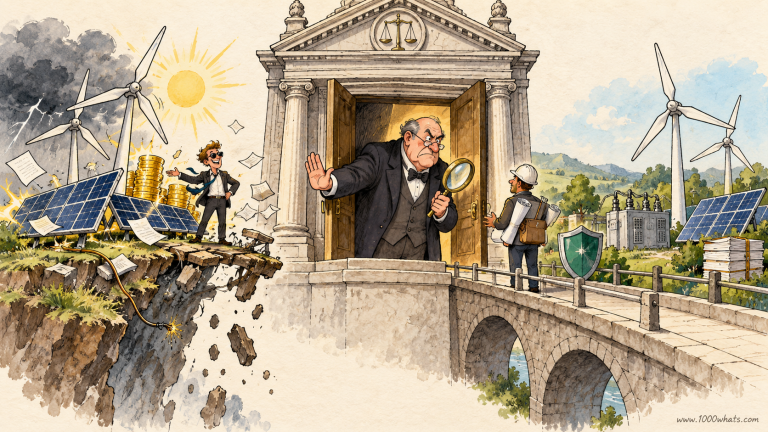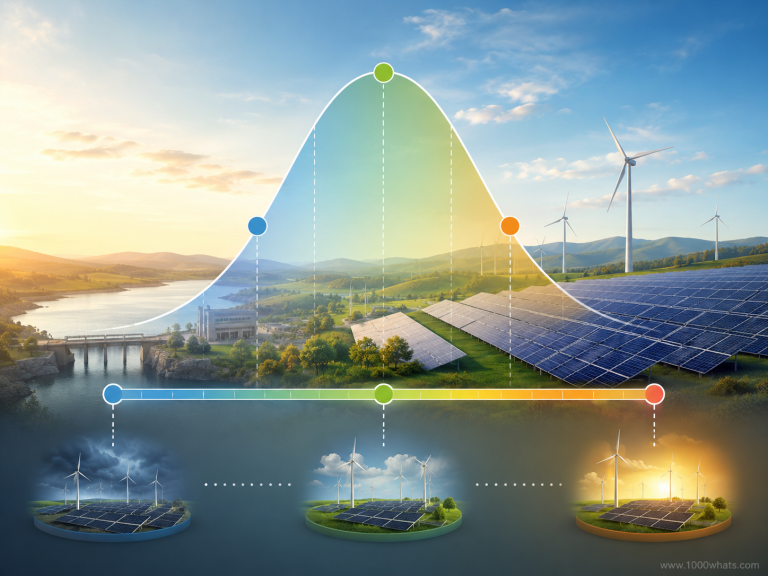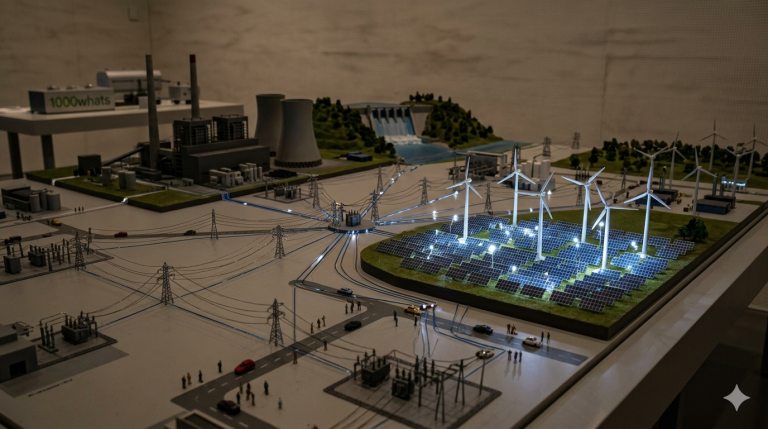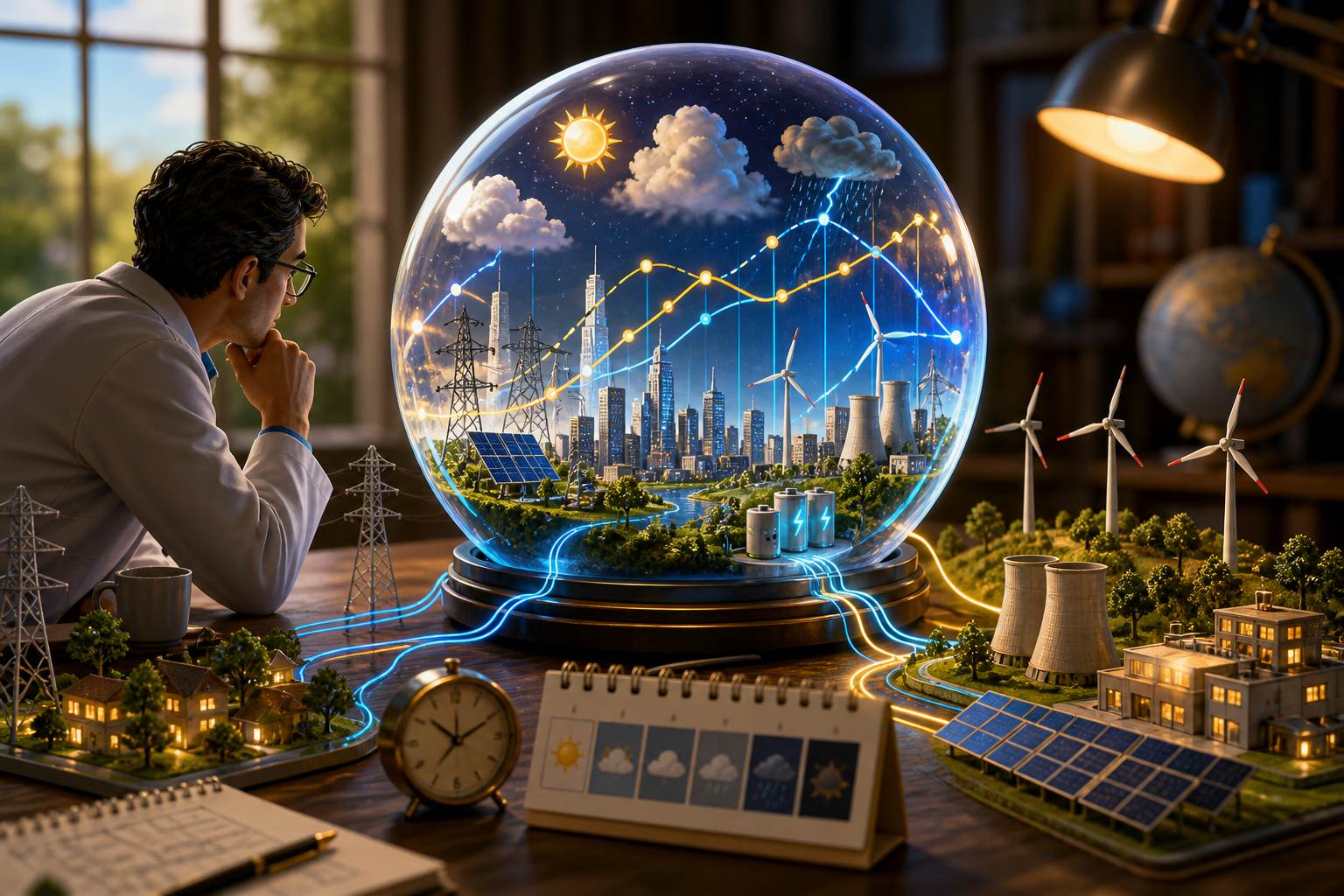
Have you ever tried to peek around the corner of tomorrow?
Of course you have. We all do it.
You bet on the next game with friends.
You pack sunglasses because the forecast promises sunshine.
You set a budget because payday should arrive on time.
In each case, you make a small wager on the future.
“Forecasting starts the moment we ask, ‘What happens next?’”
That simple question drives a serious skill. We call it forecasting.
Forecasting means using what we know today to make a smart guess about tomorrow.
It mixes logic with intuition.
It uses data, but it also needs judgment.
So yes, forecasting feels like science.
Yet it also carries a touch of art.
Welcome to 1000whats. Here, I make energy ideas simple, useful, and maybe even fun.
What is energy forecasting?
At its core, energy forecasting is the process of predicting future energy demand, supply, prices, or generation using data, models, and informed assumptions.
That is the formal answer.
A simpler version sounds more human: energy forecasting is educated guessing for a very unforgiving machine.
Past behavior gives us clues. Current conditions add context. Analytical models turn those clues into a forecast. Decision-makers then use that forecast to avoid getting blindsided by reality.
Depending on the problem, forecasting can focus on:
- Electricity demand
- Power generation
- Renewable energy output
- Fuel consumption
- Electricity prices
- Grid congestion
- Long-term energy needs
Some forecasts look just a few minutes ahead. Others stretch years into the future. Both matter.
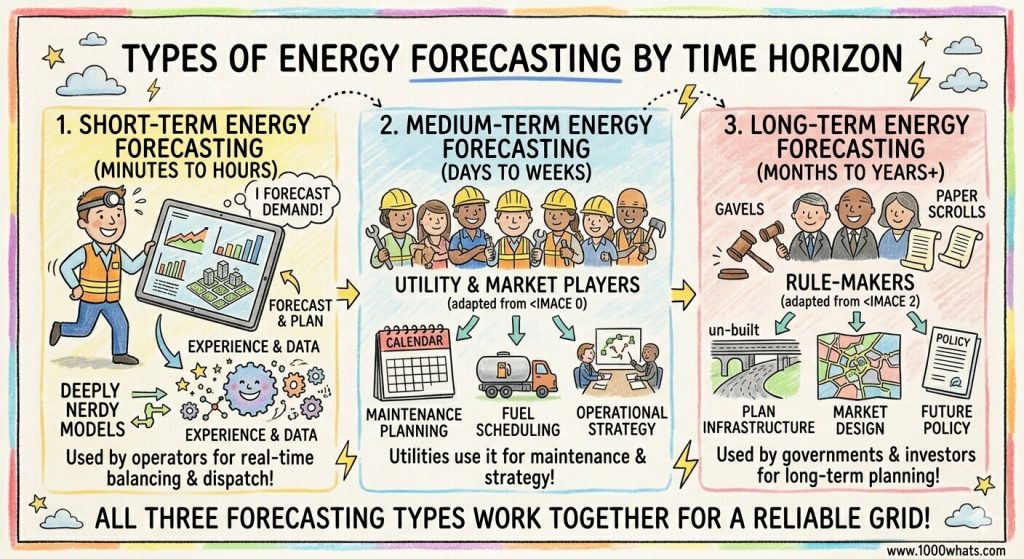
Types of energy forecasting by time horizon
| Short-term energy forecasting | This usually covers minutes to hours. Grid operators use it for real-time balancing, dispatch decisions, and keeping supply aligned with demand. |
| Medium-term energy forecasting | This usually covers days to weeks. Utilities and market players use it for maintenance planning, fuel scheduling, and operational strategy. |
| Long-term energy forecasting | This usually covers months to years, sometimes longer. Investors, regulators, and governments use it to plan infrastructure, market design, and future energy policy. |
One forecast might answer what happens at 6 p.m. today.
Another might help decide what kind of power system we build for 2040.
Why does energy forecasting exist?
Because electricity is fussy.
You cannot stack huge piles of it behind a power plant the way you store coal, grain, or canned beans. Storage helps, yes, but most of the system still depends on a simple rule: power has to show up when people need it.
That requirement creates pressure all across the energy chain.
A utility needs to anticipate tomorrow’s demand. A trader wants a read on tomorrow’s price. A wind farm operator must estimate tomorrow’s output. Policymakers try to guess how demand, electrification, and clean energy will reshape the system years from now.
Every one of those choices depends on forecasting.
Without it, the energy world becomes more expensive, more fragile, and much more chaotic.
⚡ “Energy forecasting is what happens when physics meets planning and neither side fully trusts the weather.”
Why energy forecasting matters
This is where the topic stops sounding technical and starts sounding useful.
1. It reduces costs and risks
A good forecast helps utilities, suppliers, traders, and large consumers avoid expensive mistakes.
It can reduce:
- Overproduction
- Under-supply
- Fuel waste
- Emergency power purchases
- Exposure to price spikes
- Unnecessary market risk
From a market perspective, even a small improvement in forecasting can mean serious money.
2. It improves grid reliability
The grid has to stay balanced all the time.
Not most of the time. Not when convenient. All the time.
Better forecasts help operators prepare for:
- Demand surges
- Generation shortfalls
- Transmission congestion
- Voltage and frequency issues
- Renewable swings
- Potential outages
Reliable electricity looks effortless from the outside. Under the hood, it depends on constant anticipation.
3. It makes renewable energy easier to manage
Coal plants do not care about cloud cover.
Solar farms care a lot.
Wind turbines are brilliant machines, but they are also glorified weather translators. If the wind drops, output drops. If clouds move in, solar production can plunge. More renewable power means more variability, and more variability means forecasting becomes far more valuable.
That is one of the hidden truths of the energy transition:
the greener the grid gets, the more important prediction becomes.
4. It supports planning and policy
Forecasting does not stop at tomorrow morning.
Longer-range forecasts help answer bigger questions:
- Will electric vehicles push up evening demand?
- Do we need more transmission?
- Where should battery storage go?
- How quickly will electricity consumption grow?
- Which technologies make sense under different policy scenarios?
Good planning starts with a decent map of what might be coming.
How energy forecasting works
At first glance, forecasting can seem mysterious.
Numbers go in. Charts come out. Experts nod gravely. Somewhere in the middle, a spreadsheet becomes a life form.
The basic logic, though, is surprisingly simple.
First, you gather clues.
Next, you look for patterns.
After that, you build a model that says, “Given everything we know, here’s our best estimate of what happens next.”
That is forecasting.
Not prophecy. Not wizardry. Just disciplined reasoning with more data than your average dinner-table argument.
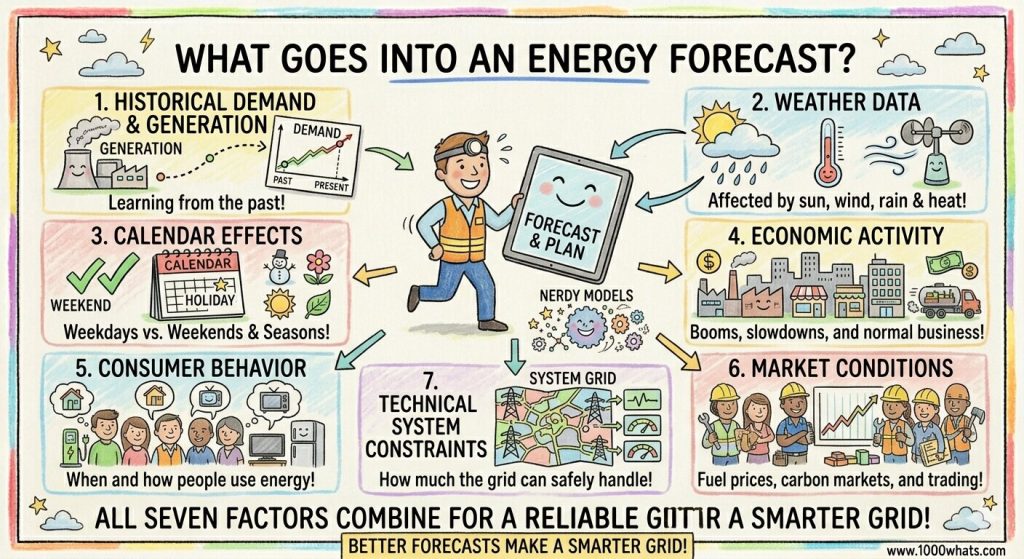
What goes into an energy forecast?
Most forecasts use a mix of:
- Historical demand and generation data
- Weather data
- Calendar effects such as weekdays, weekends, holidays, and seasons
- Economic activity
- Consumer behavior
- Market conditions
- Technical system constraints
A freezing Monday morning does not produce the same demand pattern as a mild Sunday afternoon. A windy spring day does not behave like a still summer evening. Models have to account for those differences or they end up describing a fantasy grid.
Main methods used in energy forecasting
No single method wins every time.
Different problems call for different tools. Broadly speaking, most forecasting methods fall into three camps.
1. Statistical methods
These methods look for mathematical relationships in historical data.
Typical questions include:
- What happens to demand when temperature rises?
- How much does yesterday’s load tell us about today?
- Are there clear daily or seasonal patterns?
Common examples include:
- Regression models
- Time series models
Statistical methods can be elegant, practical, and surprisingly effective when the system behaves with some consistency.
2. Machine learning methods
Messier problems often push forecasters toward machine learning.
Instead of spelling out every relationship by hand, analysts let the model learn patterns from the data itself.
Common examples include:
- Artificial neural networks
- Support vector machines
- Decision trees
- Random forests
Used well, these tools can pick up complex relationships hidden inside large, tangled datasets.
Used badly, they can produce very impressive nonsense.
3. Simulation methods
Sometimes pattern-spotting is not enough.
Simulation methods try to represent how the energy system actually behaves under different conditions.
Examples include:
- Load flow analysis
- Agent-based modeling
- System dynamics
These methods are especially useful for scenario testing, physical constraints, and long-term system behavior.
What data is used in energy forecasting?
Forecasting lives and dies by its inputs.
That sounds obvious until you spend five minutes with real-world data and realize it behaves like a raccoon in a kitchen: energetic, messy, and rarely where you want it.
Common energy forecasting data sources include:
- Weather data: temperature, wind speed, cloud cover, solar radiation, humidity
- Energy data: generation, consumption, outages, fuel use, prices
- Socio-economic data: GDP, population, industrial activity, employment
- Grid and market data: meter data, operator reports, bids, system constraints
Collecting the data is only half the battle.
Cleaning it matters too. Validation matters too. Timing matters too. A smart model fed with dirty data can still give you a bad answer very efficiently.
That is why forecasting is never just a math problem.
Data quality sits right in the middle of it.
Tools used for energy forecasting
Not every forecast starts in a futuristic control room with giant screens and ominous lighting.
Plenty of forecasting work begins with ordinary tools.
Common ones include:
- Excel for simple models and quick analysis
- R for statistics and visualization
- MATLAB for engineering calculations and advanced modeling
Software helps, of course.
Understanding helps more.
A thoughtful analyst with a simple model can beat a confused analyst armed with expensive software and a dashboard that looks like a spaceship cockpit.
Benefits of energy forecasting
A strong forecast improves the system in several ways.
| Efficiency | Better forecasts help match supply and demand more accurately, reduce waste, improve scheduling, and lower avoidable costs. |
| Reliability | Operators can prepare for variability more effectively, which supports a steadier and more resilient grid. |
| Innovation | Forecasts reveal future needs, weak spots, and market opportunities, which helps guide better investment and smarter technology choices. |
Put simply, forecasting helps make the energy system:
- Cheaper
- Steadier
- Smarter
Not bad for a discipline built on trying to be less wrong than yesterday.
Challenges of energy forecasting
Now for the annoying part.
Forecasting is useful, but it is never perfect.
If it were perfect, we would stop calling it forecasting and start calling it cheating.
1. Data problems
Forecasting needs data that is:
- Accurate
- Timely
- Relevant
- Consistent
Real-world data, sadly, often prefers being:
- Incomplete
- Delayed
- Messy
- Contradictory
- Expensive to gather
Bad inputs damage good intentions fast.
2. Model problems
Every model leaves something out.
That is not a flaw. That is the whole point. A model has to simplify reality or it becomes reality wearing a fake mustache.
Trade-offs come with that simplification.
A model can be:
- Too simple
- Too rigid
- Overfitted
- Biased
- Hard to interpret
The goal is not to build the fanciest model in the room.
Useful beats impressive almost every time.
3. Uncertainty
This is the big beast.
Weather shifts. Markets panic. Policies change. Technology surprises us. People behave like people, which is not always a forecast-friendly quality.
Uncertainty is not an extra complication added on top of forecasting.
It is baked into the whole exercise.
⚡ “A forecast is not a promise. It’s a disciplined way of being less wrong.”
Real-world examples of energy forecasting
This is where the whole subject stops sounding theoretical.
Load forecasting for a utility
A utility company forecasts hourly electricity demand using weather data, historical load records, smart meter information, and calendar patterns.
The reason is simple: it needs to plan generation, manage grid operations, and buy or sell power more intelligently.
Price forecasting for an energy trader
An energy trader forecasts day-ahead electricity prices using supply-demand dynamics, market rules, bidding behavior, and scenario analysis.
Being wrong about power prices can get expensive in a hurry.
Wind power forecasting for a wind farm
A wind farm operator forecasts hourly output using meteorological models, turbine characteristics, and historical power data.
That forecast helps with maintenance planning, grid compliance, and reducing imbalance costs.
Taken together, these examples reveal something important:
energy forecasting is not one single activity. It is a whole family of tools used by different people for different reasons across the energy sector.
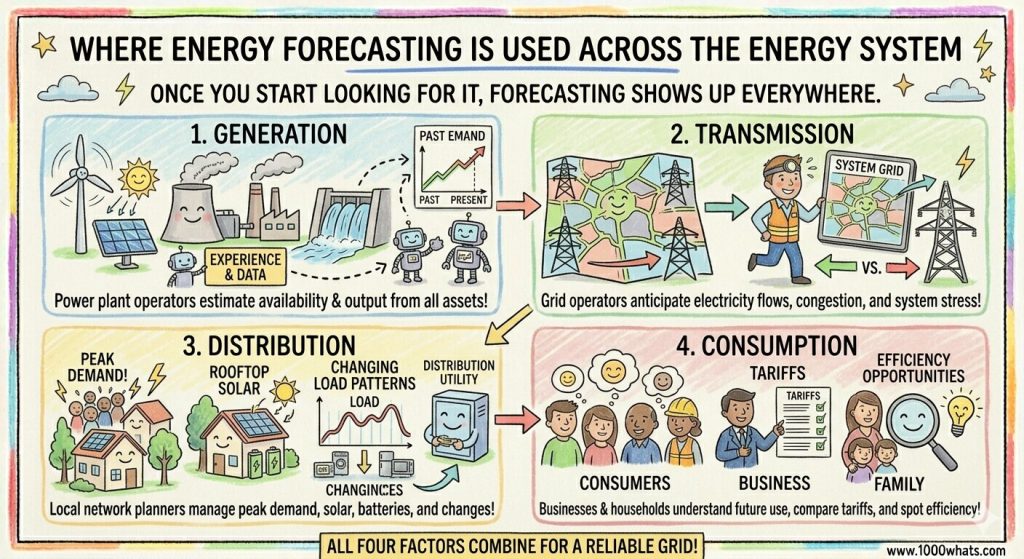
Where energy forecasting is used across the energy system
Once you start looking for it, forecasting shows up everywhere.
| Generation | Power plant operators use forecasting to estimate availability and output from coal, gas, hydro, nuclear, wind, solar, and biomass assets. |
| Transmission | Grid operators use it to anticipate electricity flows, congestion, and system stress across the network. |
| Distribution | Local network planners use forecasting to manage peak demand, rooftop solar, batteries, and changing load patterns. |
| Consumption | Businesses and households benefit too, especially when forecasting helps them understand future use, compare tariffs, and spot efficiency opportunities. |
So while the term sounds niche, its effects reach all the way from control rooms to kitchen counters.
How to apply energy forecasting in practice
This is where people often stumble.
Many assume forecasting is one neat tool you can pull off a shelf like a toaster. Reality is messier than that.
A practical forecasting process usually looks like this:
- Define the goal
Decide what needs forecasting, who needs it, and over what time horizon. - Collect and clean the data
Garbage in still leads to garbage out, no matter how sophisticated the model sounds. - Choose the method
Fit the model to the problem instead of choosing one just because it impressed someone at a conference. - Test the forecast
Measure accuracy, compare alternatives, and examine uncertainty. - Update the process
Conditions change, so the forecast has to adapt with them.
In practice, forecasting is less about finding one perfect model and more about building a process that learns.
The future of energy forecasting
The energy system is not getting simpler.
Quite the opposite.
More renewables are coming online. More devices are becoming connected. More power is flowing through distributed systems. More volatility is showing up in markets and weather alike.
That makes forecasting more valuable, not less.
Big data and AI
Smart meters, sensors, weather models, and digital platforms are producing far more data than before. AI can help turn that flood of information into faster, more adaptive forecasts.
Distributed and collaborative forecasting
Rooftop solar, batteries, electric vehicles, and flexible demand are pushing forecasting beyond the old top-down utility model. More participants now have their own data, assets, and decisions to manage.
Scenario and adaptive forecasting
The future rarely arrives in the neat form we expected. Strong forecasting increasingly relies on scenarios, updates, and flexible decision-making rather than one rigid prediction.
That is not weakness.
It is maturity.
Final thoughts
Energy forecasting sounds technical until you realize what it is really doing.
It helps humans operate one of the largest and most complicated machines we have ever built.
Better forecasts support a more stable grid. Smarter predictions reduce costs. Cleaner power systems become easier to manage. Long-term planning improves when tomorrow is not treated like a total mystery.
That is what makes the subject so fascinating.
We know perfectly well that the future cannot be seen with complete clarity. Still, walking into it blindly is a terrible strategy. So we gather clues. We build models. We test assumptions. We make our best estimate. Then we improve it and try again.
That is energy forecasting.
Not fortune-telling.
Just curiosity, discipline, and a refusal to be caught off guard by tomorrow.
What part of energy forecasting do you find most interesting: the weather side, the market side, or the grid side?
Until next time, stay curious! 😎
Discover more from 1000whats
Subscribe to get the latest posts sent to your email.