“Fossil fuel” is one of those phrases people say with total confidence and only medium understanding.
It sounds dramatic. A little spooky, even. Like your car is somehow running on liquefied dinosaur elbow.
That is not the situation.
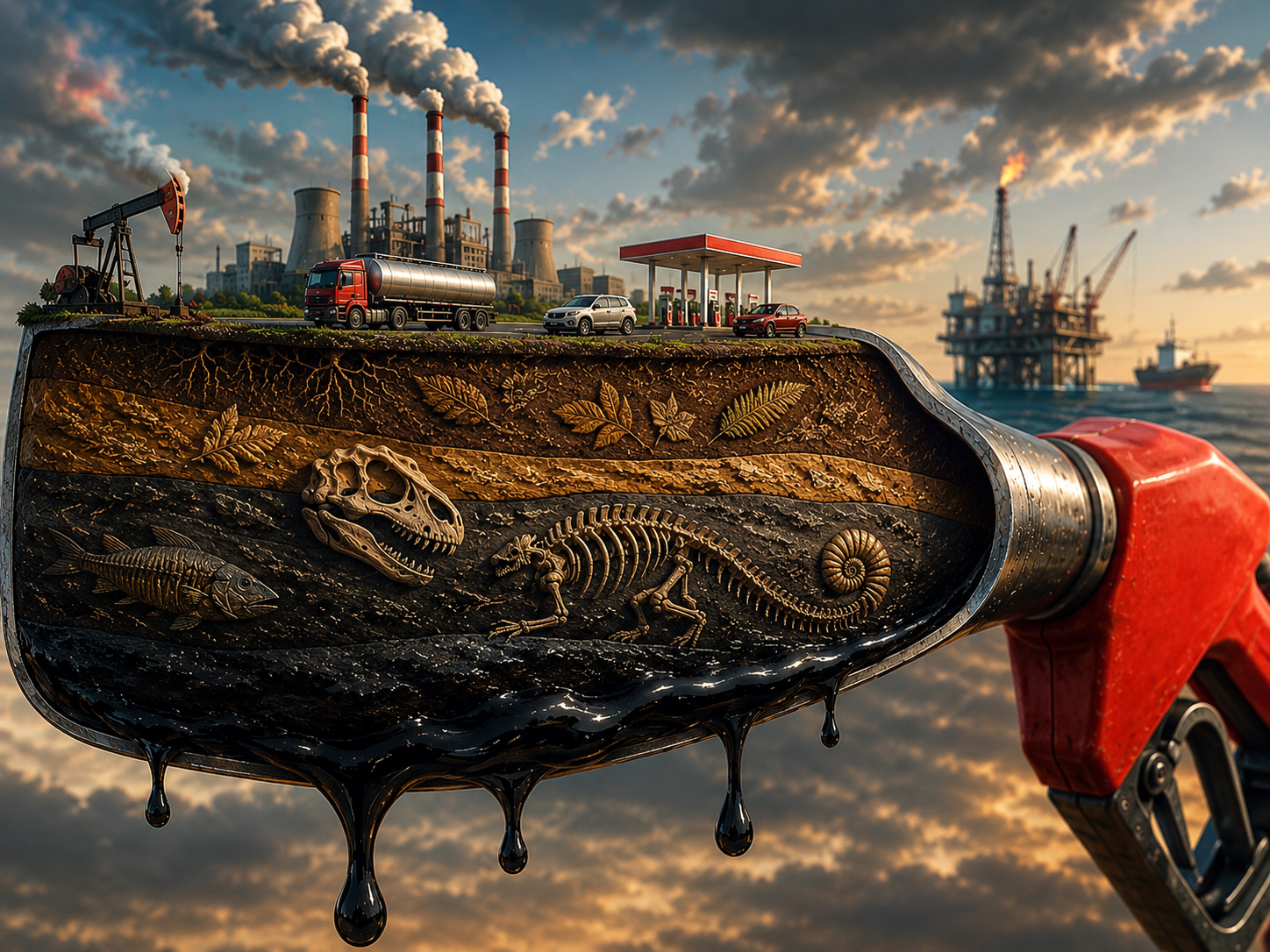
Still, the word fossil is there for a reason. Coal, oil, and natural gas come from ancient living stuff that got buried underground, then slowly transformed by heat and pressure over absurd stretches of time. Millions of years. Not “a while.” Geological while.
And that, right away, tells you something important: a fossil fuel is basically old life turned into concentrated energy.
Or, if you want the mischievous version: ancient sunlight with a carbon attitude problem.
⚡ “A fossil fuel is what happens when dead living matter gets buried, compressed, and turned into a very convenient fire starter.”
Welcome to 1000whats — where we drill down to the truth about energy.
Why do we call it “fossil” fuel?
Good question, because this is where the whole thing gets weird.
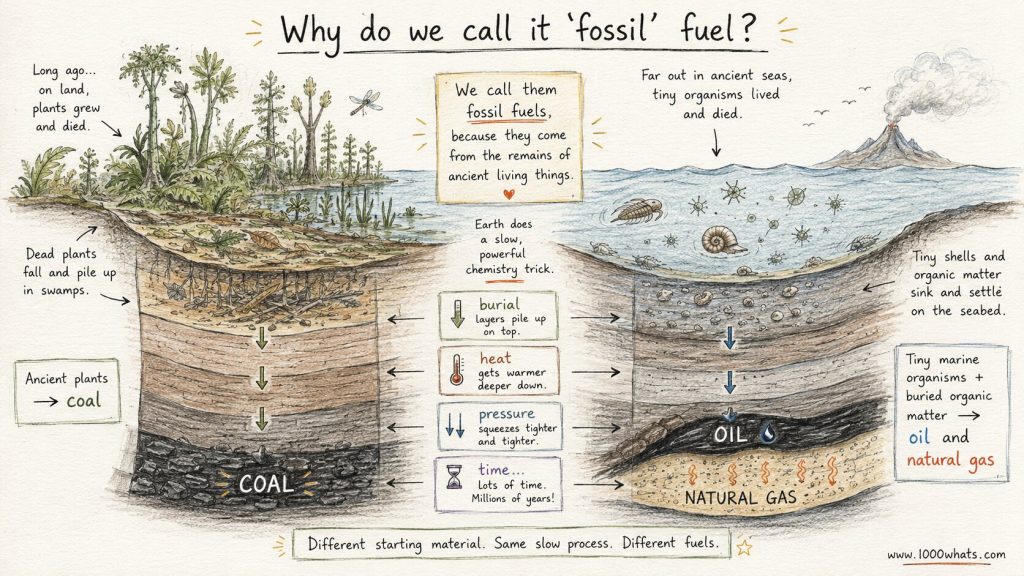
We use the word fossil because these fuels come from the remains of ancient organisms. Coal mainly comes from old plants. Oil and much of natural gas come largely from tiny marine organisms and other buried organic matter. Then the Earth does its slow, patient chemistry trick: burial, heat, pressure, time. Lots of time.
So no, you are not pouring “pure fossil” into your car.
You are using fuel made from carbon-rich material that was once alive and later transformed underground.
That’s the key idea.
The name is clunky, but it’s not wrong.
What is fossil fuel?
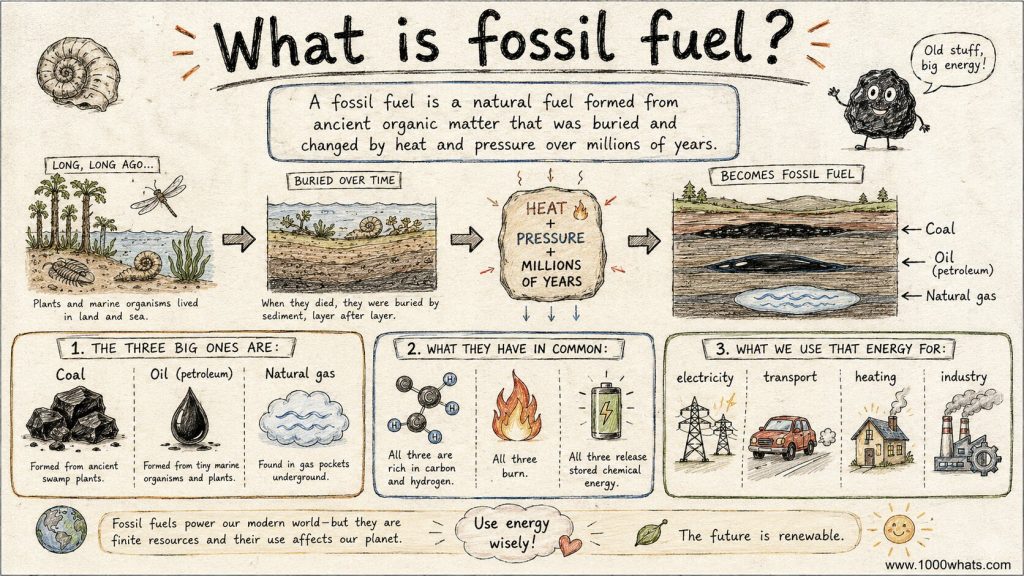
A fossil fuel is a natural fuel formed from ancient organic matter that was buried and changed by heat and pressure over millions of years.
The three big ones are:
- Coal
- Oil (or petroleum)
- Natural gas
All three are rich in carbon and hydrogen.
All three burn.
All three release stored chemical energy that we use for electricity, transport, heating, and industry.
That’s the practical reason humanity got so obsessed with them.
In practice, fossil fuels are like energy savings accounts filled by ancient biology and cashed out by modern civilization.
How do fossil fuels form?
Here’s the stripped-down version.
1. Something alive dies
Plants, plankton, algae, and other organisms die and pile up in the right environment—usually somewhere muddy, swampy, or oxygen-poor.
2. They get buried
Sediment piles on top. Then more sediment. Then more, because Earth apparently never stops redecorating.
3. Heat and pressure do the dirty work
As that organic material gets buried deeper, temperature and pressure rise. The material slowly changes chemically.
4. Different stuff becomes different fuels
- Ancient swamp plants mostly became coal
- Buried marine microorganisms and organic muck helped form oil and natural gas
That’s why fossil fuels are non-renewable on any human timescale. You can burn them this afternoon. You cannot grow them back by Tuesday.
⚡ “The Earth can make fossil fuels. It’s just hilariously slow about it.”
Fossil fuel examples you already know
This part is less abstract.
You’ve met fossil fuels plenty of times, even if you didn’t give them a formal introduction.
Coal
Coal is the black, carbon-heavy rock that powered steam engines, factories, and huge chunks of the Industrial Revolution. It is still used for electricity and in heavy industry, especially steelmaking.
Oil
Crude oil gets refined into gasoline, diesel, jet fuel, and petrochemical feedstocks. So your car, airplane ticket, plastic toothbrush, and suspiciously shiny food packaging all have oil somewhere in the story.
Natural gas
Natural gas is used for heating, cooking, electricity generation, and industrial processes. It is mostly methane, which is useful as a fuel and also useful—unhelpfully—as a potent greenhouse gas when it leaks.
What most people don’t see is that fossil fuels are not just “stuff we burn.”
They are also raw materials for chemicals, plastics, fertilizers, and industrial products. That is one reason they became so deeply wired into the economy.
Why were fossil fuels so useful?
Now we get to the part nobody should pretend away.
Fossil fuels did not win because humans are cartoon villains twirling soot-covered mustaches.
They won because they were ridiculously useful.
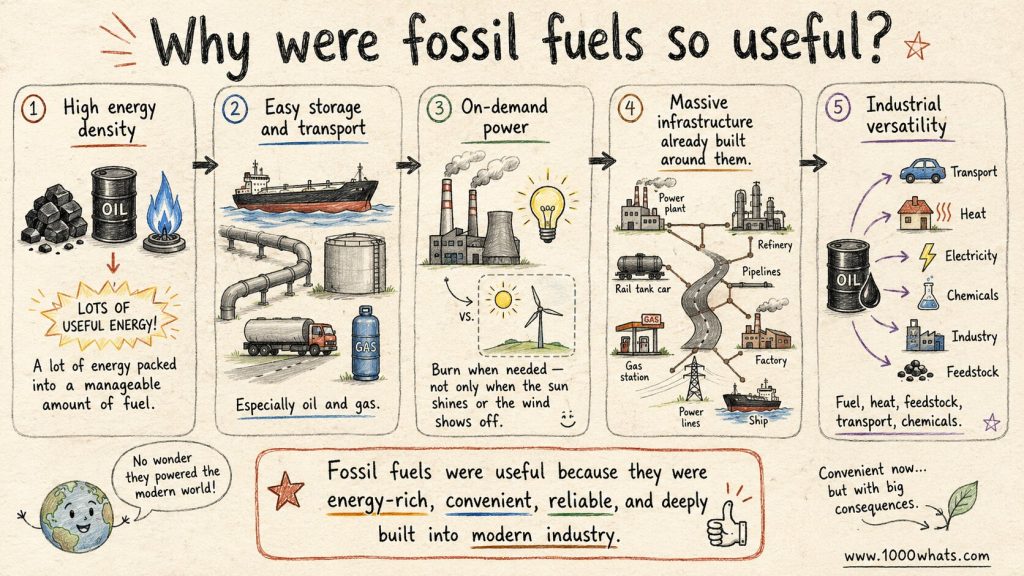
From a market perspective, fossil fuels had several unfair advantages:
- High energy density — a lot of energy packed into a manageable amount of fuel
- Easy storage and transport — especially oil and gas
- On-demand power — burn when needed, not only when the sun shines or the wind shows off
- Massive infrastructure already built around them
- Industrial versatility — fuel, heat, feedstock, transport, chemicals
That combination built railroads, factories, shipping networks, power systems, and modern agriculture.
Without fossil fuels, the modern world would have developed very differently.
Probably slower.
Definitely messier.
Maybe with fewer leaf blowers, which would not be a tragedy.
⚡ “Fossil fuels were the cheat code for industrial growth—until the side effects started sending invoices.”
How do fossil fuels work?
This part is beautifully simple.
You burn them.
That’s it. That’s the trick.
A fossil fuel stores energy in chemical bonds. Combustion breaks those bonds and releases energy as heat. That heat can boil water, spin a turbine, move pistons, warm buildings, or power industrial processes.
Coal burns in a power plant.
Gasoline burns in an engine.
Natural gas burns in a boiler or turbine.
Simple? Yes.
Harmless? Not remotely.
Because when you burn fossil fuels, the carbon that was locked underground ends up in the atmosphere as carbon dioxide.
Pros and cons of fossil fuels
Let’s not do the fake thing where one side gets all the lines.
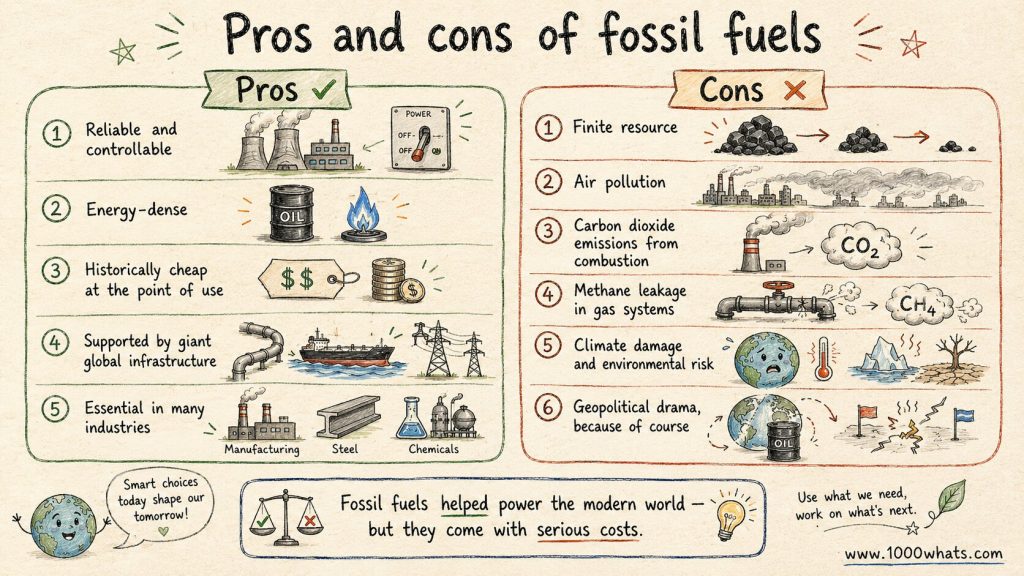
Pros
- Reliable and controllable
- Energy-dense
- Historically cheap at the point of use
- Supported by giant global infrastructure
- Essential in many industries
Cons
- Finite resource
- Air pollution
- Carbon dioxide emissions from combustion
- Methane leakage in gas systems
- Climate damage and environmental risk
- Geopolitical drama, because of course
Here’s the awkward truth: fossil fuels are both historically brilliant and environmentally expensive.
That contradiction is the whole argument.
Why do fossil fuels matter today?
Because we are still living inside the machine they built.
Homes are heated with them.
Planes still run mostly on them.
Industry still depends on them.
Large parts of the power system still lean on them.
At the same time, burning fossil fuels has produced nearly three-fourths of human-caused emissions over the past 20 years, and the energy system is the largest source of CO2 emissions globally.
So the modern conversation is no longer, “Are fossil fuels useful?”
That case was settled long ago.
The real question is this: how long can we keep using ancient carbon as the backbone of modern life without cooking the conditions that made modern life possible?
That is why fossil fuels matter now.
Not because they are mysterious.
Because they are powerful, deeply embedded, and attached to a very large bill.
A real-world example: your ordinary day is full of fossil fuel fingerprints
Take a completely average day.
You wake up in a heated home.
A gas boiler may have warmed the place.
Your alarm sits in a plastic case made from petrochemicals.
The bus or car ride uses gasoline or diesel.
Lunch arrived through a supply chain loaded with trucks, refrigeration, packaging, and fertilizer—all of which have likely touched fossil fuels somewhere along the way.
Then you get online and hear someone say, “Why don’t we just stop using fossil fuels tomorrow?”
That’s a fine slogan.
It is not a serious systems plan.
In practice, the hard part is not spotting the problem. The hard part is replacing an energy foundation that got woven into transport, heating, chemicals, manufacturing, and electricity over more than a century.
Final thoughts
So, what is fossil fuel?
It is buried ancient life turned into concentrated fuel.
That is the clean definition.
The messier truth is more interesting: fossil fuels helped build modern civilization because they were dense, flexible, and easy to use. Then we discovered the catch. Burning them moves old carbon into the atmosphere fast, while the planet removes it slowly.
That’s not a moral fairy tale.
It’s physics with consequences.
My take? We should talk about fossil fuels honestly. Not like they were pure evil from day one. Not like they are harmless because they made modern life convenient. Just honestly. They were an extraordinary energy shortcut, and now we’re learning the price of taking it.
Got a favorite analogy for fossil fuels? Or a better joke than “dinosaur juice,” which frankly deserves retirement? Drop it in.
Until next time, stay curious!
Discover more from 1000whats
Subscribe to get the latest posts sent to your email.