Electricity has a funny habit.
It shows up at the exact moment it is needed, and because of that, it tricks people into thinking the whole thing is simple.
Flip a switch. Light.
Plug in a charger. Power.
Turn on the AC. Sweet, artificial winter.
But electricity is not simple. It is an enormous synchronized performance involving physics, metal, weather, regulation, markets, and human beings signing contracts they hope will still make sense 15 years from now.
And buried inside that drama is one deceptively boring phrase:
Power Purchase Agreement.
Which sounds, frankly, like the kind of thing invented to make bright students leave the energy industry and take up pottery.
That would be a mistake.
Because a Power Purchase Agreement (PPA) is not just legal wallpaper. It is one of the key ideas that allows modern energy projects — especially renewable ones — to exist in the first place.
Welcome to 1000whats — where the energy world gets translated from nerd to normal.
What is a Power Purchase Agreement (PPA)?
A Power Purchase Agreement, or PPA, is a contract in which a buyer agrees to purchase electricity from a power producer under agreed terms, usually over a long period of time.
That is the official-looking version.
Here is the human version:
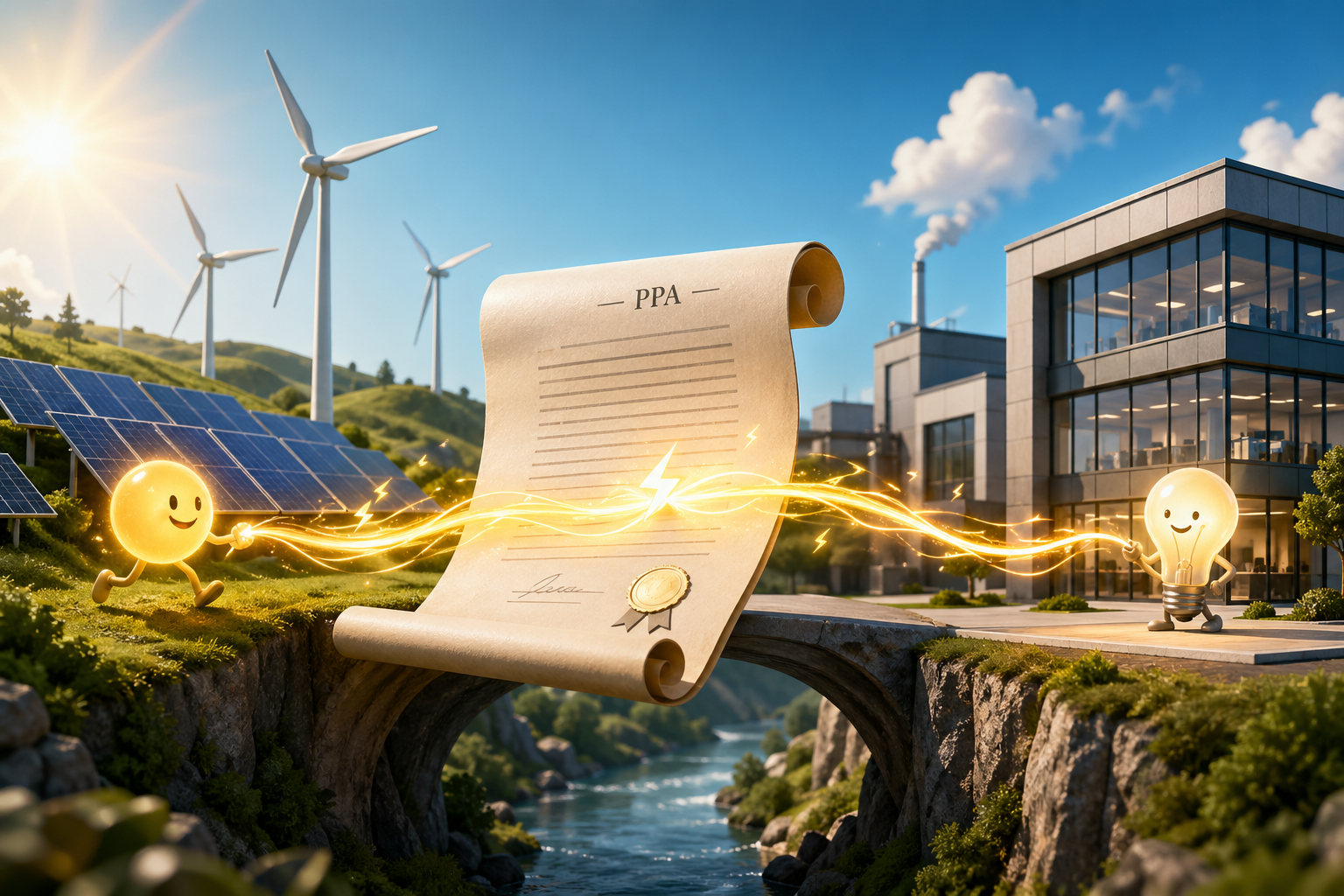
One party builds the thing that makes electricity. Another party promises to buy the electricity it produces.
That is the core of it.
A solar farm is planned. A wind project is proposed. A rooftop system is ready to go. But before money starts pouring into steel, wires, panels, transformers, and land rights, someone asks the obvious question:
Who is going to buy the power?
A PPA answers that question in writing.
⚡ “A PPA is a way of selling future electricity before the future shows up.”
Why does a PPA exist at all?
Because building energy projects is expensive, and hope is not accepted by lenders.
That is really the whole story.
Imagine trying to finance a giant solar farm by saying this:
“Look, the sun is definitely going to shine, and somebody will probably want electricity, so perhaps several million dollars could be wired over by Thursday?”
That approach tends to produce a certain stiffness in bankers. 😁
A PPA solves that problem. It says:
- who will buy the electricity
- how the price will be set
- how long the arrangement lasts
- what happens if things go wrong
So the contract does not merely describe the project.
It helps make the project believable.
In practice, that is what most people do not see. They see the turbine. They see the panels. They see the ribbon cutting and the photos with hard hats.
What they do not see is that the real magic often happened earlier, when somebody agreed to buy the output.
How does a Power Purchase Agreement work?
At first glance, it sounds almost too simple.
A power producer makes electricity.
A buyer buys it.
Money changes hands.
Everyone goes home.
But of course, if human beings are involved, it gets more intricate.
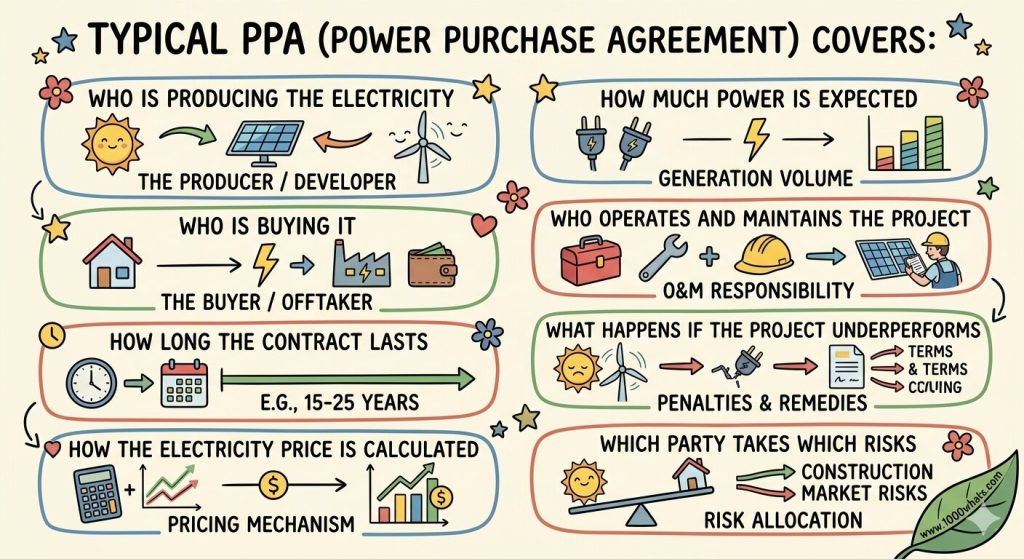
A typical PPA usually covers things like:
- Who is producing the electricity
- Who is buying it
- How long the contract lasts
- How the electricity price is calculated
- How much power is expected
- Who operates and maintains the project
- What happens if the project underperforms
- Which party takes which risks
So a PPA is not just a promise to buy power.
It is a carefully arranged plan for how the economics of that power will behave over time.
Think of it like this: a machine produces electricity, but a PPA produces predictability.
And in the energy business, predictability is nearly as valuable as electricity itself.
Why are PPAs so important in renewable energy?
Because renewable projects have an odd personality.
Once a solar or wind project is built, the fuel is cheap — sunlight does not send invoices, and wind has not yet learned how to negotiate.
But getting the project built in the first place can require a mountain of capital.
That means developers need revenue certainty early. Investors want to know the project will not just produce electricity, but produce money.
A power purchase agreement helps bridge that gap.
It gives the project a future customer before the first kilowatt-hour is delivered.
That is why PPAs became such a big deal in renewables. They help turn a clean energy idea into a financeable asset.
⚡ “A solar panel makes power. A PPA makes the solar panel legible to finance.”
Is a PPA the same as an offtake agreement?
Close, but not quite.
A PPA is a type of offtake agreement.
The general idea behind an offtake agreement is that a buyer agrees in advance to purchase future output from a project. That output could be minerals, chemicals, fuel, apples, or electricity.
A PPA is just the electricity version of that logic.
So the difference is not philosophical. It is mostly about what is being sold.
- PPA: future electricity
- Offtake agreement: future product
That connection matters because it makes the whole thing easier to understand. The energy world loves inventing new names for old ideas. Sometimes the simplest move is to spot the family resemblance.
The main types of PPAs
This is the part where the jargon tries to stage a coup.
Fortunately, the underlying ideas are not that hard.
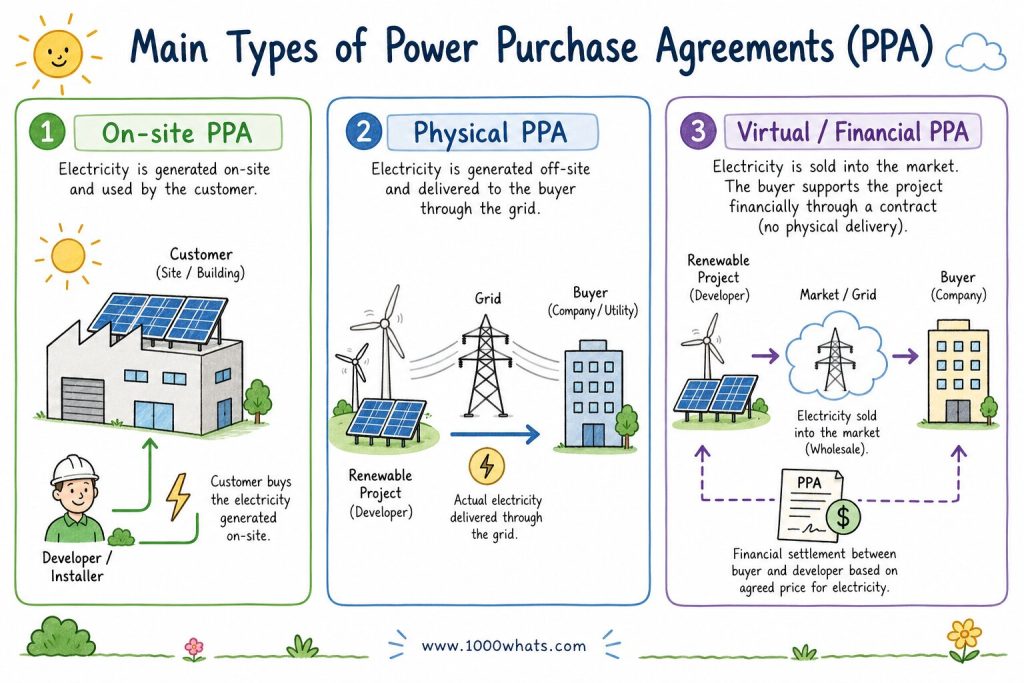
On-site PPA
This is the most tangible kind.
A developer installs a solar system on a building, facility, or campus. The developer usually owns and maintains the equipment. The customer buys the electricity the system produces.
So the customer does not buy the solar panels.
The customer buys the output from the solar panels.
That distinction sounds tiny until accountants enter the room. Then suddenly it matters a lot.
Physical PPA
A physical PPA is closer to what most people imagine: a buyer agrees to buy actual electricity from a specific project, delivered through the grid.
This is the more literal version of buying power.
Virtual PPA or Financial PPA
Now the plot gets interesting.
A virtual PPA — also called a financial PPA — usually does not mean the buyer physically receives the exact electricity from that project.
Instead, the project sells power into the market, and the buyer and seller settle the contract financially based on the difference between the market price and the agreed contract price.
Which sounds abstract because it is abstract.
But the point is practical: it can help buyers support renewable energy and manage price exposure without directly taking physical delivery from that generator.
This is where the PPA starts looking less like a utility bill and more like a strategic risk tool wearing a hard hat.
Who uses Power Purchase Agreements?
Quite a few people, actually.
Common PPA users include:
- Utilities
- Large corporations
- Manufacturers
- Universities
- Hospitals
- Data centers
- Government agencies
- Commercial property owners
Why them?
Because they use a lot of electricity, care about price stability, and increasingly care about emissions, procurement strategy, or both.
From a market perspective, that is why PPAs matter so much right now. They sit at the intersection of three big forces:
- rising demand for electricity
- pressure to decarbonize
- the need for long-term price visibility
That is a powerful combination.
What are the benefits of a PPA?
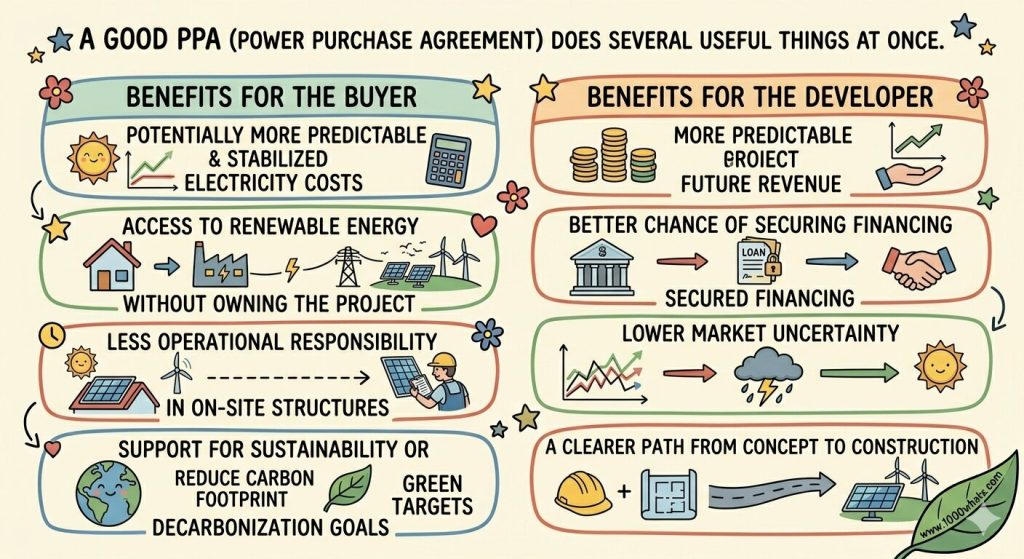
A good Power Purchase Agreement can do several useful things at once.
Benefits for the buyer
- Potentially more predictable electricity costs
- Access to renewable energy without owning the project
- Less operational responsibility in on-site structures
- Support for sustainability or decarbonization goals
Benefits for the developer
- More predictable future revenue
- Better chance of securing financing
- Lower market uncertainty
- A clearer path from concept to construction
In other words, the buyer gets structure, and the developer gets credibility.
That is a very fair trade in a business where both are expensive.
What are the downsides of a PPA?
Naturally, no useful contract comes without complications.
A PPA can also bring:
- Long-term commitment
- Complex pricing structures
- Counterparty risk
- Performance risk
- Market risk, especially in virtual PPAs
- Contract complexity that can confuse almost everyone at least once
This is important because people sometimes talk about PPAs as if they are magical instruments that spray green electrons and financial stability all over the place.
They are not magic.
They are carefully designed risk-sharing tools.
And when they are designed badly, they share risk in the same way a sinking boat shares water.
⚡ “A PPA does not remove uncertainty. It decides who gets which piece of it.”
PPA vs lease: what is the difference?
This one causes more confusion than it should.
With a lease, the customer generally pays for the use of the equipment.
With a PPA, the customer generally pays for the electricity produced by the equipment.
That is the key difference.
A lease is about the asset.
A PPA is about the output.
It is the difference between renting the cow and paying for the milk.
Not the world’s most glamorous metaphor, perhaps, but perfectly serviceable.
A simple example of a PPA
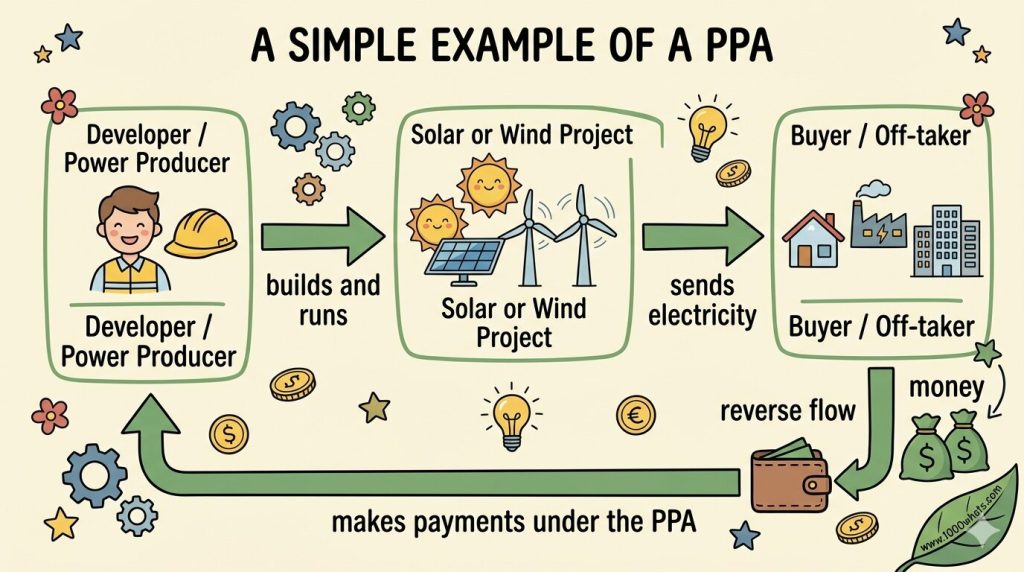
Suppose a company wants solar power on its building.
It likes the idea of lower emissions. It likes the idea of stable energy costs. It likes the idea of telling the annual report a nice clean story.
What it does not like is spending a pile of money upfront, hiring people to manage solar equipment, or becoming accidentally responsible for inverter maintenance.
So a developer steps in.
The developer installs and owns the solar system. The company signs a PPA agreeing to buy the electricity it produces for, say, 15 or 20 years.
Now look at what happened:
- the company gets electricity
- the developer gets a customer
- the lender sees future revenue
- the developer builds the project
That is the genius of the arrangement.
Nobody had to become something they were not.
Why PPAs matter today
Because energy has entered one of its weird phases.
Demand is climbing. Grids are under pressure. Companies want cleaner power. Governments want more low-carbon infrastructure. Electricity prices can behave like caffeinated squirrels. And the world keeps discovering that “just build more generation” is easy to say and annoyingly hard to finance.
So Power Purchase Agreements matter because they help connect ambition to execution.
They take a vague desire — cheaper power, cleaner power, new generation, investment certainty — and turn it into a structure people can actually sign.
That is not glamorous, but it is foundational.
Bridges are not glamorous either until one is needed.
Final thoughts
A Power Purchase Agreement (PPA) is one of those ideas that looks dull only because it works.
It is a contract, yes.
A long one, often.
Occasionally full of clauses that appear to have been written by extremely cautious aliens.
But underneath all that, the idea is elegant.
A PPA lets future electricity become present confidence.
It helps developers finance projects.
It helps buyers plan.
It helps renewable energy move from noble intention to steel, glass, wires, and actual electrons.
And if the bigger logic behind it feels familiar, that is because it is. A PPA is part of the broader world of offtake agreements — the old, powerful idea that future production becomes much more real once someone agrees to buy it.
That is how we build a lot of the modern world: first with a promise, then with a project.
Until next time, stay curious! 😎
Discover more from 1000whats
Subscribe to get the latest posts sent to your email.