Alternating current?
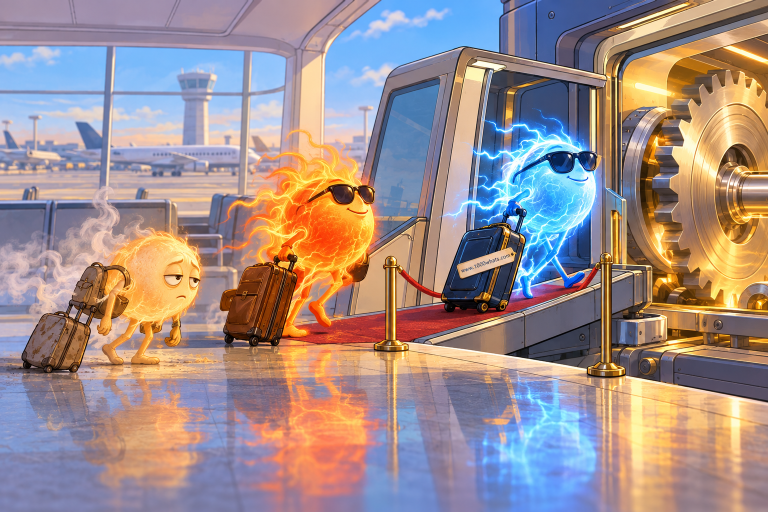
So, you’re telling me electricity rushes into my refrigerator, changes its mind, runs back out, and repeats the whole routine dozens of times every second?
Then why am I the only one getting an electric bill?
Where is the fridge’s contribution? Where is my refund? At the very least, I’d expect a thank-you card from the power company.
Unfortunately, that is not quite how alternating current works.
Yes, the electrical current in your home really does reverse direction constantly. But your refrigerator is not filling a tiny bucket with used electrons and shipping them back to the power plant.
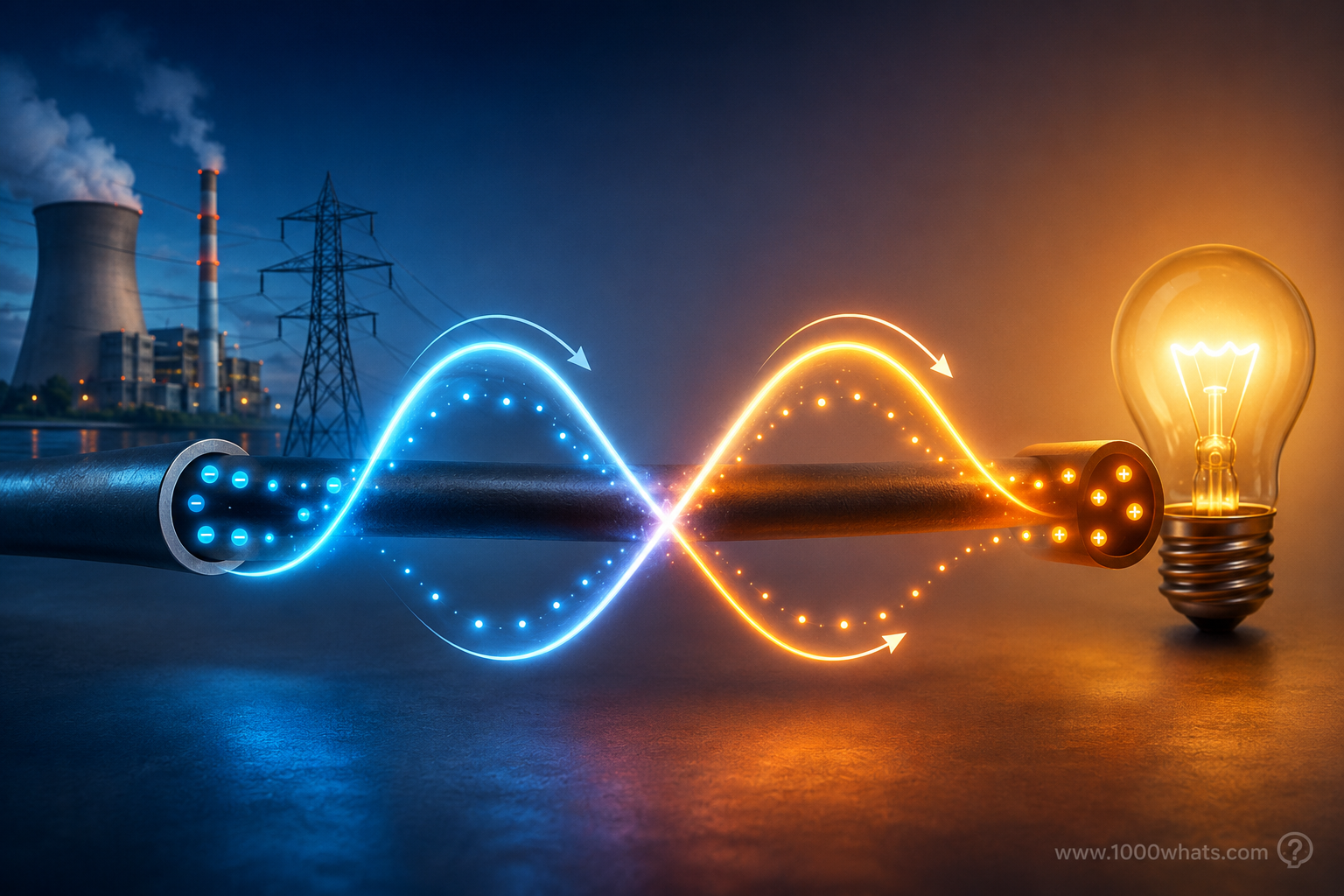
The charges inside the wires mostly move back and forth over very small distances. What travels through the system—and what you pay for—is electrical energy.
⚡ “AC changes direction constantly. That does not mean the useful energy changes its mind.”
Welcome to 1000whats—where we ask the questions your physics textbook was too serious to answer.
Let’s plug in.
What is alternating current?
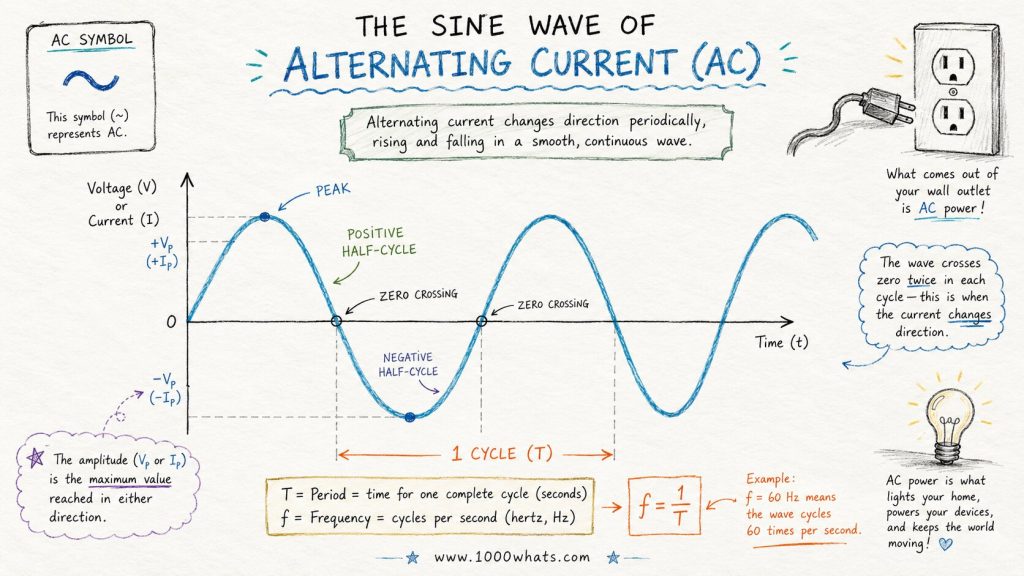
Alternating current, or AC, is an electric current that periodically changes direction and usually changes magnitude at the same time.
Instead of flowing steadily in one direction, the current moves one way, slows down, stops for a microscopic moment, reverses, and moves the other way.
Then it does it again.
And again.
And again.
In most electrical grids, this movement follows a smooth pattern called a sine wave. The number of complete waves produced every second is called the frequency, measured in hertz.
- A 50 Hz electricity system completes 50 cycles every second.
- A 60 Hz system completes 60 cycles every second.
- Because direction reverses twice during each cycle, a 50 Hz current changes direction 100 times per second.
Most of Europe, Asia, Africa, and many other regions use 50 Hz. North America commonly uses 60 Hz.
Your refrigerator has no time to get emotionally attached to either direction.
Wait—does electricity really flow backward?
Yes.
But this is where everyday language gets us into trouble.
When people hear “electricity flows,” they often imagine electrons leaving a power plant, racing through miles of cable, entering a refrigerator, doing some cooling, and then heading home exhausted.
That is not what happens.
A metal wire is already packed with free electrons. When voltage creates an electric field inside the wire, those electrons begin moving in a coordinated way.
With direct current, they drift mainly in one direction.
With alternating current, they move one way and then the other.
The individual electrons usually travel slowly. The electrical field—the organized push that makes them move—spreads through the circuit extremely quickly. That is why your light turns on almost immediately even though no electron has sprinted from a distant generator to your lamp.
Think of a long rope.
If you shake one end, a wave travels along the rope. The rope itself does not travel across the room. Each piece simply moves back and forth while transferring energy to the next piece.
AC electricity is similar.
⚡ “The electrons do not commute from the power plant to your toaster. They mostly wiggle where they already live.”
Why doesn’t the power company pay you when the current flows back?
Because current direction and energy direction are not the same thing.
This sounds suspicious, but the math explains it.
Electrical power can be expressed as:
During one half of an AC cycle, the voltage and current may both be positive.
During the next half, they may both be negative.
But remember your elementary-school math:
Negative × negative = positive.
So even though the current reverses, the power can continue flowing into the appliance during both halves of the cycle.
Your fridge’s compressor converts that electrical energy into:
- Mechanical motion
- Cooling
- Heat
- Sound
- The mysterious midnight hum that makes you wonder whether someone is in the kitchen
The current changes direction, but the refrigerator still consumes real energy.
That real energy is measured over time in kilowatt-hours, or kWh. That is what normally appears on your electricity bill.
The slightly more complicated truth
Motors, transformers, and other electromagnetic equipment can temporarily store energy in magnetic fields and send part of it back toward the grid during portions of the AC cycle.
This back-and-forth exchange is associated with reactive power.
However, the appliance still consumes net real energy to perform useful work and overcome losses. Your refrigerator cannot finance its lifestyle by returning a little magnetic energy every few milliseconds.
In practice, large industrial customers may be charged for poor power factor because excessive reactive power places additional demands on the grid. Residential customers are generally billed mainly for real energy consumption.
So yes, some electrical energy can briefly slosh backward.
No, your fridge has not started a side business.
What creates alternating current?
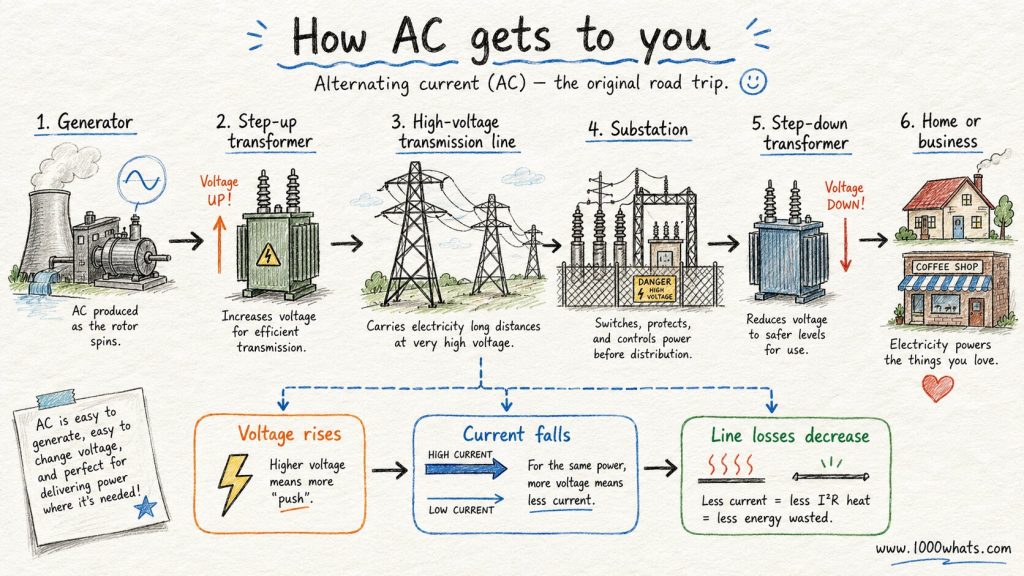
Alternating current is commonly produced by a generator.
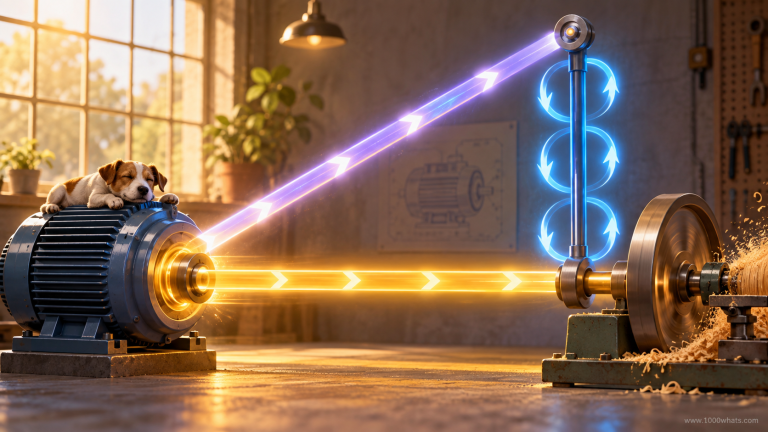
Inside a generator, mechanical energy rotates a magnetic field relative to coils of wire. That changing magnetic field induces a voltage in the coils through electromagnetic induction.
The mechanical rotation may come from:
- A steam turbine in a nuclear, coal, gas, or geothermal plant
- Flowing water in a hydropower plant
- Wind turning a turbine
- An engine connected to a portable generator
As the generator rotates, the magnetic relationship between the rotor and the coils continuously changes.
The induced voltage rises, falls, reaches zero, reverses polarity, and repeats.
In other words, the spinning motion naturally produces an alternating electrical wave.
Michael Faraday’s discovery of electromagnetic induction in 1831 laid the foundation for generators, transformers, motors, and ultimately the modern AC power system.
Why does alternating current exist?
Alternating current exists because rotating generators produce it naturally—but that is only part of the story.
Its biggest historical advantage was something far more practical:
AC voltage can be changed efficiently using transformers.
And voltage control is the secret behind economical power transmission.
Suppose a grid needs to transmit a certain amount of power:
If engineers increase the voltage, they can transmit the same power using less current.
That matters because power lines lose energy as heat. Those losses rise with the square of the current:
Power loss = Current² × Resistance
Cut the current in half, and the resistive loss falls to one-quarter.
This is why electricity leaving a power station is stepped up to extremely high voltages for transmission. Near cities and neighborhoods, transformers step it back down to levels suitable for local distribution and household use.
📉 “AC won the early grid because transformers made long-distance electricity dramatically cheaper.”
AC versus DC: What is the difference?
Alternating current is easiest to understand when compared with direct current, or DC.
Alternating current
In AC systems:
- Current periodically reverses direction.
- Voltage normally changes polarity.
- The waveform is often sinusoidal.
- Voltage can be changed easily with traditional transformers.
- It is widely used for grids, buildings, motors, and large appliances.
Direct current
In DC systems:
- Current flows mainly in one direction.
- Polarity stays fixed.
- Voltage is relatively steady.
- It works naturally with batteries and many electronic devices.
- It is used in phones, computers, solar panels, electric vehicles, and battery storage.
A battery is the classic DC source. One terminal remains positive, and the other remains negative.
A wall outlet supplies AC.
But plug your phone charger into that outlet and something interesting happens: the charger converts the AC into DC because your phone’s battery and electronics require direct current.
Your house may receive AC, while half the devices inside immediately say, “Thanks, but we’ll take it from here.”
Where do we use alternating current today?
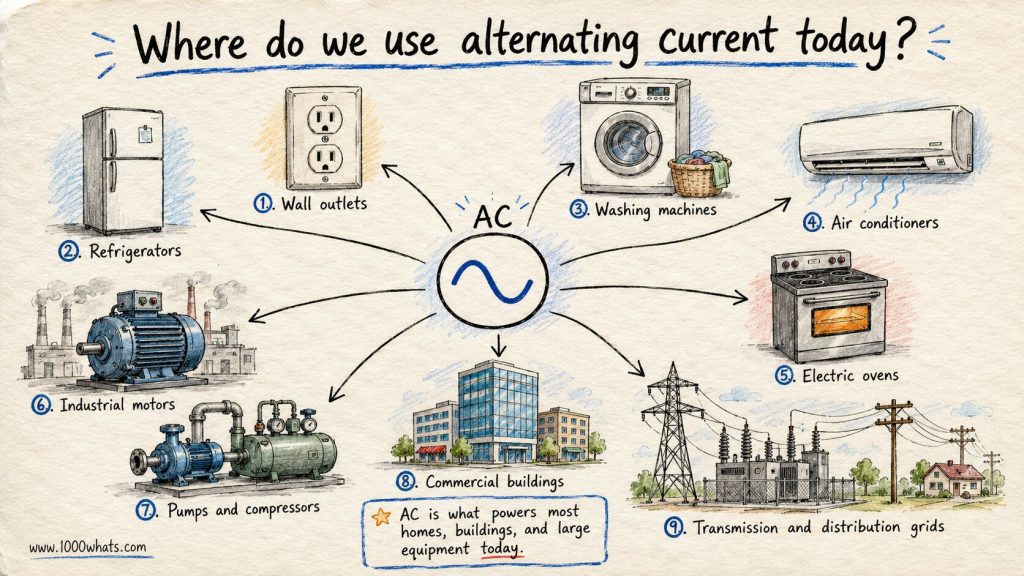
AC surrounds you.
Common examples include:
- Wall outlets
- Refrigerators
- Washing machines
- Air conditioners
- Electric ovens
- Industrial motors
- Pumps and compressors
- Commercial buildings
- Transmission and distribution grids
Large AC motors are especially important in industry. They run fans, conveyor belts, manufacturing equipment, water systems, and countless machines that quietly keep the economy moving.
Modern grids also use three-phase AC, where three alternating waveforms operate at slightly different points in their cycles.
Three-phase electricity provides smoother power delivery and works exceptionally well with large motors. From a market perspective, it is one of those invisible engineering choices that nobody notices—until a factory loses it.
What are the advantages of AC?
1. Voltage is relatively easy to transform
Traditional transformers can raise or lower AC voltage efficiently without requiring complicated moving equipment.
2. It supports economical power transmission
High-voltage transmission reduces current and therefore reduces resistive losses.
3. AC generators are practical
Rotating generators naturally produce alternating voltage through electromagnetic induction.
4. AC motors are robust
Many AC motor designs are efficient, durable, and relatively simple to maintain.
5. The infrastructure already exists
The global power system has been built around AC generation, transmission, distribution, protection, and equipment standards.
That installed base is enormous.
Replacing it would not be like changing a phone charger. It would be like changing the nervous system of industrial civilization.
What are the disadvantages of AC?
AC is useful, but it is not automatically superior in every situation.
1. Many modern devices require DC
Computers, LED lighting, batteries, solar panels, phones, data centers, and electric vehicle systems often operate internally on direct current.
This means AC must be converted into DC, creating cost, complexity, and some energy loss.
2. Reactive power complicates the grid
Motors, transformers, and long power lines can create phase differences between voltage and current.
Grid operators must manage this reactive power to maintain stable voltage and efficient operation.
3. Synchronization matters
Connected AC generators must operate at the correct frequency and remain synchronized with the grid.
A major imbalance between generation and demand can disturb frequency and potentially trigger equipment disconnections or outages.
4. AC shock can be extremely dangerous
Both AC and DC can injure or kill. Low-frequency AC is particularly dangerous because it can cause sustained muscle contraction and interfere with the heart’s rhythm.
Never treat household electricity as harmless simply because it is familiar.
Familiar danger is still danger.
Is AC always better for long-distance transmission?
No.
This is one of those simplified claims that survives because it was historically true enough to become a slogan.
AC was revolutionary because transformers made high-voltage transmission practical and economical. But modern power electronics can now convert and control high-voltage direct current.
That has made high-voltage direct current, or HVDC, attractive for:
- Extremely long point-to-point transmission
- Long submarine cables
- Connecting grids that operate asynchronously
- Carrying large volumes of renewable electricity across regions
HVDC systems require expensive converter stations, but they can reduce losses and avoid some AC-related limitations over suitable routes.
What most people do not see is that the modern energy system is no longer choosing one winner.
It is becoming a hybrid:
- AC for interconnected regional grids and local distribution
- DC for batteries, electronics, solar generation, data systems, and selected transmission projects
The old War of the Currents has quietly turned into a partnership.
Why alternating current matters today
AC is more than a physics lesson.
It shapes where power plants can be built, how electricity crosses countries, how renewable projects connect to the grid, and how reliably millions of devices operate together.
As more solar panels, batteries, electric vehicles, wind farms, and data centers join the system, electricity must pass through a growing collection of converters, inverters, transformers, and control systems.
A solar panel produces DC.
A battery stores DC.
The traditional grid operates mainly on AC.
A wind turbine may generate variable-frequency electricity that must be electronically converted before entering the grid.
Your phone requires DC but charges from an AC outlet.
Modern electrification is therefore not simply about producing more power. It is about converting and controlling power intelligently.
In practice, some of the most important technologies in the energy transition are not the glamorous turbines or giant battery containers.
They are the boxes in between.
The inverters.
The transformers.
The converters.
The equipment that helps AC and DC cooperate without starting another 19th-century corporate feud.
So, is your fridge sending electricity back?
The current in its power cable repeatedly reverses direction.
The electrons mostly shuffle back and forth.
Some energy may temporarily move between the appliance and the grid because of its motor and magnetic fields.
But over time, your refrigerator consumes net electrical energy to keep your food cold.
That is the energy recorded by your meter.
That is the energy appearing on your bill.
Final thoughts
Alternating current sounds absurd at first.
Why create a current that constantly reverses instead of simply moving forward?
Because the reversal is not a flaw. It is the feature that made generators, transformers, motors, and large interconnected power grids work together at enormous scale.
AC became the language of the electricity grid.
DC became the language of batteries and electronics.
Today, the future belongs to systems that can speak both fluently.
So the next time your refrigerator starts humming, remember: billions of electrons are performing a tiny synchronized dance inside the wires—not traveling across the country, not returning your electricity, and definitely not helping with the bill.
Do you think the future grid will remain mostly AC, or will batteries and power electronics push us toward a more DC-heavy world?
Until next time, stay curious! 😎
Discover more from 1000whats
Subscribe to get the latest posts sent to your email.