
Imagine you’re planning a huge party at your house.
You’ve invited friends, family, neighbors, and probably that one person who says they are “just stopping by for a minute” and somehow ends up staying until 2 a.m. You want everyone to have a good time, so you prepare food, drinks, music, chairs, lights, and enough snacks to survive a small apocalypse.
But then the chaos begins.
What if more people show up than you expected?
What if some guests bring food and others arrive like they have not eaten since the Bronze Age?
What if the weather suddenly changes and the whole party has to move indoors?
What if everyone wants pizza at exactly the same moment?
Planning a party is hard.
Planning the electricity supply for an entire country? Now we’re talking party-planning on nightmare mode.
The electricity grid has to keep supply and demand balanced all the time. Not “most of the time.” Not “when it’s convenient.” All the time. And that is tricky, because both sides keep moving.
Demand changes with the hour, the season, the weather, and what people are doing. A cold winter evening? Demand jumps. A brutal summer heat wave with every AC unit screaming for mercy? Demand jumps again.
Supply is just as moody. A gas plant may be offline for maintenance. Wind turbines need wind. Solar panels need sunshine. Hydropower depends on water. Coal, gas, nuclear, wind, solar, hydro—they all show up to the party differently.
So how do grid operators make sure there is enough electricity when demand spikes or supply suddenly flakes out?
One of the tools they use is called the capacity market.
It sounds technical. Maybe even a little dull.
But the idea behind it is actually simple: sometimes the grid needs to pay power plants not just for producing electricity, but for being ready to produce it when things get tight. That’s the heart of the whole thing.
Welcome to 1000whats, where we try to make complex energy topics simple, useful, and maybe even a little fun.
What is a capacity market and why do we need it?
A capacity market is a mechanism that pays power plants to be ready to generate electricity when needed.
That’s it. That’s the core idea.
Not to generate electricity right now. Not to sell a specific number of megawatt-hours this second. But to be available when the system needs them most.
It is also called a capacity mechanism or a capacity remuneration mechanism, which is a very official-sounding way of saying, “We are paying you to be on standby.”
Why is that even necessary?
Because electricity is weird.
You can’t just pile it up in giant warehouse shelves the way you store bananas, sneakers, or cans of soup. In most power systems, electricity has to be balanced in real time. Supply and demand have to match almost instantly.
If they don’t, bad things happen:
- voltage problems
- system instability
- brownouts
- blackouts
- equipment damage
- lots of angry people wondering why the lights just died in the middle of dinner
So grid operators need enough capacity not only for normal conditions, but also for those nasty peak moments when everyone wants power at once.
The real problem
Here’s where it gets interesting.
Some power plants are only needed for a few hours each year. These are often peaking plants—units that jump in when demand is especially high. They may not run much, but when they are needed, they are really needed.
And that creates a business problem.
If a plant only earns money when it actually sells electricity, and it only runs a few hours per year, it may not make enough revenue to justify staying open. It might retire. Or sit mothballed. Or never get built in the first place.
From a market perspective, that is the gap capacity markets are trying to fill.
They provide an extra revenue stream for resources that can guarantee availability during peak periods. In other words, the system is not just paying for electricity. It is paying for readiness.
⚡ “In electricity, being available at the right moment can be just as valuable as generating all day.”
Capacity market vs. energy market
This part matters.
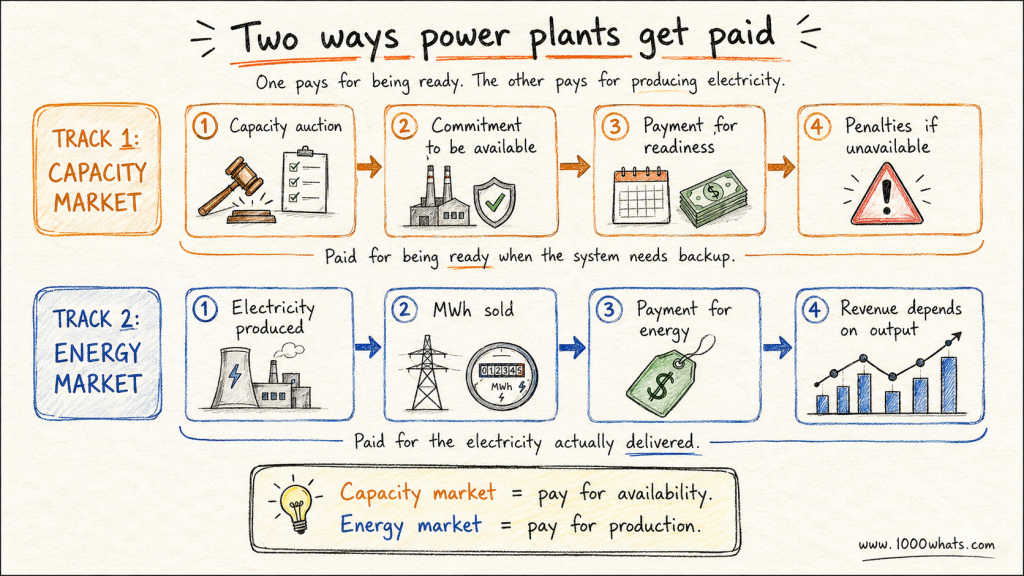
A regular energy market pays generators for the electricity they actually produce and sell.
A capacity market pays them based on their ability to produce electricity when the system needs them.
So one market pays for output.
The other pays for backup muscle.
Think of it this way:
- The energy market pays the chef for cooking the meal
- The capacity market pays the chef for being in the kitchen, sober, awake, and ready when 50 extra guests show up
That second payment may sound odd—until the guests arrive.
How does a capacity market work?
At a high level, a capacity market works through auctions.
Power plants and other eligible resources bid for contracts to provide capacity in the future. If they win, they get paid to make that capacity available during the delivery period. If they fail to show up when called, they can face penalties.
The basic flow
Here’s the simple version:
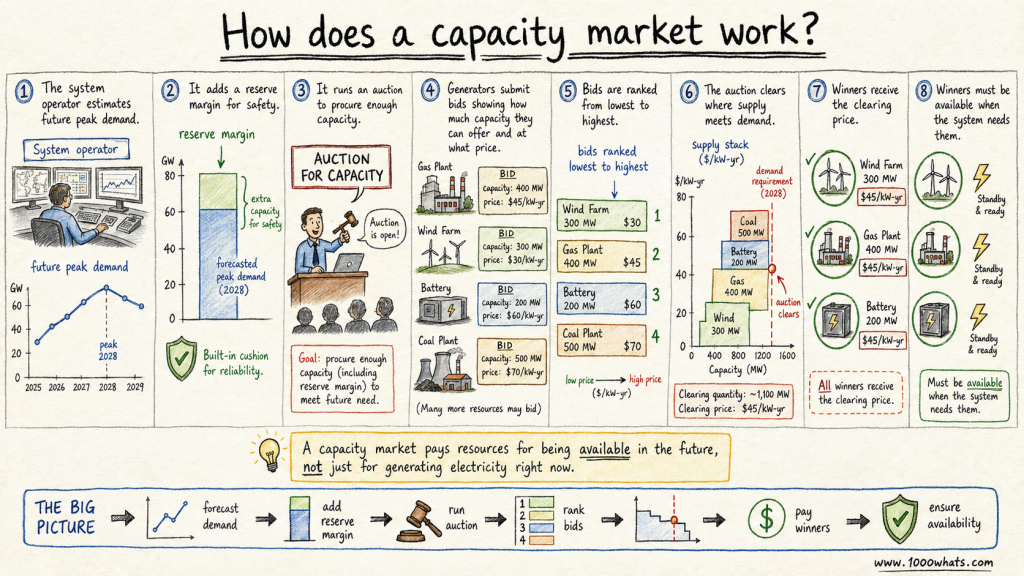
- The system operator estimates future peak demand
- It adds a reserve margin for safety
- It runs an auction to procure enough capacity
- Generators submit bids showing how much capacity they can offer and at what price
- Bids are ranked from lowest to highest
- The auction clears where supply meets demand
- Winners receive the clearing price
- Winners must be available when needed
That reserve margin is basically the grid’s emergency snack drawer. It is the extra cushion above expected peak demand in case forecasts are wrong, plants trip offline, or weather decides to get dramatic.
Forward auctions and near-term auctions
Capacity auctions can happen years ahead of time or closer to delivery.
Why hold them years in advance?
Because building new power plants is not like buying extra napkins for the party. It takes time. Permits, financing, construction, interconnection—none of that happens overnight.
So some markets hold forward auctions several years ahead, giving investors a signal early enough to act. Others use shorter-term auctions to fine-tune the system.
In practice, the timing matters a lot. Too early, and your forecasts can be wrong. Too late, and there is not enough time to build anything useful.
Who organizes these auctions?
Usually an independent body like a grid operator or regulator.
And yes, this is where things start sounding like a boardroom full of acronyms. But beneath all the paperwork, the logic is simple: the system is trying to buy enough dependable capacity before reliability becomes a problem.
⚡ “What most people don’t see is that the grid is planned around the worst hours of the year, not the easiest ones.”
An illustrative capacity market deal
Let’s make this less abstract.
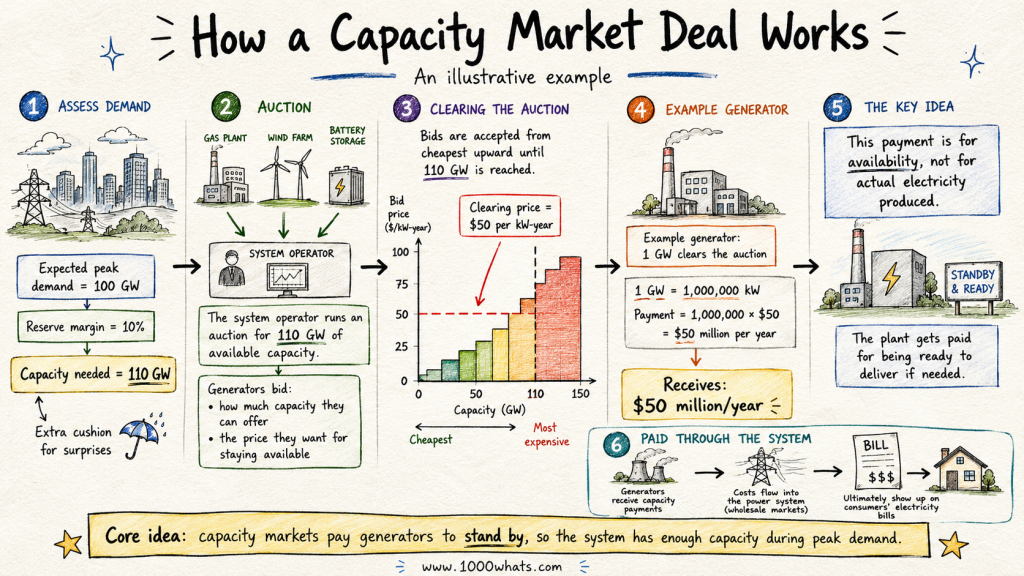
Suppose a region expects peak electricity demand of 100 GW.
Now suppose the system operator wants a 10% reserve margin to deal with unexpected events. That means the system wants 110 GW of total available capacity.
So it runs an auction to procure that 110 GW. Generators submit bids saying:
- how much capacity they can offer
- what price they want for keeping that capacity available
The bids are stacked from cheapest to most expensive. The system accepts enough bids to reach 110 GW.
Now let’s say the clearing price ends up at $50 per kW-year.
If one generator offered 1 GW of capacity and cleared the auction, it would receive $50 million per year for making that 1 GW available.
Notice something important here: that payment is not based on how much electricity the plant actually produces.
It is getting paid for standing by, ready to jump in if needed. That is the whole point of the mechanism.
Of course, those capacity payments do not come from thin air. The cost is generally passed through the system and ultimately lands on consumers’ electricity bills.
Because in the end, reliability is not free. It just gets billed in more creative ways.
Is it possible for a generator that won capacity auctions to still sell its energy?
Yes. Absolutely.
And this is one of the biggest points of confusion.
Some people hear “capacity payment” and assume the generator is now getting paid instead of selling electricity.
Nope.
It still sells electricity in the energy market like before.
Here’s what actually happens:
A generator that wins a capacity auction has committed a certain amount of capacity to the system. It continues operating normally, following market prices, dispatch instructions, fuel costs, and business logic.
But when the system gets tight and that generator is called upon to perform, it must be able to deliver up to the capacity it promised.
If it does not, penalties may apply.
If it does, it still gets paid for the actual electricity it produces and sells in the energy market.
So the generator can earn money in two ways:
- capacity payments for being available
- energy market revenues for the electricity it actually produces
In other words, capacity is the retainer fee. Energy is the actual invoice.
What are the benefits and challenges of a capacity market?
Ah yes. The classic energy question:
Does this solve a problem, or does it create three new ones while pretending to solve the first?
The honest answer is: both sides have a point.
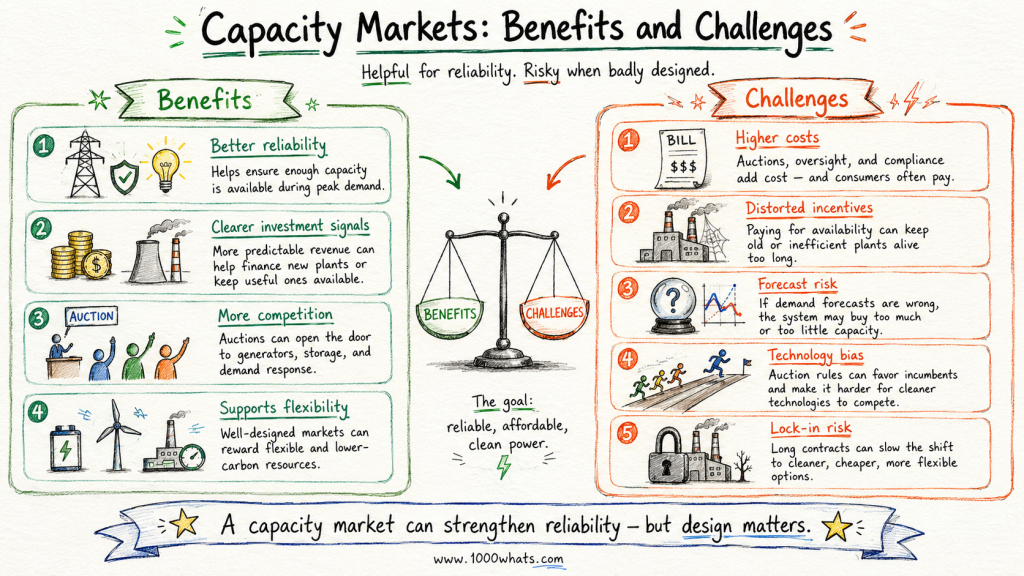
Capacity markets can absolutely help reliability. But they can also create cost, complexity, and weird incentives if they are badly designed.
The benefits
1. Improved reliability and security of supply
This is the main selling point.
A capacity market helps make sure there is enough generation capacity available during peak demand. That reduces the risk of blackouts and brownouts when the system is under stress.
Think of a heat wave when millions of air conditioners kick on at once. Without enough standby capacity, the grid can start sweating bullets.
A capacity market is meant to prevent that.
2. Better investment signals
Power plants are expensive. Investors generally prefer not to throw billions at infrastructure based on vibes.
Capacity markets create a more stable and predictable revenue stream, which can make it easier to finance new plants or maintain existing ones.
In practice, that matters a lot. A plant that looks marginal in the energy market alone might become financeable if it also has capacity revenue.
3. More competition
In a deregulated market, a few big players can sometimes dominate the generation landscape.
Capacity auctions can widen participation by letting multiple providers compete for contracts. That can include smaller generators and, depending on the rules, storage or demand-side resources too.
From a market perspective, that can reduce concentration and improve efficiency—at least in theory.
4. Support for flexibility and lower-carbon resources
A well-designed capacity market can reward flexible or low-carbon resources that help integrate renewable energy.
That could mean plants that ramp quickly, storage assets, or demand response providers that reduce load during stress periods.
That is the optimistic version, anyway. Which brings us to the other side.
The challenges
1. Higher costs and more bureaucracy
Let’s not sugarcoat it: capacity markets add another layer of administration to the system.
Auctions need rules. Regulators need oversight. Forecasts need modeling. Compliance needs monitoring.
And all of that costs money.
Guess who often ends up paying? Consumers.
2. Distorted market signals
This is one of the big criticisms.
If generators get paid for availability rather than actual production, you can end up keeping old or inefficient plants alive longer than the energy market would otherwise allow.
That can distort price signals and slow down the natural turnover of technologies.
3. Forecast risk
Capacity markets depend heavily on estimating future demand and supply.
If the forecasts are too high, the system can procure too much capacity and saddle consumers with unnecessary costs.
If the forecasts are too low, the system can still end up short.
So yes, the whole mechanism rests partly on humans trying to predict the future. Which has historically gone… mixed.
4. Technology bias
The auction rules matter enormously.
If eligibility criteria favor certain technologies—or certain incumbents—the market can end up skewed. Newer or cleaner technologies may struggle to compete even if they are valuable.
5. Lock-in risk
Long-term contracts can create a kind of market inertia.
If the system locks in old technologies for years, it may be slower to adopt newer, cleaner, cheaper, or more flexible options later on.
That is how you end up with stranded assets, awkward politics, and a grid that feels like it is wearing last decade’s shoes.
⚡ “A capacity market can buy reliability, but it can also accidentally buy yesterday’s power system for tomorrow’s grid.”
How do different countries implement capacity markets?
Here’s the fun part: there is no universal recipe.
Every country—or sometimes every region—ends up designing its capacity mechanism a little differently, depending on its market structure, reliability concerns, generation mix, and political priorities.
Your electricity market is basically a national personality test with turbines.
Australia
Western Australia introduced a capacity market mechanism for its main grid because of concerns about future supply shortages.
The problem? Forecasts of future demand turned out too high.
That led to excess capacity and higher consumer bills. As a result, the Western Australian model is often cited as a cautionary tale: capacity markets can absolutely overshoot if the assumptions behind them are wrong.
United States
The U.S. is a patchwork quilt of electricity markets, which means there is no single American model.
After the California electricity crisis of 2000–2001, some grid operators adopted capacity mechanisms while others leaned harder on energy-only reforms.
That has made the U.S. one of the most diverse electricity market landscapes in the world. Some regions use capacity-style approaches to attract investment and support reliability. Others remain skeptical, pointing to auction complexity, cost, fairness concerns, and environmental tradeoffs.
United Kingdom
The UK introduced a capacity market in 2014 as part of a broader electricity market reform package.
The aim was straightforward enough: keep the lights on as older plants retired, while also managing the transition toward a lower-carbon system.
The UK model uses auctions held several years ahead, plus shorter-term auctions for additional needs. It has helped secure capacity, but it has also faced criticism over low auction prices, fossil-heavy outcomes, and weak incentives for demand-side response and energy efficiency.
France
France took a different route with a more decentralized model.
Instead of one big centralized auction doing all the work, electricity suppliers are responsible for securing enough capacity certificates to cover peak demand from their customers. Those certificates can then be traded in a secondary market.
The French model has been effective at increasing availability and flexibility, especially from demand-side response. But it has also had challenges around administrative complexity, price volatility, and alignment with environmental goals.
What does this tell us?
That capacity markets are not one thing.
They are a family of mechanisms trying to solve the same core problem: how do you make sure enough reliable capacity shows up when the system needs it most?
Different countries answer that question differently. Some answers work better than others.
What are some alternatives to capacity markets?
Capacity markets are not the only game in town.
If the goal is reliability, there are several other approaches that can do similar work—or at least help carry the load.
1. Energy-only markets
In an energy-only market, generators get paid only for the electricity they actually produce and sell.
The theory is that when supply gets tight, prices should rise sharply. That scarcity pricing gives generators a reason to invest in capacity, because they can recover costs during those high-price moments.
Sounds elegant.
But there is a catch: if regulators cap prices too aggressively or intervene too often, those price signals can get smothered. Then the investment incentive weakens.
2. Strategic reserves
A strategic reserve is backup capacity kept outside the regular market and used only in emergencies.
Think of it like the backup generator you hope you never need—but feel very smart for having when things go sideways.
This can strengthen reliability without constantly interfering with the normal energy market. But it can also create moral hazard if market participants start assuming the reserve will always rescue them.
3. Reliability options
This one is a bit more financial-engineering flavored.
A reliability option pays power plants for offering an option tied to reliability, rather than a strict physical obligation to generate.
In simple terms, if prices spike above a certain strike price, providers may have to compensate for the difference if they cannot perform.
The upside is that reliability options can preserve stronger price signals in the energy market while still creating incentives for availability.
The downside is that they are more complex. And in electricity, “more complex” usually means “someone is about to build a 97-slide PowerPoint about it.”
4. Demand response
Demand response flips the script.
Instead of always paying someone to generate more electricity, the system pays or encourages consumers to use less during peak periods.
That could mean factories reducing load, buildings adjusting HVAC systems, or consumers shifting usage away from stress periods.
What most people don’t see is that reducing demand can sometimes be cheaper, faster, and cleaner than building another power plant.
And frankly, the megawatt you don’t need is a beautiful megawatt.
Final thoughts
A capacity market is one of those energy concepts that sounds dry at first, but once you crack it open, it reveals one of the biggest tensions in the modern grid:
Do we pay only for electricity produced, or do we also pay for insurance against the moments when the system is under pressure?
That is really what this debate is about.
In practice, capacity markets are trying to solve a very real problem. Grids need enough reliable capacity to survive extreme demand, sudden outages, and all the unpredictability that comes with modern electricity systems.
But they are not magic.
Design them well, and they can support reliability, investment, and flexibility.
Design them badly, and they can raise costs, distort markets, and keep old technologies hanging around like guests who missed every hint that the party is over.
So the real question is not whether capacity markets are good or bad in some abstract sense.
The real question is this:
What kind of reliability are we buying, and are we buying it in a way that still makes sense for the grid of the future?
That is where the interesting conversation begins.
I’d love to hear your take:
- Do you think capacity markets are a smart reliability tool or an expensive workaround?
- Should demand response and storage play a bigger role?
- Can capacity markets support decarbonization, or do they risk slowing it down?
Drop your thoughts in the comments. Let’s make this one of those nerdy energy conversations that somehow becomes way more fun than it has any right to be.
Until next time, stay curious! 😎
Discover more from 1000whats
Subscribe to get the latest posts sent to your email.