
The solar farm is producing exactly as expected.
The grid connection works.
The equipment is behaving.
The sun has even remembered to show up.
And somehow, the project is making less money than planned.
How?
Because the electricity you expected to sell for €100/MWh is suddenly worth €45/MWh.
Nothing broke.
The price did.
Welcome to price risk—the wonderfully simple idea responsible for an impressive amount of anxiety inside energy companies.
It is the reason traders hedge, industrial consumers lock in electricity costs, renewable developers negotiate 15-year contracts, and bankers ask uncomfortable questions about merchant revenue.
⚡ “A power plant can perform perfectly and still disappoint financially. The machine produces electricity. The market decides what that electricity is worth.”
And electricity markets are particularly talented at changing their minds.
Welcome to 1000whats, where we take intimidating energy concepts, remove the corporate fog, and see what is actually going on underneath.
Let’s talk about price risk.
What is price risk?
Price risk is the possibility that a change in market prices will negatively affect your revenue, costs, profitability, or financial position.
That’s it.
The basic concept is almost suspiciously simple.
You expect a price.
The market produces another price.
Your bank account gets involved.
Imagine two companies.
One owns a wind farm and sells electricity.
The other owns a steel mill and buys electricity.
If electricity prices crash, the wind farm has a problem.
If electricity prices explode, the steel mill has a problem.
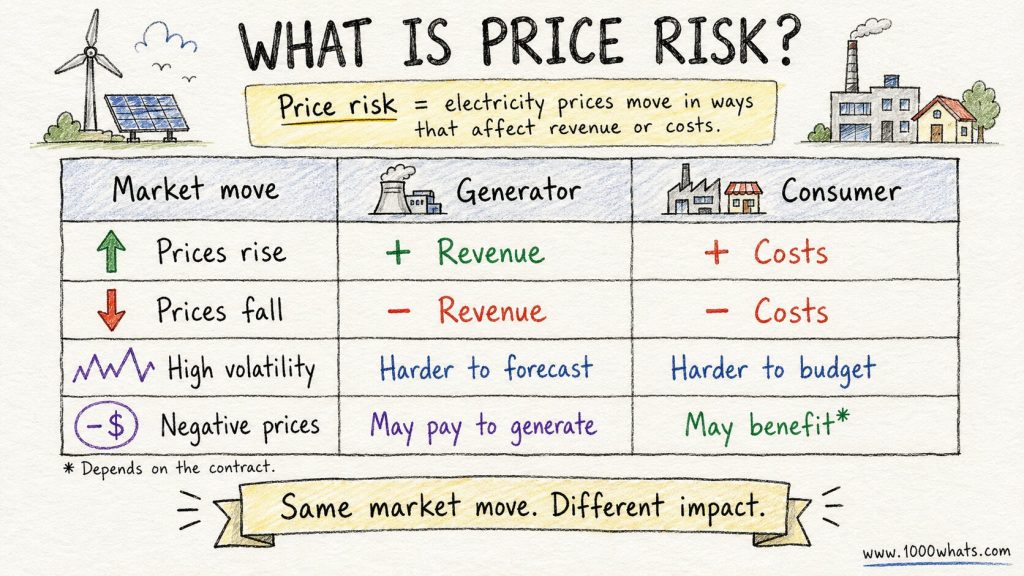
Same market movement.
Different victim.
| Market move | Generator | Electricity consumer |
|---|---|---|
| Prices rise | Usually positive: higher merchant revenue | Usually negative: higher energy costs |
| Prices fall | Usually negative: lower merchant revenue | Usually positive: lower energy costs |
| Prices become highly volatile | Revenue becomes harder to forecast | Costs become harder to budget |
| Prices turn negative | Generator may effectively pay to produce | Consumer may benefit, depending on contract |
This is why price risk is not simply about whether electricity is “expensive” or “cheap.”
It is about your exposure to the price.
And one important distinction: the market price of electricity is not the same thing as the cost of producing electricity.
If you want that rabbit hole, I have a separate breakdown of Levelized Cost of Electricity (LCOE).
LCOE asks roughly, “What does this electricity cost to produce over the project’s life?”
Price risk asks, “What will somebody actually pay me for it when I produce it?”
Those are very different questions.
Why does price risk exist?
Because markets are basically giant arguments about the future.
Buyers want one thing.
Sellers want another.
Then weather, fuel, politics, power plants, transmission lines, demand forecasts, hydrology, regulation, and occasionally a war enter the conversation.
The resulting price is what the market can agree on right now.
Tomorrow?
New argument.
Electricity makes this especially interesting because supply and demand must remain balanced almost continuously.
You cannot tell millions of consumers:
“We’re a little short today. Could everyone wait until Thursday for their electrons?”
Not really.
When supply becomes scarce, electricity prices can rise rapidly.
When supply floods the system—especially during low demand—prices can collapse.
Sometimes below zero.
To understand why one expensive generator can suddenly drag the entire wholesale market upward, read my breakdown of merit order and electricity price formation.
That’s where the price-risk story really starts.
Price risk vs. price volatility: same thing?
No.
They are close cousins, not twins.
Volatility describes how violently prices move.
Price risk describes what those movements can do to you.
Picture the ocean.
Volatility tells you how large the waves are.
Price risk asks whether you’re standing safely onshore or sitting in a kayak with one paddle.
| Concept | What it describes | Example |
| Price volatility | How much and how quickly market prices change | Electricity moves from €60 to €150/MWh |
| Price exposure | How much of your business depends on that price | A solar farm sells all output at spot |
| Price risk | Potential financial damage from the price movement | Revenue collapses when daytime prices fall |
| Hedging | Reducing or transferring that exposure | Selling power through a fixed-price PPA |
A market can be wildly volatile without hurting you much if your exposure is small.
And a relatively modest price movement can be painful if your exposure is enormous.
Risk is volatility multiplied by relevance.
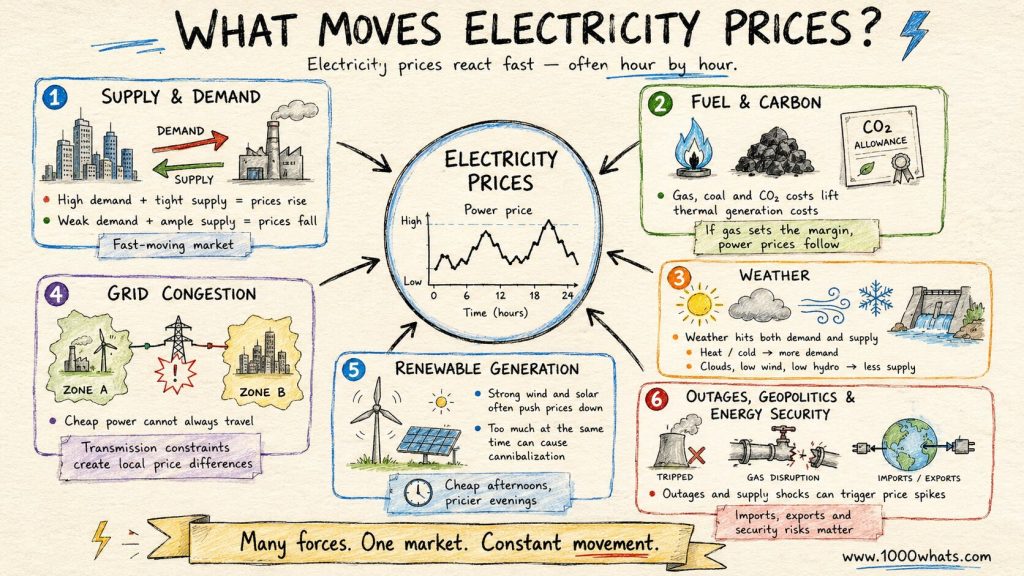
What causes electricity prices to move?
Electricity prices don’t wake up in the morning and choose chaos.
Usually.
There are very real forces underneath the movement.
Supply and demand
The oldest economic story in the book still works.
More demand with limited supply?
Prices rise.
More supply with weak demand?
Prices fall.
The twist in electricity is speed. Conditions can change hour by hour.
Fuel and carbon prices
Natural gas, coal, and carbon allowances influence the marginal cost of thermal generation.
If gas-fired plants are needed to meet demand, rising gas prices can push wholesale electricity prices higher.
This is one reason a country can have plenty of cheap renewable generation and still experience expensive electricity during certain hours.
Again: merit order explains the weirdness.
Weather
Weather doesn’t merely affect renewables.
It attacks both sides of the electricity equation.
A heat wave can increase air-conditioning demand while weakening hydro conditions.
A cold snap can increase heating demand.
Clouds reduce solar generation.
Wind disappears.
Rivers run low.
Then occasionally the weather decides subtlety is boring and does several of these things simultaneously.
Grid congestion
Sometimes cheap electricity exists.
It just exists somewhere else.
Transmission constraints can prevent power from moving freely from one area to another, producing different prices across locations.
That is where grid congestion starts turning into financial risk.
Renewable generation
Wind and solar have very low marginal costs, so when they generate strongly they tend to push wholesale prices downward.
Great news?
Usually.
But there is a twist.
When every solar project produces at approximately the same time, they can collectively depress the exact price they themselves receive.
That is price cannibalization.
If you’ve read my piece on the duck curve, you already know the shape of this problem: cheap afternoons, expensive evenings, and a power system performing financial gymnastics around sunset.
Outages, geopolitics, and energy security
A nuclear unit trips.
A gas pipeline becomes unavailable.
Hydro production falls.
An interconnector is constrained.
A major exporter suddenly becomes an importer.
Prices react.
Energy security and price risk are therefore deeply connected. My broader guide to energy security explains why reliable supply and affordable prices are really two sides of the same problem.
How does price risk affect different energy players?
This is where things get more interesting.
Because everybody says they want stable prices.
But not everybody wants the same stable price.
| Player | Main exposure | What hurts |
| Renewable generator | Selling electricity | Falling spot and captured prices |
| Thermal generator | Electricity revenue + fuel/carbon costs | Falling power prices or rising input costs |
| Energy supplier | Buying wholesale, selling retail | Wholesale prices rising faster than customer tariffs |
| Industrial consumer | Buying electricity | Price spikes |
| Trader | Open market position | Market moving against the position |
| Battery owner | Price spread between charging and discharging | Flat price curve or forecast error |
| PPA buyer | Contract vs. market relationship | Paying above market or unfavorable settlement |
| PPA seller | Contract vs. market relationship | Giving up market upside or suffering profile/basis exposure |
Electricity retailers live right in the middle of this problem.
They buy power from wholesale markets where prices jump around constantly, then sell it to customers who generally prefer bills that do not behave like cryptocurrency.
That’s why the economics behind electricity retail are essentially one giant exercise in managing risk.
A simple price-risk example
Imagine two identical 100 MW solar projects.
Same panels.
Same location.
Same sunshine.
Very different commercial strategies.
| Project A: Merchant | Project B: Fixed-price PPA | |
| Electricity sale | Spot market | Long-term contracted price |
| Upside if market prices rise | High | Limited |
| Downside if prices fall | High | Lower |
| Revenue predictability | Low | Higher |
| Financing visibility | Lower | Higher |
| Exposure to capture-price effects | High | Depends on PPA structure |
| Exposure to volume/profile risk | High | Depends on PPA structure |
| Excitement level | Occasionally unnecessary | Impressively boring |
And boring is underrated.
Especially by banks.
This is why Power Purchase Agreements (PPAs) matter so much in renewable energy.
A PPA can turn uncertain future electricity prices into a more predictable revenue stream.
That can make a project easier to finance.
But—and this matters—
a PPA does not eliminate price risk. It reallocates it.
One party gives up some upside.
Another accepts some downside.
Some risks disappear.
Others move into the fine print.
If you want the wider commercial family tree, my guide to offtake agreements explains the broader logic.
How do companies measure price risk?
Nobody has a magical crystal ball.
If your consultant says they do, check whether “crystal ball rental” appears on the invoice.
In practice, companies use several tools together:
- Historical volatility: How violently did prices move before?
- Forward curves: What is the market pricing for future delivery?
- Scenario analysis: What happens if prices fall 30%, gas doubles, or negative hours multiply?
- Stress tests: Can the business survive an extreme market event?
- Value at Risk (VaR): How much could a portfolio lose under a given probability framework?
- Earnings at Risk (EaR): How much could market movements hurt earnings?
- Cash Flow at Risk: How vulnerable is actual cash generation?
- Capture-price analysis: What price does the asset really earn when it generates?
The important part is not producing the prettiest forecast.
It is understanding what happens when the forecast is wrong.
Forecasting asks where prices might go. Risk management asks whether you can survive if they go somewhere else.
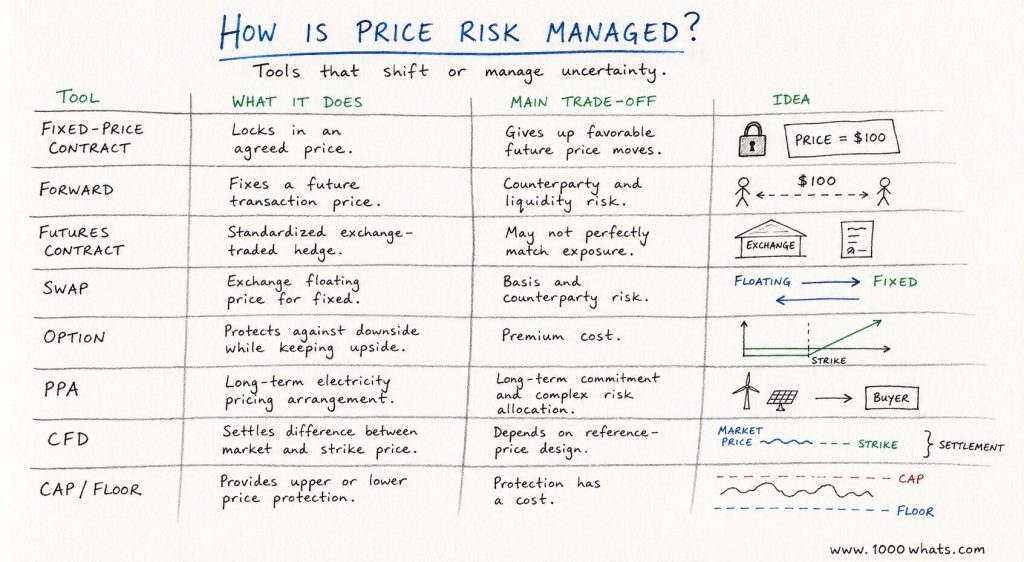
How is price risk managed?
This is where finance starts inventing increasingly creative ways to make uncertainty somebody else’s problem.
Common price-risk tools
| Tool | What it does | Main trade-off |
| Fixed-price contract | Locks in an agreed price | Gives up favorable future price moves |
| Forward | Fixes a future transaction price | Counterparty and liquidity risk |
| Futures contract | Standardized exchange-traded hedge | May not perfectly match physical exposure |
| Swap | Exchanges floating price for fixed economics | Basis and counterparty exposure |
| Option | Protects against adverse movements while retaining upside | Premium cost |
| PPA | Creates long-term electricity pricing arrangement | Long-term commitment and risk allocation complexity |
| CfD | Settles difference between market and agreed strike price | Depends heavily on reference-price design |
| Cap/floor | Creates upper or lower price protection | Protection has a cost |
I have separate explainers on Contracts for Difference (CfDs) and energy price caps if you want to go deeper into two very different ways of taming price exposure.
So should you hedge everything?
Absolutely.
If your goal is to ensure nobody in the commercial department ever experiences joy again.
Kidding.
The answer is no.
Hedging has a cost.
Sometimes literally.
Sometimes in lost opportunity.
Imagine locking electricity at €70/MWh.
Then the market jumps to €150.
Your hedge still worked.
You received the certainty you bought.
You just don’t feel clever because the unhedged guy next door is posting champagne emojis on LinkedIn.
Now imagine prices collapse to €25.
Suddenly your boring little hedge looks like a masterpiece.
This is where people misunderstand risk management.
The goal of hedging is not to beat the market.
It is to make sure the market cannot beat the business badly enough to matter.
| Strategy | Advantage | Disadvantage |
| Stay merchant | Keep market upside | Accept full downside and volatility |
| Hedge partially | Balance certainty and opportunity | More complex risk management |
| Hedge heavily | Strong revenue/cost visibility | Give up significant upside |
| Long-term PPA | Bankability and predictability | Long commitment and contract risk |
From a market perspective, there is no universally correct hedge ratio.
It depends on debt, cash reserves, risk appetite, project economics, shareholder expectations, market liquidity, and one rather important question:
How wrong can we afford to be?
Why price risk matters even more in the energy transition
Renewables are often described as reducing energy-price risk because wind and sunlight have no fuel cost.
True.
But incomplete.
Renewables remove one risk while creating a different market structure.
As wind and solar grow, we are increasingly seeing:
cheap hours become cheaper,
expensive flexible hours become more valuable,
negative prices become more common,
capture prices diverge from baseload,
storage becomes more valuable,
and location matters more when grids become congested.
In other words:
the energy transition is not eliminating price risk.
It is changing its shape.
Intermittent generation is a major reason this is happening. If you want the technical background without needing coffee and a grid-modeling degree, read my guide to intermittent renewable energy.
My personal view: Watching price risk in Serbia
This part of price risk is not theoretical for me.
I work in this region, so I watch Serbian and Southeast European electricity prices move all the time. And one thing has become increasingly obvious: the annual average price tells only a fraction of the story.
Take SEEPEX.
In 2024, the average Serbian day-ahead baseload price was €96.35/MWh. That sounds fairly normal. But underneath that average, hourly prices ranged from just €22.68/MWh to €280.10/MWh. Serbia also experienced an exceptionally hot summer, with electricity imports exceeding 0.8 TWh in both July and August as demand increased. Those numbers come from Serbia’s energy regulator, AERS.
That is price risk in real life.
| SEEPEX example | Price |
|---|---|
| 2024 annual average baseload | €96.35/MWh |
| 2024 lowest hourly price | €22.68/MWh |
| 2024 highest hourly price | €280.10/MWh |
| July 2026 average hour 13 price | €49.48/MWh |
| July 2026 average hour 21 price | €195.70/MWh |
And the market is changing shape, not just moving up and down.
In July 2026, SEEPEX’s average baseload price was €109.43/MWh. But look inside the day: the average price around hour 13 was only €49.48/MWh, while hour 21 averaged €195.70/MWh. The official SEEPEX July report makes that contrast hard to miss.
In May 2026, Serbia crossed another milestone when SEEPEX recorded its first negative day-ahead electricity price, reaching -€0.01/MWh for the 14:00–15:00 delivery hour.
What I see behind these numbers is a market becoming more dynamic.
Demand changes with temperature. Hydrology matters. Generation availability matters. Imports and neighboring markets matter because Serbia is deeply connected to the wider Southeast European system. And as more solar enters the region, the value of electricity can become increasingly dependent on when it is produced—not simply how many megawatt-hours a plant generates.
For PPAs, that distinction is becoming critical.
A solar project may sign a PPA when the headline baseload market looks attractive, yet most of its production arrives during daylight hours when prices can be much lower than the daily average. Negative-price provisions, capture prices, profile risk, imbalance responsibility, and settlement formulas suddenly stop looking like boring contract details.
They become the economics of the project.
⚡ “From where I sit, the biggest lesson from SEEPEX is simple: knowing the average electricity price is no longer enough. You need to know when your electricity is actually worth something.”
That applies to existing PPAs as much as future ones. A contract negotiated several years ago may have been designed for a different price shape. Future PPAs will increasingly need to price not only energy, but also timing, flexibility, and who carries the risk when the market behaves differently from the forecast.
Final thoughts
Price risk sounds like finance jargon.
It isn’t.
It is one of the most practical questions in energy:
What happens to me when the price changes?
A generator worries about prices falling.
A consumer worries about prices rising.
A trader worries about being on the wrong side.
A bank worries about everybody.
And a PPA tries to turn some of that uncertainty into something people can finance, budget, and sleep through.
But the big lesson is this:
Risk management is not about knowing tomorrow’s electricity price.
Nobody knows that.
It is about understanding what tomorrow’s price can do to your business.
Serbia makes that lesson increasingly visible.
Hourly prices from €22 to €280.
Negative prices arriving on SEEPEX.
Solar pushing midday prices lower.
Evening prices climbing after the sun disappears.
Regional conditions moving Serbian prices even when domestic demand falls.
That is not a broken market.
Those are market signals telling us that time, flexibility, location, and contract structure are becoming more valuable.
So the next time someone tells you:
“Our PPA price is €80/MWh.”
Ask the more interesting question:
“€80 for what exactly?”
That is usually where the real conversation begins.
Until next time, stay curious! 😎
Discover more from 1000whats
Subscribe to get the latest posts sent to your email.