
Picture this.
The solar panels are installed.
The substation is humming.
The grid connection is live.
Someone in the control room is probably staring proudly at a screen full of green numbers.
Electricity is flowing.
So… the project is finished, right?
Not necessarily.
In the energy business, producing your first electron and becoming commercially operational are two very different things.
Between them sits one of the most important milestones in the entire life of a power project:
COD — the Commercial Operation Date.
It sounds harmless. Three letters. One date.
But those three letters can determine when revenues officially start, when a Power Purchase Agreement kicks into full gear, when construction obligations end, when lenders expect repayments, and whether somebody gets paid a bonus—or a painful delay penalty.
⚡ “COD is where engineering success finally meets commercial reality.”
Your source material describes COD as the point where a project transitions from construction into operation and becomes capable of generating revenue—essentially the finish line after years of planning, construction, testing, and approvals.
But there’s much more hiding behind that finish line.
Welcome to 1000whats—where we take the energy industry’s favorite three-letter acronyms and make them behave like normal English.
Let’s crack open COD.
What is Commercial Operation Date (COD)?
Commercial Operation Date is the date on which an energy project has satisfied the technical, contractual, regulatory, and operational requirements necessary to begin normal commercial operation.
For a power plant, that usually means the facility can reliably generate electricity and deliver it according to the requirements agreed with the grid operator, buyer, lenders, and other relevant parties.
Notice the important word there:
Commercial.
COD does not simply mean:
“Hey, look! The turbine moved!”
Nor does it necessarily mean:
“We exported our first megawatt-hour!”
A plant may generate electricity during testing and commissioning long before COD is officially achieved.
Think of opening a restaurant.
You can install the kitchen.
Turn on the ovens.
Cook a few meals.
Invite staff to taste them.
Maybe even run a soft opening.
But none of that necessarily means the restaurant has officially opened for normal business.
COD is the energy industry’s grand opening—except instead of balloons and champagne, you get test reports, certificates, lawyers, engineers, grid operators, and Excel spreadsheets.
Much less glamorous.
Much more expensive.
Why does COD exist?
Because someone eventually has to answer a surprisingly difficult question:
Is this project actually ready?
Large energy projects involve dozens of companies and contracts.
You may have:
- A project developer
- An EPC contractor
- Equipment suppliers
- A grid operator
- An electricity buyer or off-taker
- Banks and other lenders
- Equity investors
- An operations and maintenance contractor
- Regulators and permitting authorities
Each party has money, risk, or legal responsibility riding on the project.
They therefore need an agreed milestone separating:
“We are still building and testing this thing”
from:
“This asset is now operating as a commercial business.”
COD creates that line.
Without it, contractual life would become wonderfully chaotic.
Imagine a lender asking:
“When does repayment begin?”
And the developer replying:
“You know… around the time the wind turbines started looking finished.”
Banks tend not to enjoy that level of creativity.
What happens before COD?
Here is where many outsiders misunderstand power projects.
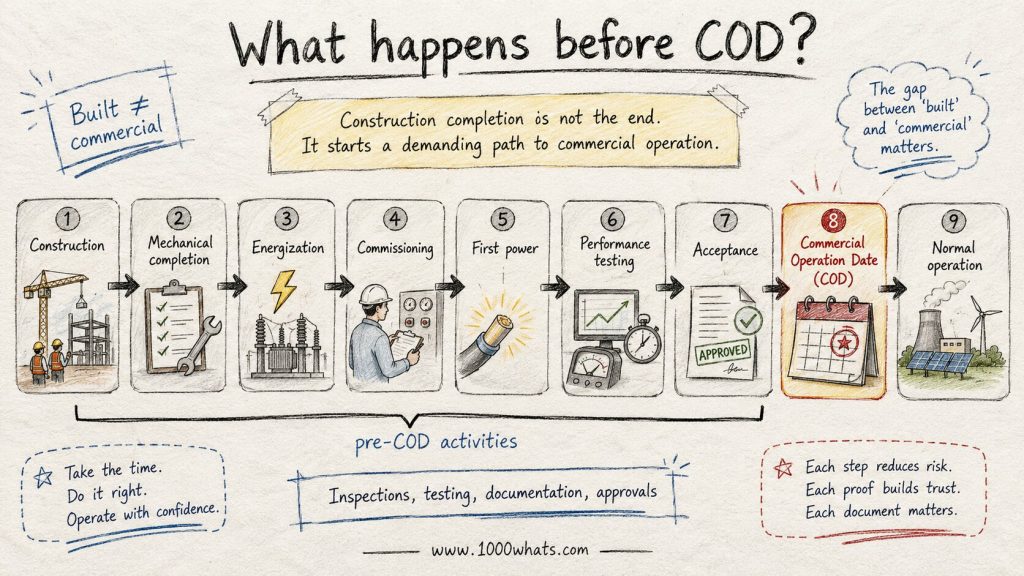
Construction completion is not the end.
It is the beginning of an intense period of inspections, energization, commissioning, testing, documentation, and approvals.
The sequence varies by technology and contract, but conceptually it looks something like this:
Construction → Mechanical completion → Energization → Commissioning → First power → Performance testing → Acceptance → COD → Normal operation
That gap between “built” and “commercial” matters enormously.
Construction completion
Most of the physical asset is now there.
Solar panels are mounted.
Wind turbines are standing.
Cables are buried.
Transformers are installed.
The control room finally looks like something other than an expensive construction trailer.
But having all the pieces doesn’t prove they work together.
Energization
Parts of the electrical system can now be safely connected to voltage.
This is a major milestone—but again, energized does not mean commercially operational.
Commissioning
Now engineers start proving that the machine they spent years building actually behaves as designed.
Systems are switched on, tested, adjusted, retested, and occasionally stared at with deep professional disappointment.
Individual components may work perfectly while the entire integrated system does something nobody expected.
That is exactly why commissioning exists.
First power
Then comes the exciting moment.
Electricity reaches the grid.
People celebrate.
Photos appear on LinkedIn.
Someone writes:
“Proud to announce another major milestone…”
And they should celebrate.
But first power is usually not COD.
The project still has to demonstrate that it can perform reliably under the conditions required by its contracts and permits.
Performance and reliability testing
This is where the project proves itself.
Depending on the asset and contractual structure, tests may examine things such as:
- Available capacity
- Power output
- Reliability
- Grid-code compliance
- Reactive power capability
- Protection systems
- Communications and metering
- Safety systems
- Equipment performance
If the plant passes the applicable requirements and the necessary paperwork is complete, COD starts getting very close.
⚡ “First power proves the project can generate. COD proves it is ready to become a business.”
How is COD actually determined?
Here comes the slightly irritating answer:
It depends on the contract.
There is no magical universal COD button hidden inside every power plant.
The requirements are normally defined through the project’s contractual and regulatory framework.
A PPA, EPC contract, financing agreement, grid connection agreement, concession, permit, or another project document may specify conditions that must be satisfied before commercial operation can be declared.
In practice, the checklist could include successful completion of testing, required regulatory approvals, grid authorization, metering readiness, completion of essential works, delivery of documentation, insurance arrangements, and certificates from an independent engineer or other authorized party.
The exact recipe varies.
And that matters.
A project can be physically capable of producing electricity while still failing to achieve contractual COD.
That distinction is where serious money starts moving.
Is COD a legal term?
Yes—but with an important caveat.
COD is commonly a contractual term rather than one universally defined legal concept with the same meaning everywhere.
Different PPAs, EPC contracts, markets, and jurisdictions may define Commercial Operation differently.
That means two solar farms sitting 20 miles apart could theoretically have slightly different contractual requirements for reaching COD.
This is why experienced project teams do something very unexciting but incredibly important:
They read the definition section of the contract.
What most people don’t see is that seemingly minor wording can determine millions of dollars of risk.
One sentence defining “Commercial Operation” can influence:
contract revenue, contractor liability, delay damages, lender rights, warranty periods, and operational responsibilities.
Suddenly that boring definition section doesn’t look so boring.
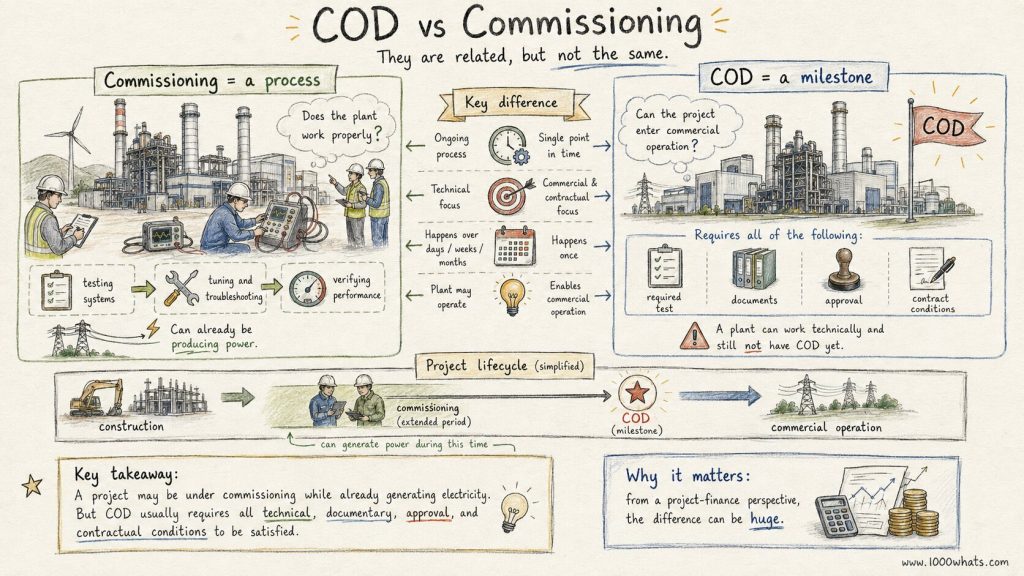
COD vs. commissioning: What’s the difference?
These two are constantly mixed up.
Commissioning is a process. COD is a milestone.
Commissioning asks:
Does the plant work properly?
COD asks:
Has the plant satisfied the requirements to enter commercial operation?
You can therefore have a facility under commissioning that is already generating electricity.
Likewise, you can have a technically functioning project that hasn’t yet achieved COD because a required test, document, approval, or contractual condition remains outstanding.
That distinction sounds academic.
It isn’t.
From a project-finance perspective, it can be enormous.
Why does COD matter financially?
Here is where COD stops being an engineering milestone and starts becoming a boardroom obsession.
Imagine a renewable project financed with hundreds of millions of dollars.
For years, money flows primarily out:
land costs.
Development costs.
Turbines or panels.
Construction.
Substation works.
Grid connection.
Engineering.
Interest.
Insurance.
Consultants.
Lawyers.
More lawyers.
And then COD arrives.
The asset moves into the phase it was built for:
earning money.
Depending on the contractual structure, COD may trigger or influence the start of full PPA obligations, debt repayment schedules, operating revenue, EPC handover, O&M responsibilities, warranty periods, insurance changes, and contractual milestone payments.
This is why even a small COD delay can hurt.
A project delayed by a month does not merely suffer from a calendar problem.
It may lose a month of expected revenue while continuing to incur financing and operating costs.
From a market perspective, COD converts project-development risk into operating-asset economics.
Before COD, investors largely ask:
“Will they finish it?”
After COD, the question becomes:
“How well will it perform?”
Very different risk.
Very different asset.
What happens if COD is delayed?
This is where things can get ugly.
A late COD might result from construction delays, equipment defects, failed performance tests, grid connection problems, permitting issues, supply-chain disruptions, weather, contractor disputes, or simply poor coordination between dozens of moving pieces.
And energy projects contain a lot of moving pieces.
A delayed COD can potentially mean:
lost electricity sales, additional financing costs, contractual damages, missed PPA milestones, disputes between developers and contractors, lower investor returns, and knock-on problems for buyers expecting the power.
Under some EPC structures, delay liquidated damages may apply if the contractor misses agreed completion milestones.
Under some PPAs, failure to achieve COD by a required long-stop date may create further contractual consequences.
The precise outcome depends on the contract.
But the principle is simple:
Every extra day between planned COD and actual COD can have a price tag.
📉 “A COD delay isn’t measured only in days. In project finance, it is measured in cash.”
A simple COD example: Meet our imaginary solar farm
Say a developer builds a 100 MW solar project.
Construction finishes in May.
Everyone is thrilled.
But the project isn’t commercially operational yet.
During June, engineers energize the plant and begin commissioning.
The first electricity reaches the grid on June 12.
Fantastic.
But testing reveals that one part of the plant’s control system isn’t responding correctly to grid instructions.
Engineers fix it.
More tests follow.
Performance requirements are finally satisfied.
Required documentation is submitted.
The grid operator gives the necessary approval.
The relevant contractual conditions are confirmed.
COD occurs on July 3.
Look at those dates:
Construction completed: May.
First electricity: June 12.
Commercial Operation Date: July 3.
Same project.
Three different milestones.
That is exactly why saying “the power plant started producing electricity” does not automatically tell you its COD.
What does COD change inside the project?
Think of COD as a giant relay baton being passed from one team to another.
Before COD, the project is dominated by:
developers + construction teams + EPC contractors + commissioning engineers.
After COD, attention shifts toward:
operators + asset managers + traders + off-takers + maintenance teams + investors.
The project hasn’t simply switched on.
Its entire organizational logic has changed.
In practice, this handover can be surprisingly intense.
Operating teams inherit an asset that construction teams have lived with for years. Documentation has to be transferred. Punch-list items must be tracked. Spare parts must exist. Maintenance systems need to be ready. Monitoring platforms need reliable data.
What most people don’t see is that good developers prepare for operations before COD.
Waiting until the commercial operation date to ask who’s actually running the plant would be a spectacularly bad project-management strategy.
Is COD always one single date for the entire project?
Not necessarily.
Large projects can sometimes achieve commercial operation in stages.
Imagine a giant wind project with several groups of turbines.
One portion may satisfy the contractual requirements and begin commercial operation before the rest.
Depending on the agreements, developers may therefore encounter concepts such as:
partial COD, phased COD, unit COD, or final COD.
Again, contracts rule the kingdom.
The terminology and consequences can vary substantially from one project to another.
What are the advantages of having a clearly defined COD?
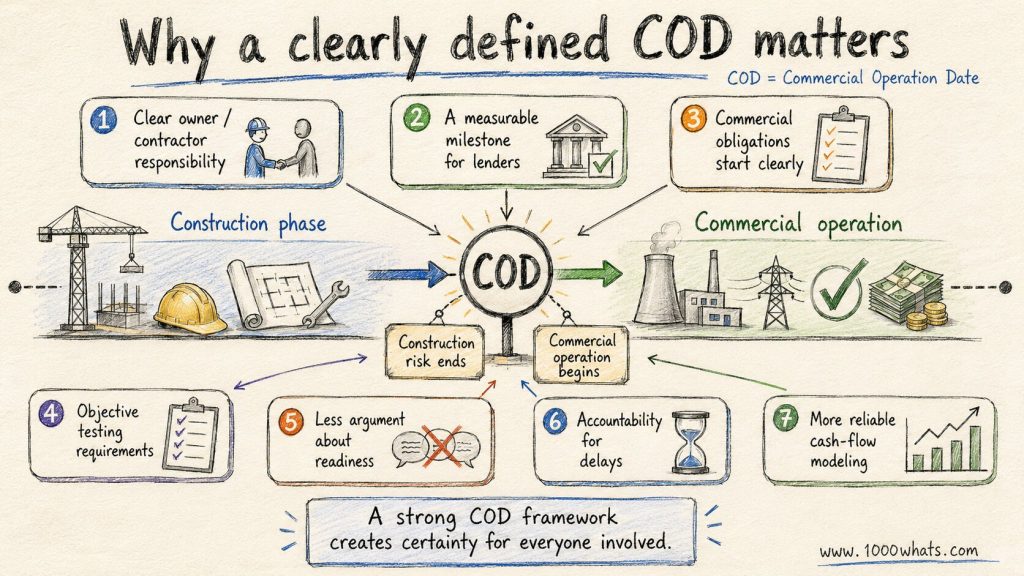
A strong COD framework creates certainty.
It tells everyone exactly when construction risk ends and commercial operation begins.
That clarity can:
- Define responsibility between contractor and owner
- Give lenders a measurable project milestone
- Clarify when commercial obligations begin
- Establish objective testing requirements
- Reduce disputes over whether the plant is genuinely ready
- Create accountability for delays
- Make project cash-flow modeling far more reliable
In other words, COD transforms “looks finished to me” into something measurable.
Very useful when millions—or billions—of dollars are involved.
What are the downsides?
COD itself isn’t really the problem.
Badly designed COD requirements are.
If the definition is vague, parties can disagree about whether the milestone has actually been achieved.
If requirements are unrealistically strict, a technically capable asset may be prevented from entering commercial operation because of relatively minor outstanding items.
If requirements are too loose, an owner could inherit a facility that technically crossed the finish line but still has serious operational problems.
The art lies in finding the balance.
A good COD definition protects the project’s stakeholders without turning commercial operation into an endless bureaucratic escape room.
Why COD matters even more in renewable energy
Renewable deployment is accelerating, but the projects themselves are becoming deeply interconnected with grids, corporate buyers, sophisticated PPAs, storage systems, financing structures, and increasingly complex electricity markets.
That makes the transition from construction to operation more—not less—important.
A wind turbine cannot simply be erected and declared victorious.
A battery cannot merely charge once and call itself commercial.
A solar farm cannot export a few kilowatt-hours and declare mission accomplished.
Modern energy assets must perform inside a much larger system.
Grid compliance matters.
Forecasting matters.
Data matters.
Metering matters.
Availability matters.
Contracts matter.
Financing matters.
COD is where all those worlds collide.
The insider view: COD isn’t really the finish line
Here is the irony.
Everyone calls COD the finish line.
Technically, it is.
But commercially?
It’s closer to the starting gun.
Years of development and construction exist for one reason: to create an asset capable of operating for another 20, 25, 30 years—or longer.
COD simply says:
“Congratulations. You have finally built the business you promised everyone you would build.”
Now it has to perform.
Every sunny afternoon.
Every windy night.
Every maintenance cycle.
Every market settlement period.
Every debt payment.
Every year.
The construction marathon is over.
The operating marathon has just begun.
Final thoughts
Commercial Operation Date sounds like one of those wonderfully dull phrases invented by lawyers to make ordinary humans leave the room.
It isn’t.
COD is one of the most economically important moments in the life of an energy project.
It marks the point where steel, concrete, panels, turbines, cables, contracts, financing, permits, and several years of controlled chaos finally become something much simpler:
an operating business selling energy.
And that’s the deeper lesson.
Building a power plant isn’t enough.
You have to prove it works.
You have to prove it complies.
You have to prove it can deliver.
Then—and only then—does the industry give you three beautiful letters:
COD.
Got a project-development acronym you’d like 1000whats to dismantle next? Send it my way.
Until next time, stay curious! 😎
Discover more from 1000whats
Subscribe to get the latest posts sent to your email.