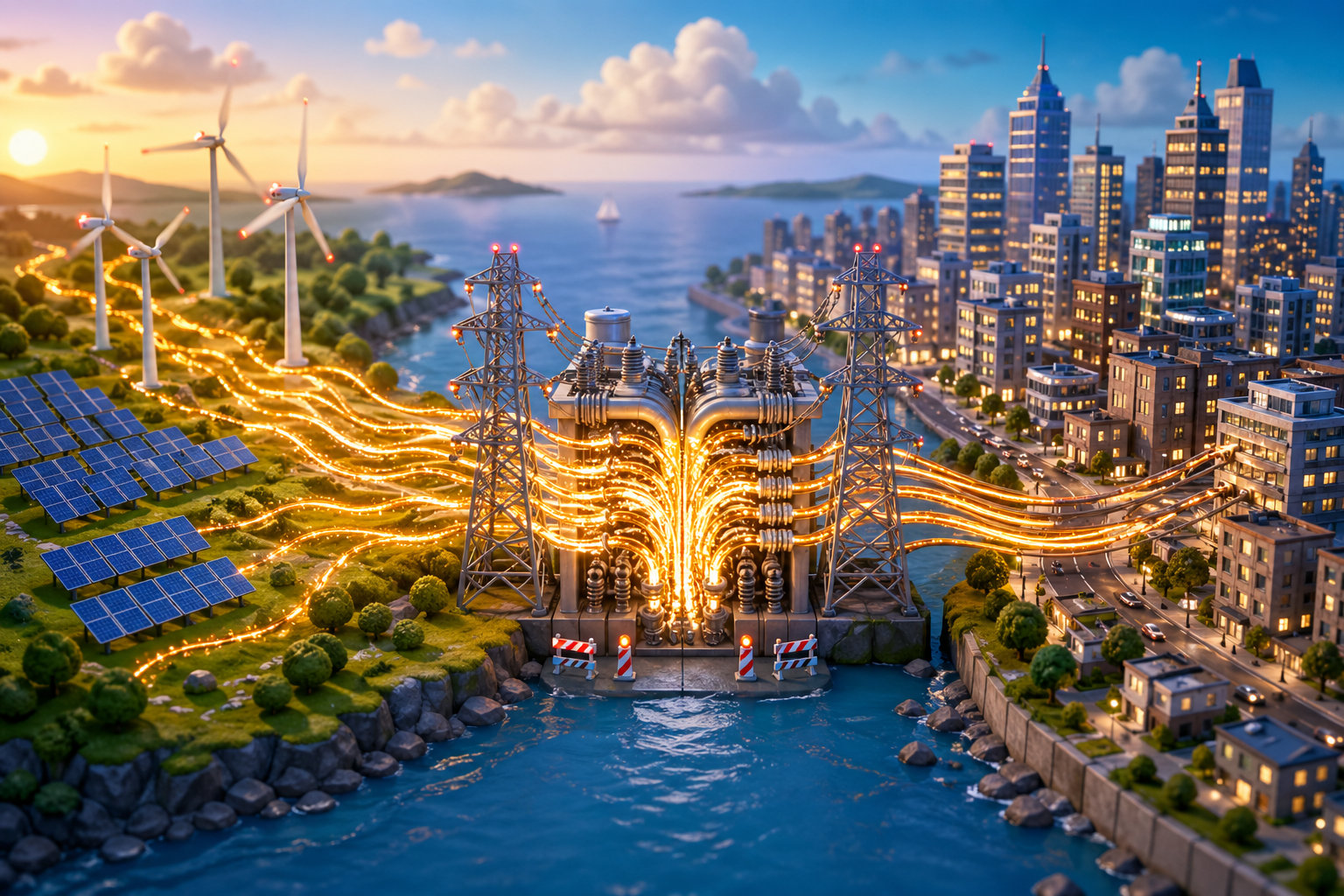
Here’s the strange part: in many places, we do not have an electricity production problem first.
We have a delivery problem.
It’s a bit like opening a fantastic new bakery in town, baking thousands of perfect loaves, and then realizing the road out front is one lane wide and already jammed with trucks. The bread exists. People want it. But the road says, “Not today.”
That, in spirit, is grid congestion.
And what most people don’t see is this: the energy transition is no longer being slowed only by the cost of solar panels or wind turbines. In many cases, it is being slowed by the wires, substations, rules, and bottlenecks of the grid itself. Existing grids were not built for large amounts of decentralized, variable renewable power, and that creates bottlenecks in moving electricity from where it is produced to where it is needed.
⚡ “The future of clean energy is not just about making power. It’s about moving it.”
Welcome to 1000whats — where energy terms lose the lab coat and learn to speak human.
What is grid congestion?
Let’s start simple.
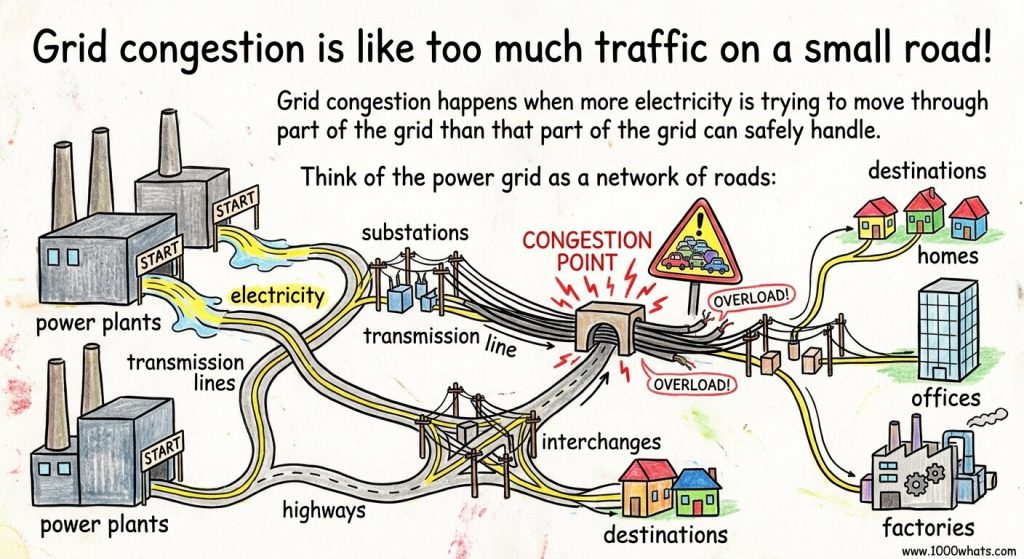
Grid congestion happens when more electricity is trying to move through part of the grid than that part of the grid can safely handle.
That’s it.
Think of the power grid as a network of roads:
- power plants are places where the traffic starts
- transmission lines are the highways
- substations are the interchanges
- homes, offices, and factories are the destinations
If too many vehicles try to use the same road at once, you get a traffic jam.
If too much electrical power tries to use the same part of the network at once, you get grid congestion.
When that happens, grid operators cannot just shrug and say, “Well, let it squeeze through.” The system has to remain balanced and stable every second. So they may have to:
- tell a generator to reduce output
- delay a new project’s connection
- reroute power through other lines
- rely on more expensive local generation
- curtail renewable energy that could otherwise have been used
And that is where the trouble starts. Because once clean energy is being wasted or delayed by the grid, the transition stops being a technology problem and becomes a systems problem. Existing infrastructure often struggles with decentralized and variable renewable generation, which is exactly why congestion is becoming more important now.
But wait—how can electrons get “jammed”?
That is exactly the kind of question a smart reader should ask. 😉
Because if you picture grid congestion as billions of little electrons piling up inside a wire like angry commuters on a freeway, you’ve been betrayed by the metaphor.
That is not really what is happening.
Let’s fix the picture
When people say the grid is “congested,” they do not mean electrons are literally stuck bumper-to-bumper in a cable.
What they really mean is:
too much electrical power is trying to move through a part of the system, and the equipment has limits.
That’s the real idea.
The wire, transformer, or substation can only carry so much power safely. Beyond that, equipment can overheat, voltage can drift, stability can worsen, and reliability can be put at risk.
So grid congestion is not a tiny-particle traffic jam.
It is a network limit problem.
⚡ “Grid congestion is not electrons crashing into each other. It’s the grid saying: this route is already carrying as much as it safely can.”
So what’s actually moving?
This is where electricity gets slippery.
The electrons in a wire are already there. In an AC grid, they mostly shuffle back and forth; they are not sprinting from the wind farm to your toaster like marathon runners.
What really matters is energy transfer through the network.
So:
- the electrons do not pile up like cars
- the power flow is what hits the limit
- the equipment is what constrains how much can be carried
A better analogy is not a road full of cars. It is a bridge with a weight limit. 💡
You can have plenty of trucks waiting to cross. The problem is not that the trucks forgot how to drive. The problem is that the bridge can only handle so much load safely.
Transmission lines are like that.
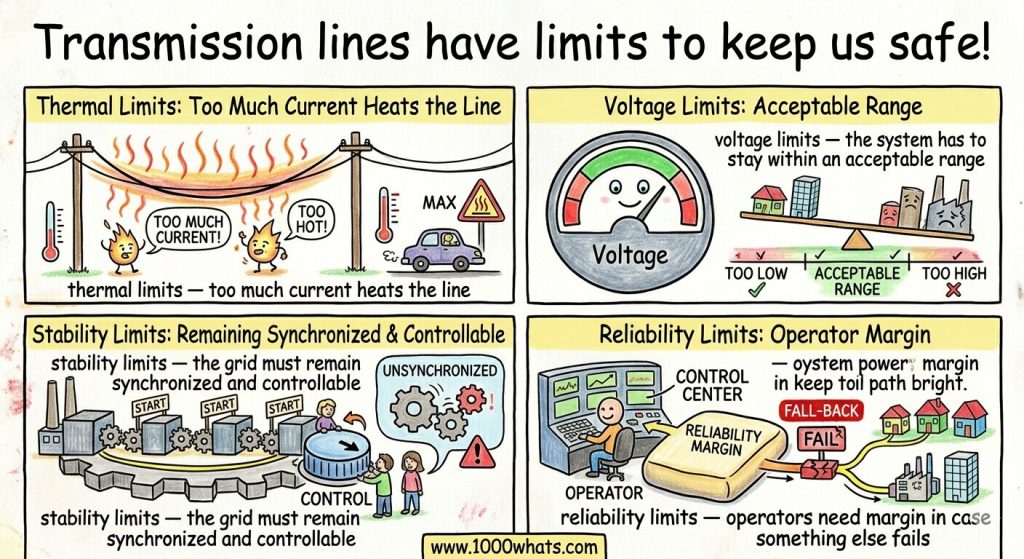
They have:
- thermal limits — too much current heats the line
- voltage limits — the system has to stay within an acceptable range
- stability limits — the grid must remain synchronized and controllable
- reliability limits — operators need margin in case something else fails
So when engineers talk about congestion, they are really talking about power flows hitting safe operating limits.
That is the proper mental model.
Why does grid congestion happen in the first place?
Because the grid is a bit like an old city plumbing system. It worked fine when the town was smaller, the water came from a few big reservoirs, and nobody was trying to pipe in sunshine from the desert and wind from three counties away.
Now we’ve changed the energy system faster than we’ve changed the wires.
| Reason | Plain-English version | Why it causes congestion |
|---|---|---|
| The grid is old | The grid was built for yesterday’s energy world: big power plants in predictable places, doing boringly reliable things. | Now we’re asking that same system to handle lots of renewable power coming from new places in new patterns. The old roads are still there, but the traffic has changed completely. |
| The best wind and solar sites are far away | Nature does not care where cities are. The best wind is often out in the middle of nowhere, and the best solar is usually not on top of downtown office towers. | So electricity has to travel farther to reach people. That means a lot of power gets funneled through a limited number of transmission lines — and those lines have the electrical equivalent of “maximum occupancy” signs. |
| Renewable output and demand don’t match nicely | The sun shows up at noon whether you need it or not. The wind blows at 2 a.m. without asking permission. | Sometimes you get a flood of cheap electricity exactly when the grid has the least room for it. So the problem is not “no power.” The problem is “too much power, here, right now.” |
| Building new transmission is slow | You can build a solar farm surprisingly fast. Building the giant wire that connects it to the rest of civilization? Ah. Welcome to paperwork, permits, land fights, and waiting. | New clean power arrives before the grid is ready for it. So projects end up stuck in line, half-plugged in, like guests at a party waiting for someone to unlock the door. |
| The rules are messy | The grid is not run by one wise wizard in a tower. It involves regulators, utilities, landowners, planners, market operators, engineers, and the occasional person who strongly objects to pylons near their cows. | Even when everyone agrees more grid is needed, coordination can be painfully slow. Physics is hard, but committees are often harder. |
One-line takeaway
Grid congestion happens because we’re trying to run a 21st-century clean energy system on a network that was largely designed for a 20th-century electricity world.
⚡ “The trouble is not that renewable energy is too weird. The trouble is that the grid is too old to be casual about it.”
How does congestion actually show up in real life?
Let’s do a concrete example.
Imagine a windy region far from a major city.
A big wind farm is built there because the wind resource is excellent. On a blustery night, the turbines are ready to generate 1,000 megawatts.
But the transmission corridor connecting that region to the city can only safely carry 600 megawatts at that moment.
Now what?
The extra 400 megawatts cannot be forced through the wires by good intentions.
So the operator has to make a choice:
- tell the wind farm to reduce output
- reroute power, if another path exists
- dispatch more local generation near demand
- wait until the system has more room
That first option has an important name: curtailment.
Curtailment means a power plant is forced to produce less electricity than it could have, because the grid cannot carry or absorb it safely.
So yes — the wind is blowing, the turbines are ready, and the clean electricity is available. But the grid says, “Not so fast.”
That is congestion.
Not because the wind farm failed.
Not because electricity stopped working.
But because the path between supply and demand is too narrow.
And that is why clean energy can be available and still not fully usable.
Why is grid congestion slowing down the energy transition?
Because the transition is not just about building more clean generation.
It is about building a system that can absorb, move, balance, and use that generation.
This is where many people get fooled by a nice simple number like LCOE. It tells you the cost of generating electricity over a project’s lifetime, which is useful. But it does not fully capture grid bottlenecks, curtailment, storage needs, intermittency, or whether the electricity is delivered where and when the system needs it.
So yes, a wind farm can be “cheap.”
But from a system perspective, cheap power in the wrong place, at the wrong time, on a constrained network, is not as valuable as the brochure suggests.
Here’s how congestion slows everything down:
| Problem | The short version |
|---|---|
| Projects get stuck | Clean energy is built faster than the grid can welcome it. |
| Electricity gets wasted | The power exists, but the wires say no. |
| Costs go up | Cheap power is blocked, so pricier options step in. |
| Investors get nervous | Uncertainty makes projects harder to finance. |
| The transition feels sluggish | We are no longer just building generators — we are rebuilding the plumbing. |
⚡ “The panel is not the problem. The plug is.”
Why this matters more today than it did a few years ago
Because renewables are no longer a sideshow.
When wind and solar were tiny slices of the energy mix, the system could mostly absorb them without major drama. But as their share grows, all the hidden issues become more obvious:
- variability matters more
- balancing becomes harder
- storage becomes more valuable
- transmission constraints become painful
- outdated market rules start to show their age
In other words, once renewables become serious, the grid has to become serious too.
⚡ From a market perspective, this is the moment when the conversation shifts from “Can we build clean power?” to “Can the system actually use all the clean power we build?”
That is a much tougher question.
What can be done about it?
No miracle. No silver bullet. Just engineering, planning, and political patience.
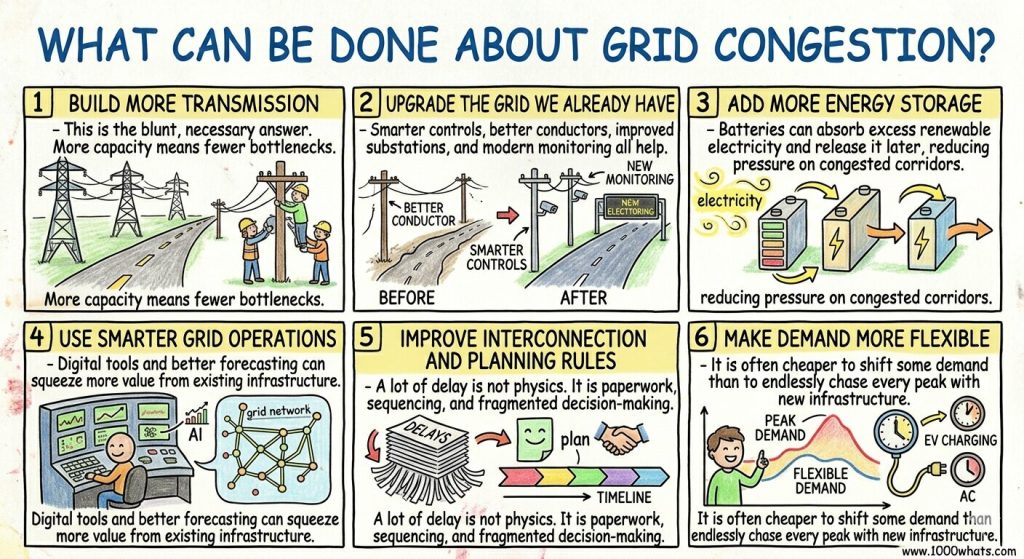
The main fixes are pretty clear:
- Build more transmission
This is the blunt, necessary answer. More capacity means fewer bottlenecks. - Upgrade the grid we already have
Smarter controls, better conductors, improved substations, and modern monitoring all help. - Add more energy storage
Batteries can absorb excess renewable electricity and release it later, reducing pressure on congested corridors. - Use smarter grid operations
Digital tools and better forecasting can squeeze more value from existing infrastructure. - Improve interconnection and planning rules
A lot of delay is not physics. It is paperwork, sequencing, and fragmented decision-making. - Make demand more flexible
It is often cheaper to shift some demand than to endlessly chase every peak with new infrastructure.
What most people don’t see is that solving congestion is not just about “more wires.” It is also about better timing, better coordination, and a smarter system overall.
The uncomfortable truth
Grid congestion is boring.
That is part of why it matters so much.
Solar panels are photogenic. Wind turbines look heroic. Batteries sound futuristic. But transmission planning? Interconnection queues? Congested substations? That stuff has the charisma of a tax form.
And yet this dull machinery may decide how fast the transition really happens.
Because civilization runs not on slogans, but on systems.
And systems have choke points.
Pros and cons of tackling grid congestion
The upside
- more renewable projects can connect
- less clean energy gets curtailed
- reliability improves
- long-term system costs can fall
- investors get more confidence
The downside
- transmission is expensive upfront
- permitting takes forever
- local opposition can be fierce
- coordination is politically exhausting
- the benefits are huge but often invisible to the public
That last point matters. People notice a wind farm. They do not throw parties for upgraded substations. But the substations may matter just as much.
Real-world insight: where projects often get stuck
One of the least glamorous truths in energy development is that a project can look “done” long before it is truly ready to deliver power.
A renewable project may secure land, permits, financing, equipment, and construction progress — and still get stuck in the last mile of interconnection and grid approval. Final utility review, testing, commissioning, and connection steps can all become bottlenecks.
So when people ask, “Why aren’t we moving faster?” the answer is often not that we forgot how to build solar panels.
It is that the system around the project is overloaded, fragmented, or simply too slow.
Final thoughts
Grid congestion sounds like technical trivia.
It isn’t.
It is one of the central reasons the energy transition feels slower, messier, and more frustrating than the headline costs of solar and wind would suggest.
We know how to build clean generation. Increasingly, that is not the mystery.
The mystery is whether our grids, rules, infrastructure, and planning systems can catch up.
My view is simple: the next phase of the energy transition will be won less by flashy generation technology and more by boring excellence in networks, storage, and system design.
That may not be romantic. But it is how the real world works.
What do you think — are we still talking too much about generation and not enough about the grid underneath it?
Until next time, stay curious! 😎
Discover more from 1000whats
Subscribe to get the latest posts sent to your email.