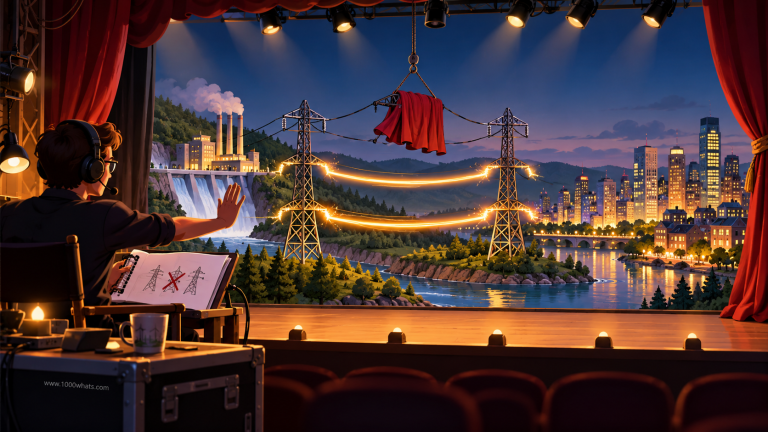
People are scared of all sorts of things: spiders, sharks, whatever’s making that weird noise in the attic. But electricity producers? They’ve got their own boogeyman.
It’s called curtailment.
Sounds harmless, right? Like a polite sneeze. But to them, it’s pure nightmare fuel.
Picture this: you’re throwing a party. The playlist slaps, the drinks are colder than your ex’s heart, and the kitchen smells like you’re about to win a cooking show. You’ve got enough food to feed a small village.
But then—plot twist—only three people show up.
Now you’re left with a mountain of lasagna and a fridge full of soda.
So now what?
You’ve got options. You can stash the leftovers for another day. Share the feast with neighbors. Maybe send it off to a food bank. Or—and we’ve all done this—scrape the whole thing into the trash and pretend it never happened.
Now let’s swap the lasagna for electricity.
You’re running a wind farm. The blades are spinning fast, catching a strong breeze. You geared up for high demand, expecting homes and factories to light up all at once. But then—surprise—hardly anyone’s flipping the switch.
Suddenly, you’ve got more energy than people need.
Your options? Store the excess in giant, expensive batteries. Or—and here’s the party foul—curtail.
That’s a fancy word for letting the wind do its thing while you sit there, arms crossed, watching money float away.
No wonder energy producers are terrified. They’re not afraid of the dark. They’re afraid of wasting perfectly good wind on a party nobody showed up for.
In this post, I’ll unpack the curious case of curtailment. You’ll see what curtailment is, why it happens, how it works, what it costs, and how smart tech might help us do less of it in the future.
Welcome to 1000whats, where I turn the complex world of energy into stories you’ll actually want to read.
What is curtailment?
You might be thinking, “I got it already—electricity generators don’t produce when there’s no demand. Simple. Are you really going to bore me to death with more of this?”
Well… kind of. 😉
Yes, curtailment means pulling back on power production. But not all power cutbacks are curtailment.
Let’s clear something up first: there are plenty of reasons a generator might dial things down. Maybe it’s scheduled maintenance. Maybe market prices are so low that operating just isn’t worth it. But curtailment? That’s a different beast.
Curtailment happens when the grid operator steps in and says, “Thanks, but no thanks.”
And when that happens, generators don’t really get a vote.
The grid operator isn’t just being dramatic. Their job is to keep the delicate see-saw of electricity supply and demand balanced every second of every day. If demand drops, supply has to follow.
Otherwise, things get messy.
Like blackout-level messy.
Welcome-to-the-dark-ages messy.
⚡ “Curtailment is a forced reduction in power output from a generator, usually because the grid can’t safely or economically absorb that electricity.”
In theory, any power source can be curtailed. Coal, gas, nuclear, hydro, unicorn farts—you name it.
But in practice, wind and solar get hit the hardest.
Why?
Because they follow the weather, not instructions. The sun doesn’t ask whether the grid feels overwhelmed. The wind doesn’t call ahead to check if the timing works.
Wind and solar show up unannounced—full of energy, ready or not.
Why does curtailment happen?
Think of the grid like a tightrope walker with no safety net.
Supply and demand have to match exactly. If supply overshoots demand, voltage and frequency start wobbling. Too much wobble and you’re looking at damaged equipment, instability, or even cascading failures.
That’s why curtailment exists.
When there’s too much generation and not enough demand, the grid operator has only a few options:
- Increase demand somehow
- Export electricity elsewhere
- Store the excess
- Cut generation
And here’s the problem: grid operators can’t magically force everyone to charge their EVs, run the dryer, or crank up the dishwasher at the perfect moment.
So when demand disappears, curtailment becomes the emergency brake.
⚡ “Curtailment isn’t about wasting power. It’s about protecting the grid from blowing a fuse—literally.”
Why is curtailment necessary for the grid?
Here’s the wild part about electricity: it’s not a warehouse product.
It’s a live performance.
Flip your light switch and boom—electricity is there instantly. No delay. No buffering wheel. That power didn’t sit around in a battery down the street waiting for your dramatic entrance. It came from a generator at the exact moment you needed it.
That’s why timing matters so much.
Generators must produce exactly as much electricity as people are using right now. Not in five minutes. Not later tonight. Right now.
You press a button, somebody somewhere spins a turbine.
That’s the most tightly choreographed dance you’ll never see.
So what happens if demand suddenly drops but power plants keep pushing electricity out anyway?
Two words: frequency and voltage.
Frequency: the grid’s heartbeat
Frequency is the rhythm of the grid. In most places, it runs at a steady 50 or 60 hertz.
If generators keep pushing power while demand falls, the system speeds up. Frequency rises. Too much of that, and the grid starts behaving like a drummer on espresso.
That can damage equipment and trigger outages.
Voltage: the grid’s blood pressure
Voltage is the pressure pushing electricity through wires.
If you generate more electricity than the system can use, that pressure builds. And high voltage can fry electronics faster than you can say “surge protector.”
So no, extra electricity can’t just hang out in the wires and vibe.
It either gets used, stored, exported, or avoided.
That’s why curtailment is necessary.
How does curtailment work?
You might imagine curtailment as a frantic midnight call from the grid operator:
“Hey buddy, shut it down! I’ve already lost two transformers and I’m one fried cable away from a full meltdown!”
But nope. That’s not usually how it works.
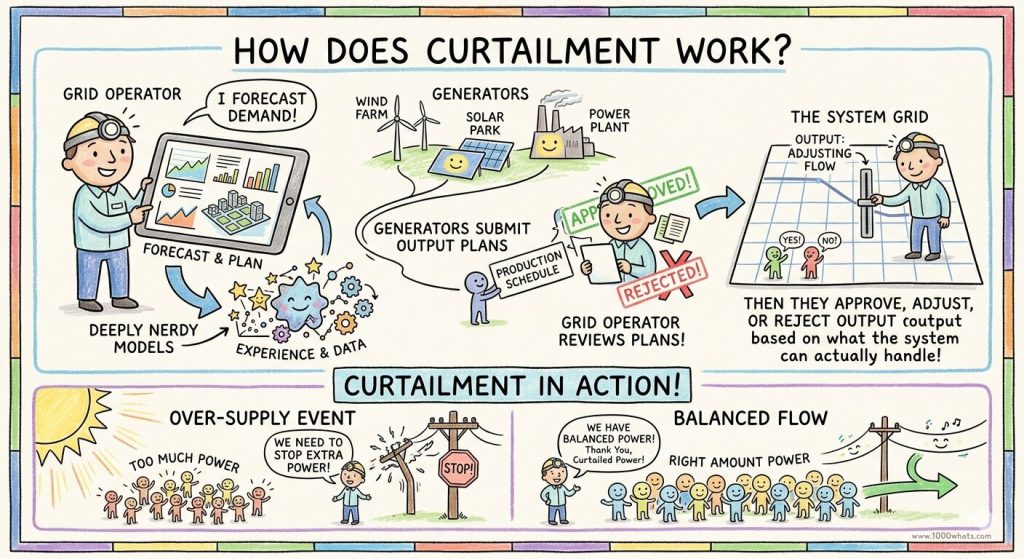
In practice, grid operators are planners. They monitor the grid in real time, yes—but they also forecast demand using experience, data, and some deeply nerdy models.
Generators submit production schedules. Grid operators review them. Then they approve, adjust, or reject output based on what the system can actually handle.
Electricity isn’t just made—it’s auditioned, booked, and choreographed before it takes the stage.
How is curtailment implemented for different power plants?
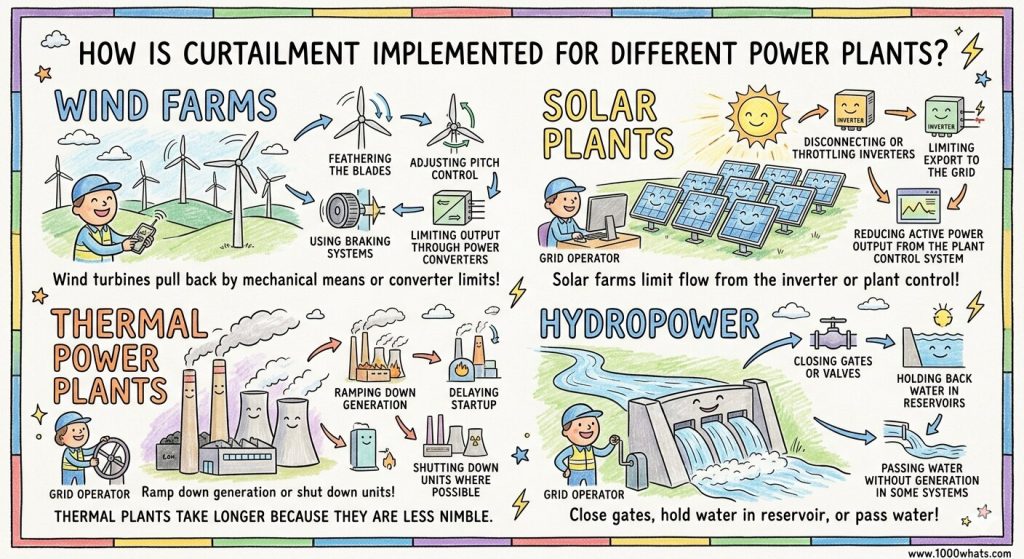
Curtailment isn’t one-size-fits-all. Different technologies pull back in different ways.
Wind farms
Wind turbines can be curtailed by:
- Feathering the blades
- Adjusting pitch control
- Using braking systems
- Limiting output through power converters
Mechanically, the turbine is still dealing with wind energy, but the system is told not to convert all of it into usable electricity.
Solar plants
Solar farms can be curtailed by:
- Disconnecting or throttling inverters
- Limiting export to the grid
- Reducing active power output from the plant control system
The sunlight still hits the panels. The plant just doesn’t send all that potential electricity into the grid.
Thermal power plants
Coal, gas, and nuclear plants usually curtail by:
- Ramping down generation
- Delaying startup
- Shutting down units where possible
This process can take longer because thermal plants are less nimble.
Hydropower
Hydro plants may curtail by:
- Closing gates or valves
- Holding back water in reservoirs
- Passing water without generation in some systems
What are the impacts of curtailment?
Curtailment sounds like a technical grid-management issue. And it is.
But it also has real economic and social consequences.
- Lost revenue for generators
Power producers can’t sell electricity they were ready to generate. - Lost clean electricity for consumers
People miss out on renewable power that could have lowered prices and emissions. - Lower system efficiency
The grid ends up using less of the available low-carbon energy. - Missed social value
That electricity could have powered heating, EV charging, industrial demand, or even hydrogen production.
From a market perspective, curtailment is a warning light. It tells you the grid, market design, or flexibility tools aren’t keeping up with renewable growth.
What most people don’t see is that curtailment is not just about wasted generation. It’s about wasted system potential.
How can curtailment be reduced?
Here’s the good news: curtailment isn’t inevitable forever.
It can be reduced. Not eliminated completely, probably—but reduced a lot.
1. Build better grid infrastructure
Sometimes the problem is brutally simple: the wires aren’t where they need to be.
More transmission capacity, stronger interconnections, and smarter local networks can help move electricity from where it’s generated to where it’s needed.
2. Expand energy storage
Batteries give the grid something it desperately needs: time.
Instead of rejecting excess renewable power, operators can store it and use it later.
That includes:
- Grid-scale batteries
- Behind-the-meter storage
- EV charging as flexible demand
- Thermal storage in buildings and industry
3. Use demand response
Curtailment happens when supply outruns demand.
So why not move demand to match supply?
Demand response does exactly that by encouraging consumers and businesses to use electricity when renewable output is high.
Think:
- Smart charging for EVs
- Industrial load shifting
- Smart appliances
- Flexible heating and cooling
4. Improve market design
Better price signals can do a lot of heavy lifting.
Dynamic pricing, balancing markets, and better dispatch rules can make it easier to absorb renewable generation instead of shutting it off.
5. Diversify generation by location and technology
If all your renewable generation is concentrated in one place and one weather pattern, curtailment risk goes up.
A more diversified mix of:
- wind
- solar
- hydro
- biomass
- storage
- geographically spread assets
can reduce those synchronized “too much, all at once” moments.
Real-World examples of curtailment
Curtailment is not just theory. It shows up in real grids all the time.
- California: CAISO says solar curtailment happens most often in spring and fall, when mild weather keeps demand low but sunny, breezy days flood the grid with renewable power.
- Germany: In Q2 2024, Germany curtailed 5% of wind generation and 2% of solar generation because of congestion on the grid.
- Texas: ERCOT’s West Texas export study found that generation curtailment has been necessary to manage transmission constraints, especially where renewable growth has outpaced the wires needed to move that power.
Different grid, same headache: too much power, not enough flexibility.
Final thoughts
Curtailment is one of those energy terms that sounds boring until you realize it sits right at the heart of the renewable transition.
It’s not just about turning turbines down.
It’s about the collision between a fast-growing clean energy system and a grid that still isn’t flexible enough to keep up.
And that’s the real story.
From a market perspective, curtailment is both a problem and a clue. It tells us where the bottlenecks are. It exposes where the grid needs to grow up. And it reminds us that generating clean electricity is only half the battle.
Using it well is the other half.
How do you see curtailment? Necessary evil? Temporary growing pain? Or one of the biggest hidden challenges in the energy transition?
Until next time, stay curious! 😎
Discover more from 1000whats
Subscribe to get the latest posts sent to your email.