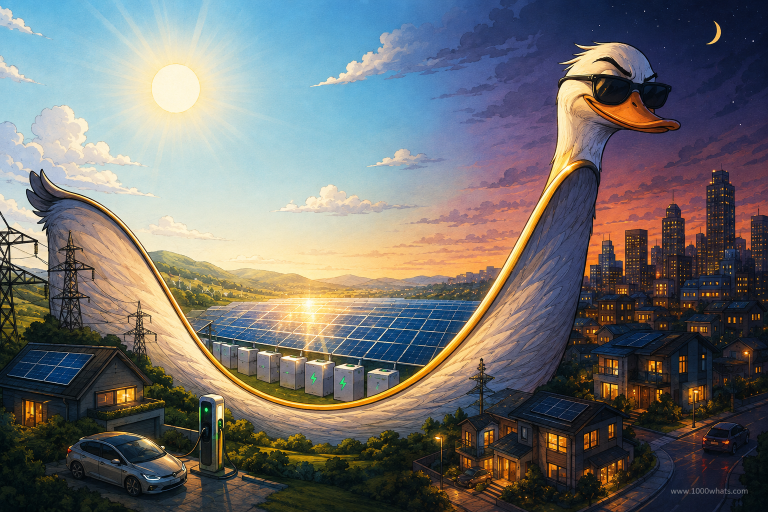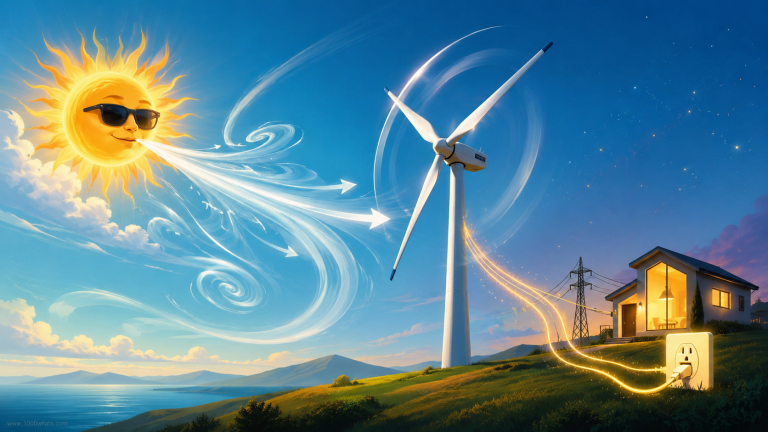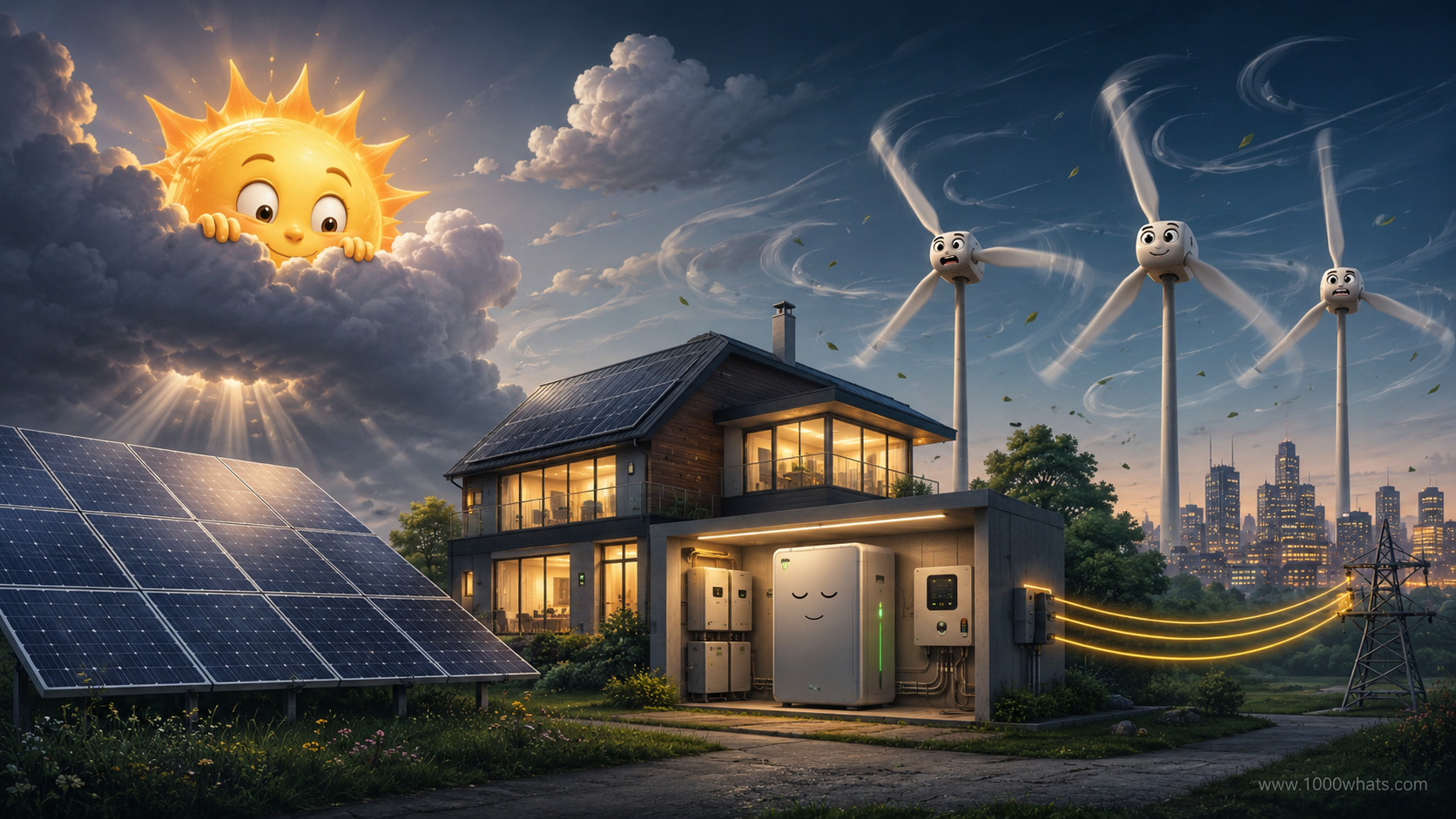
Here’s the awkward truth nobody tells you in the clean energy sales pitch: some of our best energy sources are terrible at keeping a schedule.
The sun disappears every night. Wind can go from heroic to useless in a few hours. Rivers shrink. Clouds crash the party. And yet, these same messy, weather-driven resources are now some of the cheapest and fastest-growing sources of electricity on Earth.
So what gives?
If renewable energy is the future, why does everyone keep calling it intermittent like it’s some kind of fatal character flaw?
Because intermittent renewable energy is real. But it’s also misunderstood.
Intermittency does not mean renewable power is broken. It means the grid has to stop pretending electricity comes from one giant, obedient machine.
Welcome to 1000whats—where the sun clocks out, the wind ghosts the grid, and we find out how renewable energy keeps the lights on anyway.
What is an intermittent renewable energy source?
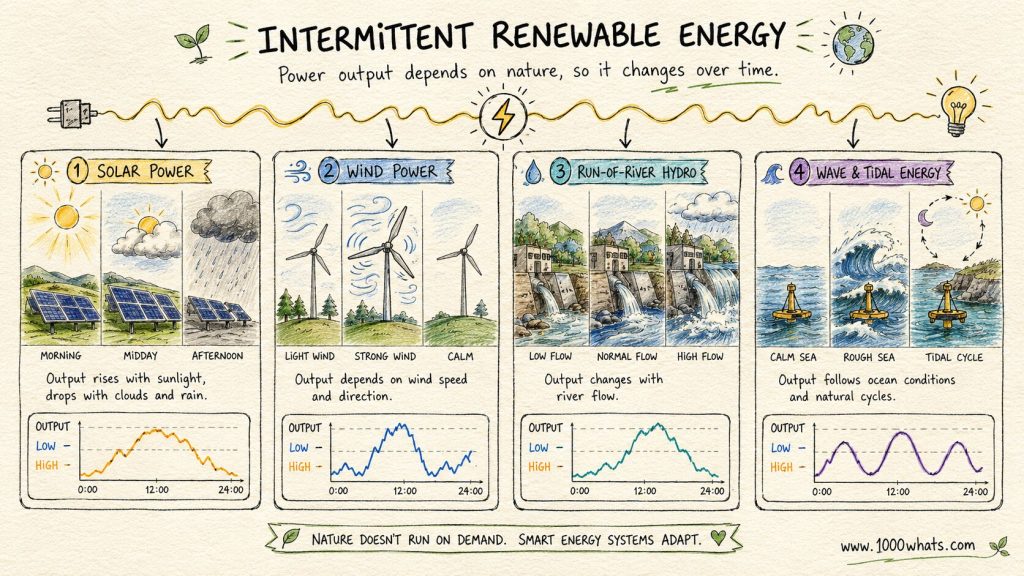
An intermittent renewable energy source is a source of power that does not produce electricity continuously on command because its output depends on natural conditions.
In plain English: nature is in charge.
The big examples are:
- Solar power — output rises and falls with sunlight
- Wind power — generation depends on wind speed and direction
- Run-of-river hydropower — output changes with water flow
- Wave and tidal energy — production follows ocean conditions and cycles
These energy sources are renewable because they rely on naturally replenished resources. But they’re called intermittent because those resources show up unevenly.
That’s the key distinction.
A gas plant can usually ramp production up when asked. A solar farm cannot negotiate with a thunderstorm.
⚡ “Intermittent doesn’t mean unreliable. It means variable—and variability is a grid management challenge, not a moral failure.”
Why does intermittency exist?
Because renewable energy is tied to physical systems that humans do not control.
That may sound obvious, but what most people don’t see is how radical that is compared to the old energy model.
For more than a century, power systems were built around fuels you could store, burn, and dispatch whenever demand spiked. Coal sat in piles. Gas moved through pipelines. Operators told plants when to run.
Intermittent renewables flipped that logic.
Now the grid increasingly works with energy that arrives when nature delivers it:
- Solar peaks during sunny hours
- Wind may surge overnight or during storms
- Hydro can vary by season, drought, or rainfall
- Marine energy follows ocean rhythms rather than human routines
In practice, this means the challenge is not just generating clean electricity. It’s matching variable supply with real-world demand.
And that is where things get interesting.
How does intermittent renewable energy work in the real world?
Think of the grid as a giant live performance with no pause button.
At every second, supply and demand must stay in balance. Too little power, and you risk outages. Too much power at the wrong place and time, and prices can crash or systems get stressed.
Intermittent renewable energy feeds into that system like a talented musician who improvises.
Sometimes brilliantly. Sometimes inconveniently.
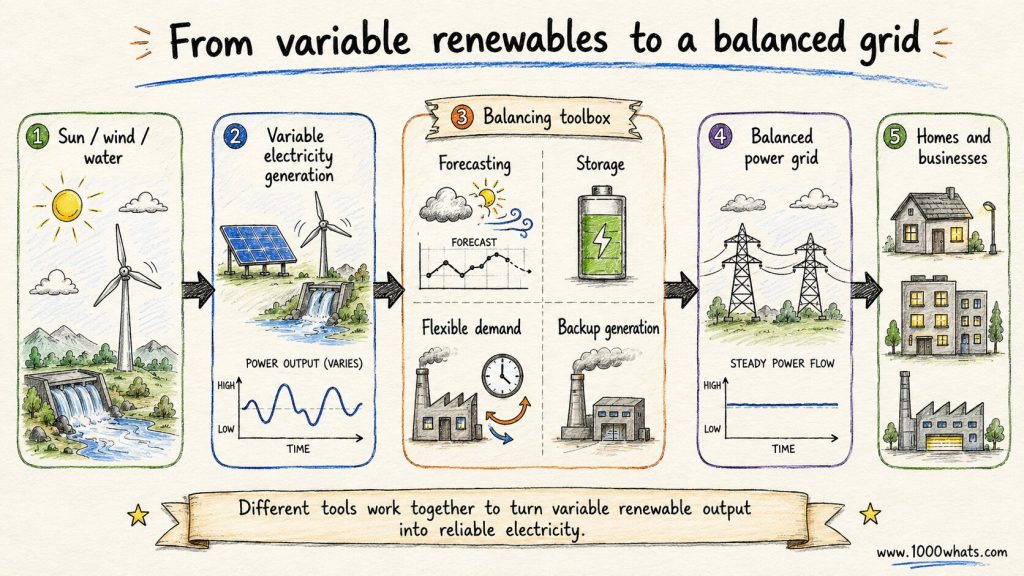
Here’s the basic flow:
- Nature provides the resource: sun, wind, water, tides
- Renewable generators convert that resource into electricity
- Grid operators forecast expected output
- Other resources help fill the gaps when output drops
- Storage, demand response, and flexible generation smooth the system
So yes, solar and wind are variable.
But the grid was never truly “constant” to begin with. Demand changes all day. Power plants trip offline. Transmission lines fail. Fuel prices swing. Electricity systems have always managed volatility.
Renewables didn’t invent complexity. They just made it visible.
Real-world example: a windy night vs. a still evening
Picture a windy night in a region packed with wind farms.
Demand is moderate. Wind output is roaring. Electricity floods the grid. Prices may drop because supply is abundant.
Now fast-forward to the next evening.
The wind eases off just as people come home, turn on lights, cook dinner, and charge devices. Demand climbs. Renewable output falls. The system needs backup—fast.
That backup might come from:
- battery storage
- hydropower
- flexible gas generation
- imports from neighboring regions
- industrial users reducing demand temporarily
From a market perspective, this is where intermittent renewables reshape the economics of power.
They often produce very low-cost electricity when available, but they also increase the value of flexibility, forecasting, storage, and grid coordination.
⚡ “The real question isn’t whether wind and solar are variable. The question is whether the power system is smart enough to work with reality.”
What are the advantages of intermittent renewable energy?
For all the criticism they get, intermittent renewables bring serious strengths.
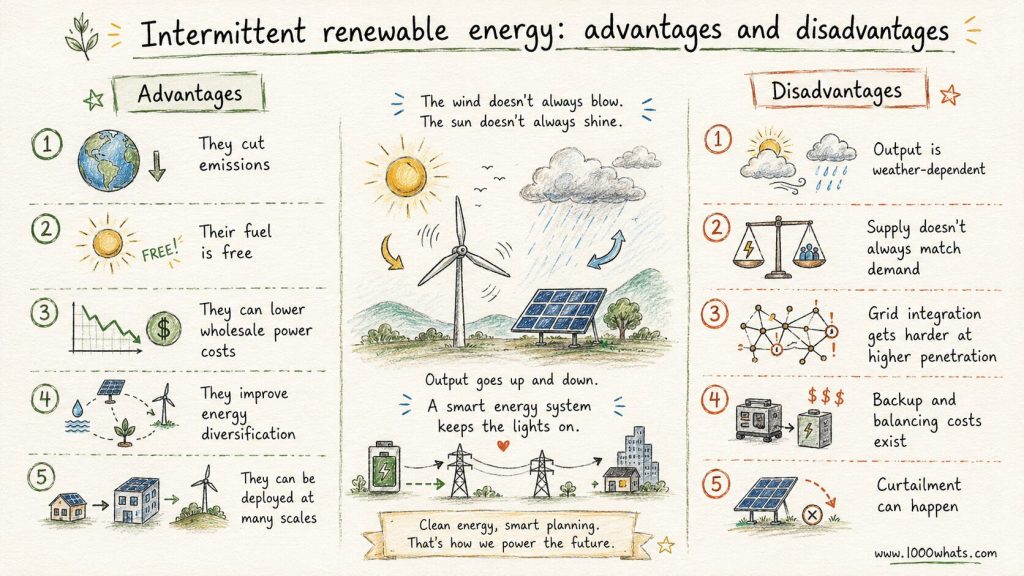
1. They cut emissions
This is the obvious one, but it still matters.
Electricity from wind and solar can displace fossil-fuel generation and reduce greenhouse gas emissions, air pollution, and long-term climate damage.
2. Their fuel is free
No one sends the sun an invoice.
Once infrastructure is built, the energy input itself costs nothing. That changes the economics of power in a big way.
3. They can lower wholesale power costs
When renewable output is strong, it can push more expensive generators out of the market.
That’s one reason wind and solar have become such disruptive forces.
4. They improve energy diversification
A grid that uses multiple sources is generally more resilient than one leaning too hard on a single fuel.
Intermittent renewables add diversity to the generation mix.
5. They can be deployed at many scales
From rooftop solar to utility-scale wind farms, these technologies are flexible in size and location.
That opens doors for both centralized and distributed energy systems.
What are the disadvantages?
Now for the part critics love to shout and advocates sometimes underplay.
Intermittency creates real operational and economic challenges.
1. Output is weather-dependent
This is the headline issue.
A cloudy week or a low-wind period can sharply reduce generation.
2. Supply doesn’t always match demand
Solar often peaks midday. Electricity demand may peak later in the evening.
That mismatch matters.
3. Grid integration gets harder at higher penetration
A small amount of variable power is easy to absorb.
A large amount requires better forecasting, faster balancing, more transmission, and more flexible resources.
4. Backup and balancing costs exist
Intermittent systems often need support from storage, dispatchable plants, demand response, or grid interconnections.
The cheapest megawatt-hour at the plant level is not always the whole story.
5. Curtailment can happen
Sometimes renewable generation is available, but the grid cannot use all of it due to congestion or oversupply.
That means clean power may be wasted unless the system evolves.
This is where the debate gets sloppy.
Critics say intermittency makes renewables weak. Supporters say storage solves everything.
Reality is less dramatic.
Intermittency is manageable—but not free.
Is intermittent renewable energy the same as unreliable energy?
No. And this is one of the biggest misunderstandings in the energy conversation.
Intermittent means the resource varies. Unreliable means the system fails to deliver power when needed.
Those are not the same thing.
A power system can use intermittent resources reliably if it has the right mix of:
- forecasting
- storage
- transmission
- reserve capacity
- flexible demand
- diversified generation
In other words, reliability is not about whether one solar panel works at midnight.
It’s about whether the broader system is designed intelligently.
What most people don’t see is that traditional power systems also depend on things going right: fuel delivery, cooling water, plant maintenance, transmission availability, and market stability.
Every system has vulnerabilities.
Intermittent renewables just force us to confront them more honestly.
How do we deal with intermittency?
This is where the conversation gets good, because the solutions already exist—they just need scale, investment, and competent planning.
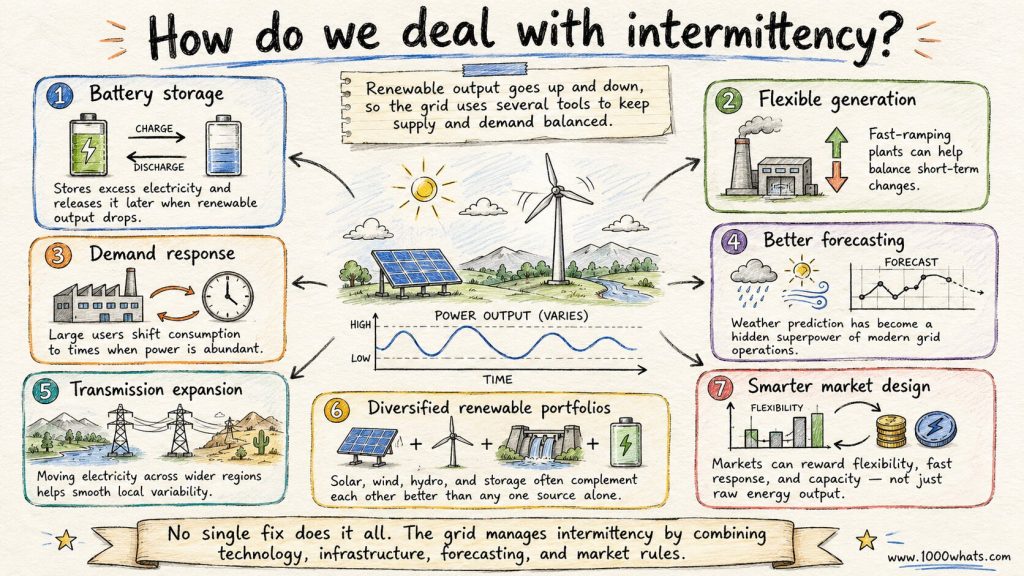
The main tools include:
- Battery storage
Stores excess electricity and releases it later when renewable output drops. - Flexible generation
Fast-ramping plants can help balance short-term changes. - Demand response
Large users shift consumption to times when power is abundant. - Better forecasting
Weather prediction has become a hidden superpower of modern grid operations. - Transmission expansion
Moving electricity across wider regions helps smooth local variability. - Diversified renewable portfolios
Solar, wind, hydro, and storage often complement each other better than any one source alone. - Smarter market design
Markets can reward flexibility, fast response, and capacity—not just raw energy output.
From an insider perspective, intermittency becomes far less scary when you stop viewing the grid as a rigid machine and start viewing it as a coordinated ecosystem.
Why does intermittent renewable energy matter today?
Because the energy transition is no longer theoretical.
Intermittent renewables are not niche technologies anymore. They’re central players in how modern power systems are evolving.
And that means this topic matters for at least three big reasons:
Climate pressure
Decarbonizing electricity is one of the fastest ways to reduce emissions.
You do not get there without large-scale renewables.
Energy security
Domestic wind and solar can reduce exposure to imported fuels and geopolitical shocks.
That does not eliminate risk, but it changes the map.
Power market disruption
Renewables don’t just generate electricity. They change pricing patterns, investment logic, and the value of flexibility across the whole system. 🔍
This is why intermittent renewable energy keeps showing up in policy debates, grid planning, and investor presentations.
It is not a side issue.
It is the issue.
⚡ “Intermittency is not the end of renewable energy. It’s the beginning of a smarter electricity system.”
Final thoughts
Intermittent renewable energy is one of those phrases that sounds like a warning label.
It isn’t.
It’s a description of reality.
Yes, solar and wind are variable. Yes, that creates planning challenges. Yes, grids need storage, flexibility, and smarter design to handle high shares of clean power.
But none of that is an argument against renewables.
It is an argument for building a better system around them.
In practice, the old model of power was never as simple or stable as people like to remember. Fossil-based systems came with fuel risk, pollution, price shocks, and geopolitical baggage. Intermittent renewables replace some of those problems with a different one: variability.
And frankly, that’s a trade many energy systems are willing to make.
Because once you understand the game, intermittency stops looking like chaos.
It starts looking like the cost of working with the real world instead of against it.
What do you think—is intermittency overhyped as a problem, or still underestimated in energy planning?
Until next time, stay curious! 😎
Discover more from 1000whats
Subscribe to get the latest posts sent to your email.