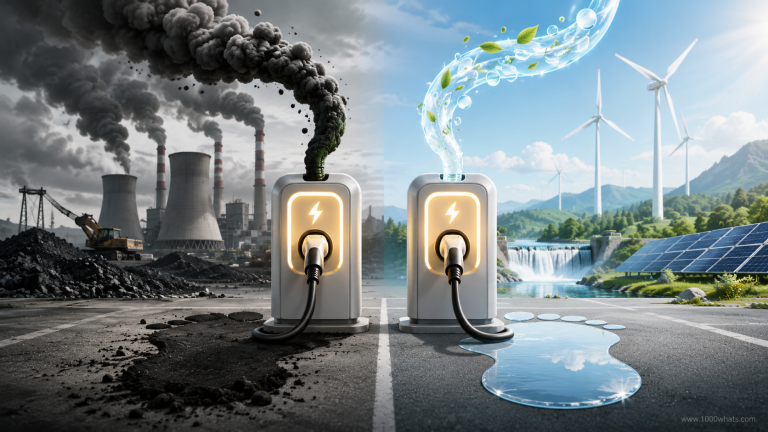
If we all agree emissions are heating the planet, then the obvious question is:
Why don’t we just stop emitting. Today. Right now. End of story.
It sounds so clean. So satisfying. Like finally spotting the villain in a mystery movie and yelling, “Well, arrest him already!”
But then reality barges in wearing muddy boots.
Your home uses electricity. Buildings need cement and steel. Food rides around in trucks. Planes fly. Factories make stuff. The internet, despite its magical reputation, is not powered by good intentions and herbal tea.
So does net zero mean we’re sort of accepting emissions instead of stopping them?
That bothered me too.
The more I dug into it, the clearer it became: net zero is not a compromise with pollution. It’s a strategy for dealing with a world where some emissions are easy to cut, some are hard to cut, and some are still stubbornly baked into modern life.
That may sound less heroic than “just stop everything,” but it has the advantage of being attached to reality.
⚡ “Net zero is not a permission slip for pollution. It’s a plan for squeezing pollution into a smaller and smaller corner.”
Welcome to 1000whats — where we bring your energy knowledge to net zero confusion.
What is net zero?
At its simplest, net zero means the greenhouse gases going into the atmosphere are balanced by the greenhouse gases coming out.
Not zero emissions in the absolute sense.
Net zero.
That little word, net, is where people start squinting suspiciously, and fair enough. It sounds like the kind of word a consultant would use right before showing you a chart no one asked for.
But the idea itself is not silly.
It means this:
- We cut emissions as much as possible
- We stop doing dumb, wasteful, high-carbon things where cleaner options exist
- We redesign systems that currently depend on fossil fuels
- Then, for the small amount of emissions that are still very hard to eliminate, we remove an equivalent amount from the atmosphere
That is the real concept.
Not “keep polluting forever and buy a few feel-good offsets on the weekend.”
Not “print a sustainability report so green it could photosynthesize.”
The serious version of net zero starts with deep emissions cuts first. The balancing part comes at the end, not the beginning.
Why net zero exists in the first place
Because the world is not a light switch.
You can’t decarbonize a whole civilization by dramatically pointing at the sky and saying, “No more emissions, everybody.”
Well, you can say it. It just won’t build cleaner grids, invent better fuels, or replace industrial equipment that lasts forty years.
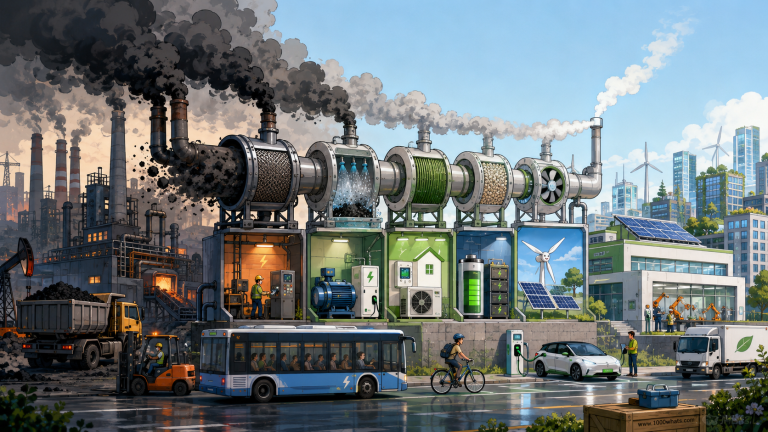
In practice, some sectors can cut emissions pretty fast:
- Electricity generation
- Passenger vehicles
- Building efficiency
- Heat pumps
- Some parts of manufacturing
Other sectors are much nastier:
- Cement
- Steel
- Aviation
- Shipping
- Chemicals
- Heavy industry
- Agriculture
Those are the climate problem’s stubborn uncles. They show up late, smell like diesel, and refuse to leave.
From a market perspective, this is why net zero matters. It gives governments, companies, and investors a direction of travel without pretending every sector can decarbonize on the same schedule.
That is not weakness.
That is what happens when your ideas collide with infrastructure, chemistry, and economics.
The bathtub analogy: the simplest way to understand net zero
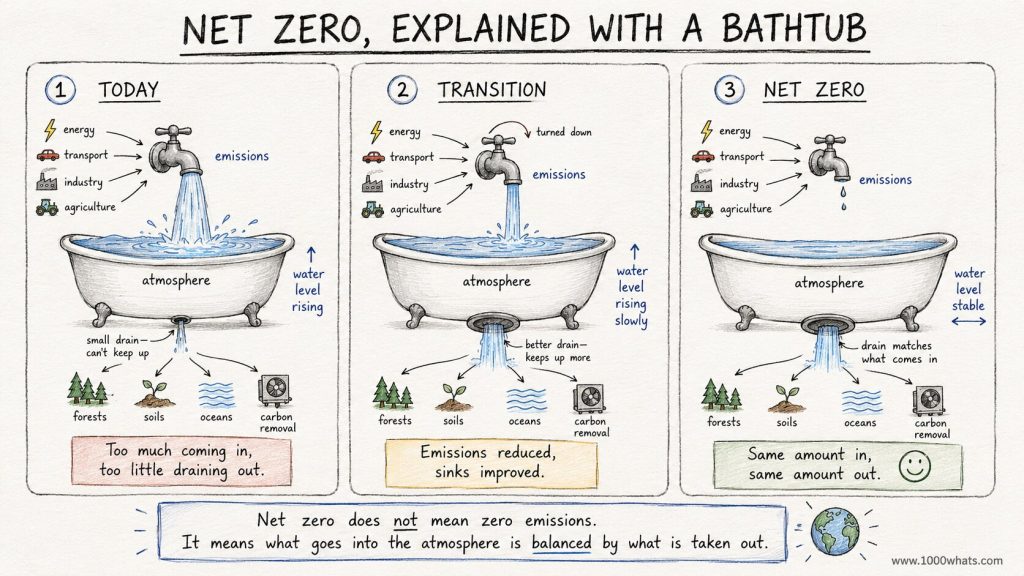
Imagine the planet as a giant bathtub.
The water in the tub is the greenhouse gases already sitting in the atmosphere.
The faucet is us: burning coal, oil, and gas, making cement, running factories, flying planes, heating buildings, and generally behaving like a species that discovered power tools before wisdom.
The drain is everything that removes greenhouse gases from the atmosphere: forests, soils, oceans, and technologies that capture carbon.
For a long time, we’ve had the faucet blasting while the drain was nowhere near big enough.
So the tub kept filling.
That rising water level is global warming.
Now here’s the key point:
Net zero means getting the water flowing in and the water flowing out into balance so the bathtub stops filling up.
That does not mean the faucet is fully off.
It means we turn it down as far as we can, and then make sure the drain handles the small leftover trickle.
⚡ “Net zero doesn’t mean the faucet is off. It means the bathtub stops filling up.”
That’s why net zero is not about “accepting” emissions. It’s about recognizing that the first job is to crank down the tap hard, and the second job is to deal with what remains.
One more wrinkle, because it matters: a bathtub that stops filling is better than a bathtub still rising, but it’s still full of water. Net zero stops the problem from getting worse overall. It does not magically erase all the warming already in the system.
That’s why earlier action matters so much.
So why don’t we just stop emissions completely?
Because “stop emissions” is easy to say in one breath and very hard to do across the machinery of civilization.
Take electricity. You can replace coal plants with solar, wind, hydro, nuclear, and storage over time. That’s difficult, but the path is visible.
Take cement. Even if you used clean energy to heat the process, the chemistry of making cement still releases CO2.
Take aviation. Long-haul planes do not run especially well on wishful thinking.
Take steel. Some steel can be recycled with lower emissions. Great. A lot of primary steel production is still deeply tied to coal and high-temperature industrial processes.
So if someone says, “Why not just stop emissions tomorrow?” the honest answer is:
Because that would require instantly rebuilding energy, transport, industry, construction, agriculture, and supply chains all at once.
And while that sounds thrilling in a manifesto, it’s a terrible way to run a civilization.
How net zero actually works
Here’s the cleaner, less buzzwordy version.
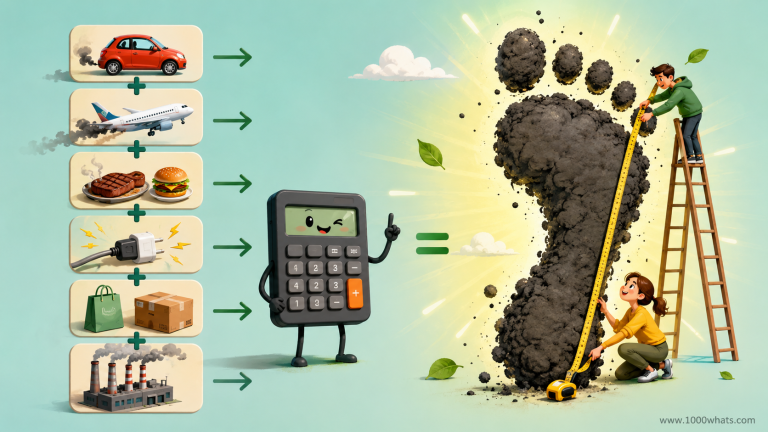
1. Measure the mess
First, you figure out where emissions are coming from.
For a company, that might mean:
- Fuel burned on site
- Electricity purchased from the grid
- Emissions from suppliers
- Shipping and transport
- Product use
- Waste
For a country, it means power plants, vehicles, factories, buildings, farming, and more.
This sounds boring, and it is. But boring is underrated. You cannot reduce what you refuse to count.
2. Cut the easy stuff fast
This is where a lot of progress can happen quickly:
- Use less energy
- Waste less heat
- Switch to cleaner electricity
- Electrify vehicles where it makes sense
- Upgrade buildings
- Improve industrial efficiency
None of this is glamorous. Neither is brushing your teeth, and yet somehow civilization has accepted that as a good idea.
3. Attack the hard stuff
This is where the real engineering headache starts.
Think:
- Cleaner industrial heat
- Low-carbon fuels
- Better materials
- Carbon capture in some sectors
- New manufacturing processes
- Supply-chain pressure
This is the part that separates serious net-zero plans from climate cosplay.
4. Remove the leftovers
Only after big cuts.
That last slice of emissions might come from things that are still very difficult to eliminate. In those cases, carbon removals may be used to balance what remains.
The trick is not to turn this into a loophole.
Because once removal becomes an excuse to keep the faucet wide open, the whole thing collapses into nonsense.
⚡ “Offsets should be the mop at the end of the disaster, not the excuse for flooding the bathroom in the first place.”
A real-world example: the pizza chain problem
Let’s say you run a pizza company.
You’ve got emissions from:
- Store electricity
- Gas ovens
- Delivery vehicles
- Refrigeration
- Packaging
- Cheese production
- Flour milling
- Food waste
Now your marketing team declares, with heroic font choices, “We are going net zero.”
Wonderful. What does that actually mean?
A real plan might look like this:
- Switch stores to cleaner electricity
- Improve insulation and refrigeration efficiency
- Electrify delivery scooters or vans
- Cut food waste
- Reduce packaging emissions
- Work with suppliers on lower-emission ingredients
- Use removals only for the tiny bit that remains
A fake plan would be:
- Keep everything the same
- Buy questionable carbon credits
- Put a leaf on the logo
- Post a photo of a tree sapling
- Congratulate yourselves publicly
One of those is decarbonization.
The other is performance art.
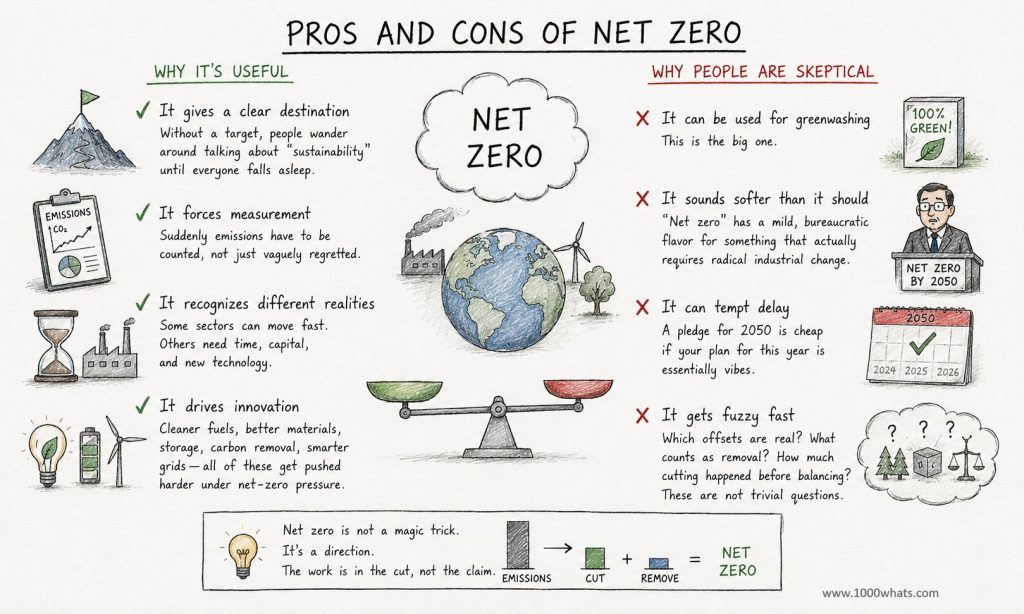
Pros and cons of net zero
Like most big ideas, net zero is useful, imperfect, and frequently abused.
Why it’s useful
- It gives a clear destination
Without a target, people wander around talking about “sustainability” until everyone falls asleep. - It forces measurement
Suddenly emissions have to be counted, not just vaguely regretted. - It recognizes different realities
Some sectors can move fast. Others need time, capital, and new technology. - It drives innovation
Cleaner fuels, better materials, storage, carbon removal, smarter grids—all of these get pushed harder under net-zero pressure.
Why people are skeptical
- It can be used for greenwashing
This is the big one. - It sounds softer than it should
“Net zero” has a mild, bureaucratic flavor for something that actually requires radical industrial change. - It can tempt delay
A pledge for 2050 is cheap if your plan for this year is essentially vibes. - It gets fuzzy fast
Which offsets are real? What counts as removal? How much cutting happened before balancing? These are not trivial questions.
What most people don’t see
What most people don’t see is that climate progress is not mainly blocked by ignorance anymore.
It’s blocked by inertia.
Machines last a long time. Buildings last a long time. Infrastructure lasts a long time. Regulations move slowly. Supply chains are tangled. Capital is cautious. Politics is allergic to discomfort.
So when you hear “net zero,” try not to hear a slogan.
Hear a wrench turning inside a giant machine.
Slowly, noisily, imperfectly, but in the right direction.
That’s the real fight.
Why net zero matters today
Because the atmosphere does not care about our branding.
It only cares about accumulation.
As long as greenhouse gases keep piling up, the climate problem keeps getting worse. Net zero matters because it is aimed at stopping that pile from getting bigger.
That makes it one of the most important climate ideas in circulation, even if it has been bruised by overuse and cheap promises.
A serious net-zero plan should answer questions like these:
- What are you cutting now?
- How fast are emissions actually falling?
- Which emissions are genuinely hard to eliminate?
- What removals are credible?
- What happens in the next five years, not just in 2050?
If those questions don’t have solid answers, the plan probably belongs in the recycling bin.
Final thoughts
Net zero has a branding problem.
It sounds polite. Slightly beige. A phrase invented by a committee trapped in a hotel conference room with weak coffee.
But behind the clunky wording is a serious idea:
Cut emissions as far and as fast as possible, then deal with the stubborn leftovers without cheating.
That’s it.
So no, net zero is not about accepting emissions in some lazy, defeatist way.
It’s about admitting the problem is mechanical, chemical, economic, and political all at once—and then getting to work anyway.
My own view? We still need the term. We just need to stop letting it be fluffy.
If a company or government says “net zero,” the response should not be applause.
It should be:
Show me the cuts. Show me the timeline. Show me the hard parts.
That’s when the conversation gets interesting.
What do you think—has net zero become a useful roadmap, or has the phrase been watered down so much people don’t trust it anymore?
Until next time, stay curious! 😎
Discover more from 1000whats
Subscribe to get the latest posts sent to your email.