Ever used glitter for a birthday card?
Of course you have. It’s festive, chaotic, and somehow immortal. You clean it up once, twice, ten times—and six months later it still appears in your sock, your laptop case, and maybe your soul.
Greenhouse gases are a bit like that.
You don’t always see them. You rarely think about them. But once they’re out there, they tend to stick around and do their thing in the atmosphere for a long time. The difference is that glitter ruins your carpet, while greenhouse gases help warm the planet.
That’s where the idea of a carbon footprint comes in.
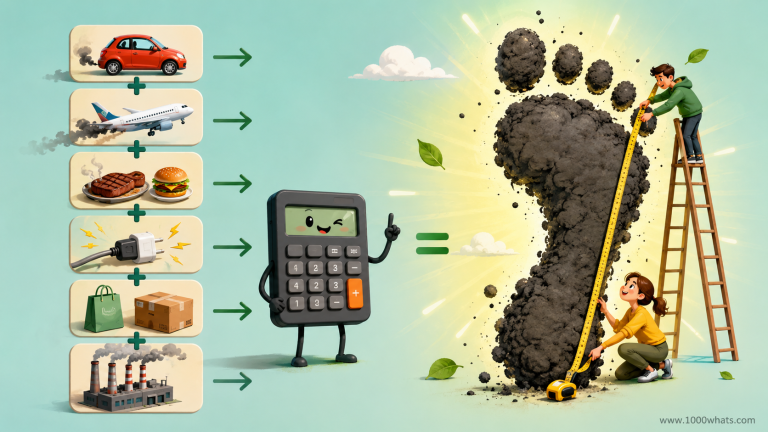
It’s the invisible trail your life leaves behind. Not because you’re personally wandering around puffing smoke like a tiny chimney villain, but because your choices set a whole chain of emissions in motion—electricity, transport, food, deliveries, heating, cooling, all of it.
⚡ “You didn’t light the smokestack yourself—but you may have ordered what it powered.”
Welcome to 1000whats — where climate jargon becomes everyday language and carbon footprints become impossible to ignore.
What is a carbon footprint?
Let’s start with the clean version.
A carbon footprint is the total amount of greenhouse gases released directly and indirectly because of a person, household, product, company, service, or event. Those emissions are usually expressed in CO₂e, or carbon dioxide equivalent, so different gases can be rolled into one comparable number.
That last part matters.
Because despite the name, a carbon footprint is not just about carbon dioxide. It also includes other greenhouse gases like methane and nitrous oxide, which warm the planet too—often much more intensely than CO₂ on a per-unit basis. CO₂e is the accounting trick that puts them all into one common language.
In practice, that means your carbon footprint is less like a literal footprint and more like a climate receipt.
It totals up the emissions tied to your daily life:
- the electricity that powers your home
- the fuel burned in your car
- the flight you booked for that “quick weekend getaway”
- the burger, the package delivery, the new phone, the heating bill
None of those things float into your life by magic. They require energy, materials, transport, and infrastructure. And somewhere along that chain, greenhouse gases get released.
Why is it called a carbon footprint?
Fair question.
Because if the metric includes methane and nitrous oxide too, why not call it a “greenhouse gas footprint” and move on with our lives?
Because carbon footprint is simpler, stickier, and easier to visualize. The “footprint” part signals that your actions leave a mark. The “carbon” part points to carbon dioxide, the best-known greenhouse gas and the one most people associate with climate change. The term works because it turns an abstract planetary issue into something personal and traceable.
And honestly, that’s why the phrase survived.
“Greenhouse gas consumption-linked atmospheric impact metric” was never going to win the popularity contest.
⚡ “A carbon footprint is climate change made personal.”
Direct vs. indirect emissions: where people get confused
This is where most people hit the brakes.
Someone hears the definition and says:
“Hold on. I’m not emitting CO₂ right now. Unless breathing suddenly became illegal?”
And fair enough. The concept can feel weird at first.
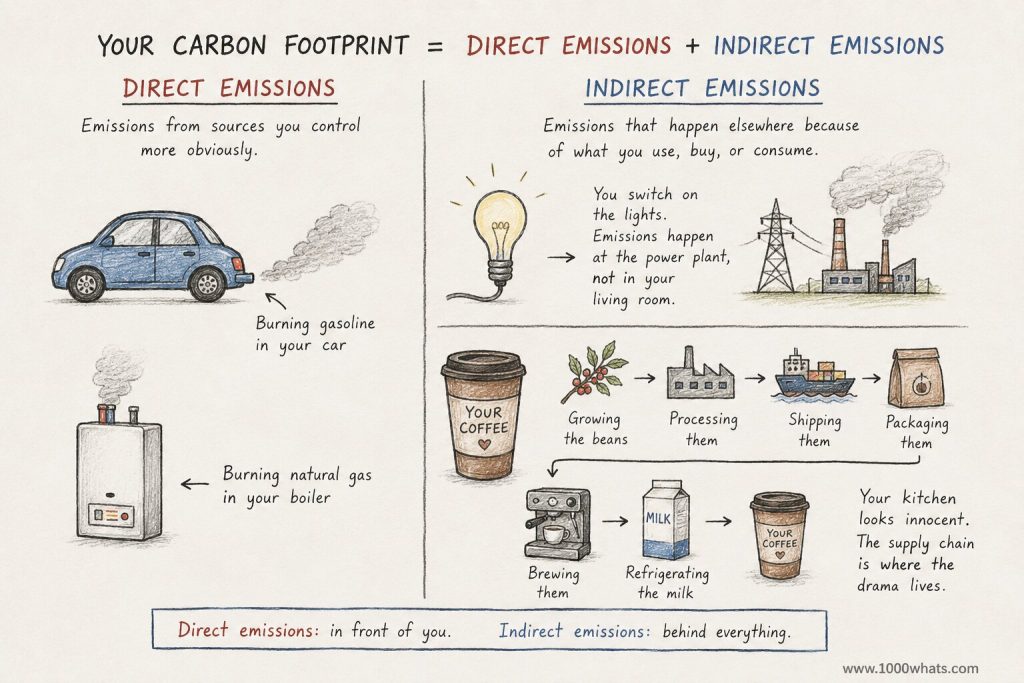
A carbon footprint includes direct emissions and indirect emissions. Direct emissions come from sources you control more obviously—like burning gasoline in your car or natural gas in your boiler. Indirect emissions are the ones that happen elsewhere because of what you use, buy, or consume.
So if you switch on the lights, the emissions may happen at the power plant, not in your living room.
If you buy coffee, the emissions may come from growing the beans, processing them, shipping them, packaging them, brewing them, and maybe refrigerating the milk you pour into it. Your kitchen looks innocent. The supply chain is where the drama lives.
What most people don’t see is that a carbon footprint is not trying to assign blame with courtroom precision. It’s trying to map consequences.
You may not own the factory, the truck, the grid, or the cargo ship. But your demand is still part of the system that keeps them running.
From a practical perspective, most carbon footprints are driven by a few big categories:
- Energy use in homes and buildings
- Transportation, especially car travel and flights
- Food, particularly high-emission diets
- Goods and services, including the stuff we buy and replace
- Waste, especially landfill-related emissions like methane
In personal life, transport and household energy tend to hit hard.
In business, things get even messier because emissions spread across operations, electricity use, supply chains, logistics, procurement, and product use. That’s why carbon accounting often turns into a mix of detective work, spreadsheets, and mild existential discomfort.
How does a carbon footprint actually work?
At its core, the math is simple.
You take an activity—say electricity use, fuel consumption, miles traveled, or kilograms of beef consumed—and multiply it by an emission factor, which is basically the average amount of greenhouse gas tied to that activity. That is how raw activity data becomes estimated emissions.
For example:
- electricity use × grid emission factor
- gas burned × combustion emission factor
- miles flown × aviation emission factor
That gives you estimated emissions for each activity. Add them together, convert everything into CO₂e, and there’s your footprint.
In practice, this is why two people with “the same lifestyle” can still have very different footprints.
A home powered by a coal-heavy grid will usually come with a different footprint than a home powered by cleaner electricity. A short commute in a small efficient car is not the same as frequent flights and a giant SUV. Location, habits, energy mix, and consumption patterns all matter.
A real-world example
Imagine two cups of coffee.
Cup one looks harmless. You boiled water, pressed a button, and drank it while pretending to answer emails.
But the footprint behind that cup may include:
- growing the beans
- using fertilizer
- processing and drying
- shipping across countries
- packaging
- brewing
- maybe refrigerating milk
- maybe tossing the cup or pod in the trash
So the carbon footprint of that coffee is not just the electricity used by your kettle. It’s the whole chain behind the moment. That is the key idea. Carbon footprints follow systems, not just smokestacks.
What this concept gets right—and where it gets messy
The carbon footprint is useful because it makes the invisible visible.
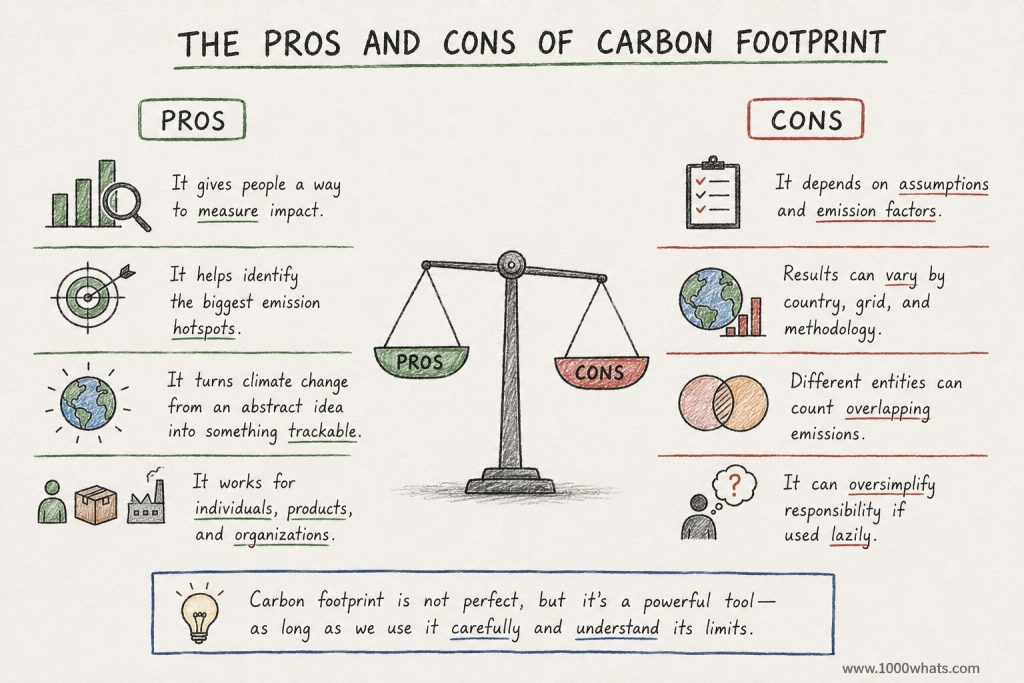
What it gets right:
- It gives people a way to measure impact.
- It helps identify the biggest emission hotspots.
- It turns climate change from an abstract idea into something trackable.
- It works for individuals, products, and organizations.
But it is not perfect.
Where it gets messy:
- It depends on assumptions and emission factors.
- Results can vary by country, grid, and methodology.
- Different entities can count overlapping emissions.
- It can oversimplify responsibility if used lazily.
That overlap is important.
If you count your flight in your personal footprint, and the airline counts that same flight in its corporate footprint, that does not automatically mean the math is broken. It means emissions can be viewed from different levels of responsibility. What most people don’t see is that carbon accounting is often about shared responsibility, not a single guilty party.
⚡ “A carbon footprint isn’t a moral verdict. It’s a map.”
Why it matters today
Because climate change is no longer some distant, theoretical issue reserved for grim conference rooms and PDF reports.
The idea of a carbon footprint matters because it helps connect personal choices, business decisions, and public systems to real-world emissions. It gives people a starting point. Not the whole answer, but a starting point.
From a market perspective, this matters more than ever.
Consumers want cleaner products. Companies are being pushed to measure emissions across their value chains. Governments are tightening expectations. And the more clearly we can trace emissions, the harder they are to ignore.
Final thoughts
A carbon footprint is not the kind of footprint you leave on the beach.
It doesn’t wash away with the tide, and it doesn’t care whether you meant well.
It is the total climate impact tied to how we live, move, buy, eat, and power our lives. Sometimes directly. Often indirectly. Always through systems bigger than any one person.
And that’s exactly why the concept matters.
Because once you can see the trail, you can start changing where it leads.
What part of the carbon footprint conversation do you think people misunderstand most: personal choices, corporate responsibility, or the supply chain behind everyday life?
Until next time, stay curious! 😎
Discover more from 1000whats
Subscribe to get the latest posts sent to your email.