
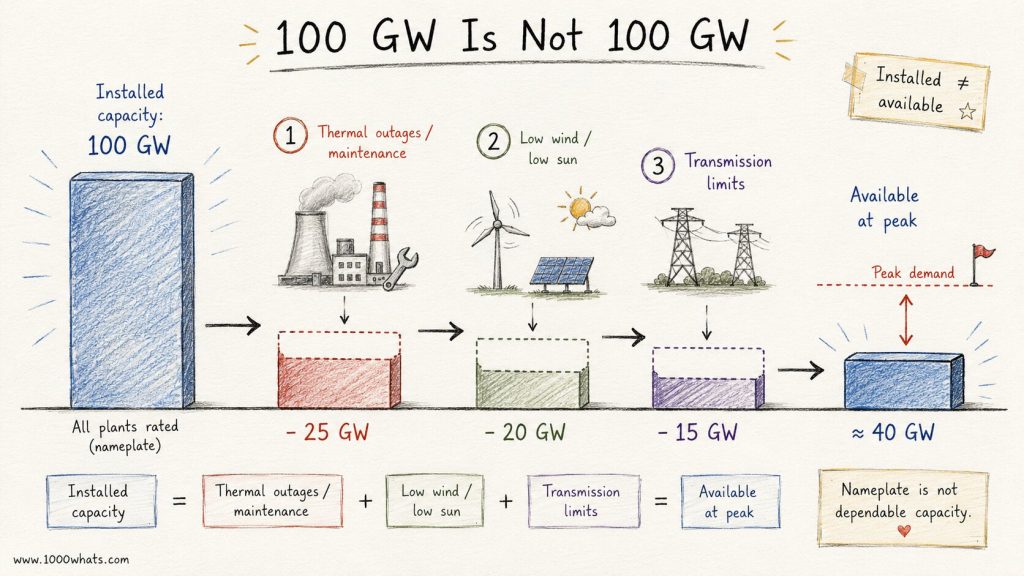
Imagine a country with:
80 GW of peak electricity demand
and:
100 GW of power plants.
Excellent.
Twenty gigawatts to spare.
Turn off the lights in the planning department and go home.
Except that on the coldest evening of the year:
10 GW of those plants are down for maintenance or unexpected failures.
The wind fleet is producing far below its installed capacity.
Solar is contributing exactly what solar tends to contribute after sunset.
A neighboring country you normally import from is having the same freezing evening.
And several gigawatts of supposedly available capacity cannot get electricity through a congested transmission corridor to where demand actually is.
Suddenly:
100 GW installed
does not look anything like:
100 GW available.
And this is where electricity planning becomes considerably more interesting than adding up power plants.
⚡ “The grid does not care how much capacity you own on paper. It cares what actually shows up when things get ugly.”
Welcome to 1000whats — where today we’re asking one of the most important questions in the electricity system:
Will there be enough?
The technical name for that question is resource adequacy.
What is resource adequacy?
Resource adequacy is the ability of a power system to have enough available resources to meet electricity demand at an acceptable level of risk.
That last part matters.
We are not simply asking:
Do we have enough power plants?
We are asking:
Under thousands of possible combinations of demand, weather, outages, renewable production, storage availability, imports, and other conditions, how often might available resources fail to meet demand?
ENTSO-E’s European Resource Adequacy Assessment does essentially this for the European power system up to ten years ahead.
And notice the word resources.
Not generation.
Resources.
Because keeping the lights on does not necessarily require another gas turbine.
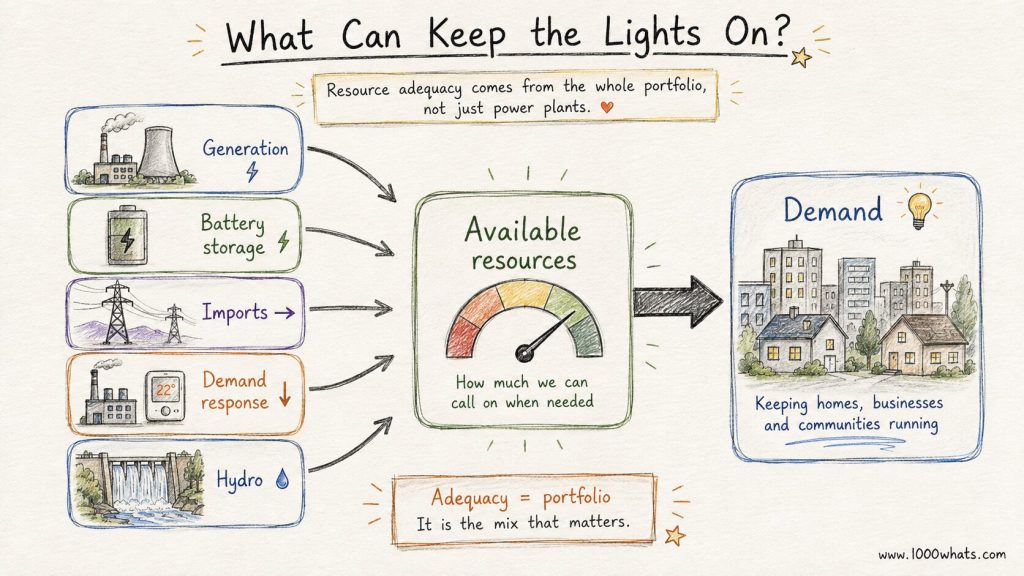
The system can draw on:
- power plants;
- batteries;
- hydropower reservoirs;
- electricity imports;
- demand response;
- flexible consumers;
- other forms of storage;
- and transmission connecting available resources to demand.
ACER describes European resource adequacy in precisely this wider sense: assessing whether sufficient electricity resources will exist to meet future demand.
Resource adequacy is therefore not a power-plant count.
It is a system-risk problem.
Installed capacity is the number that gets everyone into trouble
Suppose Country A has:
10 GW of electricity demand
and:
15 GW of installed generation capacity.
You might reasonably conclude that the country has plenty of electricity.
But what exactly are those 15 GW?
Imagine:
- 5 GW solar;
- 4 GW wind;
- 3 GW gas;
- 2 GW hydro;
- 1 GW coal.
At noon on a windy spring day, that fleet might look spectacular.
Now move the clock to:
19:00 on a cold, windless January evening.
Solar:
0 GW.
Wind:
perhaps much less than 4 GW.
One gas unit:
unexpectedly unavailable.
Hydro:
limited by reservoir conditions.
Demand:
near its annual maximum.
Nothing about the installed-capacity number changed.
The adequacy situation changed completely.
This is why comparing:
installed capacity vs. peak demand
is useful as a first glance and dangerous as a conclusion.
The grid does not consume nameplates.
It consumes available power at a particular moment.
Capacity factor does not solve this either
You might now reach for another familiar metric:
If a wind farm has a 40% annual capacity factor, perhaps we can simply count 40% of its installed capacity toward adequacy?
No.
That 40% tells us how much energy the plant produced over a period compared with its theoretical maximum.
It tells us very little about whether the plant will be producing during the specific hours when the system is under stress.
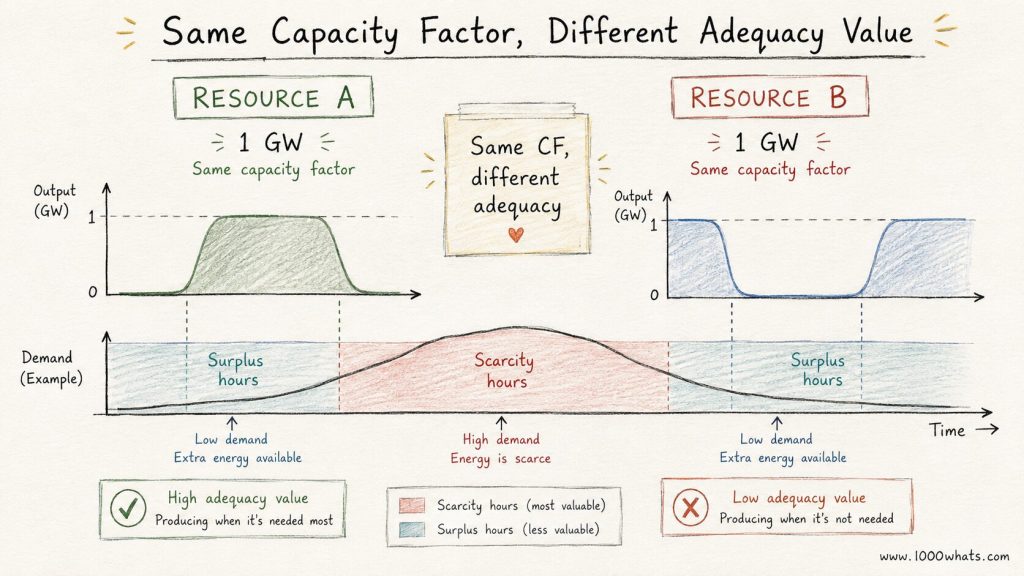
Consider two hypothetical 1 GW resources.
Both have a 40% annual capacity factor.
Resource A tends to produce heavily during the system’s winter evening peaks.
Resource B produces mostly when electricity demand is low.
Same annual capacity factor.
Very different adequacy value.
⚡ “Capacity factor asks how much a plant produces. Adequacy asks whether it produces when the system is desperate.”
This distinction becomes increasingly important in systems with large amounts of weather-dependent generation.
A megawatt is still a megawatt.
But a megawatt available during a scarcity event is worth something very different from a megawatt available when the system already has plenty.
So how much does a wind or solar plant actually count?
Now we have reached the interesting bit.
Imagine adding:
1,000 MW of solar.
Can the system retire 1,000 MW of firm conventional capacity?
Usually not.
What about 500 MW?
200 MW?
50 MW?
There is no universal answer.
It depends on:
- when electricity demand peaks;
- the solar profile;
- weather correlations;
- geographic diversity;
- storage;
- interconnection;
- the rest of the generation fleet;
- and how much solar is already installed.
The contribution a resource makes toward system reliability is often described through concepts such as capacity credit or effective load carrying capability, usually shortened to ELCC.
The basic idea is more useful than the acronym:
How much additional demand could the system reliably serve because this resource exists?
For the first few gigawatts of solar in a summer-peaking system, the answer can be substantial.
Why?
Because sunny afternoons may coincide nicely with air-conditioning demand.
Then you add more solar.
And more.
Eventually the system’s difficult hour moves later.
The famous evening ramp appears.
Solar production begins disappearing just as demand remains high.
The next solar plant therefore contributes less adequacy value than the first one.
Nothing went wrong with solar.
The system changed around it.
That is a recurring theme in electricity markets.
The value of a technology depends partly on how much of that technology you already have.
Batteries make the question even more fun
Now add a battery.
Say:
100 MW / 400 MWh.
It can discharge at 100 MW for roughly four hours at full output, ignoring operational details.
Does that mean it contributes 100 MW to resource adequacy?
Maybe.
But suppose the critical shortage lasts six hours.
Or ten.
Or occurs on several consecutive evenings after the battery has not had enough opportunity to recharge.
Now duration matters.
This is why the MW/MWh distinction in battery storage is not merely engineering trivia.
For adequacy:
MW tells you how hard the battery can push.
MWh helps determine how long it can keep pushing.
A 100 MW / 100 MWh battery and a 100 MW / 800 MWh battery have identical power ratings.
They can have very different reliability contributions.
Once again:
nameplate capacity is not the answer.
Imports count too—until everyone needs them
Europe adds another layer.
Countries are interconnected.
If Serbia, Hungary, France, Germany, Austria, Italy, or anyone else runs short, electricity can potentially arrive from neighboring systems.
That is one of the enormous benefits of interconnected electricity markets.
Not every country needs to build enough generation to survive every conceivable situation entirely alone.
But there is a catch.
Imagine France expects to import during a cold winter evening.
Germany expects the same.
Belgium too.
Austria would also quite like some electricity.
Unfortunately, Europe is having the same weather system.
Everyone’s demand is high.
Wind production is low across a broad region.
Several thermal units are unavailable.
The same hypothetical imported megawatt may now appear in several national plans.
It cannot be in Paris, Berlin, Brussels, and Vienna simultaneously.
This is one reason the European adequacy assessment is pan-European rather than merely 27 national spreadsheets stapled together.
ACER explicitly highlights these cross-border interdependencies: changes in supply or demand in one Member State affect security of supply elsewhere, and adequacy assessments must account for how countries can rely on each other during system stress.
Interconnection improves adequacy enormously.
But imports are not magic generation.
Someone on the other side of the cable still needs electricity available to export.
Adequacy is not the same thing as grid stability
This distinction is particularly important after our recent article on power grid frequency.
Suppose tomorrow evening the system has:
more than enough generation available to meet demand.
Great.
The system may be adequate.
Then a giant power station suddenly trips.
Frequency begins falling.
Now the problem is immediate system operation and stability.
Can the grid withstand the disturbance?
Can reserves react?
Can frequency be controlled?
Those are related reliability questions.
But they are not the same question as long-term resource adequacy.
Think of it this way:
Adequacy: Do we have enough resources available?
Security/stability: Can the system survive disturbances and continue operating properly?
A system can have plenty of installed generation and still suffer a major operational disturbance.
Conversely, a technically stable grid can face an adequacy problem because simply not enough energy or capacity is available during an extreme period.
Same electricity system.
Different failure modes.
And adequacy is not “zero chance of blackout”
Here is where the concept gets slightly uncomfortable.
Could we design an electricity system that can meet demand under absolutely every imaginable combination of events?
Perhaps.
Build absurd amounts of redundant generation.
Massive storage.
Huge transmission.
Backup everything with more backup.
Then backup the backup.
Your electricity bill would become a fascinating piece of literature.
In reality, power systems operate around an acceptable level of risk.
That means resource adequacy is fundamentally probabilistic.
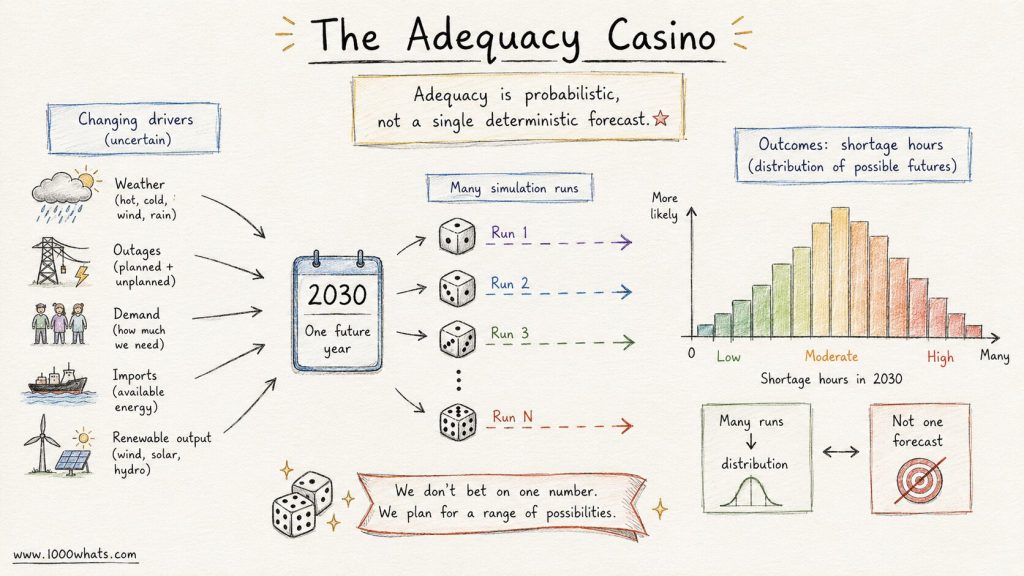
Europe’s ERAA simulates many possible future conditions rather than pretending to know exactly what weather, plant outages, demand, fuel availability, and cross-border flows will look like years from now.
One key metric is:
Loss of Load Expectation — LOLE.
ENTSO-E defines LOLE as the expected number of hours during which available market resources would be insufficient to cover demand across the modeled simulations.
Read that carefully.
It does not mean:
“The lights will definitely go out for five hours in 2030.”
It means the modeled system produces an expected scarcity risk equivalent to that value across many possible futures.
ENTSO-E explicitly warns that non-zero LOLE is a risk indicator, not a blackout prediction. Exceptional measures may still prevent actual disconnections.
That distinction tends to disappear the moment an adequacy report reaches a newspaper headline.
Let’s gamble with the weather 10,000 times
The easiest way to understand modern adequacy modelling is to imagine a casino run by electrical engineers.
Take a future year.
Say 2030.
Now create one possible version of it.
Maybe:
January is very cold.
Wind production is mediocre.
A nuclear unit fails.
Gas is available.
Hydro reservoirs are healthy.
Demand is high.
Run the electricity system hour by hour.
Did supply meet demand?
Good.
Now reset.
Run 2030 again.
This time:
mild winter;
poor hydro;
excellent wind;
higher EV demand;
two gas plants unavailable;
different interconnector conditions.
Run it again.
And again.
Thousands of combinations.
This type of probabilistic modelling allows planners to estimate not merely whether installed capacity exceeds peak demand, but how often plausible combinations of bad events produce scarcity.
That is why ENTSO-E describes ERAA as a probabilistic assessment rather than a concrete prediction of the future.
The future is uncertain.
So the model embraces uncertainty instead of hiding it.
Why the hardest hour keeps moving
Traditional power systems often had a fairly intuitive adequacy problem.
Find annual peak demand.
Make sure enough dispatchable generation exists to cover it plus a reserve margin.
Modern electricity systems complicate that logic.
Solar changes the shape of net demand.
Wind introduces weather-dependent output across hours and days.
Batteries move electricity through time.
EVs add new demand but may eventually become flexible demand.
Heat pumps can create strong winter peaks.
Data centers create large concentrated loads.
Interconnectors allow countries to share resources.
Demand response can make consumption itself part of the adequacy toolkit.
The system’s most difficult moment therefore may not be:
the hour with highest demand.
It may be:
the hour with the worst combination of demand and resource availability.
Those are not necessarily the same thing.
Imagine demand at 90 GW with 100 GW reliably available.
Fine.
Another hour has demand of only 80 GW—but low wind, no solar, unavailable generators, depleted storage, and constrained imports leave only 78 GW available.
Lower demand.
Bigger problem.
Adequacy is about scarcity conditions, not merely peak consumption.
Real-world Europe: This is not theoretical
Europe already performs this exercise every year through the European Resource Adequacy Assessment.
The latest ERAA examines whether the European electricity system has sufficient resources over the coming decade.
And the answer is not simply:
Renewables good.
or:
Thermal plants good.
The actual problem is much less slogan-friendly.
ENTSO-E’s latest assessment warns that significant existing capacity may retire while electricity demand increases, creating adequacy risks unless enough replacement resources, flexibility, storage, demand response, interconnection, or other solutions appear.
At the same time, Europe’s generation mix is changing rapidly. The IEA expects variable renewable energy to reach about 46% of EU electricity generation by 2030, up from around 30% in 2025.
That does not automatically make the system inadequate.
But it does make the old equation:
peak demand + reserve margin = enough power plants
increasingly inadequate itself.
We now need to know when resources are available, for how long, under which weather conditions, where they are located, whether energy can reach consumers, and how different technologies interact.
That is a much more interesting planning problem.
So why do capacity markets exist?
Now resource adequacy connects directly to electricity-market design.
Imagine a gas plant that runs only during the 20 most stressed hours of the year.
Those 20 hours may be extremely important.
Without the plant, the system could face shortages.
But there is a commercial problem.
The plant still has:
staff,
maintenance,
insurance,
capital costs,
connection costs,
and a spectacular amount of metal sitting around for the other 8,740 hours.
Can revenue from a tiny number of operating hours keep it economically alive?
Maybe.
If scarcity prices are sufficiently high and the energy market is allowed to produce those prices.
But regulators and policymakers may not be comfortable relying entirely on rare, extreme price spikes to incentivize enough capacity.
Enter the capacity mechanism.
The European Commission describes capacity mechanisms as measures that pay resources for being available to support security of supply, in addition to whatever they earn from selling electricity.
And ACER makes the connection explicit:
a capacity mechanism should be introduced only when an adequacy concern has been identified.
So the logic is:
Adequacy assessment → identify future scarcity risk → market reforms where possible → capacity mechanism if a residual problem remains.
That is why resource adequacy sounds like engineering but quickly becomes economics.
Someone eventually has to pay for reliability.
And no, capacity mechanisms are not just payments to old power plants
This is another important shift.
Historically, discussions about adequacy often sounded like:
How many power stations do we need?
Modern systems ask:
What resources can reliably help during scarcity?
That can include:
- gas or other dispatchable generation;
- hydropower;
- batteries;
- demand response;
- cross-border resources;
- flexible industrial loads;
- other qualifying technologies.
ACER’s definition explicitly includes generators, demand response, and storage among resources that can receive capacity remuneration.
This is conceptually important.
If a factory can reliably reduce 50 MW of consumption during a scarcity event, the grid sees something remarkably similar to finding 50 MW of additional supply.
One produces more.
The other consumes less.
The balance improves either way.
The cheapest adequacy resource may therefore occasionally be a power plant that nobody builds.
What most people don’t see: Every MW needs an accreditation haircut
Suppose we have:
1,000 MW gas
and:
1,000 MW solar.
Writing both as 1,000 MW on a capacity table is physically correct.
Treating them as equally dependable during the system’s critical hours may not be.
But the same caution applies to supposedly “firm” resources.
A 1,000 MW gas fleet does not deserve an automatic 1,000 MW adequacy contribution either.
Plants fail.
Fuel supplies can be constrained.
Extreme temperatures can reduce performance.
Several generators may fail simultaneously because they are exposed to the same weather or infrastructure problem.
Hydropower depends on water availability.
Batteries depend on duration and state of charge.
Imports depend on neighboring conditions and transmission.
Demand response depends on customers actually responding.
Every resource has an availability story.
Modern adequacy analysis tries to quantify those stories rather than dividing technologies into the simplistic categories:
reliable
and:
unreliable.
In practice, reliability is a probability.
That is much harder to put on a bumper sticker.
It is also much closer to reality.
More renewables do not automatically mean less adequacy
This deserves saying clearly.
A system with high wind and solar penetration is not inherently incapable of maintaining resource adequacy.
But the portfolio around those resources matters enormously.
A high-renewables system may combine:
wind,
solar,
hydro,
batteries,
long-duration storage,
interconnectors,
demand response,
dispatchable generation,
and flexible consumption.
Geographic diversity also matters.
Wind may be weak in one region and strong in another.
Solar profiles differ across longitude and weather systems.
Transmission allows the system to exploit that diversity.
Storage shifts energy between hours.
Demand response shifts consumption.
Dispatchable generation covers residual periods.
The question is therefore not:
Can solar keep the lights on?
Solar is not applying for the job of “entire electricity system.”
The useful question is:
Can this portfolio of resources meet demand across the range of conditions we care about?
That is resource adequacy.
Why resource adequacy matters more now
For decades, much of electricity planning revolved around relatively predictable demand growth and large dispatchable generators.
The system is becoming more dynamic.
Electricity demand is changing because of:
- EVs;
- heat pumps;
- data centers;
- industrial electrification;
- hydrogen production.
Supply is changing because of:
- wind;
- solar;
- battery storage;
- coal retirements;
- aging thermal and nuclear fleets;
- changing hydro conditions.
Climate and weather add another layer because heat waves, droughts, cold spells, and prolonged low-wind periods can simultaneously affect both supply and demand.
Meanwhile, electricity is becoming more important to the rest of the economy.
If transport, heating, industry, and digital infrastructure increasingly depend on electricity, the cost of getting adequacy wrong becomes larger.
That is why something as obscure-sounding as LOLE ends up influencing billion-euro investment decisions.
The uncomfortable truth: Reliability has a price
Suppose Model A produces:
3 expected hours of scarcity per year.
Model B produces:
0.1 hours.
Obviously B is better.
But what if achieving B requires €50 billion of additional infrastructure?
What if reducing the risk further to:
0.01 hours
requires another €100 billion?
At some point, society is making an economic decision.
How much are we willing to pay to reduce the probability of electricity shortages?
This is why ENTSO-E says LOLE must be compared with national reliability standards and why adequacy ultimately involves a policy and economic trade-off.
Perfect reliability sounds wonderful.
So does infinitely cheap electricity.
Unfortunately, they have yet to meet.
⚡ “Resource adequacy is not about eliminating risk. It is about deciding how much risk we are willing to buy our way out of.”
That is the part hidden underneath all the modeling.
So, what is resource adequacy in one sentence?
Resource adequacy is the ability of an electricity system to have enough available generation, storage, imports, and flexible demand to meet electricity needs at an accepted level of risk.
Not enough capacity on paper.
Not enough annual electricity production.
Not enough renewable generation.
Not enough thermal generation.
Enough usable resources at the moments when the system actually needs them.
That is the distinction worth remembering.
Final thoughts
Electricity planning used to look deceptively simple.
Demand peaks at 80 GW.
Build 100 GW.
Congratulations.
Except the real grid never read the spreadsheet.
Power plants fail.
Wind changes.
The sun sets.
Hydro reservoirs empty.
Demand surprises us.
Batteries run out of stored energy.
Transmission becomes constrained.
Neighboring countries have problems of their own.
And occasionally several annoying things happen at exactly the same time.
Resource adequacy exists because the electricity system must work in those hours too.
That is why the question is changing from:
How much capacity have we built?
to:
What can the system actually deliver when conditions are difficult?
That shift matters enormously as electricity systems become more renewable, interconnected, flexible, and electrified.
A solar panel does not need to behave like a gas turbine.
A battery does not need to behave like a hydro reservoir.
Demand response does not need to generate anything at all.
They need to form a portfolio that collectively does the job.
And ultimately, that job is wonderfully simple:
When someone flips the switch, electricity needs to be there.
Everything else is modeling.
What energy concept should we pull apart next?
Until next time, stay curious! 😎
Discover more from 1000whats
Subscribe to get the latest posts sent to your email.