Most people hear nuclear and immediately picture either apocalypse or genius.
That is unfair to kettles.
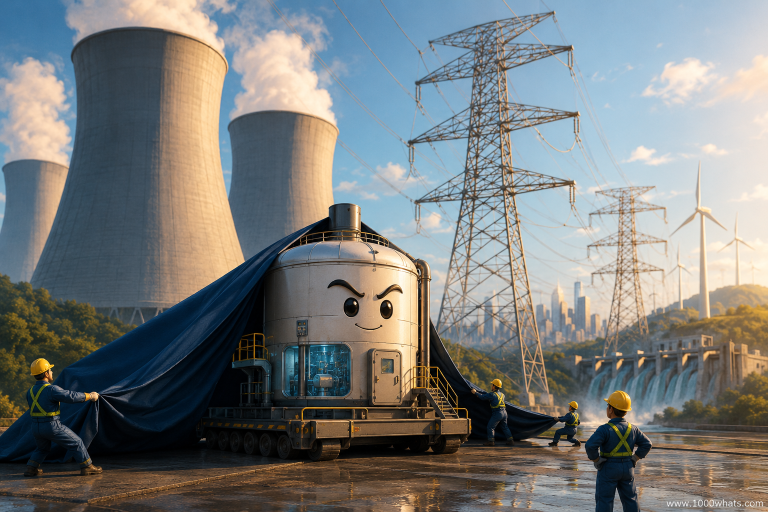
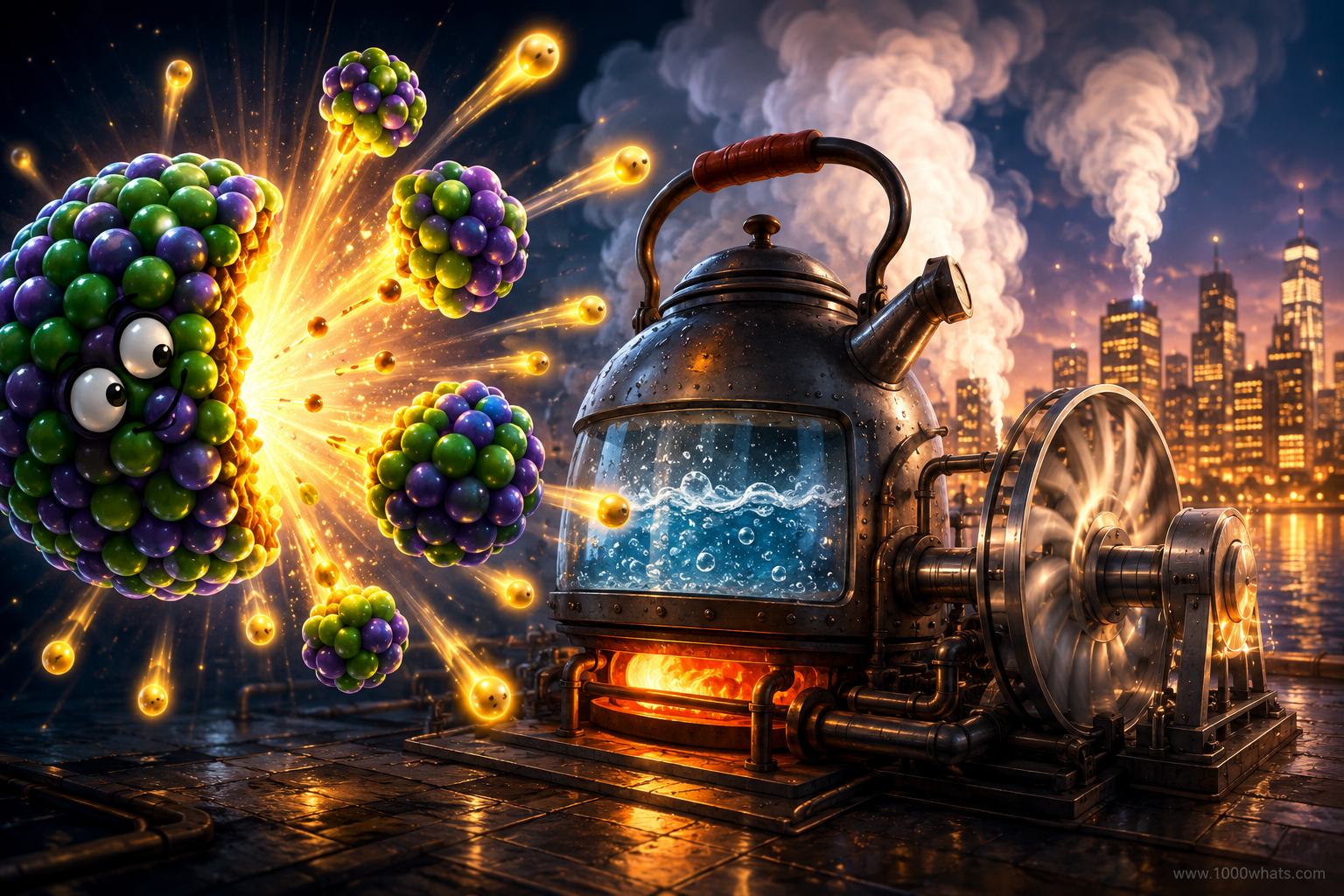
Because the funny little secret is this: in a nuclear power plant, all the glorious atomic drama mostly ends with boiling water. That heat becomes steam, the steam spins a turbine, and the turbine makes electricity. Very advanced. Also deeply unglamorous. Nuclear power still provides just under 10% of global electricity, and the IEA says global nuclear generation hit a record in 2025, with more than 60 reactors under construction worldwide.
⚡ “Nuclear fission is not magic. It is a very expensive way of making water act enthusiastic.”
Welcome to 1000whats — where I split energy jargon like an atom.
What is nuclear fission?
Here is the plain-English version.
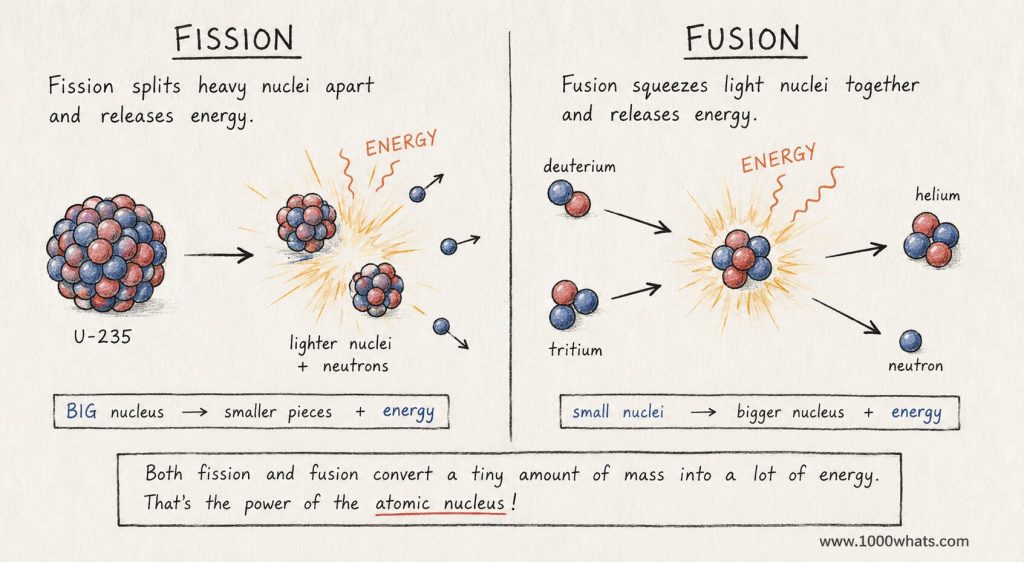
Nuclear fission is when the nucleus of a heavy atom splits into smaller nuclei and releases energy. In common reactor fuel, that usually means uranium-235 getting hit by a neutron, splitting, and throwing off heat, radiation, and a few more neutrons that can keep the process going.
That is the key distinction:
- Fission splits heavy nuclei apart.
- Fusion squeezes light nuclei together.
People mix them up all the time. One chops the log. The other glues two twigs into a bigger twig.
Why does nuclear fission exist at all?
Because some atomic nuclei are, in a very technical sense, a bit touchy.
Heavy nuclei like uranium are crammed with protons and neutrons. There is a lot of energy tied up in the bonds inside that nucleus. When the nucleus splits in the right way, some of that nuclear energy is released as heat and radiation. The smaller pieces are a more comfortable arrangement than the original overcrowded giant.
Nature likes better bookkeeping, even when the ledger is on fire.
In practice, fission happens because a neutron barges into the nucleus like an uninvited guest at a dinner party. The nucleus wobbles, loses its composure, and breaks into smaller chunks. Those chunks fly away with energy, and extra neutrons come flying out too. That is where the fun begins.
Or, depending on your temperament, the paperwork.
How does nuclear fission work, simply?
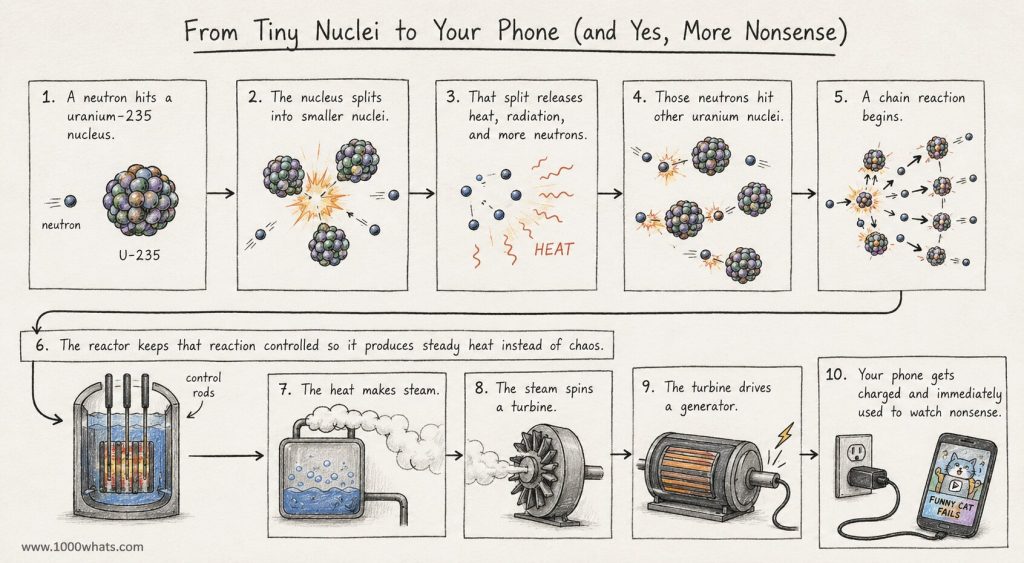
Strip away the concrete, steel, valves, and thousand-page safety manuals, and the process looks like this:
- A neutron hits a uranium-235 nucleus.
- The nucleus splits into smaller nuclei.
- That split releases heat, radiation, and more neutrons.
- Those neutrons hit other uranium nuclei.
- A chain reaction begins.
- The reactor keeps that reaction controlled so it produces steady heat instead of chaos.
- The heat makes steam.
- The steam spins a turbine.
- The turbine drives a generator.
- Your phone gets charged and immediately used to watch nonsense.
Inside many reactors, water does double duty: it cools the core and also helps slow neutrons down so the chain reaction can continue efficiently. Control rods absorb neutrons, which lets operators reduce or increase the reaction rate. That is the difference between “useful machine” and “terrible headline.”
⚡ “A reactor is basically a neutron traffic problem with a turbine attached.”
A stupidly simple example
Imagine a gym full of mousetraps.
Now put two ping-pong balls on each mousetrap.
Throw one extra ping-pong ball into the room.
Snap. Then snap-snap. Then snap-snap-snap-snap-snap.
That is the chain reaction idea.
Each fission event kicks out neutrons. Those neutrons can trigger more fissions. A power reactor does not want one giant frenzy. It wants a controlled, boring, beautifully predictable series of snaps. Engineers spend their lives making sure the atomic mousetrap room behaves like a disciplined orchestra, not a toddler birthday party.
Real-world examples of nuclear fission
1. Nuclear power plants
This is the big one.
Commercial reactors use controlled fission to make heat, turn water into steam, and generate electricity. The heat source is exotic. The rest is classic power engineering. Coal plants boil water too. Gas plants often do turbine things more directly. Nuclear plants just get their heat from the atom’s nucleus instead of from burning fuel.
2. Tiny fuel, absurd energy
DOE says a uranium fuel pellet about the size of an egg can contain as much energy as 88 tons of coal. That is the part that makes engineers sit up straighter and accountants start blinking.
3. Science, medicine, and beyond
DOE notes fission processes are also used in research, medicine, non-proliferation and defense, and energy applications. So this is not just about giant cooling towers and dramatic documentaries.
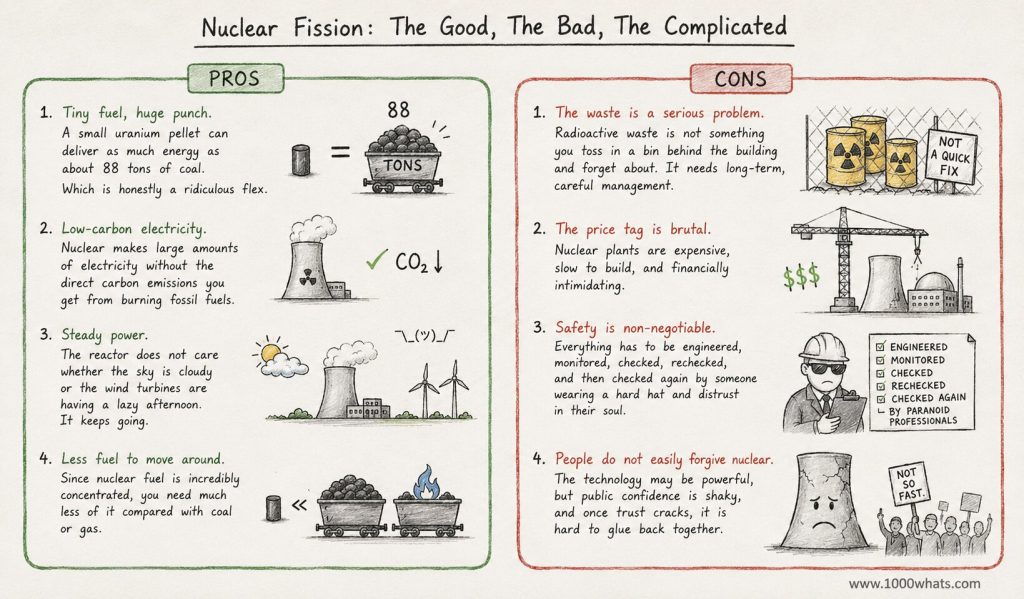
Pros of nuclear fission
- Tiny fuel, huge punch. A small uranium pellet can deliver as much energy as about 88 tons of coal. Which is honestly a ridiculous flex.
- Low-carbon electricity. Nuclear makes large amounts of electricity without the direct carbon emissions you get from burning fossil fuels.
- Steady power. The reactor does not care whether the sky is cloudy or the wind turbines are having a lazy afternoon. It keeps going.
- Less fuel to move around. Since nuclear fuel is incredibly concentrated, you need much less of it compared with coal or gas.
Cons of nuclear fission
- The waste is a serious problem. Radioactive waste is not something you toss in a bin behind the building and forget about. It needs long-term, careful management.
- The price tag is brutal. Nuclear plants are expensive, slow to build, and financially intimidating.
- Safety is non-negotiable. Everything has to be engineered, monitored, checked, rechecked, and then checked again by someone wearing a hard hat and distrust in their soul.
- People do not easily forgive nuclear. The technology may be powerful, but public confidence is shaky, and once trust cracks, it is hard to glue back together.
Why nuclear fission matters today
What most people don’t see is that the modern power system has two separate jobs.
First, it must get cleaner.
Second, it must still work on Tuesday night when everyone is cooking, charging, streaming, cooling, and generally behaving like electricity is a birthright.
That is where fission stays relevant. The IEA says nuclear produced just under 10% of global electricity, generation hit a record in 2025, and more than 60 reactors are under construction while over 40 countries have plans to expand nuclear use. That is not a niche sideshow. That is a serious chunk of the world trying to solve the same puzzle: how do we keep power reliable while cutting emissions and strengthening energy security?
From a market perspective, nuclear fission is attractive because it offers firm, low-emissions electricity. In practice, grids do not run on slogans. They run on power that actually shows up. Nuclear is not the whole answer. Nothing is. But it is one of the few technologies that can produce large amounts of electricity without direct combustion emissions while also avoiding the weather dependence of wind and solar.
Final thoughts
So, what is nuclear fission?
It is the trick of cracking open a heavy atom and collecting the energy that spills out.
That sounds outrageous, and it is. Yet the practical result is almost comically ordinary: hot water, spinning metal, electricity.
The deeper lesson is even better. Nature hides ridiculous power inside tiny things. Then it waits to see whether we are clever enough to use that power without being fools about it.
I think nuclear fission deserves neither worship nor panic. It deserves understanding. Look at the physics clearly. Look at the costs honestly. Look at the waste seriously. Then argue like grown-ups.
Got a favorite analogy for fission, or a nuclear question people keep mangling at dinner parties? Drop it into the conversation.
Until next time, stay curious! 😎
Discover more from 1000whats
Subscribe to get the latest posts sent to your email.