Imagine electricity is almost free at 2 p.m.
Solar generation is everywhere. The grid has more electricity than it particularly knows what to do with.
At 8 p.m., the Sun has left the meeting, electricity prices are high, and thousands of buildings need heating.
The obvious modern answer seems to be:
battery.
Charge it at 2 p.m.
Discharge it at 8 p.m.
Use the electricity to make heat.
Perfectly reasonable.
But there is another option.
At 2 p.m.:
make the heat.
Then keep it.
Welcome to 1000whats — where today the glamorous future of energy storage turns out to include hot water, ice, rocks, salt, and several technologies your grandmother would recognize as:
keeping something warm for later.
The technical name is:
thermal energy storage.
And once you notice how much of our energy demand ultimately wants to become heating or cooling, the idea becomes much less primitive than it sounds.
⚡ “If the final product you need is heat, electricity does not necessarily need to make the entire round trip.”
First, forget batteries for a moment
When people hear:
energy storage
they increasingly picture lithium-ion batteries.
That makes sense.
Batteries are extraordinarily useful because they store energy in electrochemical form and return it as electricity.
But electricity is not the only useful form of energy.
Sometimes what you actually want is:
hot water,
warm air,
steam,
industrial process heat,
cold water,
air conditioning,
or refrigeration.
In those cases, converting energy into heat or cold and storing that can be much simpler.
Thermal energy storage means storing energy in a material as a heat source or cold sink and using it at another time. Depending on the technology, thermal energy can be stored from hours to weeks — and some underground systems can stretch the idea much further.
So the basic principle is beautifully simple:
energy available now → thermal storage → heating or cooling later
We already know the concept from everyday life.
A thermos stores hot coffee.
A freezer stores cold food.
A hot-water cylinder stores thermal energy.
A building itself stores some heat in its walls, floors, furniture and air.
Thermal energy storage simply takes the idea seriously enough to engineer it.
Sometimes very seriously.
Industrial-tank-full-of-molten-salt seriously.
The grid does not care whether your radiator owns lithium
Suppose a building needs 1 MWh of useful heat at 8 p.m.
One possible chain is:
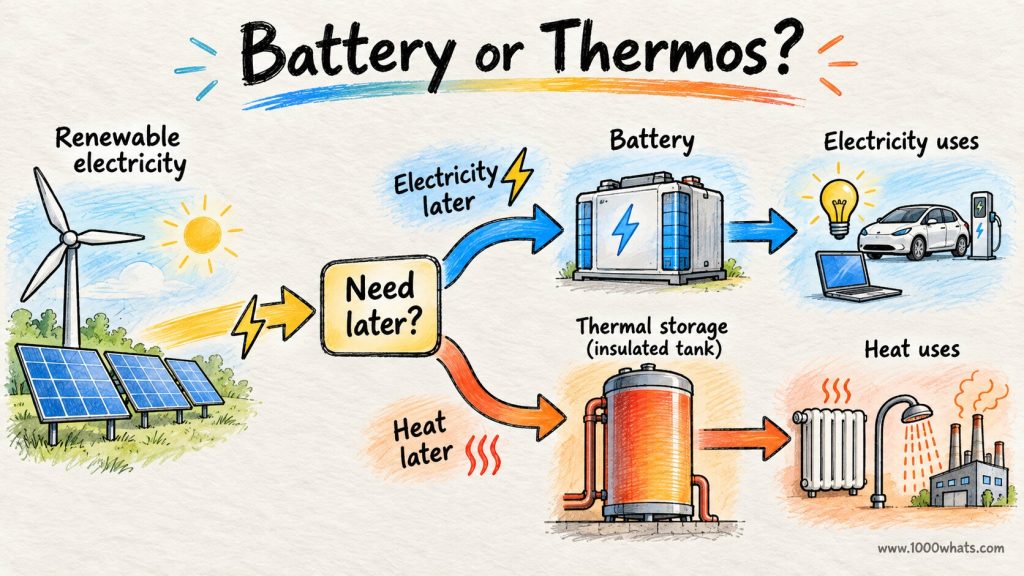
electricity at 2 p.m. → battery → electricity at 8 p.m. → heater or heat pump → heat
Another is:
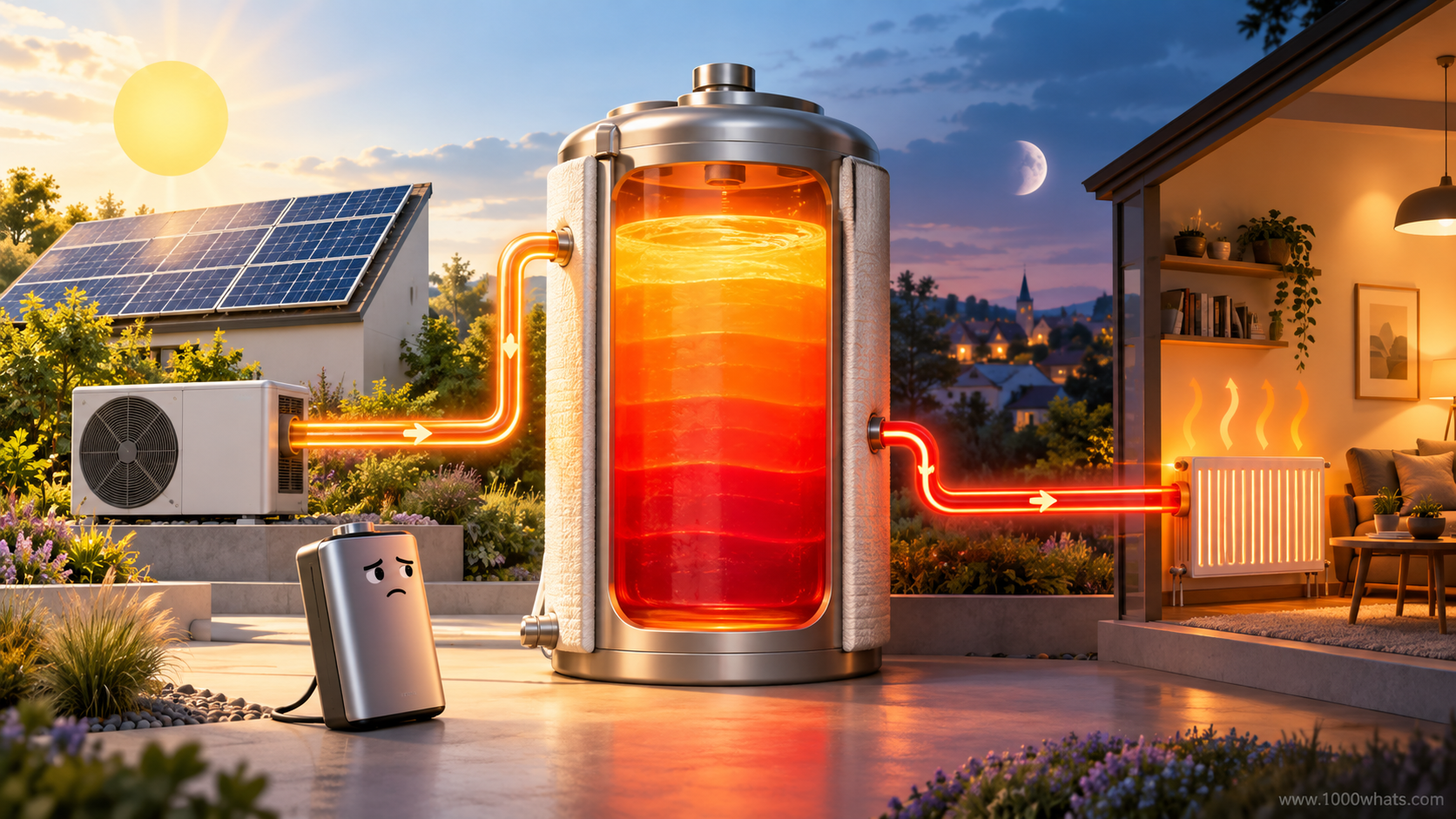
electricity at 2 p.m. → heater or heat pump → thermal storage → heat at 8 p.m.
Both can make sense.
But notice what happened in the second chain.
We stopped insisting that the energy remain electricity until the last possible moment.
If the final customer wants heat, we store heat.
That can avoid unnecessary thermal/electrical energy conversions — one of the reasons thermal storage is being developed as a tool for flexible and efficient buildings.
And it can use remarkably inexpensive storage media.
Water, for example, is not currently experiencing a global gigafactory shortage.
⚡ “Sometimes the cheapest battery for a heating system is not a battery. It is a tank.”
The simplest thermal battery is water
My article on heat introduced the equation:
Q = mcΔT
In plain English, the amount of thermal energy you can store depends on:
- how much material you have;
- its specific heat capacity;
- and how much you change its temperature.
Water is excellent at this because it has a high specific heat capacity.
Heat a lot of water.
Insulate the tank.
Use the hot water later.
Congratulations.
You have thermal energy storage.
No lithium.
No cobalt.
No inverter.
No battery-management system sending concerned emails about cell temperature.
Just water refusing to cool down as quickly as you would like.
This form is called:
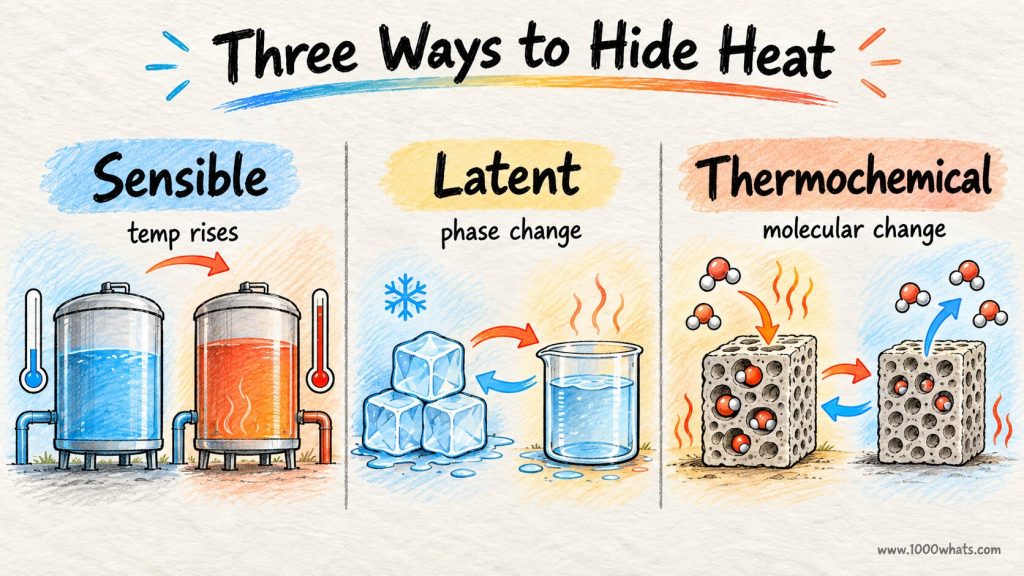
sensible heat storage.
“Sensible” here does not mean the tank has made responsible life choices.
It means the stored energy causes a measurable temperature change.
Sensible heat storage: make something hotter
This is the oldest and most straightforward thermal-storage approach.
You store energy by changing the temperature of a material without deliberately changing its phase.
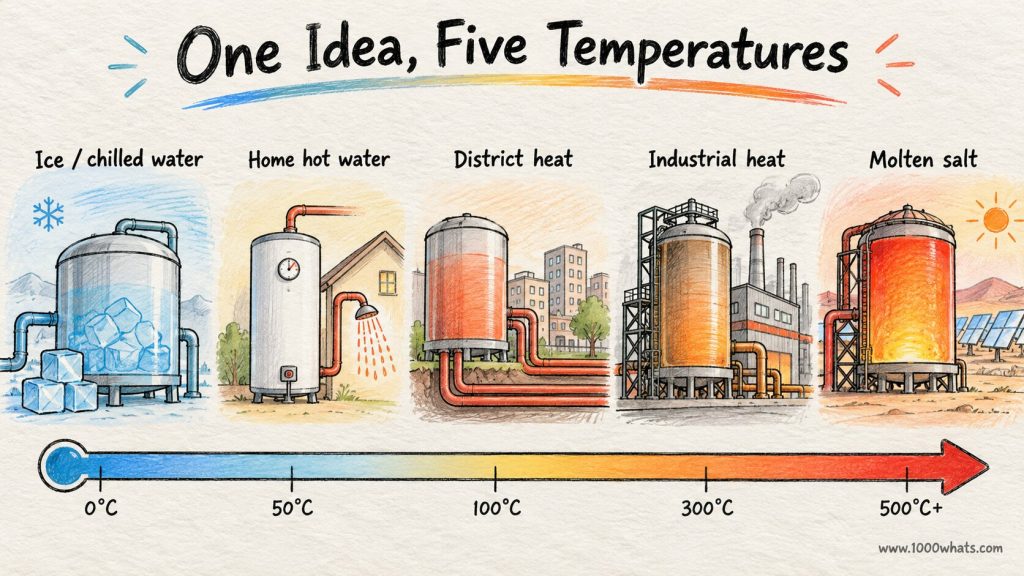
Possible storage media include:
- water;
- rocks;
- concrete;
- sand or solid particles;
- thermal oils;
- molten salts;
- underground rock and water formations.
The principle remains:
cold-ish material + energy → hotter material → useful energy later
Simple physics.
Enormous range of temperatures.
A household hot-water tank and a 500°C thermal-storage system can belong to the same broad family.
Energy technology occasionally has a very generous definition of “same.”
Wait. Molten salt?
Yes.
And no, we have not suddenly wandered into a medieval metallurgy blog.
Concentrating solar power plants can collect sunlight as heat rather than converting it directly into electricity with photovoltaic cells.
That heat can be stored in molten salt inside insulated tanks.
Later, the hot salt supplies heat to the power block.
Steam drives a turbine.
Electricity appears.
Modern reference designs for molten-salt concentrating solar power use a hot-salt tank and a cold-salt tank, allowing stored heat to continue feeding electricity generation after sunset. A representative NREL configuration includes around 10 hours of thermal storage.
That is an important variation.
Sometimes thermal storage stores heat because we eventually want:
heat.
Sometimes it stores heat because we eventually want:
electricity.
Those are not the same application.
If you deliberately convert:
electricity → heat → electricity
conversion losses can become a serious issue.
But in a solar-thermal power plant, the solar resource is already being collected as thermal energy before the steam turbine.
Storing that heat before the power block can therefore be a natural part of the plant architecture.
Then there is latent heat storage
Now thermodynamics gets more interesting.
Remember what happens when ice melts?
You can keep adding energy while the material changes phase without its temperature rising in the ordinary way during the transition.
That energy is associated with:
latent heat.
Thermal storage can exploit this.
Instead of merely heating a material from, say:
20°C → 60°C
we can choose a material that melts or freezes near the temperature we care about.
During that phase change, it can absorb or release substantial energy.
These are called:
phase-change materials — PCMs.
They can include paraffins, salt hydrates, certain salts and other engineered materials.
The advantage is attractive: a phase change can store substantial thermal energy within a relatively narrow temperature range.
The mental model is:
sensible storage → energy changes temperature
latent storage → much of the energy changes phase
And one material makes this wonderfully intuitive.
Ice.
Yes, buildings can make ice when electricity is cheap
This sounds like somebody solved a modern grid problem using technology from a fishing boat.
But it works.
Large buildings can use electricity during off-peak hours to:
make ice.
Later, when electricity demand and prices rise, that stored cold helps cool the building.
The chiller can reduce its electrical load during the peak.
So:
cheap/off-peak electricity → ice → afternoon cooling
Notice something important.
The building did not reduce the service.
People are still cool.
The meeting room remains survivable.
The office printer continues generating mysterious heat for reasons known only to printer engineers.
What changed was:
when the electricity was consumed.
That makes thermal storage a flexibility resource.
A thermal battery can behave like demand response
My demand-response article already explored the strange fact that buildings contain flexible loads.
Air conditioners do not necessarily need to run at exactly 16:07.
Water heaters do not need to heat water at precisely the moment somebody will shower four hours later.
Thermal storage makes that flexibility explicit.
Charge the thermal store when:
- electricity is cheap;
- renewable production is abundant;
- the grid has spare capacity;
- or the heating/cooling equipment can operate efficiently.
Use the stored heat or cold when:
- electricity is expensive;
- the grid is tight;
- demand peaks;
- or equipment operation would otherwise be inconvenient.
From the power system’s perspective, that can look surprisingly similar to a battery.
But from inside the building:
nothing dramatic happens.
That is the ideal demand-response technology.
The customer experiences comfort.
The grid experiences flexibility.
Nobody receives a notification saying:
Congratulations! For grid stability, your living room is now 16°C.
District heating makes the idea enormous
Now scale the hot-water tank from:
house
to:
city.
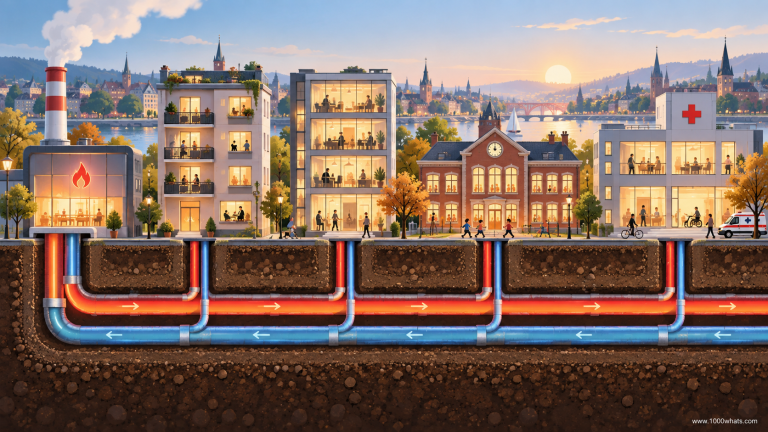
My district-heating article already introduced this possibility.
A heat network can combine:
large heat pumps,
electric boilers,
CHP,
geothermal,
industrial waste heat,
and:
thermal storage.
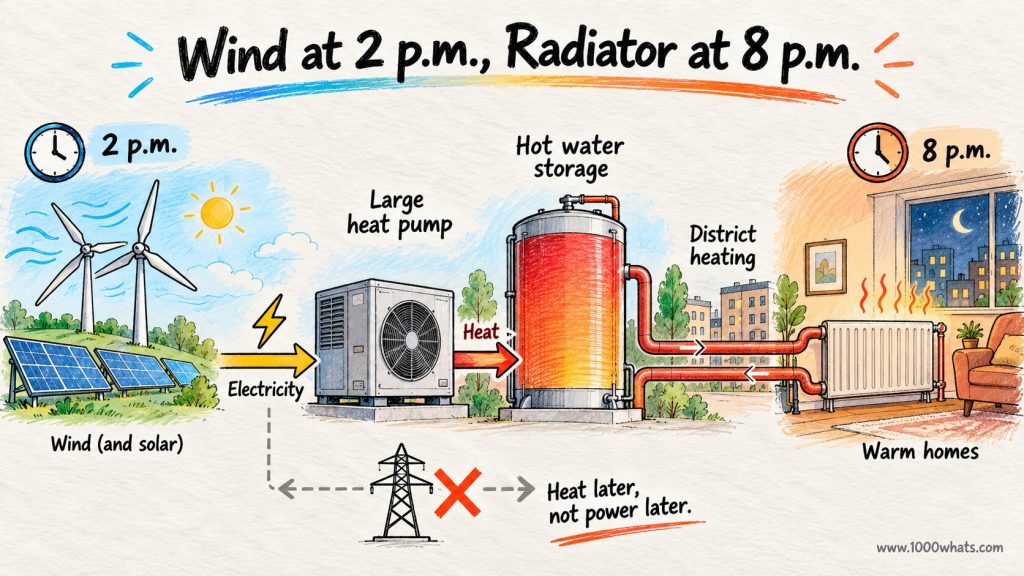
Suppose wind and solar output are abundant at 2 p.m.
Electricity costs €25/MWh.
A large heat pump runs hard.
Instead of sending all the resulting heat directly to customers, some goes into a large insulated water tank.
At 8 p.m.:
electricity costs €150/MWh.
The heat pump reduces consumption.
The tank supplies heat.
Apartments remain warm.
The power system has shifted electricity demand by several hours without storing a single electron.
This is why thermal storage is becoming increasingly valuable in district energy: heat can be shifted across hours, days and potentially seasons while the network responds more flexibly to electricity prices and renewable generation.
Sometimes the grid needs a sophisticated electrochemical battery.
Sometimes it needs:
an absurdly large thermos.
Both are engineering.
One simply photographs better at technology conferences.
And this is not theoretical
Take Helsinki.
One of the world’s largest underground thermal-storage facilities is being developed there to store heat produced during summer — including heat produced from surplus electricity — for use during winter.
Hamburg provides a smaller but wonderfully tangible example: a 2-million-liter water tank inside an energy bunker helps balance heat supply and demand while also supporting the electricity system.
These are examples of a broader shift in modern district-heating systems, where heat pumps, waste heat, renewables and thermal storage increasingly work together rather than behaving as separate technologies.
The tank is not merely storing heat.
It is connecting:
the heat market to the electricity market.
That is much more interesting.
Thermal storage can also go underground
A tank has an obvious problem.
Eventually you need:
a very large tank.
But beneath our feet is an enormous amount of material with useful thermal properties.
So engineers store heat underground.
Different forms of underground thermal storage can use aquifers, boreholes and other subsurface formations.
And “later” can mean much later.
Summer heat can potentially be stored for winter.
Winter cold can be stored for summer cooling.
Now we are no longer shifting:
2 p.m. → 8 p.m.
We are potentially shifting:
July → January.
Lithium-ion batteries are excellent at many things.
Charging one in July and politely asking it to wait until January is not usually the business case.
Thermal storage can operate on very different timescales because the storage medium and end use are different.
Seasonal storage changes the question completely
Imagine a neighborhood with abundant solar thermal energy in summer.
Unfortunately, summer is precisely when nobody desperately needs space heating.
This is a recurring energy-system joke:
the resource and the demand have declined to coordinate calendars.
Seasonal thermal storage attacks that mismatch.
Collect surplus heat during warm months.
Store it underground.
Recover some of it during winter.
The losses, geology, temperatures, drilling costs and system design determine whether this makes sense.
But conceptually, the idea is extraordinary:
summer becomes part of the winter heating system.
This is not electricity storage with a different logo.
It solves a different storage problem.
And then there is thermochemical storage
So far we have stored thermal energy by:
changing temperature,
or:
changing phase.
There is a third major family.
Thermochemical storage.
Here energy is stored through reversible chemical reactions.
Heat drives a reaction during charging.
The resulting materials can be stored.
Later, the reverse reaction releases heat.
This can offer high energy density and, depending on the chemistry and system design, potentially very low losses during long storage periods because the energy is stored chemically rather than simply trying to keep a hot object hot.
Which sounds considerably more sophisticated than our tank of water.
It is.
It is also generally less commercially mature.
Energy technology contains both extremes:
Tank.
and:
reversible molecular chemistry.
Both somehow end up in the same PowerPoint slide.
So there are really three main thermal-storage tricks
| Type | What stores the energy? | Simple example | Main idea |
|---|---|---|---|
| Sensible heat | Temperature change | Hot water, rocks, molten salt | Make material hotter or colder |
| Latent heat | Phase change | Ice, phase-change materials | Melt or freeze material |
| Thermochemical | Reversible reaction | Salt-based systems | Store energy through chemical change |
The technologies look different.
The job is the same:
separate the moment thermal energy becomes available from the moment somebody needs it.
⚡ “Thermal storage does for heat what batteries do for electricity: it gives energy permission to arrive at the wrong time.”
Thermal storage is not automatically efficient
Here is where we need to avoid the usual energy-transition magic trick.
Storage does not make energy free.
A thermal store loses energy over time.
Hot things cool.
Cold things warm.
Thermodynamics remains employed.
Insulation reduces those losses but does not abolish them.
Pumps consume electricity.
Heat exchangers need temperature differences.
Some storage materials degrade.
Molten salts create corrosion and freezing challenges.
Underground storage depends heavily on geology.
Phase-change materials can have cycling and heat-transfer issues.
Thermochemical systems add complexity.
And if you convert:
electricity → heat → electricity
you may incur much larger round-trip losses than with a conventional battery, depending on the technology.
So the useful question is not:
Is thermal storage more efficient than batteries?
That is too vague.
The useful question is:
What form of energy do I need at the end?
If you need electricity later, electrical storage may be ideal.
If you need 60°C water later, storing thermal energy may avoid doing unnecessary gymnastics.
The destination matters.
Heat pumps make this much more interesting
Suppose you have one unit of electricity.
An electric resistance heater can turn roughly:
1 kWh electricity → 1 kWh heat
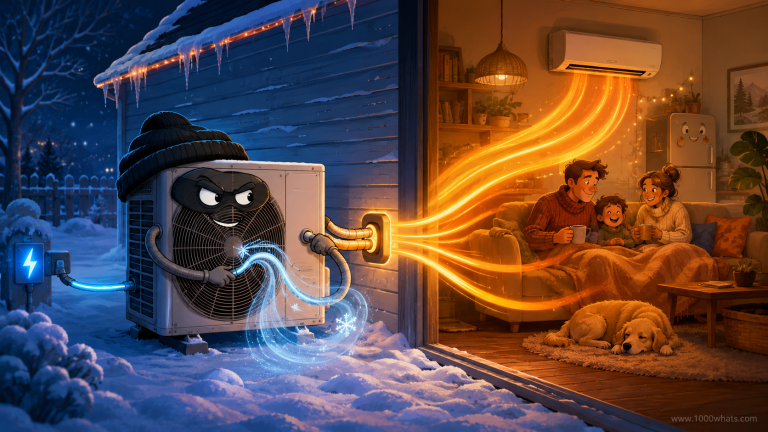
But as my heat-pump explainer shows, a heat pump can use one unit of electricity to deliver several units of heat by moving thermal energy from the environment.
So imagine:
cheap electricity → heat pump → hot-water storage
Now the thermal store is not merely shifting electricity demand.
The heat pump can also deliver multiple units of useful heat for each unit of electrical input.
And thermal storage gives the heat pump freedom to choose when to consume that electricity.
That combination is powerful:
efficient electrification + storage + flexible operation.
The effect is already visible at power-system level. Heat pumps paired with thermal storage and digital controls can shift consumption away from peak periods, helping integrate renewable generation while reducing the need for additional peak generation and grid capacity.
A heat pump makes heat efficient.
Thermal storage makes the timing flexible too.
Now we have something interesting.
Thermal storage can also save energy we were about to throw away
Consider an industrial plant.
A process generates substantial waste heat at noon.
Another process needs heat at 6 p.m.
Without storage:
no match.
The noon heat may be rejected.
The evening process burns fuel.
Excellent work, everyone.
With thermal storage:
waste heat → storage → later process heat
Now storage solves not only a timing problem but also an energy-efficiency problem.
This connects directly to something already hiding inside our CCGT article: useful energy often exists in streams we casually label “waste” simply because their temperature, location or timing is inconvenient.
Storage can fix the timing part.
Thermal storage versus battery storage
The two technologies overlap.
They do not compete everywhere.
| Question | Battery storage | Thermal energy storage |
|---|---|---|
| What usually comes out? | Electricity | Heat or cooling; sometimes electricity |
| Best when final need is… | Electrical | Thermal |
| Typical storage medium | Electrochemical cells | Water, ice, salt, rock, PCM, underground formations |
| Common role | Arbitrage, grid balancing, backup, ancillary services | Heating/cooling shifting, industrial heat, district energy, CSP |
| Can provide electricity directly? | Yes | Usually no |
| Seasonal storage? | Poor fit for mainstream Li-ion economics | Potentially attractive in some thermal systems |
| Needs an inverter? | Usually | Not necessarily |
The most important distinction is not:
lithium versus water.
It is:
What service are we storing energy for?
A battery is wonderfully versatile because electricity is wonderfully versatile.
Thermal storage is less versatile.
But specialization can be cheap.
A hot-water tank is terrible at powering your laptop.
Fortunately, your district-heating operator was not planning to ask it.
Why thermal storage matters more in a renewable-heavy grid
Wind and solar change the timing and price of electricity.
Some hours can have abundant low-cost generation.
Other hours become tighter.
At the same time, heating and cooling represent enormous loads.
If those thermal loads operate whenever they please, electrification can add substantial peak electricity demand.
If some can shift through thermal storage, the grid gains flexibility.
That can mean:
- heating water before the evening peak;
- making ice before afternoon cooling demand;
- charging district-heating storage during cheap electricity hours;
- storing industrial heat between process cycles;
- absorbing surplus renewable generation;
- reducing peak heat-pump electricity demand;
- storing summer heat for winter use in suitable systems.
That last point matters.
The IEA’s latest work on renewable district energy explicitly identifies thermal storage as a way to shift heat across hours, days or even seasons, helping integrate variable renewable energy and connect heat systems more intelligently with electricity markets.
We spend a lot of time asking:
Where will we build enough batteries?
A complementary question is:
How much electricity demand never needed an electrical battery in the first place?
So, what is thermal energy storage in one sentence?
Thermal energy storage captures energy as heat or cold in a material or system so it can be used later for heating, cooling, industrial processes or — in some systems — electricity generation.
But the better mental model is:
a battery for temperature.
Not literally.
Please do not connect jumper cables to your hot-water tank.
Conceptually.
Final thoughts
Energy-storage discussions have a strange habit.
We start with the word:
energy
and immediately begin discussing:
electricity.
But civilization does not consume electricity merely for the emotional satisfaction of moving electrons.
We use electricity to get services.
Light.
Motion.
Computing.
Heating.
Cooling.
Hot water.
Industrial processes.
And once the final service is thermal, storing electricity is no longer automatically the obvious answer.
Sometimes a battery is exactly right.
Sometimes the smarter solution is molten salt at several hundred degrees.
Sometimes it is ice.
Sometimes it is a geological formation.
And sometimes civilization’s advanced energy-storage technology is:
a really, really big tank of hot water.
That sounds disappointingly simple.
It shouldn’t.
The energy transition will not be won by choosing the most futuristic technology.
It will be won by matching the right technology to the right problem.
If tomorrow’s problem is:
I need electricity at 8 p.m.
store electricity.
If tomorrow’s problem is:
I need heat at 8 p.m.
perhaps store the heat.
Thermodynamics has already done enough work.
There is no prize for making it take the scenic route.
Until next time, stay curious! 😎
Discover more from 1000whats
Subscribe to get the latest posts sent to your email.