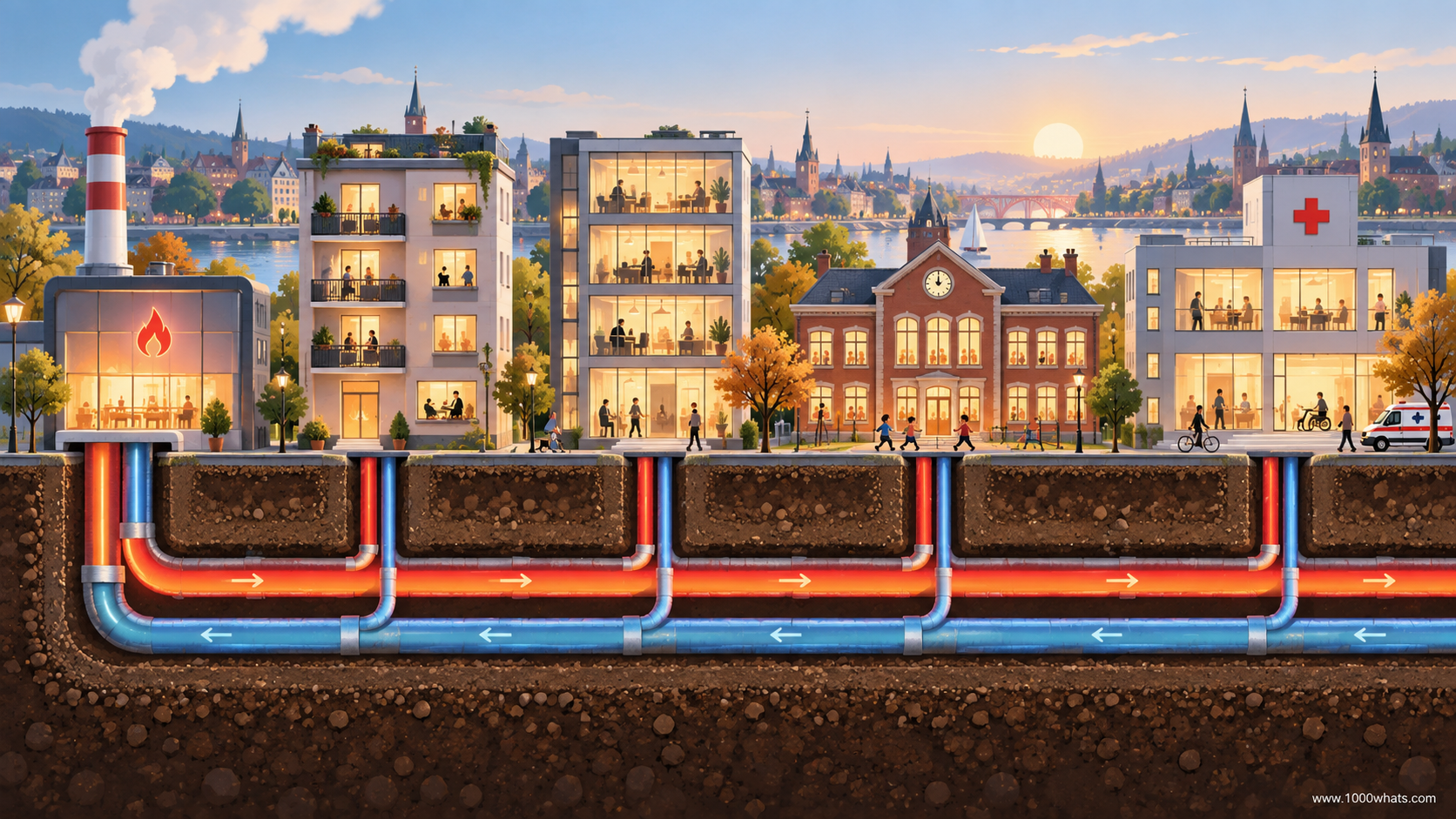
Somewhere underneath a city street, there may be a pipe full of hot water.
It passes an apartment building.
Then an office.
Then a school.
Then a hospital.
None of those buildings necessarily has to produce all of its own heat.
They can simply take heat from the pipe.
Which raises a wonderfully simple question:
If thousands of buildings need heat, why must thousands of buildings each make it separately?
Welcome to 1000whats — where today we discover that heating a city can look suspiciously like building another utility.
Electricity has a grid.
Natural gas has a grid.
Water has a network.
And in many cities:
heat has one too.
Because apparently civilization looked at hot water and eventually decided it deserved infrastructure.
That is district heating.
⚡ “District heating does not tell you where heat comes from. It tells you how heat gets to everyone.”
That distinction is the entire story.
And it gets much stranger than one large boiler.
First, forget the giant boiler
When people hear “district heating,” they often picture one enormous boiler somewhere outside the city burning fuel and sending hot water toward apartment blocks.
Preferably surrounded by concrete chimneys and buildings that look like they were designed by somebody deeply suspicious of windows.
That certainly exists.
But it is not what defines district heating.
The defining feature is the network.
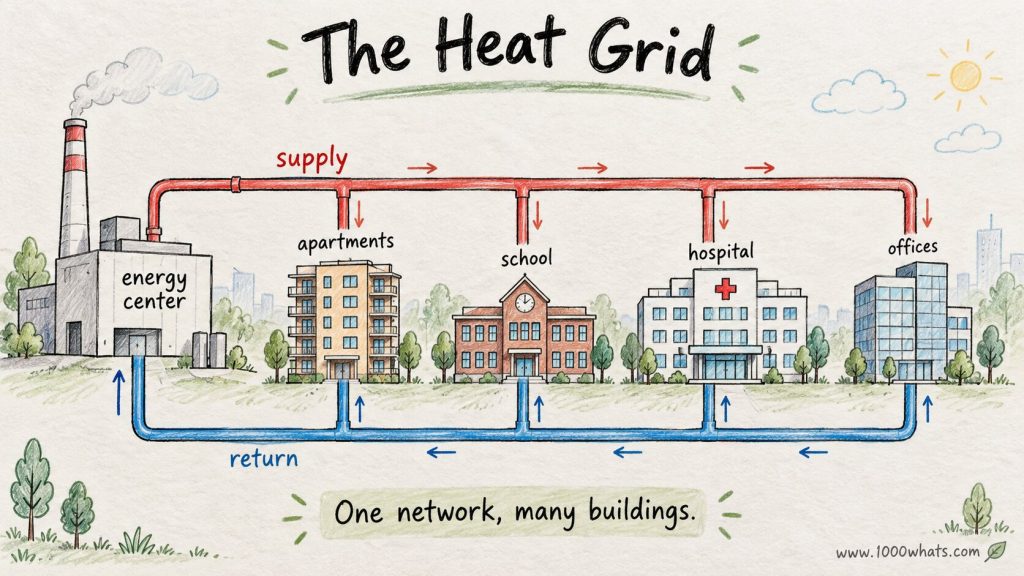
A district heating system typically has three basic parts:
heat source → pipe network → buildings
Heat is produced—or recovered—somewhere.
Hot water, or in some older systems steam, moves through insulated pipes.
Buildings extract useful heat.
Cooler water returns through another pipe.
The cycle starts again.
Conceptually:
central heat source → hot supply pipe → buildings → cooler return pipe → heat source
That is it.
Congratulations.
We have invented a grid for hot water.
Everything else gets more interesting from there.
What actually enters the building?
Usually not the district-heating water itself.
This is an important detail.
The network pipe reaches the building and typically connects through a heat exchanger.
Heat moves from the district-heating water into the building’s own heating circuit.
The fluids remain separate.
So the system is effectively saying:
You keep your water.
I’ll give you my heat.
A remarkably mature relationship between two plumbing systems.
The building can then use that transferred energy for:
- radiators;
- underfloor heating;
- domestic hot water;
- ventilation heating;
- other thermal loads.
After giving up some of its energy, the district-heating water leaves the building cooler and returns toward the heat source.
Our existing article on heat explains the underlying physics: heat is energy transferred because of a temperature difference.
District heating simply looked at that physics and said:
Fine. Let’s do it for 50,000 apartments.
But where does all the heat come from?
This is where district heating becomes much more interesting than the name suggests.
A network does not particularly care what heated the water.
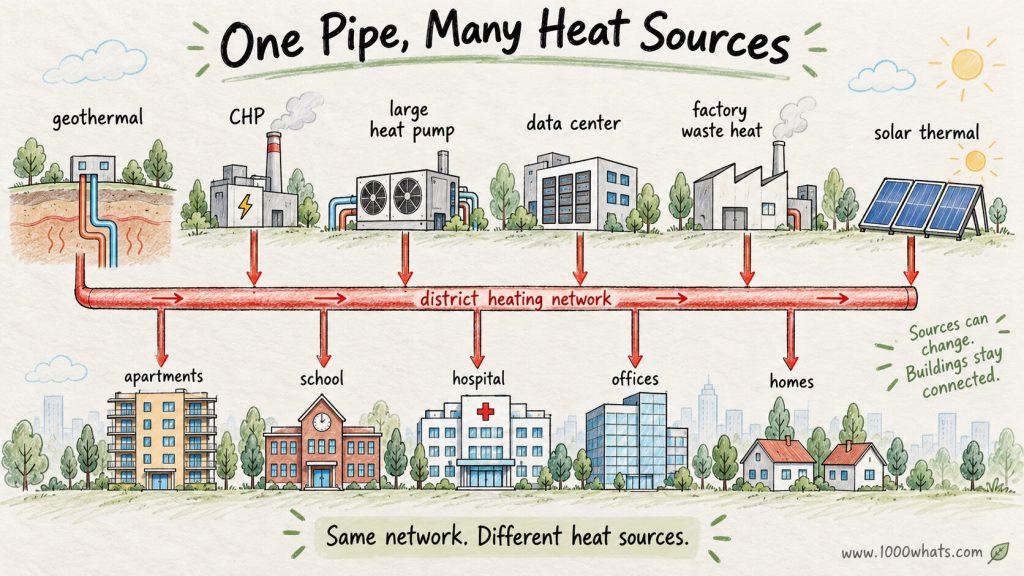
Possible sources include:
- natural-gas boilers;
- coal boilers in older systems;
- combined heat and power plants;
- biomass;
- geothermal energy;
- large heat pumps;
- solar thermal;
- waste incineration;
- industrial waste heat;
- data centers;
- sewage systems;
- rivers, lakes, or seawater through heat pumps;
- thermal storage.
Yes.
Sewage.
We will politely call it a low-temperature heat source and move on.
The IEA’s 2026 Renewables in District Energy report emphasizes exactly this flexibility: existing networks can integrate renewable energy, geothermal resources, large-scale heat pumps, bioenergy, solar thermal, recovered heat, and thermal storage.
And that gives district heating a peculiar advantage.
You can change the heat source without changing every building.
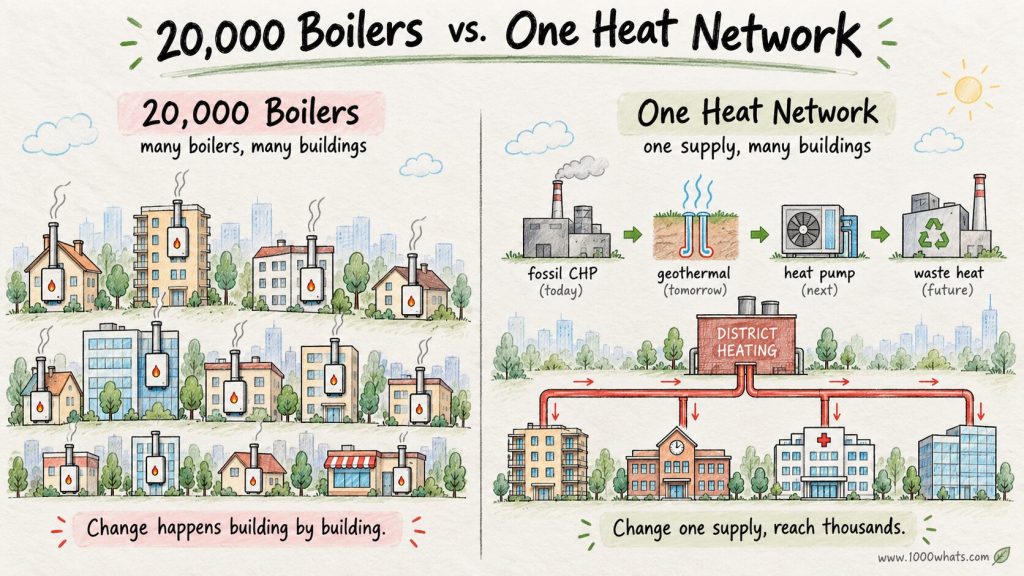
Imagine 20,000 apartments each heated by an individual gas boiler.
To change the heating technology, you potentially need to visit:
20,000 apartments.
Twenty thousand doors.
Twenty thousand installations.
Twenty thousand conversations beginning with:
“It should only take about two hours.”
And at least several thousand people who were definitely told you were coming but somehow had no idea.
Now imagine those same buildings are connected to a district heating network.
Change what feeds the network and thousands of customers can inherit that change upstream.
The pipes remain.
The heat source evolves.
⚡ “A district heating network separates the question ‘How do we make heat?’ from ‘How do we deliver heat?’”
That is a surprisingly powerful piece of infrastructure.
The classic version: burn fuel centrally
Let’s start with the traditional model.
A central heating plant burns:
coal,
natural gas,
oil,
biomass,
or another fuel.
The resulting thermal energy heats water.
Pumps move that hot water through the city.
Buildings take heat.
Water returns.
Simple.
Centralization can make operation and pollution control easier than maintaining thousands of individual combustion systems.
But there is an obvious problem.
If the central plant burns fossil fuels, the district heating system is still fossil-fueled.
Pipes are not automatically green.
Painting them green would not help.
Putting a leaf on the annual report would help even less.
This matters because the global district-heating system remains surprisingly carbon-intensive.
According to the IEA’s latest district-energy assessment, coal still supplies roughly half of global district heat production, while natural gas contributes close to another third. Renewables currently provide only around 7%.
So district heating is not inherently clean.
But it can be unusually upgradeable.
And that is where the story gets interesting.
CHP made the system smarter
Now imagine a power plant.
It burns fuel.
Produces electricity.
And inevitably produces heat.
A conventional thermal power plant may reject a substantial amount of that thermal energy into cooling systems or the environment.
Meanwhile, a few kilometers away, thousands of people are burning another fuel because they would quite like some heat.
There is a point in every engineering story where somebody looks at these two facts long enough and says:
Hang on.
Enter combined heat and power, or CHP.
Instead of treating the thermal energy as unwanted waste, the plant supplies useful heat into a district network while producing electricity.
I explain that mechanism in What Is Cogeneration (CHP)? The Power of Two.
The energy chain becomes:
fuel → electricity + useful heat
rather than:
fuel → electricity + discarded heat
Which is generally preferable to:
throw heat away → burn more fuel somewhere else to make heat.
Thermodynamics appreciates the effort.
But modern district heating is starting to move beyond even that model.
The really interesting heat may already exist
Cities throw away extraordinary amounts of thermal energy.
Factories reject heat.
Data centers reject heat.
Wastewater carries heat.
Metro systems produce heat.
Refrigeration plants reject heat.
Power plants reject heat.
Then nearby buildings burn additional fuel to create…
heat.
Energy systems occasionally possess a magnificent talent for solving one problem while carefully preserving an identical problem next door.
District heating provides a way to connect those two sides.
Suppose a data center needs to remove heat from thousands of servers.
That heat may not be hot enough to send directly into an older district network.
Fine.
A large heat pump can raise its temperature.
Now:
data-center waste heat → heat pump → district network → apartments
The server still needs cooling.
The apartment still needs heating.
But instead of treating those as unrelated problems, the energy system lets one help solve the other.
Which means the internet may eventually help heat your apartment.
Your cat videos have finally found a productive use.
More accurately, the electricity consumed by the servers produces low-grade heat that can potentially be recovered—but that sentence is much less satisfying.
This is where district heating starts feeling less like a boiler network and more like urban energy recycling.
Large heat pumps change the game
A household heat pump might heat one home.
Now make the heat pump enormous.
Not “slightly larger.”
Industrial-building-with-pipes-coming-out-of-it enormous.
Instead of extracting heat from the air outside one house, it can extract thermal energy from:
a river,
the sea,
sewage,
industrial cooling water,
a data center,
or another low-temperature source.
Then it raises that heat to a useful network temperature.
The IEA’s Heat Pump Monitor 2026 identifies district heating as an important growth frontier for large heat pumps because they can exploit low-temperature heat sources while also connecting heating demand to the electricity system.
This is the same basic physics we explored in our heat-pump explainer.
The machine does not need to create all the heat from electricity.
It moves existing heat uphill in temperature.
At city scale, that becomes very interesting.
A heat pump heating one house is an appliance.
A heat pump heating part of a city is infrastructure.
Same thermodynamic trick.
Considerably more plumbing.
Geothermal becomes much more useful with a heat network
My recent geothermal article focused partly on electricity.
But electricity is not always the smartest thing to make from underground heat.
Suppose geothermal water is:
80°C.
That is extremely useful for heating.
But relatively unimpressive for conventional electricity generation.
You could insist on making electricity from it first.
Thermodynamics would prefer that you stop trying to impress it.
A district-heating network can use that thermal resource directly.
Instead of:
geothermal heat → electricity → electric heater → heat
you may be able to do:
geothermal heat → district network → building
Fewer conversions.
Less thermodynamic showing off.
Potentially much better use of the resource.
Sometimes the clever engineering solution is not doing three unnecessary things first.
This is why district heating and geothermal energy fit together so naturally.
Temperature turns out to matter enormously
Older district-heating systems often operated at relatively high temperatures.
That made sense when heat came from:
coal plants,
gas boilers,
or high-temperature CHP.
But high network temperatures create disadvantages.
Heat losses increase.
Some renewable and waste-heat sources become harder to integrate.
Heat pumps need to work harder to raise low-temperature heat to the network temperature.
So modern systems increasingly aim for lower supply temperatures, where building efficiency and radiator systems allow it.
That sounds like a small engineering tweak.
It is not.
Lowering network temperature can unlock completely different heat sources.
A 35°C waste stream is almost useless to a network demanding extremely hot water.
To a low-temperature network combined with a heat pump?
Now we have something to talk about.
The IEA has highlighted low-temperature district energy as a way to increase the use of heat pumps, geothermal energy, solar thermal, and secondary heat sources such as data-center and industrial waste heat.
The temperature of the pipe, it turns out, can decide whether something is:
waste
or:
fuel.
Not bad for a thermostat setting.
The generations of district heating
Engineers sometimes describe the evolution of district heating in “generations.”
Because apparently even hot water gets generational labels.
| Generation | Typical idea | What changed |
|---|---|---|
| 1st | Steam networks | Very high temperatures, high losses |
| 2nd | Pressurized hot water | Better than steam, still hot |
| 3rd | Lower-temperature hot water | More efficient distribution |
| 4th | Low-temperature smart networks | Easier integration of renewables and waste heat |
| Emerging concepts | Very-low-temperature networks | Buildings may use local heat pumps to raise temperature |
Thankfully, nobody appears to have named them:
Boomer Heat
Gen X Heat
Millennial Heat
and:
Gen Z Low-Temperature Smart Thermal Network.
Yet.
The important trend is not the label.
Nobody needs to stand beside a radiator wondering whether they are currently experiencing third- or fourth-generation warmth.
It is this:
district heating is gradually moving from “one hot plant feeding everyone” toward “a network collecting useful thermal energy from many places.”
That is a much more interesting system.
A real-world example: Denmark
If district heating sounds like a niche technology, Denmark is a useful corrective.
The IEA notes that district heating already supplies around 65% of heat demand in Danish buildings.
At that point, district heating is not really an alternative heating technology anymore.
It is simply:
how heating works.
And that changes how you think about the entire system.
In many countries, heating is treated as something belonging to the building:
my boiler,
my furnace,
my heat pump.
In a district-heating city, heat becomes much more like electricity or water:
a service arriving through infrastructure.
You do not particularly care which generator produced the electrons currently entering your television.
Similarly, a district-heating customer does not necessarily need to care whether today’s heat originated from:
a CHP plant,
a geothermal well,
a large heat pump,
waste heat,
or thermal storage.
What matters at the radiator is:
hot enough, reliable enough, affordable enough.
Nobody has ever hugged a radiator because of its elegant upstream energy mix.
But people become remarkably interested in energy policy the moment it goes cold.
District heating can also behave like energy storage
Now things become even stranger.
Hot water stores energy.
A lot of it.
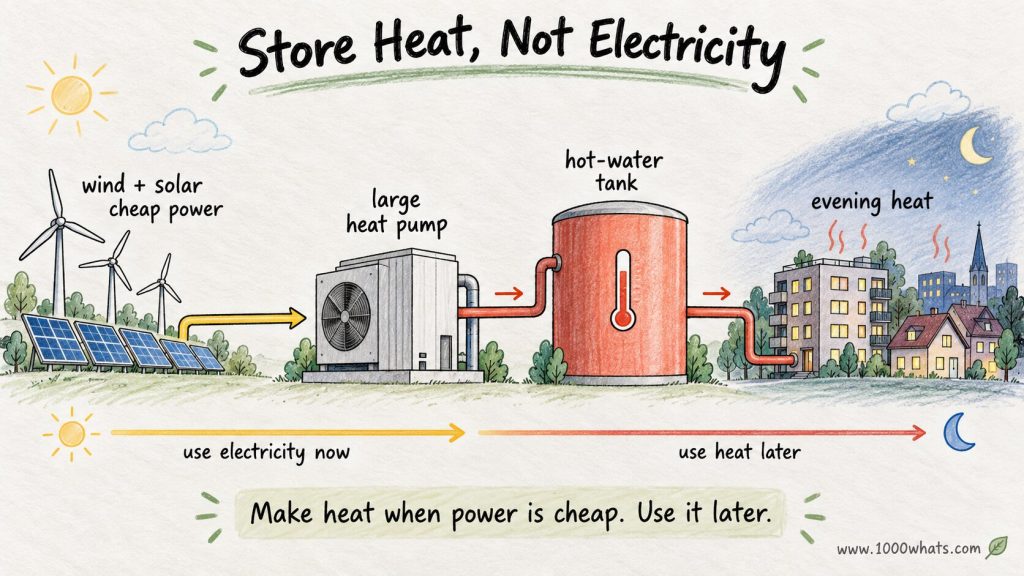
District-heating systems can therefore use large hot-water tanks or other forms of thermal energy storage.
Imagine electricity prices are very low at 2 p.m. because wind and solar generation are abundant.
A large heat pump runs harder.
Instead of immediately sending all that heat into buildings, some goes into a giant hot-water tank.
At 7 p.m., electricity demand rises.
The heat pump can reduce consumption.
Stored heat keeps flowing to customers.
So we have effectively moved energy through time.
Not with:
lithium,
electrons,
cobalt,
a battery-management system,
or a startup promising to revolutionize storage by 2029.
With:
hot water.
It is perhaps the least cyberpunk energy-storage technology imaginable.
And it works.
From a power-market perspective, this is one of the most interesting features of modern district heating.
The heating system can become a flexible electricity consumer.
That creates a bridge between:
the power grid
and:
the heat network.
Wind at 2 p.m. can heat your apartment at 8 p.m.
This deserves a simple example.
Suppose a district-heating operator has:
- a large electric heat pump;
- a hot-water storage tank;
- flexible operating capability.
At 2 p.m.:
wind and solar output are high.
Electricity price:
€25/MWh
The heat pump runs strongly.
The storage tank heats up.
At 8 p.m.:
electricity price:
€150/MWh
The operator reduces heat-pump consumption.
Stored thermal energy supplies part of the heat demand.
The building resident notices:
nothing.
The radiator remains warm.
That is the point.
The IEA notes that large heat pumps in heat networks can absorb surplus renewable electricity and shift thermal output over time, strengthening the connection between heat and power systems.
A district-heating network can therefore become something more than heating infrastructure.
It can become a flexibility asset.
Or, put differently:
sometimes the grid does not need another battery.
Sometimes it needs an absurdly large thermos.
So why don’t we district-heat everything?
Because pipes are expensive.
And geography is merciless.
District heating works best when many customers need significant heat within a reasonably compact area.
Think:
dense cities,
apartment blocks,
hospitals,
universities,
industrial zones,
large commercial districts.
Now imagine a rural area where houses are separated by hundreds of meters.
You would need enormous lengths of pipe to serve relatively little heat demand.
Heat would also be lost along the way.
At some point you have built seven kilometers of insulated pipe, three pumping stations, and a small administrative department so that six houses can share hot water.
Suddenly:
one heat pump per house
starts looking rather sensible.
This gives district heating one of its most important economic concepts:
heat density.
How much useful heat demand exists per unit of network length or area?
Dense demand?
Potentially excellent.
Sparse demand?
Potentially terrible.
You cannot solve that with a clever slogan.
You need a map.
This is unfortunate because slogans are considerably cheaper than pipes.
Heat networks are natural local monopolies
There is another interesting economic problem.
Imagine two companies competing for your heating business.
Company A digs up the street and installs two enormous insulated pipes.
Company B then arrives and says:
Excellent. We will dig up the same street and install another pair beside them.
Company C announces a disruptive app-based heating platform and begins digging too.
Residents start throwing things from balconies.
Nobody wants this.
District-heating networks therefore have strong natural-monopoly characteristics, much like electricity or gas distribution grids.
Duplicating the physical network usually makes little economic sense.
That creates regulatory questions:
Who owns the network?
Who sets tariffs?
Can third-party heat producers access it?
How are customers protected?
Who pays for expansion?
Who carries fuel-price risk?
Who finances decarbonization?
Suddenly our innocent hot-water pipe has become infrastructure regulation.
Energy has a habit of doing that.
Give engineers a pipe.
Eventually lawyers arrive.
District heating can be efficient and still be expensive
These are not contradictions.
A technically efficient system can have:
high capital costs,
expensive fuel,
poor tariff design,
old infrastructure,
high financing costs,
or inefficient operation.
Likewise, an old network can lose significant heat even if the central plant itself is efficient.
So evaluating district heating requires separating several questions:
Production efficiency: How efficiently is heat produced?
Network efficiency: How much heat is lost during distribution?
System economics: How much does the infrastructure cost to build and maintain?
Fuel exposure: What energy sources determine operating costs?
Customer economics: What tariff does the consumer actually pay?
One efficiency percentage cannot answer all of them.
Unfortunately, energy systems have repeatedly failed to fit inside one convenient percentage.
Excel remains disappointed.
And there is a lock-in problem
District heating’s biggest strength can also become its weakness.
Infrastructure lasts.
For decades.
Which is excellent when you like the infrastructure.
Less excellent when you discover that your brilliant 1984 heating strategy is still physically embedded underneath every major road in the city.
If a city builds a network around a coal-fired CHP plant, that network can become deeply tied to the plant.
But remember the earlier distinction:
the network is not the heat source.
A smart transition strategy can preserve useful pipes while changing what feeds them.
Coal CHP today.
Large heat pump tomorrow.
Geothermal later.
Industrial waste heat from another direction.
Thermal storage beside it.
The challenge is designing the network so that future sources can actually work with its temperatures, hydraulics, economics, and customer demand.
That is why decarbonizing district heating is not simply:
replace boiler.
It is a system redesign.
The pipes may be old.
The energy system using them does not have to be.
How big is district heating already?
Bigger than most people realize.
According to the IEA’s 2026 assessment:
- district heating serves more than 600 million people worldwide;
- global networks extend for more than one million kilometers;
- district heat delivery has increased by roughly 35% since 2010;
- district energy supplies around 10% of global final energy consumption for heat.
More than one million kilometers of pipes.
So no, this is not a startup concept awaiting Series A funding and a minimalist logo.
We already built it.
The interesting question is what happens to the enormous network already underground.
Because today much of it still runs on fossil energy.
Tomorrow, those same pipes could distribute a much stranger mixture of heat sources.
Buildings matter too
There is one final piece people often miss.
You cannot modernize a heat network while pretending the buildings attached to it do not exist.
Poorly insulated buildings need more heat.
Old radiators may require higher water temperatures.
Higher network temperatures make some renewable and low-grade heat sources harder to use efficiently.
So building renovation and district-heating modernization interact.
Better insulation can reduce heat demand.
Larger radiators or underfloor systems can operate at lower temperatures.
Lower return temperatures improve network performance.
Large heat pumps become more efficient.
Waste heat becomes easier to use.
The building and the network are one thermal system whether the ownership documents admit it or not.
Unfortunately, the physics has never shown much respect for property boundaries.
The European Commission’s current definition of a zero-emission building explicitly recognizes efficient district heating and cooling as one route for supplying clean energy to buildings.
District heating vs. individual heat pumps
This is not necessarily a winner-takes-all competition.
| District heating | Individual heat pump | |
|---|---|---|
| Infrastructure | Shared network | Building-level system |
| Best geography | Dense heat demand | Works in many building types |
| Heat sources | Potentially many | Usually ambient/ground/water heat |
| Equipment location | Much is centralized | At each building |
| Waste-heat integration | Excellent potential | Usually limited |
| Thermal storage | Can be very large | Usually smaller/local |
| Network losses | Yes | No district-network losses |
| Upfront civil works | Potentially very high | Usually lower network requirement |
| System flexibility | Can be substantial | Can also provide flexible demand |
The correct question is not:
Which technology is better?
It is:
Which thermal architecture makes sense here?
Dense city center beside a river, data center, metro system, and industrial waste heat?
District heating starts looking very interesting.
Scattered suburban homes?
Individual heat pumps may win easily.
Energy systems are irritatingly resistant to universal answers.
Consultants have nevertheless heroically continued trying to fit them into PowerPoint matrices.
District heating is really an infrastructure platform
This is the part worth remembering.
A gas boiler is a technology.
A heat pump is a technology.
A geothermal well is a resource and technology system.
A CHP plant is a generation technology.
District heating is different.
It can connect all of them.
That makes it closer to:
a platform.
Once the network exists, the city has somewhere to put useful heat.
And suddenly previously awkward resources become valuable.
A factory has surplus heat?
Connect it.
A geothermal resource is discovered?
Connect it.
A large heat pump can use river water?
Connect it.
Cheap electricity appears for several hours?
Make heat and store it.
A data center arrives?
Perhaps its cooling problem becomes somebody else’s heating source.
The pipe does not care.
It does not follow energy Twitter.
It has no technology preference.
It has one job:
Bring heat.
That may be district heating’s most important feature.
⚡ “The future of district heating may be less about producing heat centrally and more about collecting useful heat wherever the city happens to have it.”
So, what is district heating in one sentence?
District heating is a centralized thermal network that produces or collects heat, distributes it through insulated pipes to multiple buildings, and returns cooler water to be heated again.
But the better mental model is:
a grid for heat.
Once that clicks, everything else becomes easier to understand.
Final thoughts
For most of us, heating feels private.
Your apartment has a radiator.
Your house has a boiler.
Your neighbor has a heat pump.
And somebody in the building is permanently convinced everyone else is stealing their heat.
The machine belongs to the building.
District heating changes the scale of the question.
Instead of asking:
How should this building make heat?
it asks:
Where does this city already have useful heat, and how do we move it to the buildings that need it?
That can mean a gas boiler.
But increasingly it can also mean geothermal water, a giant heat pump, industrial waste heat, a data center, solar thermal, thermal storage, or several of them working together.
And that is why an old technology suddenly looks modern again.
The revolutionary part may not be the machine making the heat.
It may simply be having a pipe available when a better source of heat comes along.
One million kilometers of infrastructure.
Six hundred million people.
Geothermal wells.
Giant heat pumps.
Data centers.
Electricity markets.
Thermal storage.
Urban planning.
Regulation.
Decarbonization.
And underneath all of it, the basic technology remains gloriously unimpressive:
hot water in a pipe.
Until next time, stay curious! 😎
Discover more from 1000whats
Subscribe to get the latest posts sent to your email.