Your refrigerator and your home heating system may be doing basically the same job.
That sounds wrong.
One makes things cold.
The other makes things warm.
One protects cheese.
The other protects you from January.
But underneath the plastic, pipes, fans and marketing brochures, they are playing the same thermodynamic game:
move heat from one place to another.
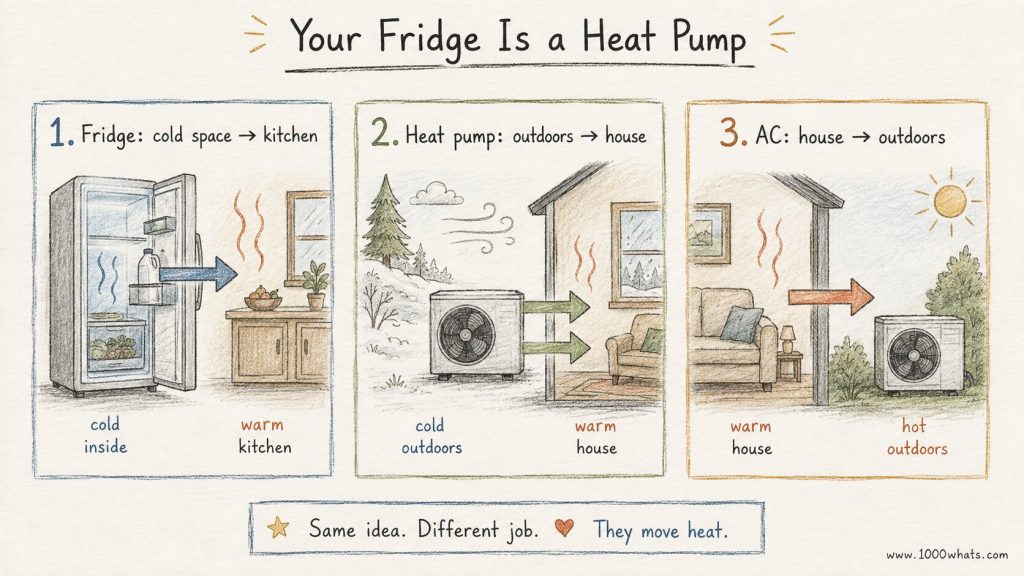
A refrigerator moves heat from inside the fridge into your kitchen.
An air conditioner moves heat from your house to the outdoors.
A heat pump can do exactly that—and then reverse direction and bring heat into your house.
Welcome to 1000whats — where today your refrigerator gets promoted to energy-transition technology.
And things are about to get slightly weird.
Because a heat pump can use:
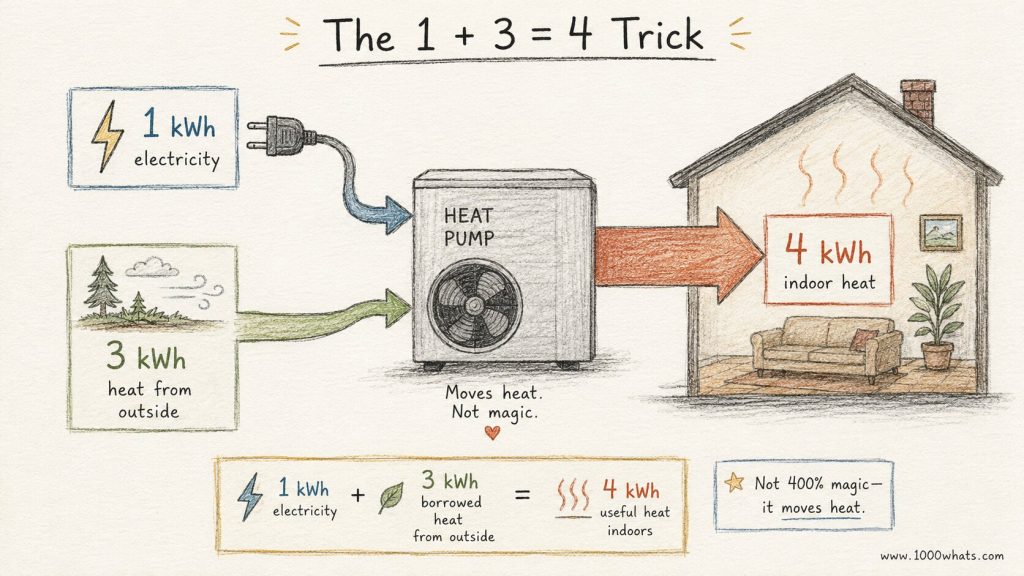
1 kWh of electricity
and deliver something like:
3 or 4 kWh of heat.
No perpetual-motion machine.
No violation of physics.
No suspicious extension cord plugged directly into the universe.
The machine simply understands something we often forget:
you do not have to make heat if you can move heat that already exists.
⚡ “A boiler makes heat. A heat pump goes outside and steals it.”
First problem: How can there be heat outside when it is cold?
This is where intuition gets in the way.
Imagine it is 5°C outside.
You walk outdoors.
Cold.
Definitely cold.
Surely there is no useful heat out there.
Except there is.
Temperature is not an on/off switch between heat exists and heat does not exist.
Outdoor air at 5°C still contains thermal energy.
So does air at 0°C.
So does air well below freezing.
Absolute zero is around −273.15°C. That is the point where our ordinary intuition about available thermal motion finally gets something resembling permission to say, “Okay, now we are really cold.”
Your heat pump does not need the outdoor air to feel warm to you.
It needs it to contain energy that can be transferred.
And it does.
We already unpacked the underlying distinction in our article on heat: heat is energy transferred because of a temperature difference.
A heat pump simply manipulates temperatures so that heat flows where we want it to go.
Which is considerably more clever than setting something on fire.
So what exactly is a heat pump?
A heat pump is a machine that uses energy—usually electricity—to move heat from a lower-temperature place to a higher-temperature place.
In heating mode:
outside → heat pump → inside
In cooling mode:
inside → heat pump → outside
That second version should look familiar.
It is an air conditioner.
In fact, a reversible air conditioner is a heat pump.
The distinction people make in everyday conversation is often about how the equipment is marketed or primarily used rather than some completely different physical principle.
The International Energy Agency’s explanation of heat-pump operation describes exactly this relationship: the technology works similarly to refrigerators and air conditioners, extracting heat from air, ground, water or waste-heat sources and transferring it where needed.
That means millions of people already own heat pumps without necessarily calling them that.
Your split AC unit hanging on the wall?
If it can heat as well as cool, congratulations.
There is a heat pump in your life.
But heat naturally moves from hot to cold
Correct.
Leave a hot cup of coffee on your desk and it cools.
The room does not spontaneously donate heat back into the coffee until it starts boiling.
Thermodynamics has boundaries.
Heat naturally flows from higher temperature toward lower temperature.
So if the air outside is colder than your house, how can we move heat in the opposite direction?
We cheat.
Not physics.
Just the natural direction of heat flow.
We use electricity to operate a compressor and create the temperature conditions needed to push heat uphill.
Think of water.
Water naturally flows downhill.
If you want it uphill, you use a pump.
Heat behaves differently from water, but the intuition is useful.
A heat pump spends energy to move thermal energy in the direction it would not spontaneously go.
Hence the name.
For once, the energy industry named something reasonably well.
Meet the refrigerant
The hero of this little thermodynamic robbery is a fluid called a refrigerant.
A refrigerant is useful because it can change between liquid and vapor at convenient temperatures and pressures.
And phase changes can move a lot of energy.
You have experienced the basic idea yourself.
Sweat evaporates from your skin.
Evaporation requires energy.
Some of that energy comes from your body.
You cool down.
A heat pump exploits the same broad physical principle in a controlled loop.
The refrigerant repeatedly:
evaporates → gets compressed → condenses → expands → evaporates again.
Around and around.
It is less a fuel than an energy courier.
It does not get burned.
It keeps circulating through the system, picking up thermal energy in one place and dropping it somewhere else.
The four-step heat-pump trick
Ignore the intimidating HVAC diagrams for a moment.
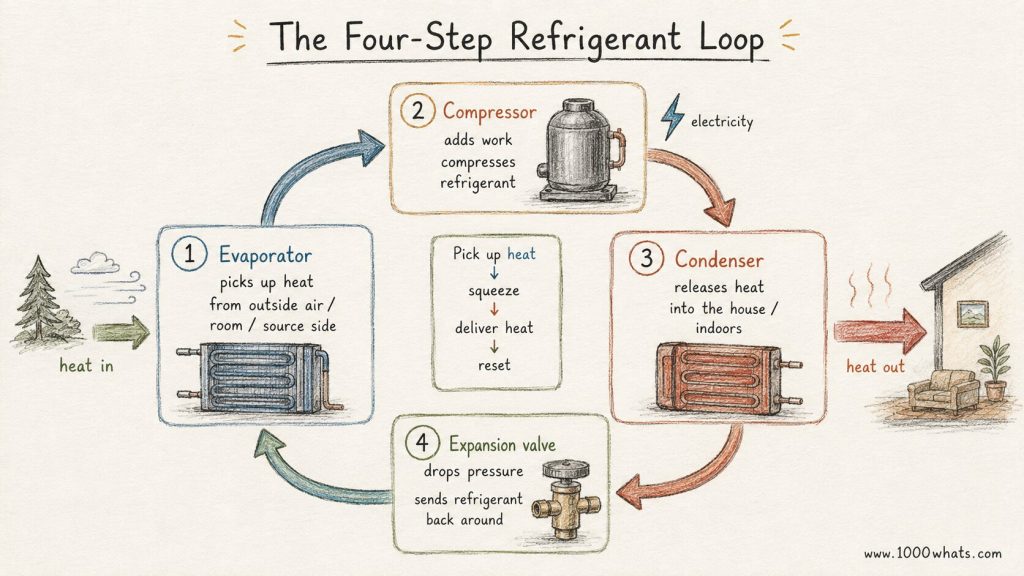
The basic cycle has four important pieces:
1. Evaporator: Pick up heat
Cold, low-pressure refrigerant passes through a heat exchanger.
It absorbs energy from the heat source—perhaps outdoor air.
As it absorbs that energy, the refrigerant evaporates.
So now we have refrigerant vapor carrying energy extracted from outside.
Even though outside felt cold.
Physics remains annoyingly smug about this.
2. Compressor: Squeeze it
Now electricity enters the story.
A compressor squeezes the refrigerant vapor.
Compression raises its pressure.
And its temperature rises dramatically.
This is the key move.
The heat pump has taken energy collected at a relatively low temperature and created a refrigerant state hot enough to transfer that energy into your building.
3. Condenser: Drop off the heat
The hot refrigerant flows through another heat exchanger.
Your heating system is cooler than the refrigerant.
So heat now naturally flows from the refrigerant into the building.
The refrigerant cools and condenses back toward liquid.
Your house gets warmer.
4. Expansion valve: Reset
The refrigerant passes through an expansion device.
Its pressure drops.
Its temperature falls.
Now it is cold enough to absorb heat from outside again.
Back to step one.
And around we go.
⚡ “The compressor does not create all the heat your house receives. It creates the conditions that allow existing heat to be moved there.”
That distinction explains the ridiculous-looking efficiency numbers.
Wait. How can a heat pump be 300% or 400% efficient?
It isn’t.
At least not in the ordinary way we use the word efficiency.
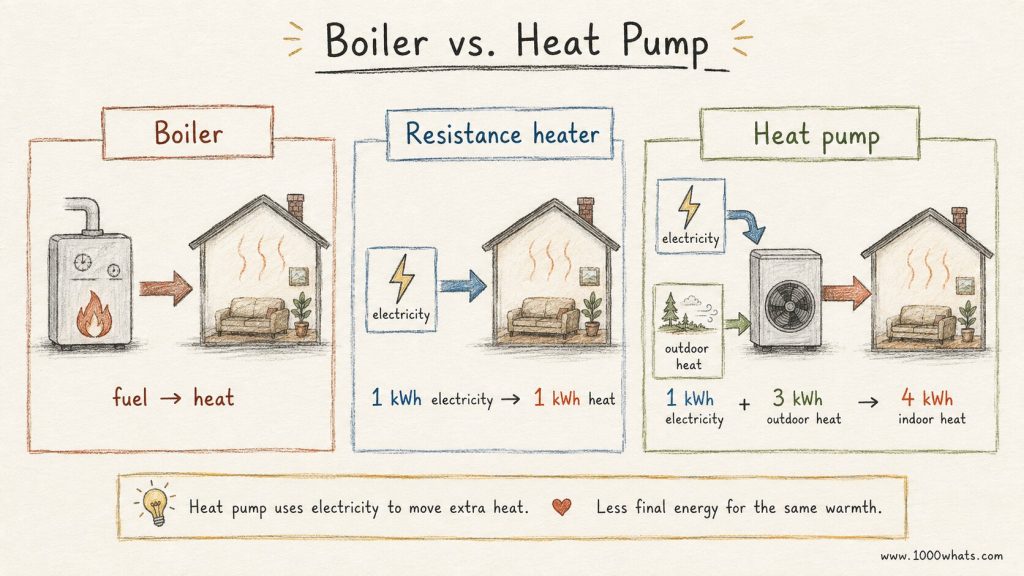
Suppose you have a simple electric resistance heater.
Electricity enters a heating element.
The element gets hot.
Roughly:
1 kWh electricity → 1 kWh heat
Very straightforward.
Now imagine a heat pump.
It uses:
1 kWh electricity
to operate the compressor, fans, pumps and controls.
But while doing that, it transfers another:
3 kWh of thermal energy
from outside.
Inside the house you receive roughly:
4 kWh of heat.
So:
1 kWh electricity + 3 kWh environmental heat = 4 kWh delivered heat
Nothing came from nowhere.
The energy balance still works.
The useful metric here is called the Coefficient of Performance, or COP.
For heating:
COP = useful heat delivered / electricity consumed
If a heat pump delivers 4 kWh of heat using 1 kWh of electricity:
COP = 4
The IEA says a typical household heat pump can have a COP around four, with output several times greater than the electrical input because most of the delivered heat is transferred rather than generated.
That is why saying a heat pump is “400% efficient” is catchy but slightly dangerous.
It sounds like somebody defeated conservation of energy.
They didn’t.
COP 4 is cleaner.
Your refrigerator has been doing this for decades
Open your refrigerator.
Cold inside.
Warm kitchen outside.
The refrigerator continuously removes heat from its interior and dumps that heat into the room.
Put your hand near the coils or warm exhaust area.
There it is.
The refrigerator is not manufacturing cold.
There is no cold factory hidden behind the yogurt.
It is removing heat.
That is a much better way to understand cooling in general.
An air conditioner does the same thing at building scale.
And a reversible heat pump simply adds a clever piece of plumbing—a reversing valve—that lets the refrigerant cycle switch direction.
Summer:
house → outside
Winter:
outside → house
Same machine.
Seasonal personality change.
Air-source, ground-source, water-source: Same trick, different victim
Heat has to come from somewhere.
The source determines the main type of heat pump.
Air-source heat pumps
These extract heat from outdoor air.
They are the most familiar type and include many split-system air conditioners used for heating.
The big advantage is obvious:
air is everywhere.
No drilling required.
The disadvantage is equally obvious:
outdoor-air temperature changes.
When it gets colder outside, extracting useful heat becomes harder and performance generally falls.
Ground-source heat pumps
A few meters underground, temperatures are much more stable than the air above.
Ground-source systems exploit that stability using buried loops that exchange heat with the ground.
This can provide excellent performance.
But somebody has to install all those pipes.
The Earth is free.
Digging into it is not.
Water-source heat pumps
Water can also provide a relatively stable thermal source where suitable groundwater, lakes or other water systems are available.
Waste-heat heat pumps
Now things become particularly interesting from an energy-system perspective.
Factories.
Data centers.
Wastewater.
Industrial processes.
District-energy networks.
Many systems continuously reject low-temperature heat that is not hot enough to be directly useful.
A heat pump can upgrade some of that thermal energy to a useful temperature.
Suddenly:
waste → resource.
Energy engineers enjoy this kind of thing almost indecently.
But don’t heat pumps stop working when it freezes?
No.
This myth refuses to die.
Cold weather does make an air-source heat pump’s job harder.
The colder the outdoor air becomes, the larger the temperature difference the machine must overcome.
That generally means:
- lower COP;
- less available heating capacity;
- more compressor work;
- occasional defrost cycles;
- potentially more need for supplementary heating.
But harder is not the same as impossible.
Modern cold-climate heat pumps are specifically designed to operate at low outdoor temperatures.
For example, the current U.S. ENERGY STAR cold-climate specification requires qualifying units at 5°F (-15°C) to maintain at least 70% of their rated 47°F heating capacity and achieve a COP of at least 1.75 under the specified test conditions.
A COP of 1.75 is much worse than 4.
But notice what it still means.
Even at that cold test condition, the qualifying machine delivers considerably more heat than the electricity it consumes.
So the better question is not:
Do heat pumps work when it is cold?
They do.
The useful question is:
How well does this particular heat pump perform at the temperatures this particular building actually experiences?
That is a much less exciting sentence.
It is also how engineering works.
The house matters almost as much as the machine
Here is where glossy heat-pump discussions often become suspiciously quiet.
A fantastic heat pump installed in the wrong building can produce disappointing results.
Why?
Because heating is a system.
Imagine two houses at exactly the same outdoor temperature.
House A:
well insulated,
good windows,
low heat loss,
large low-temperature radiators or underfloor heating.
House B:
poor insulation,
drafty windows,
small radiators designed for very hot boiler water.
The same heat pump does not experience the same job.
Heat pumps generally perform better when they can deliver heat at lower temperatures.
Underfloor heating is therefore an excellent partner because it uses a large surface area and can warm a room with relatively low water temperatures.
Older radiator systems may require higher supply temperatures.
Higher temperature lift means the compressor works harder.
COP falls.
That does not automatically mean heat pumps cannot work in older buildings.
It means somebody should actually calculate the building’s heat loss and required heating temperatures instead of installing equipment based on optimism and brochure photography.
⚡ “A heat pump is not a magic box. It is one component inside a thermal system, and the building gets a vote.”
This is also why insulation and heat pumps like each other
Suppose your house loses heat rapidly through:
walls,
roof,
windows,
doors,
air leakage.
The heat pump must continuously replace that lost energy.
Improve the building envelope and the heating load falls.
Now you may need:
a smaller heat pump,
lower water temperatures,
less electricity,
less peak power,
lower operating cost.
This is one of those wonderfully boring combinations that actually works.
Efficiency reduces the job.
The heat pump performs the remaining job efficiently.
No futuristic molecule required.
What does a heat pump cost to run?
Here comes the sentence beloved by energy professionals:
It depends.
But we can make the economics surprisingly simple.
Suppose:
Electricity costs €0.20/kWh.
Your heat pump has an average COP of 4.
Then 1 kWh of electricity delivers roughly 4 kWh of heat.
So the electricity component of delivered heat costs roughly:
€0.20 / 4 = €0.05 per kWh of heat
Now suppose the COP falls to 2.
The same calculation becomes:
€0.20 / 2 = €0.10 per kWh of heat
This is why both electricity price and real-world COP matter.
Comparing heat pumps with gas boilers requires comparing the cost of useful heat, not simply looking at the price of one kWh of electricity versus one kWh of gas.
A gas boiler also does not convert every unit of fuel into useful indoor heat.
Different equipment.
Different efficiencies.
Different energy prices.
Same heating bill waiting at the end.
Heat pumps are really an electrification technology
This is where the machine becomes much bigger than household HVAC.
Heating is a gigantic part of global energy use.
Historically, much of it has come from directly burning fuels:
natural gas,
heating oil,
coal,
biomass.
A heat pump changes the energy chain.
Instead of:
fuel → flame → heat
we increasingly get:
electricity → compressor → moved heat
That matters for two reasons.
First, the heat pump can require much less purchased energy for the same amount of useful heating.
Second, electricity can become progressively lower-carbon as the power system changes.
The same installed heat pump can therefore become cleaner over time if the grid supplying it becomes cleaner.
A gas boiler cannot do that.
It will remain extremely committed to gas.
This is why heat pumps appear in our broader explanation of decarbonization.
Clean the electricity.
Electrify heating.
Use less energy to provide the same comfort.
Those changes reinforce each other.
And then millions of heat pumps become a grid problem
Of course they do.
Energy never allows one problem to be solved without introducing another interesting spreadsheet.
Replace millions of gas boilers with electric heat pumps and winter electricity demand rises.
If every heat pump switches on hard at the same moment during a freezing evening, the electricity system notices.
Generation needs change.
Distribution networks see higher loads.
Peak demand can rise.
But heat also has a useful characteristic:
buildings store it.
Not forever.
But long enough to matter.
A well-insulated building can sometimes be heated slightly earlier, allowing the heat pump to reduce consumption during an expensive grid peak without occupants noticing much.
Hot-water tanks add more thermal storage.
Smart controls can respond to electricity prices or grid signals.
Hybrid systems can add another layer of flexibility.
The IEA’s 2026 Heat Pump Monitor says heat pumps accounted for roughly 2% to 16% of annual peak electricity demand across major markets in 2024, depending on climate and adoption, while digital controls and thermal storage can allow part of that demand to shift away from peak periods.
So millions of heat pumps are not merely new electrical loads.
Properly controlled, they can become flexible loads.
That distinction will matter more and more.
The air conditioner hiding in plain sight
There is another reason heat-pump deployment statistics can be confusing.
Huge parts of the world already have reversible air conditioners.
Those machines can heat.
In China, for example, reversible air conditioners used as primary heating equipment make up around half of the country’s heat-pump market as counted by the IEA.
This matters because the transition does not always look like:
remove boiler → install mysterious new machine called HEAT PUMP.
Sometimes the equipment category already exists.
The behavioral change is using it for heating.
In countries where split AC systems are everywhere, the heat-pump revolution may already be hanging quietly above the living-room window.
Heat pumps are also coming for industry
Residential heating gets most of the attention.
Industry is potentially even more interesting.
Factories need enormous quantities of heat.
Not all industrial processes require blast-furnace temperatures.
Food processing.
Drying.
Washing.
Paper production.
Chemicals.
Various low- and medium-temperature processes.
These can sometimes use industrial heat pumps to upgrade waste or low-temperature heat into useful process heat.
According to the IEA’s 2026 assessment, commercially available heat-pump systems could technically supply around 20% of global industrial heat demand, mainly in low- and medium-temperature applications. Deployment remains small, however, because retrofitting industrial processes and making the economics work is considerably harder than drawing an attractive Sankey diagram.
This is a good reminder:
heat pumps are not really a home heating technology.
They are a temperature-moving technology.
Homes just happen to be one enormous application.
Why are heat pumps suddenly such a big energy story?
The physics is not new.
The refrigeration cycle has been around for a very long time.
What changed is the energy system around it.
Governments want to reduce fossil-fuel use.
Power grids are getting cleaner.
Buildings need decarbonization.
Air conditioning is spreading.
Variable-speed compressors and controls have improved.
Energy security has become much more politically important.
And a machine capable of replacing direct fossil-fuel combustion while using electricity very efficiently suddenly becomes extremely interesting.
The IEA estimates that heat pumps avoided about 53 billion cubic meters of natural gas use for building heating across Europe, Japan and China in 2025.
That is no longer a niche HVAC story.
That is energy-system scale.
Are heat pumps always the right answer?
No.
Energy technologies become much easier to understand once we stop demanding that one of them win every argument.
Heat pumps have real limitations.
Upfront cost
Installation can be considerably more expensive than replacing a conventional boiler, especially where building modifications, new emitters, drilling or electrical upgrades are needed.
Building suitability
Poorly insulated buildings with high heating loads may need additional work to get good performance.
Cold-weather performance
Modern systems work in cold climates, but COP and capacity still change with temperature.
Electricity prices
A technically efficient heat pump can still produce an unattractive bill where electricity is expensive relative to competing fuels.
Grid impact
Large-scale electrification of heating adds electrical load and can increase winter peaks if unmanaged.
Refrigerants
Heat pumps depend on refrigerants, and refrigerant leakage matters because some refrigerants have high global-warming potential. The industry is progressively moving toward lower-GWP alternatives, but refrigerant choice, installation quality and end-of-life handling remain part of the environmental story.
Installation quality
A badly sized or badly configured heat pump can turn excellent thermodynamics into mediocre reality.
That last one deserves more attention.
Technology does not operate according to brochure COP.
It operates according to the actual building, actual weather, actual controls and actual installer.
So are heat pumps better than gas boilers?
That is usually the wrong first question.
A gas boiler and a heat pump solve the same final problem—keeping a building warm—but they do it in fundamentally different ways.
The boiler:
buys chemical energy and converts it into heat.
The heat pump:
buys electricity and uses it to move additional heat from the environment.
That difference is why heat pumps can dramatically reduce final energy demand for heating.
Whether they also reduce cost depends on energy prices, system performance, installation and building characteristics.
Whether they reduce emissions depends strongly on the electricity mix, although their high efficiency gives them an important advantage as grids decarbonize.
Whether they are the best investment for a particular house?
Now we need actual numbers.
Energy gets less ideological when somebody opens Excel.
The genuinely strange thing about heat pumps
Most of our energy history is about obtaining heat.
Burn wood.
Burn coal.
Burn oil.
Burn gas.
Run electricity through resistance.
Release stored energy and make something hotter.
A heat pump takes a different approach.
It looks around and says:
There is already thermal energy everywhere. Why are we making all of it from scratch?
That is the conceptual leap.
The outdoor air does not have to be warm.
The ground does not have to be hot.
Waste heat does not have to be useful at its existing temperature.
The heat pump takes low-temperature thermal energy, spends some high-quality electrical energy, and upgrades that heat into something useful.
It is less furnace.
More thermal elevator.
And once you see it that way, the COP stops looking like magic.
What is a heat pump in one sentence?
A heat pump is a machine that uses energy, usually electricity, to move thermal energy from a colder source to a warmer destination—or in reverse for cooling.
It does not create most of the heat it delivers.
It transports it.
That is why:
1 kWh of electricity can deliver several kWh of useful heat.
Not because physics broke.
Because we were counting only the electricity going into the machine and forgetting the environmental heat coming along for the ride.
Final thoughts
The heat pump may be one of the least futuristic technologies in the energy transition.
No glowing reactor.
No giant offshore platform.
No hydrogen molecule rendered in tasteful corporate blue.
It is basically refrigeration technology doing a job refrigerators have understood for generations.
And that may be exactly why it matters.
The energy transition will not be built only from spectacular inventions.
Some of it will come from taking machines we already understand and using them much more intelligently.
A refrigerator moves heat out of a small insulated box.
An air conditioner moves heat out of a building.
A heat pump turns the same idea around and uses it to replace combustion.
Then millions of those machines begin changing gas demand, electricity demand, winter peaks, building efficiency and eventually entire energy systems.
All because somebody realized that when you need heat, making more is not your only option.
Sometimes you can just move the stuff.
Until next time, stay curious! 😎
Discover more from 1000whats
Subscribe to get the latest posts sent to your email.