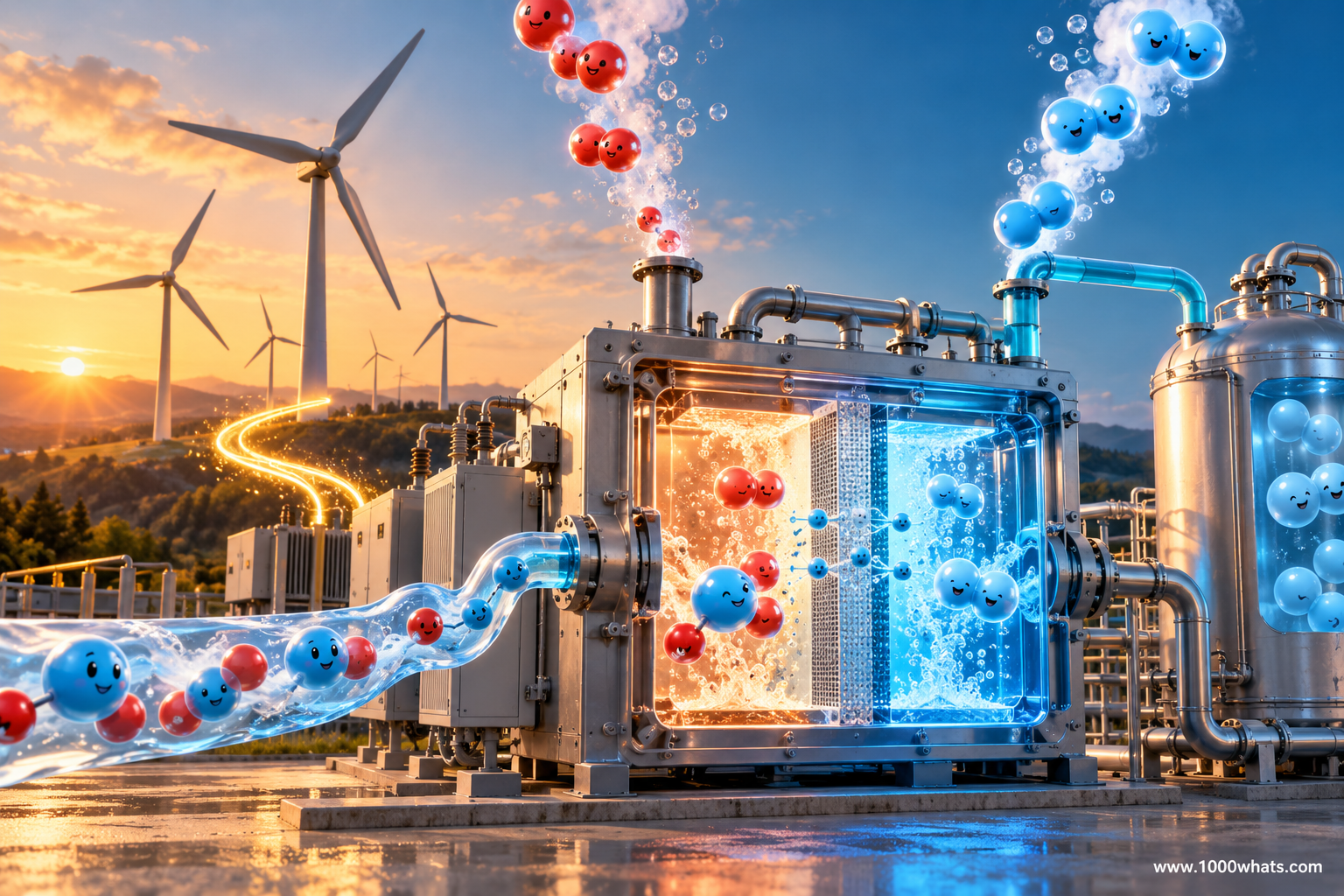
Build a wind farm.
Generate electricity.
Send that electricity through a machine containing water.
Out comes:
hydrogen.
At first glance, this feels suspiciously close to alchemy.
We started with electrons and water.
We ended with a combustible gas that can make fertilizer, reduce iron ore, store energy, or eventually become synthetic jet fuel.
No hydrogen mine was involved.
Welcome to 1000whats – where today we meet the machine responsible for turning one of the energy transition’s favorite arrows-
electricity → hydrogen
– into an actual industrial process.
It is called an:
electrolyzer.
And despite what approximately fourteen thousand hydrogen PowerPoint diagrams suggest, it is not simply a mysterious green box with H₂ coming out of the right-hand side.
⚡ “An electrolyzer does not find hydrogen. It uses electricity to persuade water to give up the hydrogen it already contains.”
First, we are not making hydrogen atoms
This is worth clearing up immediately.
Water is:
H₂O.
Two hydrogen atoms.
One oxygen atom.
The hydrogen already exists.
An electrolyzer does not manufacture new hydrogen atoms.
It separates hydrogen from oxygen using electricity.
The overall reaction is usually written:
2H₂O → 2H₂ + O₂
Electricity supplies the energy required to drive a chemical reaction that water has absolutely no intention of performing voluntarily.
The U.S. Department of Energy’s electrolysis guide describes the process simply: electricity splits water into hydrogen and oxygen inside an electrolyzer.
That sounds almost too easy.
So naturally, we now need electrodes, ions, membranes, catalysts, power electronics, water treatment, cooling, gas purification, compression, controls, and several people discussing stack degradation.
Industrial chemistry has entered the chat.
What is actually inside an electrolyzer?
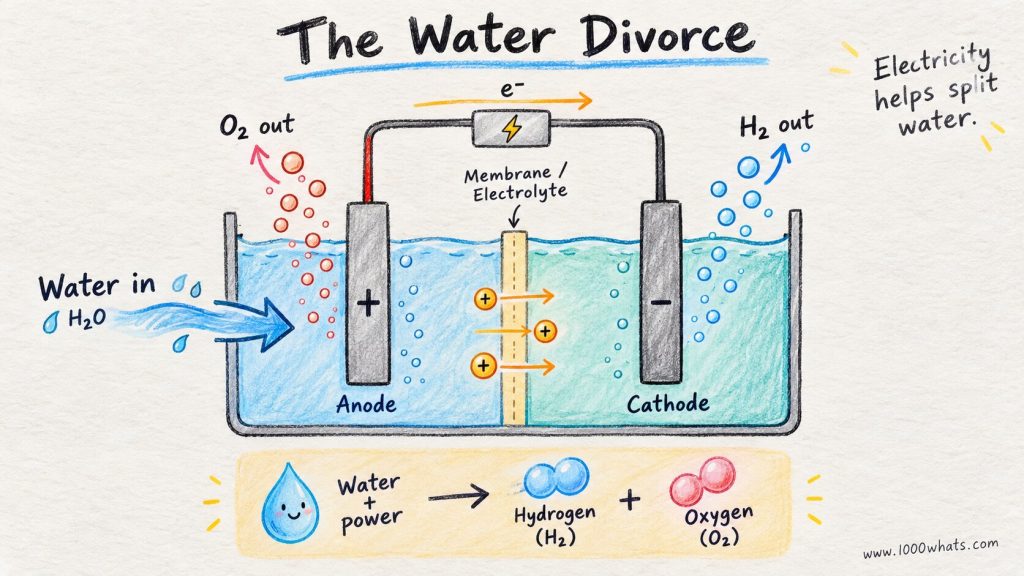
Strip the machine back to its essential electrochemical heart and you usually find:
an anode
and:
a cathode
separated by:
an electrolyte.
Apply electrical voltage.
Chemical reactions occur at the electrodes.
Charged particles move through the electrolyte.
Electrons travel through the external electrical circuit.
Hydrogen forms on one side.
Oxygen forms on the other.
That separation matters.
Producing a convenient mixture of hydrogen and oxygen in the same container would be an exciting design choice for all the wrong reasons.
The exact ion moving through the electrolyte depends on the electrolyzer technology.
But the central trick remains:
use electrical energy to pull a stable water molecule apart and keep the products separated.
One cell does not make a hydrogen plant
A single electrolysis cell is small.
Industrial hydrogen projects need a lot more surface area.
So cells are assembled into:
stacks.
Multiple stacks become electrolyzer modules.
Modules become a plant.
This distinction is useful because people often hear:
100 MW electrolyzer
and imagine one enormous machine.
In practice, the plant is much more modular.
And even the stacks are only part of the facility.
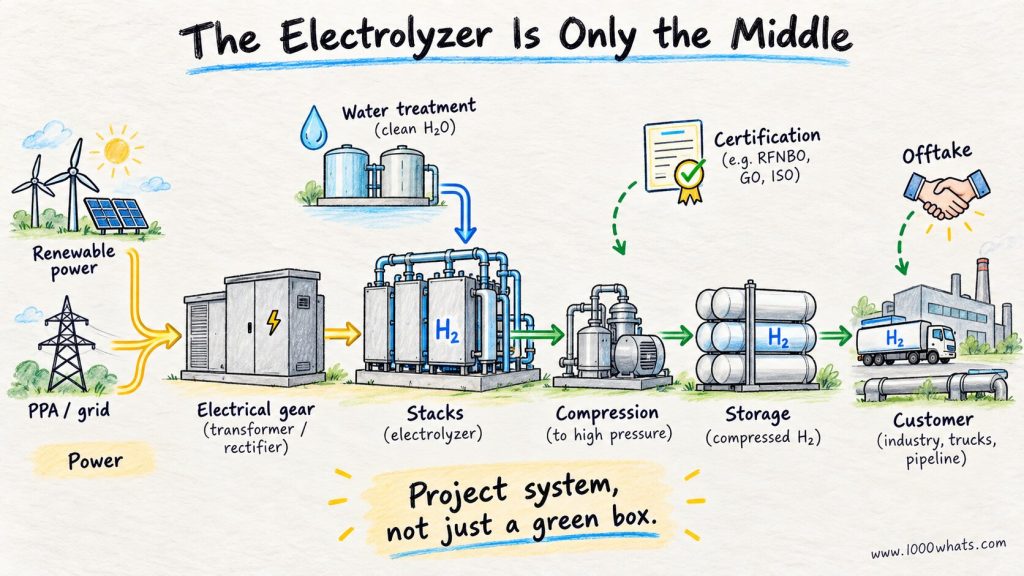
A real electrolyzer project may also need:
- transformers and rectifiers;
- water purification;
- pumps;
- cooling;
- gas-liquid separation;
- hydrogen purification;
- drying;
- compression;
- hydrogen storage;
- oxygen handling;
- control and safety systems.
The stack performs the electrochemistry.
The rest of the plant makes the electrochemistry useful.
This matters economically.
The IEA notes that the electrolyzer stack can represent only around 15–20% of the investment cost of an installed electrolyzer system in some projects. IEA
So buying cheaper stacks does not automatically produce cheap hydrogen.
There remains the minor inconvenience of:
building the plant.
What does “100 MW electrolyzer” actually mean?
This is another easy place to get confused.
A 100 MW electrolyzer is generally describing the plant’s electrical input capacity.
At full load, it can consume roughly:
100 MW of electricity.
That does not mean it produces:
100 MW of electricity.
Quite the opposite.
It consumes electricity to manufacture hydrogen.
Think of an electrolyzer less like a power plant and more like:
a giant industrial electrical load with a chemical product coming out.
That perspective becomes extremely important for electricity markets.
A 500 MW electrolyzer is not merely a hydrogen facility.
From the power system’s point of view, it can be:
a very large factory suddenly asking for half a gigawatt.
And unlike an aluminum smelter or many other industrial loads, an electrolyzer may have some ability to change its electricity consumption in response to:
renewable production,
power prices,
grid conditions,
or hydrogen demand.
Now things get interesting.
How much electricity does hydrogen actually need?
Hydrogen contains a lot of energy by mass.
One kilogram contains roughly:
33.3 kWh on a lower-heating-value basis.
But producing that kilogram by electrolysis requires more electricity than the energy ultimately stored in the hydrogen.
Because:
losses exist.
Of course they do.
The DOE’s PEM electrolysis targets track system electricity consumption in kWh per kilogram of hydrogen, because that number sits at the center of electrolyzer economics.
For a simple mental example, suppose an electrolyzer system requires:
50 kWh of electricity per kg H₂.
If electricity costs:
€40/MWh
that is:
€0.04/kWh.
Electricity cost alone becomes:
50 × €0.04 = €2/kg H₂
Now make electricity:
€80/MWh.
Same machine.
Same water.
Same hydrogen.
Electricity cost:
€4/kg H₂.
Nothing happened to the electrolyzer.
The electricity market moved underneath it.
⚡ “An electrolyzer may look like chemical equipment, but its business model can be dominated by one very familiar energy-market variable: the price of electricity.”
This is why cheap electricity matters so much
Hydrogen projects often attract attention to electrolyzer CAPEX.
Understandably.
The equipment costs real money.
But an electrolyzer consumes electricity for thousands of hours over many years.
That means a modest difference in average electricity price can overwhelm a seemingly impressive difference in equipment price.
The IEA’s latest hydrogen work repeatedly identifies renewable-electricity cost as one of the central drivers of renewable hydrogen competitiveness. China, for example, has achieved significantly lower renewable-hydrogen costs partly because of cheaper electricity, financing, and equipment.
This produces a wonderfully annoying optimization problem.
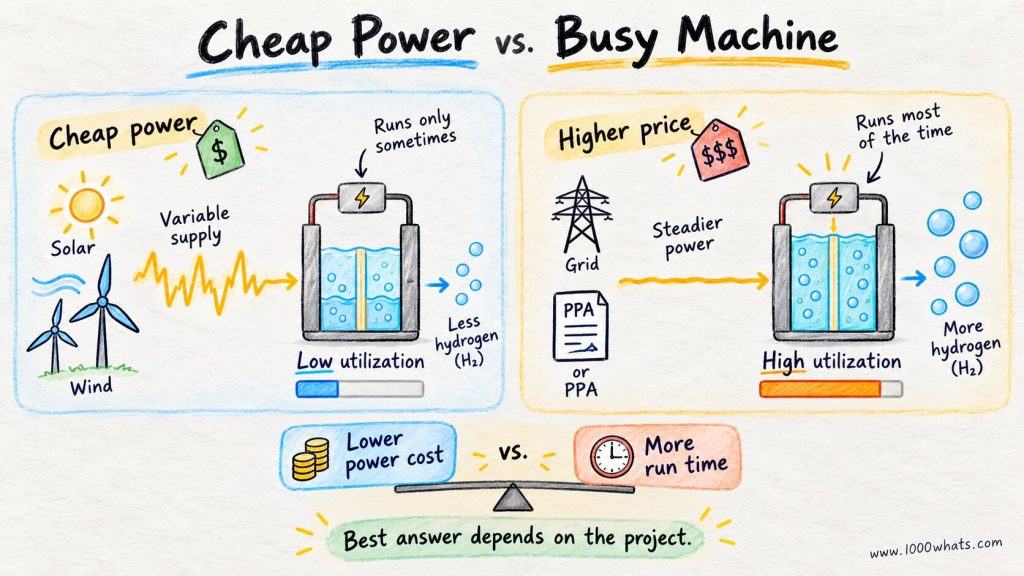
You want:
cheap electricity.
But you also want:
lots of operating hours.
Those two things do not necessarily arrive together.
Imagine an electrolyzer connected to solar
Suppose solar electricity becomes extremely cheap around noon.
Excellent.
Run the electrolyzer.
But at night:
no solar.
So the electrolyzer sits idle.
Now your electricity may be cheap when available.
But you have purchased expensive industrial equipment that spends a large part of its life:
admiring the moon.
That raises the cost of every kilogram it does produce because the capital cost is spread across fewer kilograms.
Alternatively, connect the electrolyzer to the grid and run it more often.
Utilization improves.
But now some hours may have:
higher electricity prices
and possibly:
higher carbon intensity.
So the project is constantly balancing:
electricity price
against:
utilization
against:
carbon intensity.
This is one reason hydrogen economics are much more interesting than:
cheap renewables + electrolyzer = cheap hydrogen.
The middle of that equation contains a calendar.
Can an electrolyzer simply follow wind and solar?
To a degree, yes.
And this is one of the technology’s most interesting characteristics.
Modern alkaline and PEM electrolyzers can both operate flexibly, although their dynamic characteristics, minimum loads, startup behavior, degradation, and system design differ.
The IEA notes that alkaline and PEM systems can be designed for flexible operation and directly coupled with variable renewable electricity.
So imagine:
wind output rises;
electricity prices fall;
electrolyzer consumption increases.
Later:
wind falls;
electricity becomes expensive;
electrolyzer consumption decreases.
From the power system’s perspective, that can make electrolysis a flexible demand resource.
From the hydrogen plant’s perspective, however, repeatedly changing operation must still respect:
equipment limits,
hydrogen production commitments,
storage levels,
efficiency,
and degradation.
The electrolyzer may be flexible.
The ammonia plant waiting for its hydrogen may be considerably less interested in your adventures in the balancing market.
Which brings us to hydrogen storage
Suppose the downstream factory needs:
10 tonnes of hydrogen every day.
But the electrolyzer wants to produce:
a lot when electricity is cheap
and:
less when electricity is expensive.
Those profiles do not match.
Hydrogen storage can decouple them.
Electrolyzer:
follows electricity.
Storage:
buffers hydrogen.
Industrial consumer:
gets a steadier hydrogen supply.
That can create considerable value.
But storage is not free.
Neither are compressors.
Nor pipelines.
Nor caverns.
Nor tanks.
The cheapest electrolyzer schedule on paper can therefore create an expensive hydrogen system around it.
Energy projects have an unfortunate tendency to continue existing outside Excel’s highlighted cells.
There is more than one kind of electrolyzer
Now we can talk technology.
Three names appear most often:
alkaline
PEM
and:
solid oxide
They all split water.
They do it differently.
Alkaline electrolyzers: the old industrial workhorse
Alkaline electrolysis is mature.
It has been commercially available for many years.
The electrolyte is typically an alkaline solution containing substances such as potassium or sodium hydroxide.
Hydroxide ions move through the electrolyte.
Hydrogen is produced at the cathode.
The DOE describes commercial alkaline systems as the long-established electrolysis route.
Their attraction includes:
maturity,
large-scale experience,
and generally lower equipment costs.
Historically, their drawbacks included less dynamic operation than PEM and lower current density, although modern alkaline designs have improved considerably.
If hydrogen technologies were a family, alkaline would be the relative quietly saying:
I’ve actually been doing this job for decades.
PEM electrolyzers: compact and flexible
PEM means:
proton exchange membrane
or:
polymer electrolyte membrane.
Here the electrolyte is a solid polymer membrane.
At the anode, water forms:
oxygen,
protons,
and electrons.
The protons cross the membrane.
The electrons travel through the external circuit.
At the cathode, they reunite to produce hydrogen.
PEM systems can be compact and highly responsive, which makes them attractive for integration with variable renewable electricity.
But there is a materials issue.
PEM systems traditionally rely on platinum-group metals, including scarce materials such as:
iridium.
The IEA therefore tracks reductions in critical-mineral intensity as an important development challenge for PEM electrolysis.
Flexibility is lovely.
Iridium invoices are less charming.
Solid oxide: bring your own heat
Solid oxide electrolyzers work at much higher temperatures.
DOE gives a typical operating range around:
700–800°C.
Why deliberately make life this hot?
Because part of the energy required to split water can be supplied as:
heat
instead of electricity.
That can improve electrical efficiency, particularly where high-temperature steam or waste heat is already available.
The IEA notes that solid oxide systems can achieve higher electrical efficiencies, although direct comparisons with low-temperature electrolyzers require care because the SOEC also consumes thermal energy.
This makes solid oxide particularly interesting around:
industrial sites,
high-temperature processes,
and potentially nuclear heat.
Our recent article on waste heat would have loved this section.
The machine is effectively saying:
You already have high-temperature heat?
Excellent.
I can use some of that instead of asking the grid to do everything.
The trade-off is maturity.
Solid oxide electrolysis remains less commercially established than alkaline and PEM.
A simplified comparison
| Technology | Electrolyte | Typical character | Main attraction | Main headache |
|---|---|---|---|---|
| Alkaline | Liquid alkaline electrolyte | Mature industrial technology | Cost and experience | Traditionally less compact/dynamic |
| PEM | Solid polymer membrane | Compact and responsive | Renewable integration and flexibility | Precious/critical materials and cost |
| Solid oxide | Solid ceramic | High-temperature electrolysis | High electrical efficiency when heat is available | Higher temperature and lower commercial maturity |
There is no universal winner.
There is only:
the right machine for the project.
⚡ “Asking which electrolyzer technology is best is a little like asking which vehicle is best. Before answering, it helps to know whether you are delivering pizza or crossing the Sahara.”
What about water?
Yes.
An electrolyzer needs water.
The chemistry gives us a theoretical minimum.
Producing:
1 kg of hydrogen
requires about:
9 kg of water
purely from stoichiometry.
Real plants use more because water also enters:
purification,
cooling,
and other system processes.
A detailed IRENA assessment of hydrogen water use estimated average water consumption around 17.5 liters/kg H₂ for PEM electrolysis and 22.3 liters/kg for alkaline electrolysis, although actual project requirements vary.
Globally, that does not automatically make electrolysis a water crisis.
Locally, it can matter enormously.
A hydrogen plant built beside abundant freshwater has one problem.
The same plant in a water-stressed desert has another.
Desalination can help.
Treated wastewater can help.
But once again:
infrastructure.
The IEA has noted that a significant share of planned low-emissions hydrogen projects lies in water-stressed regions, making local water planning important. IEA
A hydrogen molecule may be global.
Its water problem is extremely local.
And what happens to the oxygen?
For every kilogram of hydrogen produced from water, roughly:
8 kilograms of oxygen
are also produced by stoichiometry.
Sometimes that oxygen can have value.
Possible industrial uses include:
wastewater treatment,
chemical processes,
metallurgy,
or other oxygen-consuming operations.
Great.
But the oxygen market is not infinitely hungry.
Build a giant hydrogen industry and you cannot simply assume somebody will enthusiastically buy every molecule of oxygen appearing beside it.
At some projects, oxygen can improve economics.
At others, it is simply a by-product that must be safely handled.
Hydrogen business plans occasionally discover that even the useful by-product needs:
a customer.
Is electrolytic hydrogen automatically green?
Absolutely not.
This is one of the most important distinctions in the entire subject.
An electrolyzer does not care whether its electrons came from:
wind,
solar,
hydro,
nuclear,
gas,
or coal.
It sees electricity.
If that electricity is carbon-intensive, the resulting hydrogen can also carry substantial lifecycle emissions.
My green hydrogen explainer deals with this distinction directly.
Electrolytic hydrogen tells you how the hydrogen was made.
Green or renewable hydrogen tells you something about the electricity and the rules governing its origin.
In Europe, those rules are deliberately stricter than simply:
“I bought some renewable certificates.”
The European Commission’s renewable-hydrogen framework includes criteria for additionality, plus temporal and geographic correlation between hydrogen production and renewable electricity.
Why?
Because otherwise an electrolyzer could consume existing clean electricity while the rest of the power system compensates by running more fossil generation.
The hydrogen plant would look green.
The system might not.
Energy accounting has a habit of becoming interesting exactly where marketing would prefer it to stop.
This makes an electrolyzer an electricity-market participant
Now we arrive at the part that is often missing from technology explainers.
A large electrolyzer does not merely buy:
electricity.
It buys electricity:
somewhere
and:
at some time.
Those details matter.
Imagine a 200 MW electrolyzer.
At €30/MWh, running for one hour costs roughly:
€6,000 in electricity.
At €100/MWh:
€20,000.
Same hour of hydrogen production.
Difference:
€14,000.
That gives the plant a strong incentive to understand:
day-ahead prices,
intraday prices,
PPAs,
renewable profiles,
congestion,
curtailment,
balancing opportunities,
and potentially negative prices.
Suddenly the hydrogen engineer needs an electricity trader.
The electricity trader needs to understand stack operating limits.
The project developer needs both of them to agree before the bank arrives.
Now we have an energy project.
“Use excess renewable electricity” is only half an answer
This sentence appears constantly:
Electrolyzers can use excess wind and solar electricity that would otherwise be curtailed.
True.
DOE explicitly identifies curtailed renewable generation as a potential opportunity for hydrogen electrolysis. The Department of Energy’s Energy.gov
But consider the business model.
Suppose cheap curtailed electricity is available:
300 hours per year.
Wonderful electricity price.
Terrible electrolyzer utilization.
You have built expensive equipment that runs:
3.4% of the year.
That hydrogen may not be cheap at all once capital costs are included.
The real opportunity is therefore usually broader than:
wait for free electricity.
A viable project needs some combination of:
low electricity cost,
sufficient operating hours,
cheap capital,
efficient equipment,
hydrogen demand,
infrastructure,
and a price somebody is actually willing to pay for the product.
This is why electrolyzer projects that look obvious from the power-system side can struggle from the project-finance side.
Free electricity is excellent.
A machine that almost never runs is less excellent.
The scale-up is real – and much slower than the old PowerPoints promised
Electrolysis is no longer a laboratory curiosity.
According to the IEA’s Global Hydrogen Review 2026, global installed electrolysis capacity doubled during 2025 to more than 4 GW, with China responsible for nearly three-quarters of new installations.
That is serious growth.
But put it beside the ambition from only a few years ago and the picture becomes less triumphant.
Projects have been delayed.
Some have been cancelled.
Final investment decisions slowed in 2025.
The IEA now expects the realistic 2030 low-emissions hydrogen pipeline to be much smaller than the giant announced-project totals once suggested. IEA
The problem is not that electrolysis does not work.
It works.
The problem is building a complete commercial chain where:
someone finances the renewable generation;
someone finances the electrolyzer;
someone supplies water;
someone builds storage and pipelines;
someone buys the hydrogen;
and that buyer is willing to pay more than for conventional hydrogen or its fossil alternative.
The chemistry was the easy part.
The contracts have arrived.
China shows what scale looks like
Electrolyzer deployment has changed remarkably quickly.
The world’s largest operating project was only around 25–30 MW at the start of this decade.
By July 2025, China had commissioned a project at:
500 MW.
Saudi Arabia’s NEOM project is targeting roughly:
2.2 GW
by 2027.
The IEA describes this jump in project scale as one of the clearest signs that electrolysis is moving from niche equipment toward large industrial infrastructure.
Think about what 2.2 GW means.
At full load, the electrolyzers would consume electricity on the scale of:
multiple large conventional power plants.
We have gone from:
machine that makes hydrogen
to:
industrial electricity system with hydrogen attached.
That changes:
grid connection,
renewable procurement,
water,
land,
equipment supply,
storage,
offtake,
and financing.
Scale does not merely make the same project bigger.
It changes the project.
Why hydrogen demand matters more than electrolyzer announcements
Here is a useful antidote to hydrogen hype.
An electrolyzer is not valuable because:
it exists.
It is valuable because somebody wants:
the hydrogen.
The IEA reported in 2026 that only about 20% of newly signed low-emissions hydrogen offtake volumes in 2025 were backed by firm contractual commitments. Demand uncertainty remains one of the biggest barriers to investment. IEA
This is extremely important.
You can have:
excellent renewable resources,
a beautiful electrolyzer,
land,
permits,
and enthusiastic press releases.
But if conventional hydrogen costs less and no regulation, carbon price, subsidy, mandate, or customer willingness closes the gap:
who buys your expensive clean hydrogen?
That question has delayed a great many projects.
It is also why the EU has created mechanisms such as the European Hydrogen Bank auctions, which provide fixed premiums for qualifying hydrogen production to help bridge the cost gap.
The electrolyzer does chemistry.
Policy sometimes has to do economics.
So is the electrolyzer an energy-storage device?
Not exactly.
This distinction is worth preserving.
A battery stores electricity electrochemically and later returns electricity.
An electrolyzer:
converts electricity into hydrogen.
If that hydrogen is stored and later converted back into electricity through a fuel cell or turbine, then the overall system can provide energy storage.
But the electrolyzer itself is:
a conversion device.
Electricity → hydrogen.
That hydrogen might instead become:
ammonia,
steel,
methanol,
e-fuel,
industrial feedstock,
or heat.
No electricity ever needs to come back.
This is why calling every hydrogen project “energy storage” misses most of the story.
Sometimes the point is not to store electricity.
The point is to manufacture:
a molecule industry already needs.
And this explains why electrolyzers matter
The easiest parts of decarbonization often involve using clean electricity directly.
Replace combustion engine with motor.
Replace boiler with heat pump.
Electrify the process.
Done.
Or at least:
done-ish.
But some sectors need:
hydrogen atoms,
chemical feedstocks,
reducing agents,
high-energy molecules,
or fuels that can be stored and transported differently from electricity.
That is where the electrolyzer becomes interesting.
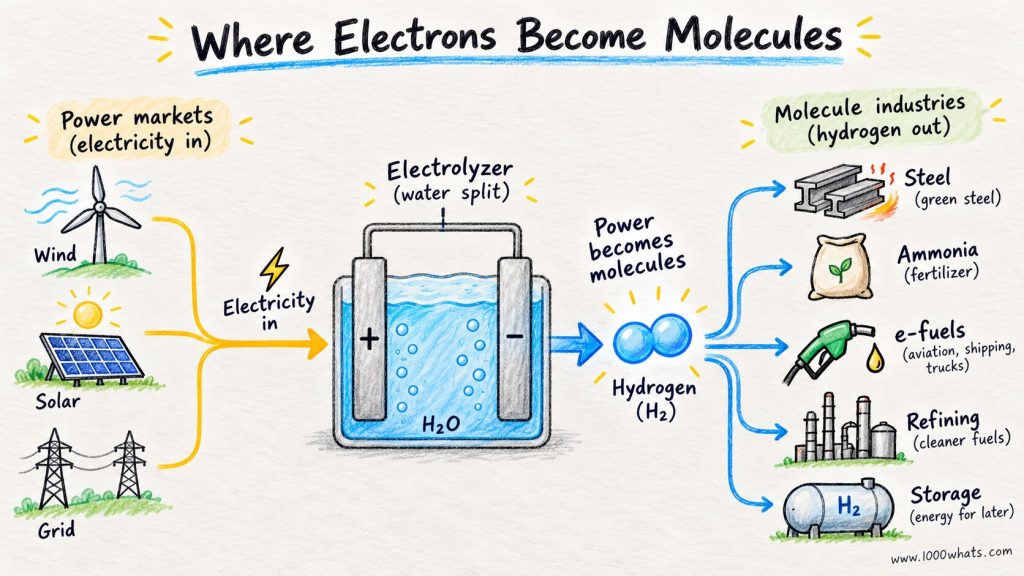
It is a bridge.
On one side:
the electricity system.
On the other:
the molecular economy.
Wind and solar can now enter industries that cannot simply plug a wire into the final process.
Steel.
Ammonia.
Refining.
Shipping fuels.
Synthetic aviation fuel.
My existing articles on green steel and e-fuels are essentially stories about what happens after electricity crosses that bridge.
What is an electrolyzer in one sentence?
An electrolyzer is an electrochemical device that uses electricity to split water into hydrogen and oxygen.
But the better mental model is:
a factory that buys electrons and sells molecules.
And once you see it that way, most of the difficult questions become obvious.
How expensive are the electrons?
How clean are they?
How often can the factory buy them?
How efficiently can it turn them into hydrogen?
How much did the factory cost?
Where does the water come from?
Where does the hydrogen go?
And, most importantly:
who is paying for it?
Final thoughts
Electrolysis is beautifully simple at molecular scale.
Water.
Electricity.
Hydrogen.
Oxygen.
Done.
Then humans decide to make:
500 MW of it.
Suddenly we need renewable projects, transmission capacity, rectifiers, stacks, purified water, cooling, compressors, hydrogen storage, pipelines, certification, offtake contracts, financing, and several thousand pages explaining exactly when the electricity is renewable enough for Europe to call the hydrogen renewable.
This is not evidence that electrolyzers are a bad idea.
It is evidence that industrial decarbonization is a systems problem.
The electrolyzer may become one of the most important machines connecting renewable electricity with steel, fertilizer, shipping, aviation fuels, and other sectors that cannot simply run everything directly on electrons.
But the machine itself is only the conversion step.
Cheap hydrogen needs:
cheap electricity,
high-performing equipment,
sensible utilization,
infrastructure,
and customers.
Miss one of those and the elegant chemistry remains elegant chemistry.
Get them all right and something much bigger happens.
A wind turbine does not merely make electricity anymore.
Through an electrolyzer, it can start making:
molecules.
Until next time, stay curious! 😎
Discover more from 1000whats
Subscribe to get the latest posts sent to your email.