Your coffee does not contain heat.
There. I said it.
That sounds ridiculous because your coffee is hot, your hand knows it is hot, and your tongue will file an official complaint if you drink it too soon.
But physics is annoyingly precise.
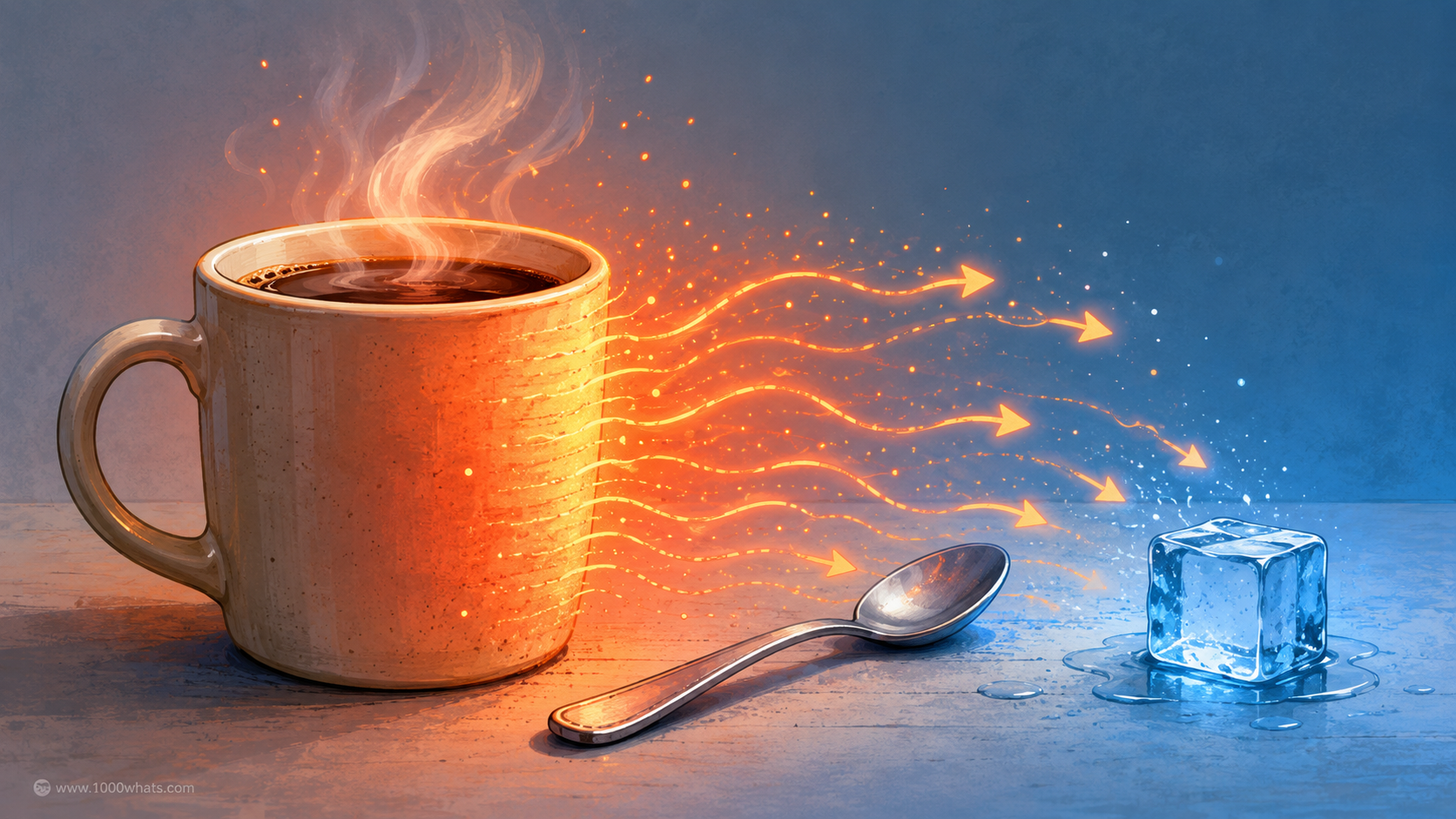
The coffee contains internal energy. Heat is what happens when some of that energy crosses from the hotter coffee into something cooler—the mug, the air, your hand, or eventually the sad little universe around your desk.
⚡ “Heat is not energy sitting still. Heat is energy crossing a temperature difference.”
That distinction sounds like scientific nitpicking.
It isn’t.
Once you understand it, suddenly boilers, radiators, refrigerators, engines, power plants, weather, air conditioners, industrial furnaces, and even climate change start making much more sense.
And from an energy perspective, heat is enormous. According to the International Energy Agency, heat accounted for almost half of global final energy consumption and 37% of energy-related CO₂ emissions in 2024.
So this isn’t just a chapter your physics teacher assigned before lunch.
Heat is one of the biggest energy stories on Earth.
Welcome to 1000whats—where even your coffee gets dragged into thermodynamics.
Let’s get warm.
What is heat?
Here’s the clean physics version:
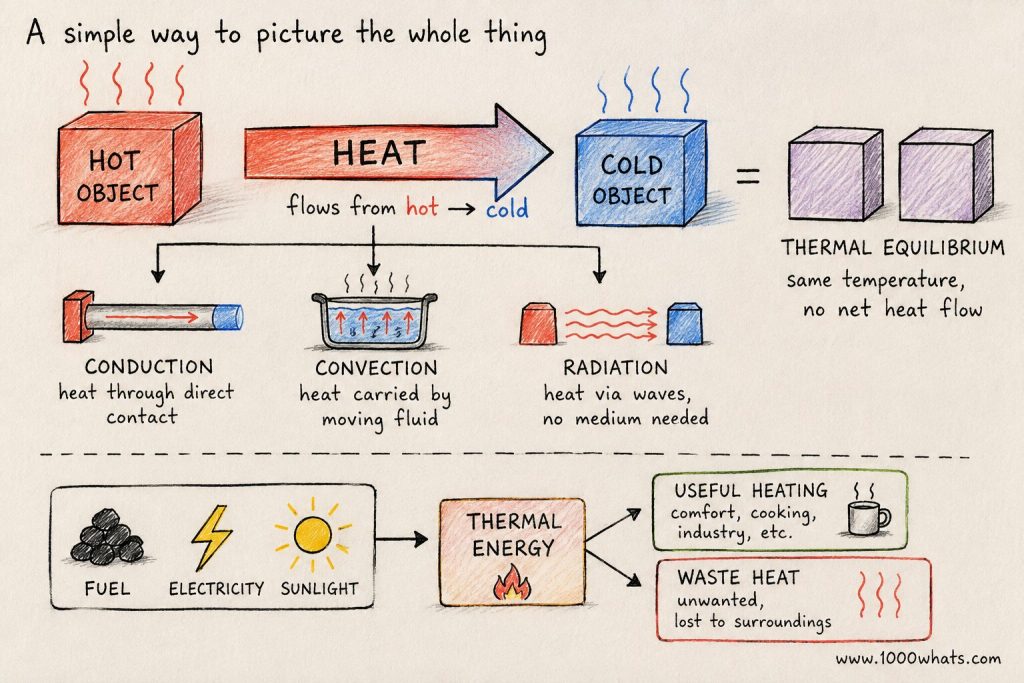
Heat is thermal energy transferred from one system to another because there is a difference in temperature.
Notice the important word:
Transferred.
Heat describes energy in transit. 💡
Imagine two blocks.
One is hot.
One is cold.
Put them together and energy begins moving from the hotter block toward the colder one. That transferred energy is what physicists call heat.
Eventually, the temperatures move toward equilibrium.
No drama.
No tiny molecules holding a committee meeting.
Just energy spreading out.
This also explains why saying an object “contains 500 joules of heat” is technically awkward. Once that energy has entered the object and become part of its microscopic energy, we normally describe it as part of the object’s internal energy.
Heat was the journey.
Internal energy is where the energy ended up.
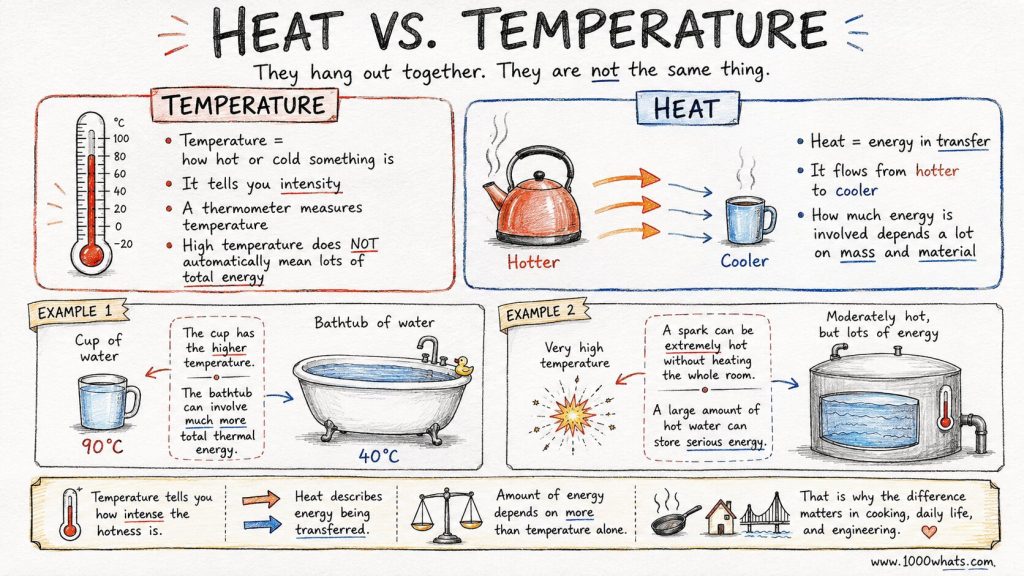
Heat vs. temperature: Please stop making them twins
Heat and temperature spend so much time together that people assume they are basically the same thing.
They aren’t.
Think of temperature as a condition.
Heat is an energy transfer.
A thermometer tells you how hot or cold something is. It does not tell you the total amount of thermal energy available in the entire object.
That creates some wonderfully counterintuitive situations.
Imagine:
- A cup of water at 90°C.
- A bathtub full of water at 40°C.
The cup has the higher temperature.
But the bathtub contains vastly more water and therefore can involve much more internal energy.
This is why a spark can reach an extremely high temperature without cooking the entire room, while thousands of gallons of moderately hot water can carry a serious amount of energy.
Temperature tells you intensity. Mass and material help determine how much energy is involved.
That difference matters everywhere from cooking to industrial engineering.
Why does heat flow at all?
Because nature has a spreading problem.
Give energy somewhere concentrated to go, and it tends to spread into the surrounding system.
Put an ice cube in lemonade.
The lemonade does not mysteriously get hotter while the ice gets colder.
Instead, energy transfers from the warmer drink toward the colder ice.
Leave a hot pizza on the counter and the room warms the pizza back up—
Wait.
No.
Sadly, thermodynamics has standards.
The pizza cools.
In ordinary spontaneous processes, net heat transfer runs from higher temperature toward lower temperature.
Eventually, the temperature difference shrinks enough that the two systems approach thermal equilibrium.
⚡ “Heat needs a difference. Remove the temperature difference, and the net heat transfer disappears.”
That little fact quietly runs half the machines around you.
Radiators work because they are hotter than the room.
Refrigerators work because they deliberately move heat away from something you want cold.
Power plants work because engineers create enormous temperature differences and then exploit them.
Your coffee cools because the universe has absolutely no respect for your schedule.
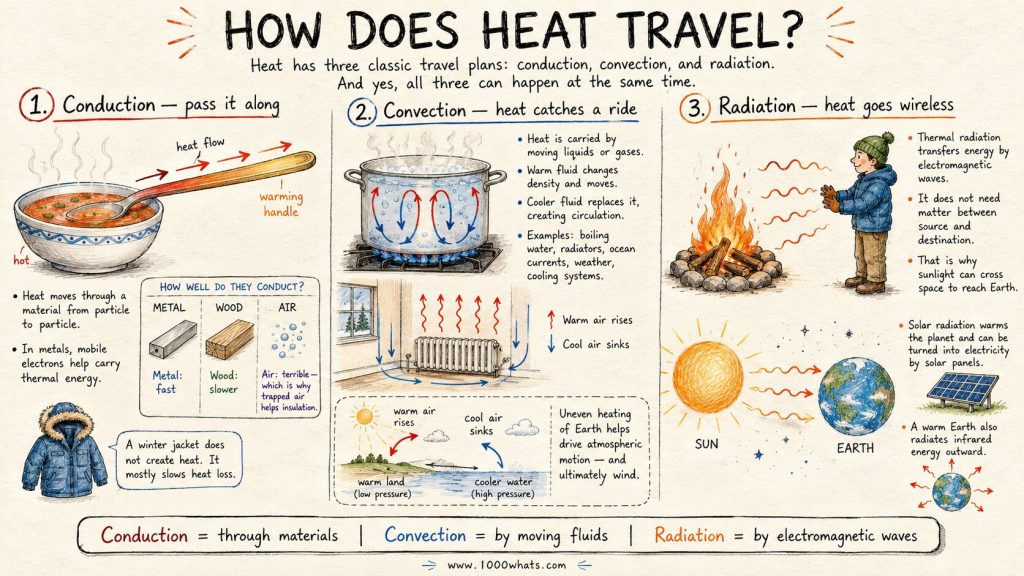
How does heat travel?
Heat has three classic travel plans:
conduction, convection, and radiation.
And unlike your family vacation, all three can happen at the same time.
1. Conduction: Pass it along
Put a metal spoon in hot soup.
Wait.
Soon the handle gets warm.
The soup did not crawl up the spoon.
Energy moved through the material.
That is conduction.
At the microscopic level, particles interact and transfer energy through the material. In metals, mobile electrons also play an important role in carrying thermal energy.
Different materials conduct heat very differently.
Metal?
Excellent.
Wood?
Much slower.
Air?
Pretty terrible—which is exactly why trapped air is so useful in insulation.
Your winter jacket is not generating heat like a miniature furnace. It is mostly slowing down your heat loss.
That distinction can save you from giving your coat supernatural powers.
2. Convection: Heat catches a ride
Now boil water.
The water near the bottom heats up, changes density, moves, and helps create circulating fluid motion.
That is convection.
Convection transfers energy through the bulk movement of liquids or gases.
You see it everywhere:
- boiling water
- radiators warming rooms
- forced-air heating
- ocean circulation
- atmospheric movement
- cooling systems
And yes, heat is indirectly involved in something even bigger.
The Sun heats Earth unevenly. Those temperature differences help create pressure differences and atmospheric motion—which becomes wind. If you want to follow that energy chain all the way into a turbine, read What is wind power? How moving air becomes electricity.
Heat does not just make things hot.
Sometimes it makes entire atmospheres move.
3. Radiation: Heat goes wireless
Stand near a campfire.
You feel warmth even though you are not touching the flames.
Some of that energy reaches you as thermal radiation.
Unlike conduction and convection, radiation does not require matter between the source and destination. Electromagnetic radiation can travel through empty space.
This is rather convenient.
Otherwise the Sun would be spectacularly useless.
Energy crosses roughly 150 million kilometers of space from the Sun before reaching Earth.
That incoming solar radiation powers ecosystems, warms the planet, drives atmospheric processes, and can also be converted directly into electricity by photovoltaic panels.
That last trick deserves its own rabbit hole: What is solar power? The extraterrestrial energy falling on your roof.
And once Earth warms, it emits thermal infrared radiation outward.
That brings us directly to another huge piece of the energy puzzle: the greenhouse effect, which changes how easily some of that outgoing energy escapes to space.
Same physics.
Very different consequences.
How do we measure heat?
Since heat is energy being transferred, its SI unit is the joule (J).
But humanity being humanity, we were apparently not satisfied with one unit.
So you will also encounter:
- calories
- kilocalories
- kilowatt-hours
- British thermal units (BTU)
If that sounds like the energy industry emptied its kitchen drawer onto the table, you’re not wrong.
I broke down that unit zoo in What is the unit of energy? Convert, compare, confuse!, including why BTUs still stalk heating and cooling equipment decades into the metric era.
For a substance whose temperature changes without changing phase, the famous starting equation is:
Q = mcΔT
Where:
- Q = heat transferred
- m = mass
- c = specific heat capacity
- ΔT = temperature change
That equation tells you something important.
Heating something depends on more than just “how hot you want it.”
It depends on how much stuff you have and what that stuff is made of.
What is specific heat capacity?
Here is where materials reveal their personalities.
Different substances need different amounts of energy to achieve the same temperature increase.
That property is called specific heat capacity.
Water has a relatively high specific heat capacity.
This means it can absorb a lot of energy without its temperature shooting upward immediately.
That is one reason water is so useful for:
- heating systems
- industrial cooling
- thermal storage
- power plants
- your suspiciously long shower
A metal pan behaves differently.
It warms quickly.
The water inside takes much more convincing.
In practice, engineers care deeply about this because choosing the wrong material in a thermal system can turn a clever design into an expensive toaster.
The weird moment when you add heat…and temperature stops rising
Here is another thermodynamic ambush.
Put water on the stove.
Its temperature climbs.
Keep adding energy.
Eventually it boils.
And then something strange happens.
At a given pressure, while the phase change is underway, you can continue transferring energy into the water without continuing to raise its temperature in the usual way.
Where does the energy go?
Into changing the phase.
The added energy helps rearrange the molecular structure as liquid becomes vapor.
That energy is associated with latent heat.
So:
Energy added ≠ always higher temperature.
Sometimes energy changes the state of matter instead.
Ice melting works the same way.
That little detail matters enormously in refrigeration, steam turbines, cooling systems, thermal storage, weather, and industrial processing.
Your electric kettle is secretly a thermodynamics laboratory
Want a real-world example?
Walk into your kitchen.
Fill the kettle.
Press the button.
You have just started a surprisingly elegant energy chain.
First, electrical energy enters the heating element.
That requires electric current moving through the circuit.
The element resists that current, converting electrical energy into internal energy.
The hot element then transfers energy into the water through conduction.
As the water warms, convection circulates it.
Eventually, the water reaches boiling temperature.
After that, additional energy can drive evaporation.
So inside one boring appliance we have:
electricity → resistive heating → conduction → convection → phase change
Not bad for something whose main job is helping you make coffee.
What most people don’t see is that energy technologies are rarely about one form of energy.
They are about conversions between forms.
Heat is also hiding inside electricity generation
Here is where heat graduates from kitchen appliance to civilization-scale infrastructure.
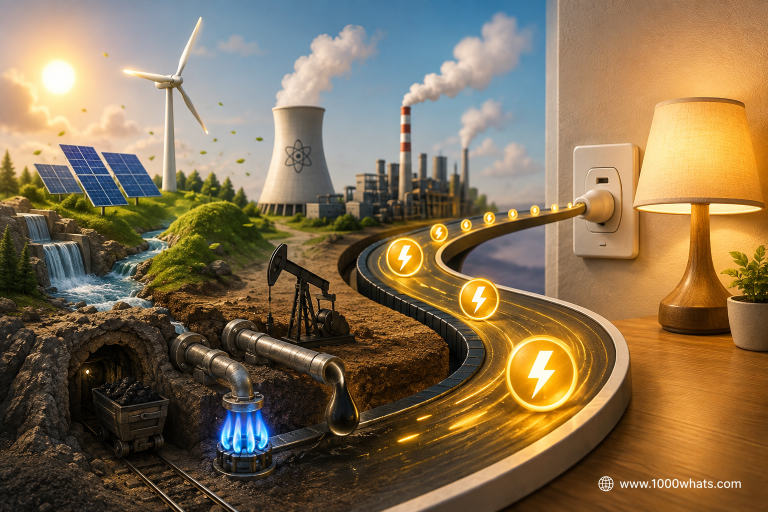
A huge share of conventional electricity generation begins by deliberately creating heat.
Take a coal-fired power plant.
Coal contains chemical energy. Burn it, and that energy becomes thermal energy. Heat is transferred into water. The water becomes high-pressure steam. The steam spins a turbine. The turbine drives a generator.
The chain looks roughly like this:
coal → combustion → heat → steam → rotation → electricity
If you want the fuel side of that story, see What is coal? The hero and the villain.
Nuclear plants take a different route to the heat.
Gas plants use different machinery.
Geothermal plants borrow thermal energy from Earth.
But the broader lesson is surprisingly consistent:
A lot of electricity begins with someone getting something very hot.
And that brings us to one of the energy industry’s oldest headaches.
Not all that heat becomes useful electricity.
Waste heat: The energy industry’s expensive exhaust
No thermal machine converts every unit of input energy into useful output.
Some energy leaves as unwanted heat.
Cooling towers.
Hot exhaust gases.
Warm cooling water.
Hot industrial surfaces.
All of it represents energy that did something other than become the final product we wanted.
From a market perspective, waste heat is basically paid-for energy trying to escape the building.
That is why efficiency engineers obsess over recovering it.
One elegant approach is combined heat and power, or CHP.
Instead of making electricity and dumping useful thermal energy into the environment, a CHP system captures some of that heat and uses it for buildings, hot water, industrial processes, or district heating.
I unpacked that logic in What is cogeneration (CHP)? The power of two.
⚡ “Waste heat is often not useless energy. It is useful energy that arrived at the wrong place, temperature, or time.”
That distinction is huge.
Because sometimes the smartest energy technology is not generating more energy.
It is wasting less of what you already bought.
Heat pumps flip the story
Most heating technologies create useful heat by converting another energy source.
Burn gas.
Burn oil.
Run electricity through resistance.
But a heat pump plays a cleverer game.
It moves heat.
During winter, a heat pump can transfer thermal energy from the colder outdoor environment into a warmer building. During summer, the process reverses and moves energy from the building toward the outdoors. The machine uses electricity to perform that transfer.
“But how can you take heat from cold outdoor air?”
Because cold does not mean zero thermal energy.
Even chilly outdoor air contains energy.
A heat pump exploits thermodynamics and a refrigeration cycle to collect some of it, compress the refrigerant, raise its temperature, and deliver useful heating indoors.
It is essentially your refrigerator wearing its jacket backwards.
That idea is becoming increasingly important as energy systems electrify.
Is heat good or bad?
Heat itself has no moral alignment.
It is not Batman.
It is not the Joker.
It is physics.
But depending on where it appears, heat can be incredibly useful—or an expensive nuisance.
When heat is the hero
We use thermal energy for:
- space heating
- hot water
- cooking
- food processing
- sterilization
- steelmaking
- chemical production
- cement production
- electricity generation
- drying
- manufacturing
Modern civilization would collapse spectacularly without controlled heat.
When heat becomes the problem
Unwanted heat can cause:
- energy losses
- lower machine efficiency
- overheating
- equipment degradation
- larger cooling requirements
- safety risks
- uncomfortable buildings
And generating heat can create environmental problems when fossil fuels provide the energy.
The key point is that heat itself is not the emission.
The carbon problem depends largely on where the energy came from.
Burning coal or natural gas to produce heat releases greenhouse gases.
Moving ambient heat with increasingly low-carbon electricity creates a very different emissions profile.
If you want to follow that climate accounting trail further, see What is a carbon footprint? The invisible trail you leave behind.
Why heat matters more than most people realize
Electricity gets the glamour.
Solar farms photograph beautifully.
Wind turbines dominate horizons.
Electric cars get launch events.
Heat?
Heat gets boilers in basements.
And yet the numbers tell a different story.
The IEA reports that heat accounted for almost half of global final energy consumption in 2024.
In advanced economies, space and water heating together account for around 70% of residential energy use.
Industry adds another challenge.
Many energy-intensive industrial processes require temperatures above 500°C, which means replacing fossil-fueled industrial heat is not always as simple as installing the same equipment we use to warm a house.
What most people don’t see is that the energy transition is therefore not just an electricity transition.
It is also a heat transition.
We need cleaner ways to:
- heat homes
- produce steam
- run furnaces
- make chemicals
- process food
- manufacture materials
- recover waste heat
- store thermal energy
- cool buildings in a warming climate
That is one reason conversations about global warming eventually collide with conversations about heating technology.
You cannot seriously decarbonize the energy system while ignoring one of its largest end uses.
Heat, thermal energy, and energy density
There is one last distinction worth making.
A fuel does not normally “store heat.”
It stores energy in another form.
Coal stores chemical energy.
Gasoline stores chemical energy.
A battery stores electrochemical energy.
Nuclear fuel stores nuclear energy.
When those energy sources are used, some or all of that energy can eventually become thermal energy.
How much energy fits into a certain mass or volume is a different concept altogether: energy density.
That matters because two fuels can produce heat while carrying wildly different amounts of energy per kilogram or liter.
For that rabbit hole, head to What is energy density? How it’s all packed in.
Energy may wear many costumes.
Heat is what we call one particularly important way energy moves between systems.
So, what is heat in one sentence?
If someone corners you at a barbecue and demands a physics answer before handing over your burger, give them this:
Heat is energy transferred between systems because of a temperature difference.
Not temperature.
Not “hotness.”
Not a mysterious fluid hiding inside your radiator.
Energy.
Moving.
Because one place is hotter than another.
That is the whole beautiful idea.
Final thoughts
Heat looks ordinary because we experience it constantly.
That is exactly why it is easy to underestimate.
It cooks breakfast, warms cities, drives industrial processes, helps generate electricity, shapes weather systems, escapes from engines, moves through buildings, and sits right in the middle of the global decarbonization challenge.
And the strangest part?
Heat is never really the thing sitting there.
It is the transfer.
The movement.
The energetic handshake between hot and cold.
Once you see that, your radiator stops being just a hot metal box. Your refrigerator becomes a heat-moving machine. A power station becomes a gigantic exercise in managing temperature differences. And your cooling coffee becomes thermodynamics happening right in front of you.
That is what I love about energy.
The deeper you look, the less ordinary ordinary things become.
What everyday example of heat should we pull apart next—an air conditioner, a refrigerator, a heat pump, a boiler, or the Sun?
Until next time, stay curious! 😎
Discover more from 1000whats
Subscribe to get the latest posts sent to your email.