Imagine I hand you an apple and ask:
What is an apple?
You think for a moment and answer:
“It is something you can eat.”
Technically correct.
Also spectacularly unhelpful.
Chocolate is edible. Bread is edible. Your tax return is technically edible if your standards collapse far enough.
And yet physics often does something remarkably similar with energy:
Energy is the ability to do work.
You have probably heard that sentence a hundred times.
It is useful.
It is also nowhere near the whole story.
Energy can heat something without producing mechanical work. Light carries energy through empty space. A motionless object has rest energy. Empty space itself may possess something we describe as vacuum energy. And in modern physics, energy reaches into quantum mechanics, relativity, thermodynamics, cosmology, and even the structure of time.
So perhaps we have been asking the wrong question.
Instead of asking only “What can energy do?”, let’s ask the more dangerous one:
What is energy?
Welcome to 1000whats.
Today we’re going all the way down.
⚡ “Energy may be the most important quantity in physics—and one of the hardest to turn into a thing you can picture.”
✨A small milestone, by the way: this is the 100th article published on 1000whats. It seemed appropriate to mark it by going back to the question underneath almost everything else on this site.
What is energy?
Let’s begin with the definition you’ll find in thousands of textbooks:
Energy is the capacity to do work or transfer heat.
Keep it.
It’s useful.
Engineers use versions of that idea every day. If you’re calculating how much fuel a boiler needs, how far an EV can travel, or how much electricity a turbine can produce, you do not need a philosophical crisis before opening Excel.
But scientifically, that definition describes what energy allows us to calculate, rather than telling us what energy fundamentally is.
A deeper definition would be:
Energy is a measurable property of the state of a physical system that can be transferred or transformed and that obeys powerful conservation relationships.
Go deeper still, into modern theoretical physics, and something beautiful appears:
Energy is intimately connected with how physical systems evolve through time.
In Hamiltonian mechanics and quantum theory, the mathematical object representing energy—the Hamiltonian—generates time evolution. And through Noether-type relationships, time-translation symmetry is connected with energy conservation. In plain English: if the fundamental rules governing a system do not mysteriously change just because you perform the experiment Tuesday instead of Wednesday, a conserved quantity associated with that symmetry appears. We call it energy.
That is very different from saying energy is simply “the ability to do work.”
It suggests that energy is woven into the architecture of physical law.
Energy is not a substance
This is probably the single most important idea in this article.
Energy is not invisible gasoline floating around the universe.
It is tempting to imagine it that way because of the language we use:
We “store” energy.
We “consume” energy.
Energy “flows.”
A battery “contains” energy.
A power plant “produces” energy.
Useful language.
Dangerous mental picture.
You cannot scoop pure energy into a bucket.
Instead, physical systems have states, arrangements, motions, fields, masses, temperatures, chemical structures, and other properties. We assign energy to those configurations because energy gives us an extraordinarily powerful way to predict what changes are possible.
Think about a stretched rubber band.
Where exactly is the energy?
Point to it.
Is it sitting between two molecules?
Inside one atom?
Floating invisibly around the rubber?
Not really.
The energy belongs to the configuration of the system. Change the configuration—release the rubber band—and the energy accounting changes with it.
The same goes for a raised weight.
A moving car.
A charged capacitor.
A tank of gasoline.
A uranium nucleus.
A photon crossing space.
Energy is not another ingredient hidden inside those things.
It is a property we calculate from their physical state.
So are the “different forms of energy” actually different things?
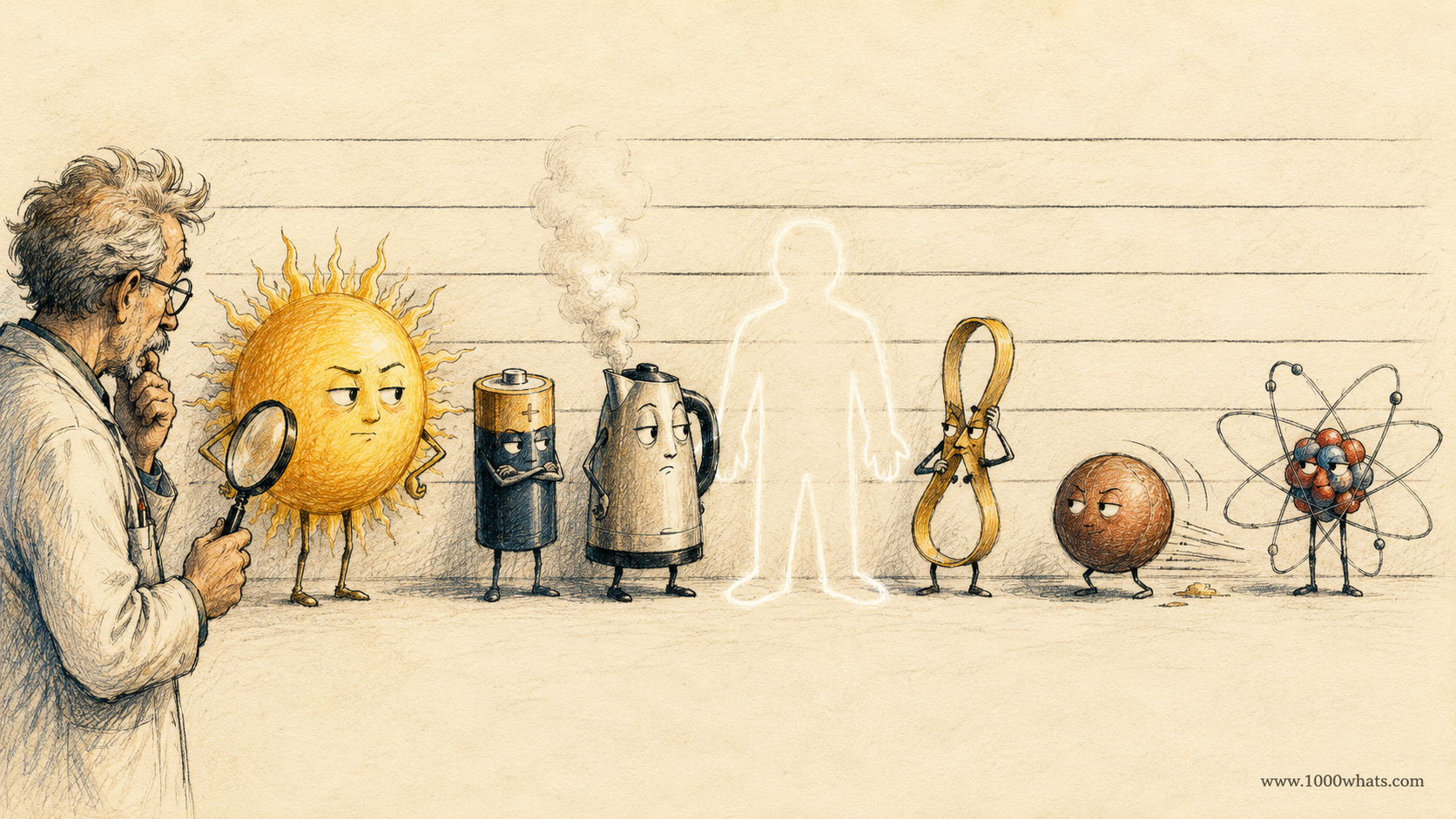
School gives us a wonderful energy wardrobe:
- kinetic energy
- gravitational potential energy
- chemical energy
- electrical energy
- thermal energy
- elastic energy
- nuclear energy
- electromagnetic energy
- rest energy
It can make energy sound like some cosmic actor changing costumes backstage.
Green shirt: chemical energy.
Red shirt: heat.
Running shoes: kinetic energy.
But these “forms” are mostly useful accounting categories describing where the energy is associated with a system and which physical interactions matter.
Kinetic energy is associated with motion.
Potential energy is associated with configuration.
Chemical energy reflects differences between molecular and electronic arrangements.
Nuclear energy involves changes in nuclear binding and mass.
Electromagnetic fields carry energy.
A body’s microscopic state contributes to its internal energy.
And if you’re already wondering where heat fits into all this, there is an important twist: heat is best understood not as a substance stored inside an object, but as energy transferred because of a temperature difference. That’s exactly why heat deserved its own 1000whats rabbit hole.
Different labels.
Same universal accounting currency.
The strange power of the joule
Whether energy appears in food, a battery, motion, radiation, or a nuclear reaction, we can express it using the same SI unit:
the joule (J).
One joule has dimensions of kg·m²/s², and it can also be understood mechanically as the work associated with one newton acting through one meter.
That should feel slightly absurd.
A falling brick.
A warm cup of coffee.
A beam of light.
Electricity.
A chemical reaction.
All measured in the same thing.
But that’s precisely the magic.
Physics discovered that phenomena which look completely unrelated can participate in the same energy bookkeeping system.
If joules, kilowatt-hours, BTUs, calories, and the rest of humanity’s measurement zoo are already starting to attack your brain, I’ve unpacked them separately in What is the unit of energy? Convert, compare, confuse!.
How does energy “work”?
Here is where language gets us into trouble again.
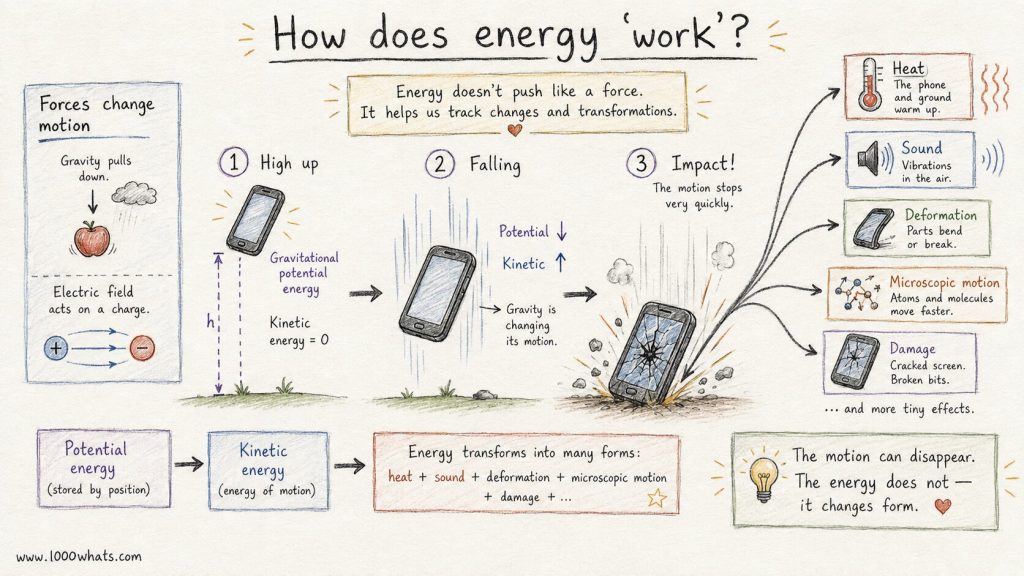
Energy does not necessarily do something like a force does.
Gravity accelerates objects.
Electric fields act on charges.
Forces change motion.
Energy is different.
Energy gives us a way to describe which states a system can move between and how the overall accounting changes while it does so.
Imagine dropping your phone.
Please don’t actually do this. Research budgets at 1000whats are limited.
At the top, the Earth-phone system has gravitational potential energy.
As the phone falls, that decreases while kinetic energy increases.
Then comes the unpleasant part.
Impact.
The phone stops moving.
So where did the kinetic energy go?
Into microscopic motion.
Deformation.
Sound waves.
Heating.
Maybe a creatively shattered screen.
The visible motion disappeared.
The energy didn’t simply vanish.
This is why energy is such a powerful concept. It lets us follow transformations even when the physical appearance of the system changes completely.
⚡ “Energy conservation does not mean nothing changes. It means change has bookkeeping rules.”
Energy conversion is basically the story of civilization
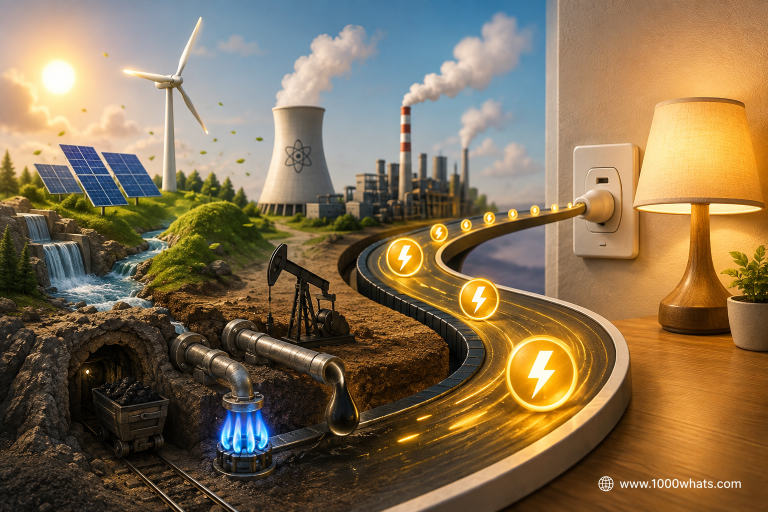
Look around the modern energy system and almost everything is an energy conversion machine.
A wind turbine takes kinetic energy from moving air and eventually delivers electrical energy. You can follow that chain in What is wind power?.
A solar photovoltaic cell interacts with incoming electromagnetic radiation and creates electrical output. That’s the story behind solar power.
A coal plant begins with chemical energy, releases internal energy through combustion, uses heat to create steam, turns a turbine, and uses electromagnetic induction to generate electricity. The fuel side of that journey is unpacked in What is coal?, while the generator physics lives in What is electromagnetic induction?.
A fusion reaction changes nuclear configurations and mass, releasing enormous amounts of energy—a much deeper rabbit hole covered in What is nuclear fusion?.
A battery converts electrochemical differences into electrical energy.
A motor converts electrical input into mechanical motion.
Your brakes convert organized vehicle motion mostly into microscopic thermal motion.
Civilization is not really an energy-producing machine.
It is an energy-conversion machine.
Wait—if energy cannot be created or destroyed, why do we say power plants “generate” energy?
Because ordinary language commits crimes against physics before breakfast.
A power plant does not normally create energy from nothing.
It converts energy.
A gas turbine converts chemical energy.
A hydroelectric station exploits gravitational and kinetic energy.
Solar panels convert electromagnetic energy arriving from the Sun.
Wind turbines extract part of the kinetic energy of moving air.
Nuclear plants access changes in nuclear binding energy.
When the electricity industry says “energy generation,” what it usually means is generation of a useful energy carrier—electricity—from some other energy source.
Electricity itself deserves special treatment because it is not simply synonymous with energy.
Electric current is the rate of flow of electric charge. Voltage describes electric potential difference—energy change per unit charge. Put voltage, current, fields, resistance, and time together, and you get electrical energy transfer.
The electrical world makes much more sense once you stop treating “electricity” and “energy” as interchangeable words.
Can energy be stored?
Yes.
But again, the mental image matters.
We say a battery stores energy.
A reservoir stores energy.
Coal stores energy.
A compressed spring stores energy.
But they are not warehouses filled with little glowing packets labeled ENERGY.
What they store are physical configurations from which energy can later be transferred.
A battery stores chemical disequilibrium.
A hydro reservoir maintains water at elevation.
Compressed gas occupies a high-pressure state.
A flywheel stores rotational kinetic energy.
Coal contains molecules whose reaction products can occupy lower-energy configurations after combustion.
Energy storage is really state storage.
That may sound like pointless philosophical nitpicking until you start designing batteries, hydrogen systems, thermal storage, pumped hydro, or grid-scale storage.
Then it becomes engineering.
Why does energy density matter so much?
Because having energy available is not the whole story.
You also care about how much energy you can associate with a certain mass or volume.
Gasoline became extraordinarily useful for transportation partly because a relatively small tank can support a large amount of useful energy conversion.
Batteries face the same problem.
Aircraft care obsessively about mass.
Ships have more room to negotiate.
Grid storage can tolerate dimensions that would make a smartphone designer faint.
This is the territory of energy density, which is one reason two energy technologies delivering the same final service can require wildly different quantities of material, space, fuel, and infrastructure.
From a market perspective, that matters enormously.
Energy is physics.
But useful energy in the right form, place, quantity, and moment is economics.
Why energy conservation is more profound than it looks
At school, conservation of energy sounds like one more rule to memorize:
Energy cannot be created or destroyed, only transformed.
Then Emmy Noether enters the room and politely detonates the simplicity.
In broad classes of physical theories, conservation laws are linked with symmetries. Spatial translation connects with momentum. Rotational symmetry connects with angular momentum. Time translation connects with energy. Modern field-theory treatments continue to use this deep relationship between spacetime symmetries and conserved energy-momentum quantities.
Imagine doing an isolated experiment today.
Then repeating the exact experiment tomorrow under exactly the same physical conditions.
If the fundamental rules themselves are unchanged merely because the calendar changed, the physics possesses a kind of time-translation symmetry.
And from that mathematical structure emerges an energy conservation relationship.
That is beautiful.
It also changes the philosophical flavor of energy.
Energy no longer looks merely like a mysterious cosmic fluid we discovered cannot disappear.
Instead, conservation appears deeply connected with the symmetry of the laws governing time evolution.
Now we’re getting somewhere.
Does that mean we finally know what energy is?
Not quite.
Physics is spectacularly successful at telling us how energy behaves.
We know how to calculate it.
We know how to measure changes in it.
We can track it through nuclear reactions, electrical circuits, chemical processes, particle collisions, heat engines, stars, and quantum systems.
What physics is less comfortable doing is answering:
“Yes, but what is energy made of?”
That question may itself be malformed.
Energy does not appear to be a material substance requiring smaller ingredients.
Asking what energy is “made of” may be like asking what velocity is made of.
Velocity is a property describing motion.
Electric charge is a property.
Momentum is a property.
Energy may belong in that conceptual family: a fundamental quantitative feature of physical states and dynamics, not a hidden substance underneath them.
And this is where science has to resist pretending that a formula automatically provides an ontology.
We can know the rules of something extraordinarily well without being able to turn it into a little object in our imagination.
Einstein made the story even stranger
Then came:
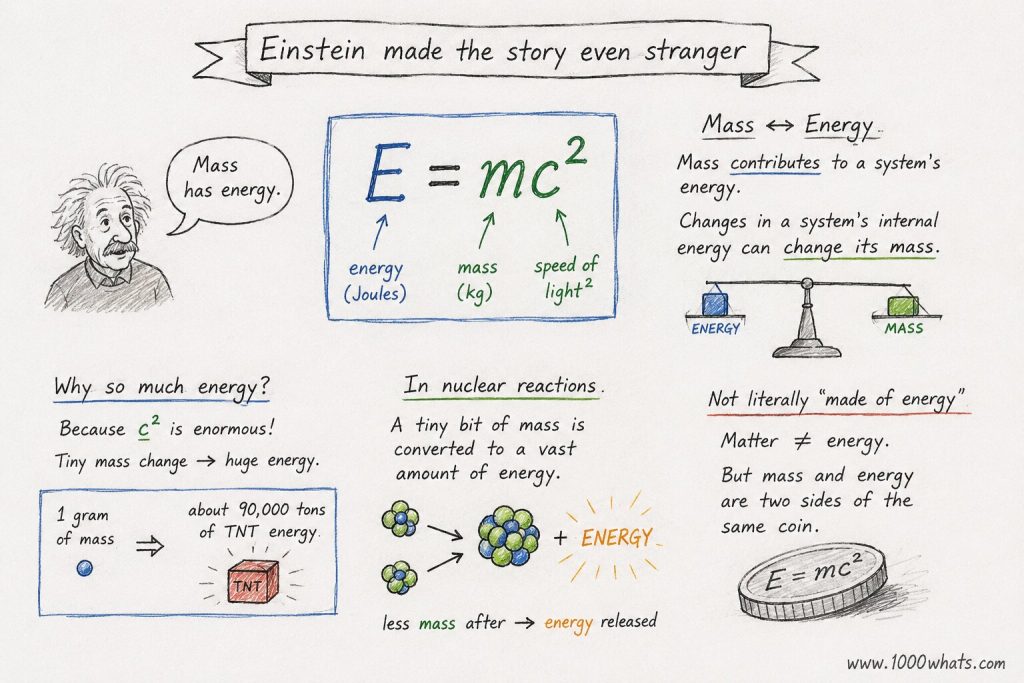
E = mc².
Probably the most famous equation on Earth.
Also one of the most abused.
The essential idea is that mass itself contributes to a system’s energy. In relativity, mass and energy are not unrelated categories living in separate filing cabinets. Rest mass corresponds to rest energy, and modern metrology itself connects mass, energy, frequency, and Planck’s constant in deep ways.
This does not mean that matter is literally “made of energy” in the way bread is made of flour.
That phrase is catchy but slippery.
A better way to say it is:
Mass contributes to the energy of a physical system, and changes in a system’s internal energy can change its mass.
This is why nuclear reactions can release enormous amounts of energy from comparatively tiny changes in mass.
And it is why nuclear fusion can get such a ridiculous energy payoff from so little fuel.
Quantum mechanics makes energy even less object-like
Now shrink reality.
Way down.
In quantum mechanics, energy is represented by an operator associated with the Hamiltonian of the system.
Certain quantum states have definite possible energy values.
Atoms, for example, do not allow electrons to occupy arbitrary classical energy states. Their permitted states are quantized.
Light joins the weirdness too.
Electromagnetic radiation exchanges energy in quantum packets associated with photons, with photon energy related to frequency through Planck’s constant.
That is part of the strange territory behind wave-particle duality, where our comfortable everyday categories start collapsing and physics keeps working anyway.
At this scale, energy looks even less like fuel.
It behaves like part of the mathematical structure defining which physical states and transitions are possible.
If energy is conserved, why do we have an energy crisis?
Because humanity does not need energy in the abstract.
The universe has plenty of that.
We need energy that is:
available,
concentrated,
controllable,
convertible,
transportable,
affordable,
and available when and where we want it.
A warm ocean contains an enormous amount of internal energy.
Good luck running your laptop directly from it.
A barrel of oil is useful because its energy is concentrated in a form that can be stored and transported.
Electricity is extraordinarily useful because it can be transmitted, controlled, and converted efficiently into motion, light, computation, and heat.
This is where thermodynamics enters with a smirk.
Energy quantity can remain accounted for while energy quality deteriorates.
A rotating turbine contains organized mechanical energy.
Friction eventually spreads that energy into microscopic thermal motion.
The energy hasn’t disappeared.
But getting all that diffuse heat back into perfectly organized turbine rotation is another matter entirely.
That is why energy conservation alone is not enough to understand engines, efficiency, economics, or civilization.
You also need entropy.
The universe keeps the energy books—but the money gets harder to spend
Here is one of the deepest practical lessons in thermodynamics:
A joule is a joule in the energy ledger, but not every joule is equally useful.
One kilowatt-hour of electricity can drive a motor with remarkable precision.
One kilowatt-hour of low-temperature heat floating around the environment is much harder to turn entirely back into electricity.
Same energy quantity.
Different usefulness.
This is why “waste energy” is often not missing energy.
It is energy that has ended up in a form, temperature, location, or time where we no longer value it much.
The heat story goes directly into this problem: power plants, industrial processes, motors, buildings, computers, and transport systems constantly move energy toward more dispersed thermal states.
What most people don’t see is that much of the energy transition is therefore not simply about finding energy.
It’s about controlling energy conversions and energy quality more intelligently.
Is energy a product?
Physics would raise an eyebrow.
Markets would send you an invoice.
In economic life, we buy gasoline, natural gas, electricity, district heat, hydrogen, coal, and other things we call energy products.
But the product is not some pure chunk of “energy.”
The product is a physical commodity or delivered service that gives us access to particular energy transformations.
That distinction is unpacked in What is an energy product? From the energy shelves.
From a market perspective, this is huge.
Nobody wants 10 kWh simply because 10 kWh is a pretty number.
They want:
a warm house,
a moving car,
molten steel,
cold beer,
a running server,
a lit hospital,
or another episode streaming at 2 a.m.
Consumers rarely want energy itself. They want what energy makes possible.
The real-world example hiding in your electric kettle
Press the switch on an electric kettle.
A surprisingly long chain of physics wakes up.
Electrical energy reaches the heating element.
Current moves through resistance.
Electrical energy becomes internal energy in the element.
Energy transfers into the water.
Molecular motion changes.
The water temperature rises.
Eventually, if you keep going, liquid water turns into vapor.
Your boring kitchen appliance has just connected:
electricity → resistance → internal energy → heat transfer → molecular motion → phase change.
And upstream?
That electricity might have come from:
wind,
solar radiation,
falling water,
coal chemistry,
natural gas,
nuclear fission,
or something else entirely.
The kettle doesn’t care.
A joule arriving electrically can have a wildly different history from the joule beside it.
Energy gives physics a common language across those histories.
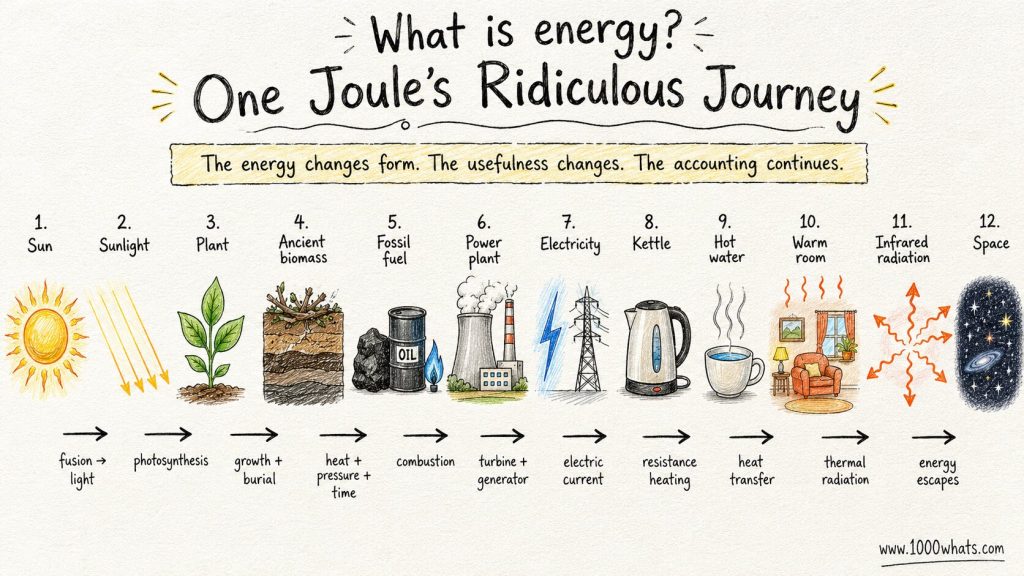
So where did all Earth’s usable energy come from?
Most—but not all—energy used by life and human civilization can be traced through a surprisingly small number of ultimate sources.
The Sun is the giant one.
Sunlight drives photosynthesis.
Ancient photosynthesis helped create the biological material that eventually became many fossil fuels.
Uneven solar heating helps drive atmospheric circulation and therefore wind.
Sunlight drives the water cycle that lifts water before hydroelectric systems exploit gravity on the way back down.
Solar panels skip many middlemen and interact with sunlight directly.
But not everything is solar.
Nuclear fuels access binding energy originating in nuclear processes.
Geothermal energy taps Earth’s internal heat.
Tidal energy involves gravitational interactions dominated by the Earth-Moon system.
So the modern energy economy is really harvesting a handful of physical gradients and reservoirs created by astrophysics, gravity, chemistry, nuclear structure, and planetary history.
Pretty dramatic origins for something that ends up as a utility bill.
Is energy good or bad?
Neither.
Energy has no political party.
No environmental ideology.
No moral alignment.
A joule doesn’t care whether it came from coal or sunlight.
But the system producing and converting that joule matters enormously.
Coal combustion can deliver useful energy while also releasing greenhouse gases and air pollutants. Solar and wind avoid fuel combustion but bring their own land, material, grid, variability, and infrastructure questions. Nuclear offers extraordinary energy density while introducing different waste, cost, safety, and institutional challenges.
That is why arguments about “good energy” and “bad energy” are usually arguments about energy technologies, externalities, economics, risk, and conversion pathways, not energy itself.
And once environmental consequences enter the discussion, concepts such as carbon footprint become part of the accounting too.
Physics tells us what transformations are possible.
Society decides which ones it wants.
Here is where energy gets genuinely weird: Is energy always conserved?
In everyday mechanics, electrical engineering, chemistry, and most energy-industry calculations, treating energy as conserved is extraordinarily successful.
Build your engineering around that assumption.
Please.
But take the question to cosmological scales and general relativity gets less cooperative.
In curved, dynamical spacetime, defining a single globally conserved “total energy of the universe” is not always straightforward or even generally possible in the same way it is for a simple isolated laboratory system. Research on energy in expanding universes explicitly highlights that even defining the relevant total energy can become difficult in general relativity.
This is not physics forgetting its own rules.
It is a reminder that the familiar conservation statement relies on deeper mathematical structure.
Remember the connection with time symmetry?
An expanding universe does not necessarily possess the same global time-translation symmetry as the systems in your mechanics textbook.
And suddenly our innocent little sentence—
“Energy is always conserved.”
—needs footnotes.
Big ones.
Does the expanding universe “lose” photon energy?
This is one of my favorite examples because it makes even scientifically literate people uncomfortable.
As the universe expands, light traveling through it can be cosmologically redshifted.
Its wavelength stretches.
Its frequency decreases.
And because photon energy is proportional to frequency, the measured photon energy decreases.
So where did the energy go?
The instinctive answer is:
“Somewhere. Obviously. Conservation!”
But in general relativity, asking for a universal global account may not have the simple answer we expect from laboratory physics.
In curved spacetime, the definition and conservation of global energy are subtle enough that serious research papers are devoted specifically to what “energy conservation” means in expanding universes.
That doesn’t destroy conservation physics in your power grid.
Your utility engineer may continue sleeping peacefully.
It means that our everyday version of the law is not automatically a universal cosmic bookkeeping statement without conditions.
And that is much more interesting.
What don’t we know about energy?
Quite a lot.
Not because physics has failed.
Because the deeper we dig, the more ambitious the questions become.
We do not know why the universe has exactly the laws and symmetries it has.
Noether’s theorem connects symmetries with conservation relationships, but that pushes the ultimate “why?” one level deeper.
Why those symmetries?
Why these fields?
Why these constants?
Why this universe?
Physics currently describes those patterns much better than it explains why reality had to choose them.
We also do not have a complete theory unifying quantum physics and gravity. And because gravity itself complicates the definition of energy, this matters enormously when we ask what energy means at the deepest level.
Then there is vacuum energy.
Quantum field theory does not picture empty space as a simple classical nothing. Cosmology, meanwhile, tells us that something associated with the dark-energy sector appears to be influencing cosmic expansion.
What that “something” fundamentally is remains unresolved.
And the story became even more interesting recently.
DESI’s three-year DR2 cosmology results found that a standard cosmological-constant model still describes important data well, while certain combinations with CMB and supernova measurements show a statistically interesting preference for models in which dark energy evolves over time. The result is intriguing, not a final discovery; the collaboration itself emphasizes that unknown systematic effects remain a possibility.
As of 2026, the dark-energy question is very much alive.
So humanity has reached an amusing point:
We can trade electricity every fifteen minutes.
Price it to fractions of a cent.
Measure energy with extraordinary precision.
Split atoms.
Fuse nuclei.
Detect photons from billions of light-years away.
And still ask:
What, fundamentally, is the energy of empty space?
Science is fun like that.
What we know—and what we don’t
Here’s the cleanest dividing line.
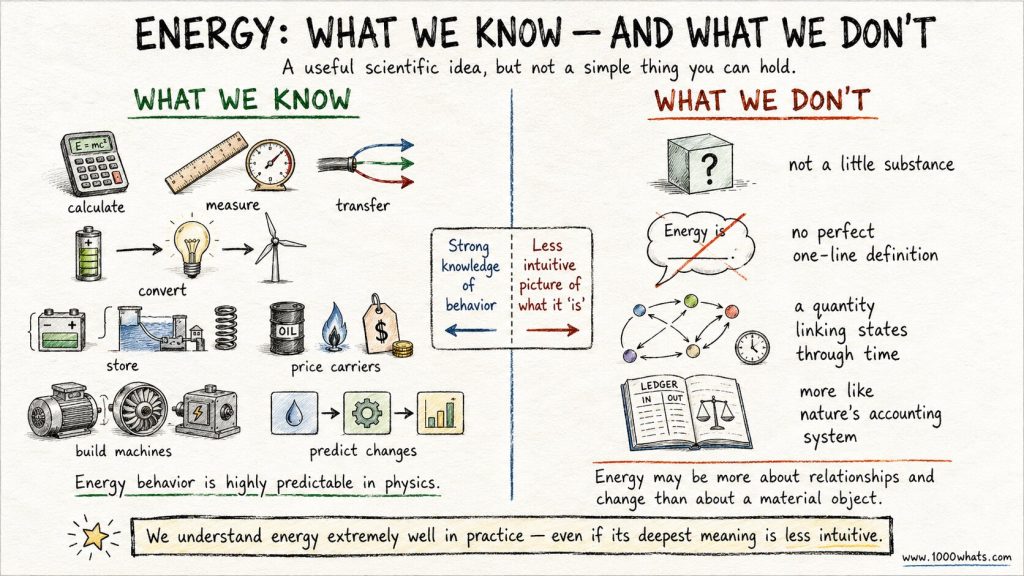
We know extremely well how energy behaves in enormous classes of physical systems.
We know how to calculate it.
Measure it.
Transfer it.
Convert it.
Store useful physical states associated with it.
Price the commodities that carry it.
Build machines around it.
And predict transformations with astonishing accuracy.
What we do not have is a tiny sentence that turns energy into an intuitive material object.
Perhaps we never will.
Because energy may not be that kind of thing.
It may be closer to one of nature’s deepest accounting structures—a quantity embedded in how physical states relate to one another through time.
⚡ “The mystery of energy is not that physics cannot use it. The mystery is that physics can use it almost perfectly without turning it into a thing.”
Why energy matters today
The irony is that the more abstract energy becomes in fundamental physics, the more brutally practical it becomes in civilization.
Everything we are trying to do right now—
electrify transport,
decarbonize heat,
build renewable power,
run AI infrastructure,
produce steel,
cool cities,
secure electricity grids,
store renewable generation,
create hydrogen,
lower emissions,
and keep energy affordable—
is fundamentally about controlling energy transformations.
That’s why understanding energy matters.
Not just because it appears in physics exams.
Because every energy-policy debate eventually collapses back into physics.
You cannot legislate around conservation laws.
You cannot negotiate with thermodynamics.
You cannot subsidize your way around entropy.
You can only build smarter systems within the rules nature gives you.
And that is where physics becomes economics.
Economics becomes politics.
Politics becomes infrastructure.
And infrastructure becomes the world you wake up in tomorrow morning.
Final thoughts
So, what is energy?
If you’re answering a school exam, say:
Energy is the capacity to do work or transfer heat.
You’ll probably get the point.
If you’re talking to an engineer, energy is the conserved accounting quantity moving through machines, fuels, fields, heat, electricity, and physical processes.
If you’re talking to a physicist, things become more interesting.
Energy is a property of physical systems, central to their dynamics, closely tied to time evolution and symmetry, expressed through different physical contributions, and conserved under conditions whose deepest meaning becomes richer once relativity and quantum theory enter the room.
And if you’re asking the biggest philosophical question—
“But what is energy really?”
—the scientifically respectable answer may be:
We know extraordinarily well what energy does, how it behaves, how it transforms, and how to calculate it.
Whether there is a deeper “thing” behind that mathematical and physical structure is a question nature has not handed us in plain English.
Maybe that is the point.
Energy isn’t mysterious because science knows nothing about it.
Energy is mysterious because science knows so much about its behavior while the simple mental picture keeps slipping through our fingers.
That is not a weakness.
That’s the edge of understanding.
And frankly, that is where things get interesting.
What do you think: is energy a real “thing” in nature, or is it the universe’s most powerful bookkeeping concept?
Until next time, stay curious! 😎
Discover more from 1000whats
Subscribe to get the latest posts sent to your email.