
Imagine a factory.
Its motors are spinning.
Pumps are pumping.
Compressors are compressing.
Machines are producing things that will eventually require meetings, invoices, and several Excel files.
The factory is consuming electrical power.
Easy.
Now imagine the electricity supplier tells you:
Some of the power flowing into your factory is doing no net useful work.
Excellent.
Can we stop paying for it?
Not so fast.
Because without that apparently useless power, many of those motors would stop behaving properly.
And at grid scale, voltage could become a serious problem.
Welcome to 1000whats — where today we meet the electricity that goes back and forth, accomplishes no net energy transfer over a complete AC cycle, occupies network capacity, creates losses, supports voltage, and somehow remains absolutely necessary.
Electricity really does enjoy making simple things complicated.
This strange quantity is:
reactive power.
⚡ “Reactive power does not deliver net energy to the load. It helps create the electrical conditions that let useful power do its job.”
That distinction is the whole article.
First, remember what electrical power normally means
In a simple DC circuit, electrical power behaves beautifully.
Voltage:
V
Current:
I
Power:
P = V × I
A 10 V source pushing 2 A through a suitable load delivers:
20 W
Nice.
Clean.
Everyone goes home early.
Alternating current has other plans.
In AC systems, voltage and current continuously change direction.
In a simple resistive load—say, an ideal heating element—they rise and fall together.
Voltage reaches its positive peak.
Current reaches its positive peak.
Voltage falls.
Current falls.
They are:
in phase.
Electrical energy flows into the load and becomes useful output such as heat.
So far, so civilized.
Then we connect a motor.
Motors ruin the easy explanation
A motor needs magnetic fields.
So does a transformer.
And magnetic fields do not simply appear because we politely requested mechanical work from the machine.
They require current.
Many common AC loads are inductive, meaning their magnetic fields store energy during part of the AC cycle and return some of that energy during another part.
This shifts the timing between:
voltage
and:
current.
Instead of rising and falling together, current can lag behind voltage.
The U.S. Department of Energy explains that inductive equipment such as motors and transformers requires a magnetizing-current component to sustain electromagnetic fields. That component creates reactive power, while another current component produces useful work.
Now AC power has split into different personalities.
We get:
real power
and:
reactive power.
Real power is the easy one
Real power is the part that performs net useful work.
It:
turns the motor shaft,
heats the oven,
lights the lamp,
runs the server,
charges the battery.
It is measured in:
watts (W)
or, at larger scales:
kW, MW, GW.
NERC defines real power simply as the portion of electricity that supplies energy to the load.
That is the power your electricity meter is mostly interested in when measuring energy consumption over time.
It is also the power we usually mean when we say:
a 500 MW power plant.
So what on Earth is reactive power?
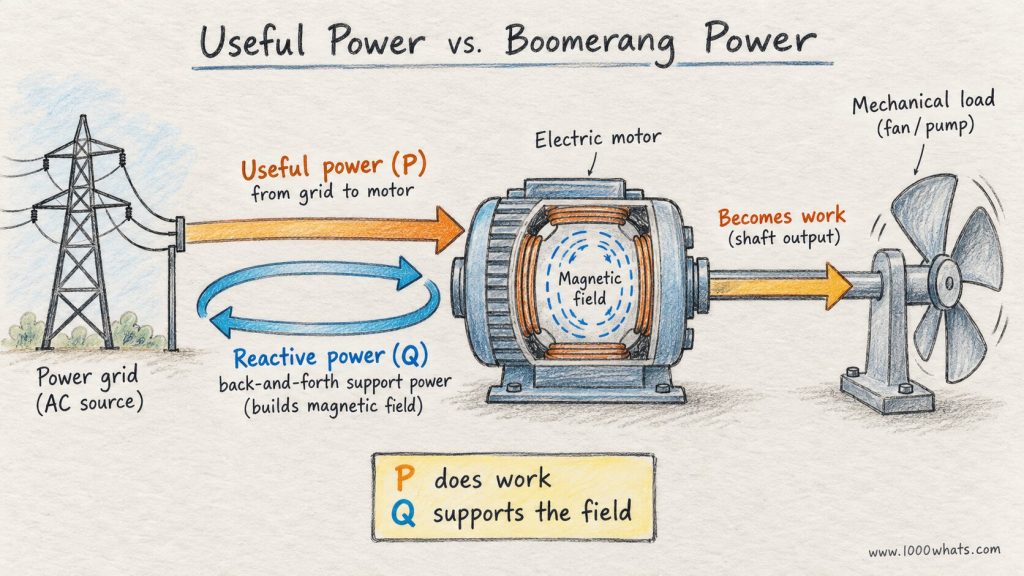
Reactive power is energy playing catch
Imagine pushing a child on a swing.
During one part of the motion, you put energy into the system.
The swing stores it temporarily as kinetic and gravitational potential energy.
Then some of that stored energy comes back through the motion.
Back.
Forth.
Back.
Forth.
An ideal inductor or capacitor in an AC system does something conceptually similar with electromagnetic or electric fields.
During part of the cycle:
energy flows into the field.
During another part:
energy flows back toward the electrical system.
Over a complete ideal cycle, there is no net energy consumed by this exchange.
But current still flows.
Equipment still has to carry it.
The network still feels it.
The U.S. Department of Energy describes reactive power as power that does not perform useful work but circulates between source and load while supporting the electromagnetic fields required by inductive equipment.
This is the key.
Reactive power is not:
energy disappearing into nothing.
It is:
energy oscillating between the network and electric or magnetic fields.
Electricity has invented a boomerang.
Why do we call it reactive?
Because the circuit is reacting to the changing AC voltage through:
inductance
and:
capacitance.
Inductors store energy in:
magnetic fields.
Capacitors store energy in:
electric fields.
And they behave oppositely with respect to the timing of voltage and current.
For a predominantly inductive load:
current lags voltage.
For a predominantly capacitive load:
current leads voltage.
That timing difference creates the reactive component of power.
If you have ever heard an electrical engineer say:
leading
or:
lagging power factor
and nodded thoughtfully while hoping nobody asked a follow-up question—
this is what they were talking about.
Reactive power gets its own unit
Real power:
watts (W).
Reactive power:
volt-amperes reactive (VAr).
At grid scale:
MVAr.
Yes.
We created an entirely different unit partly so nobody accidentally mistakes reactive power for useful real power.
NERC defines reactive power as the portion of electricity that establishes and sustains electric and magnetic fields in AC equipment and notes that it is commonly expressed in kvar or Mvar.
Then there is a third quantity:
apparent power.
Measured in:
volt-amperes (VA).
Now we have:
- P = real power, W
- Q = reactive power, VAr
- S = apparent power, VA
Because three kinds of power were apparently the minimum required to keep electrical engineering interesting.
Meet the power triangle
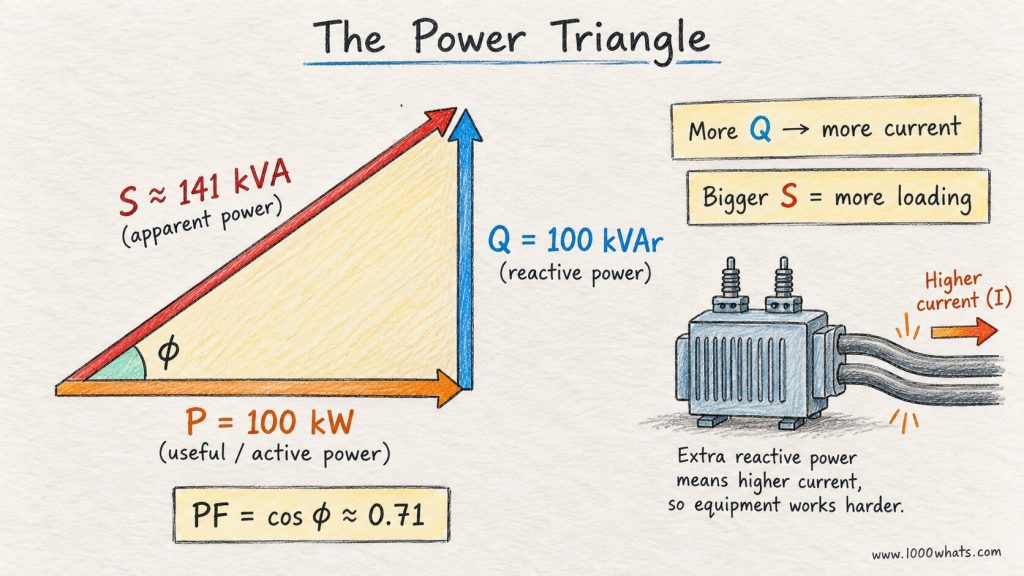
For a simple sinusoidal AC system, real power, reactive power, and apparent power form a right triangle.
Horizontal side:
P — real power
Vertical side:
Q — reactive power
Hypotenuse:
S — apparent power
So:
S² = P² + Q²
This is one of those diagrams that initially looks like engineers invented geometry to make electricity worse.
It actually makes the concept much easier.
Suppose a factory uses:
100 kW of real power
and:
100 kVAr of reactive power.
Its apparent power is not 100 kVA.
It is about:
141 kVA.
The equipment supplying that factory therefore has to deal with current corresponding to roughly 141 kVA even though only 100 kW is doing net useful work.
The Department of Energy uses essentially this example in its power-factor guidance: 100 kW real power combined with 100 kVAr reactive power produces roughly 142 kVA apparent power.
And now reactive power starts costing us something.
This is where power factor enters
Power factor tells us how much of the apparent power is real power.
For a simple sinusoidal case:
Power Factor = Real Power / Apparent Power
or:
PF = P / S
If:
P = 100 kW
and:
S = 100 kVA
then:
PF = 1.0
Beautiful.
If:
P = 100 kW
but:
S = 141 kVA
then:
PF ≈ 0.71
The same 100 kW of useful work now requires substantially more current to be carried through cables, transformers, and other equipment.
The Department of Energy defines power factor as the ratio of real power to apparent power and notes that a power factor approaching unity indicates more effective use of the electrical distribution system.
This is why industrial facilities care about power factor.
Not because accountants developed a sudden interest in trigonometry.
Because low power factor can cost money.
Why does low power factor cost money?
Suppose two factories both need:
1 MW of useful real power.
Factory A has excellent power factor.
Factory B has poor power factor.
Factory B requires more current to deliver the same real power.
More current means:
greater conductor loading,
greater transformer loading,
greater electrical losses,
larger voltage drops,
and less remaining network capacity.
So from the utility’s perspective, the second factory is asking:
Please build enough electrical infrastructure for more current than my useful energy consumption alone would suggest.
Utilities tend to notice this.
Some therefore charge large customers for poor power factor or reactive energy.
The U.S. Department of Energy notes that commercial customers can face reactive-power charges when their power factor falls below specified thresholds, with 95% cited as an example.
The reactive power may do no net work.
The invoice remains impressively real.
So how do factories fix power factor?
Often with:
capacitors.
Remember:
motors and transformers are largely inductive.
Inductive loads tend to require reactive power in one direction.
Capacitors behave in the opposite way.
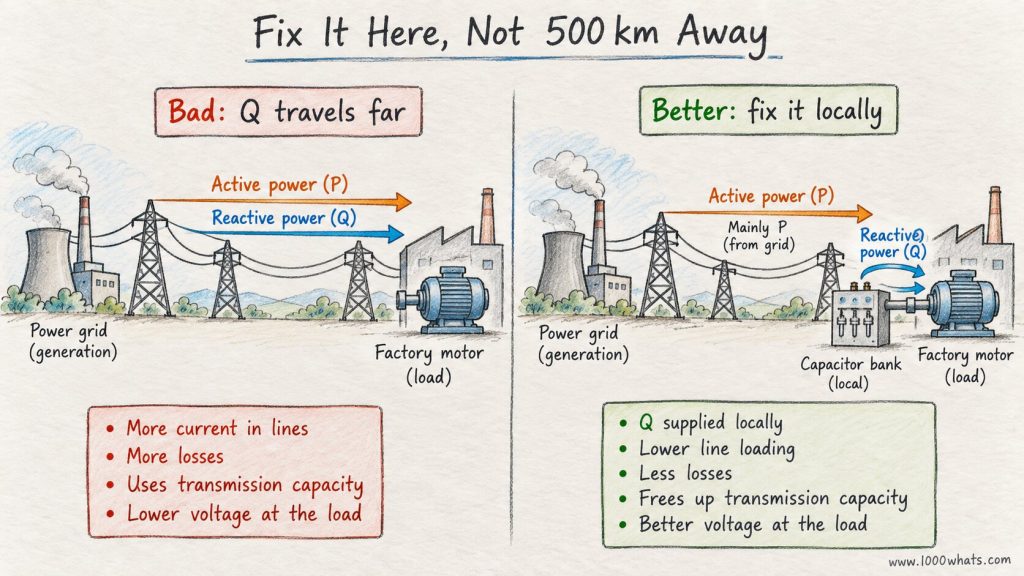
So instead of making the grid supply all the reactive power demanded by the motors, a capacitor bank installed near the load can provide part of it locally.
Imagine:
motor wants reactive power.
Capacitor says:
I have some.
Grid says:
Wonderful. Please leave me out of this.
The amount of reactive power traveling through the wider network falls.
Current falls.
Losses can fall.
Network capacity is freed.
Power factor improves.
This is:
power-factor correction.
The Department of Energy specifically recommends properly applied capacitors as a common method for reducing the reactive-power burden of inductive industrial loads.
Sometimes the smartest way to move reactive power is:
don’t.
Produce it where you need it.
And that brings us to the grid
So far we have mostly discussed factories.
At transmission-system scale, reactive power becomes even more interesting because it is closely tied to:
voltage.
My existing voltage explainer describes voltage from the basic electrical perspective.
But maintaining voltage across a huge AC network is not simply a matter of choosing:
400 kV
and typing it into a settings menu.
Voltage changes with:
generation,
load,
network topology,
transmission-line loading,
transformer operation,
and disturbances.
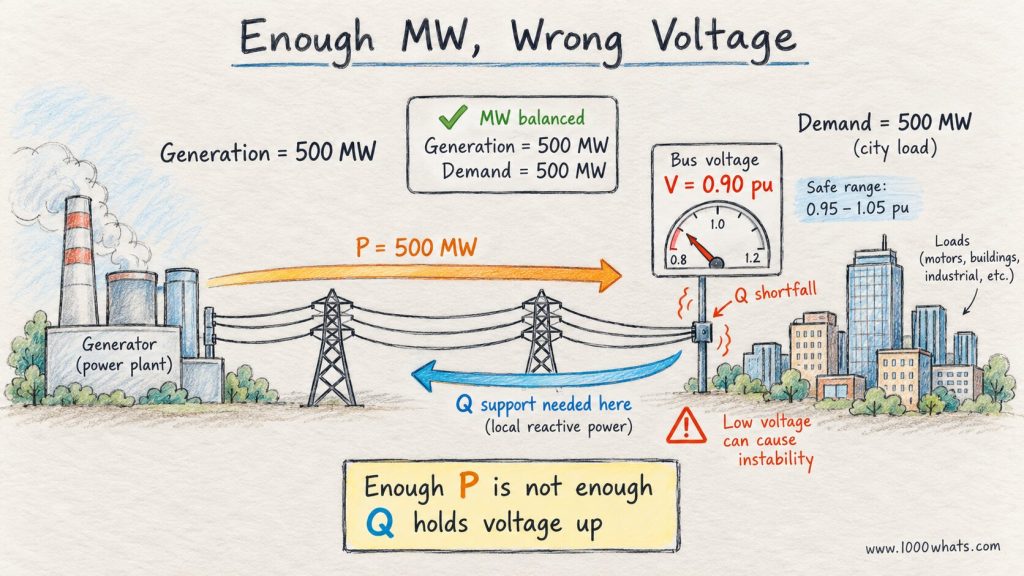
Reactive-power injection or absorption is one of the principal tools system operators use to control it.
NERC notes that reactive power directly influences electric-system voltage.
That gives us the grid-level rule worth remembering:
active power is strongly associated with frequency balance; reactive power is strongly associated with voltage control.
That is simplified.
But enormously useful.
⚡ “MW tells you whether the grid has enough real power. MVAr helps determine whether the voltage behaves while that power gets there.”
Reactive power is surprisingly local
Suppose southern Serbia needs more active power.
In an interconnected European system, electricity may potentially come from a generator hundreds of kilometers away, subject to network capacity and market arrangements.
Reactive power is much less cooperative.
Reactive power needs to be generated or absorbed reasonably close to where the system needs it because transporting it over long distances increases network loading and losses and is much less effective for local voltage control.
This makes reactive power fundamentally different from ordinary energy.
If Belgrade needs voltage support, having enormous reactive capability in Portugal is comforting in a European-solidarity sense.
Electrically?
Not the first solution I would try.
Location matters.
A lot.
Who provides reactive power to the grid?
Quite a few technologies.
Traditional synchronous generators can produce or absorb reactive power by changing their excitation.
But the grid also uses dedicated equipment such as:
- capacitor banks;
- shunt reactors;
- synchronous condensers;
- static VAR compensators;
- STATCOMs;
- wind-turbine converters;
- solar inverters;
- battery inverters.
Some produce reactive power.
Some absorb it.
Some can do both.
And increasingly, devices originally installed primarily to deliver active power are being asked to help with voltage too.
That is a major theme of the modern grid.
The machine may have been built to sell:
MW.
The system operator is increasingly interested in what else it can do.
The wonderfully strange synchronous condenser returns
If you have read our grid-inertia article, you have already met one of electricity’s most charmingly strange machines.
A:
synchronous condenser.
It looks broadly like a synchronous generator.
It spins like one.
It can provide reactive power.
It can support voltage.
It contributes short-circuit strength.
It can provide physical inertia.
But it does not need a turbine producing useful active power.
NERC lists synchronous condensers among the resources that can provide reactive power.
We essentially take a generator, remove its main job, and discover that several of its side jobs are valuable enough to keep the machine.
Energy transition engineering can be wonderfully pragmatic.
We no longer need you to generate electricity.
But could you keep spinning?
STATCOM: reactive power without the giant spinning machine
Now replace the rotating machine with power electronics.
A STATCOM, or Static Synchronous Compensator, can rapidly inject or absorb reactive current to regulate voltage at its connection point.
In simple terms:
Voltage too low?
The STATCOM can provide appropriate reactive support.
Voltage too high?
It can absorb reactive power.
And it can respond very quickly.
This is especially useful in grids increasingly filled with:
wind,
solar,
HVDC,
batteries,
and other converter-connected equipment.
The grid is gradually replacing some functions once supplied naturally by huge rotating machines with devices built specifically to provide them.
The old grid got several services bundled together.
The new grid increasingly buys them à la carte.
Solar and batteries can play too
A solar inverter’s obvious job is:
DC from solar panels → AC for the grid.
But modern inverters can do more.
They can control reactive power.
They can operate according to power-factor targets.
They can follow Volt-VAR curves and adjust reactive output according to local voltage.
The IEA has highlighted smart inverters as an important way for high-PV systems to provide voltage, reactive-power, and other ancillary services.
That means a solar plant can potentially help support the grid even when the interesting product is not another MWh.
A battery inverter can do similar things.
And under suitable inverter design and operating conditions, some inverter-based resources can provide reactive support even when active-power output is low.
Your solar plant may therefore have a night job.
Energy assets are becoming disappointingly employable.
But inverter capacity is not infinite
Suppose an inverter is rated:
100 MVA.
It is producing:
100 MW of active power
at essentially unity power factor.
How much spare apparent-power capacity remains for reactive output?
Very little.
Now suppose active output is:
80 MW.
The power triangle gives us:
S² = P² + Q²
So with:
S = 100 MVA
P = 80 MW
the theoretical reactive capability within that simple limit is:
Q = 60 MVAr.
Same inverter.
Different operating point.
This is why active and reactive capability can compete for inverter capacity.
Some projects deliberately oversize inverters or design their plants around grid-code reactive requirements.
Because the interconnection agreement does not care that your spreadsheet wanted every amp devoted to selling active power.
The grid may need something else.
Reactive power can be consumed by the network itself
Here is another fun detail.
Reactive power is not just something industrial motors demand.
The grid itself has electrical characteristics.
Transmission lines have:
inductance
and:
capacitance.
Transformers consume reactive power.
Long cables can produce significant capacitive reactive power.
Overhead lines can produce or consume reactive power depending on loading.
NERC’s reactive-power planning guidance explains the role of reactive-power sources and requirements across transmission systems.
So the grid is not merely:
a neutral pipe carrying electricity.
The pipe is electrically participating in the problem.
Of course it is.
Lightly loaded lines can create the opposite problem
We often talk about low voltage.
But voltage can also become:
too high.
Long, lightly loaded transmission lines and cables can produce capacitive reactive power.
That can push voltage upward.
Now the system may need devices that:
absorb reactive power.
For example:
shunt reactors,
synchronous condensers operating appropriately,
STATCOMs,
generators,
or other compensating equipment.
So voltage control is not:
add reactive power forever.
It is:
maintain the right local balance.
Too little support can be a problem.
Too much can also be a problem.
Electricity systems remain committed to the principle that there should be no easy setting labeled:
GOOD.
What happens if voltage control goes wrong?
Now we reach the reason this obscure-looking topic deserves its own article.
On April 28, 2025, continental Spain and Portugal suffered a massive blackout.
ENTSO-E’s independent Expert Panel published its final report on March 20, 2026.
The report did not identify one magical villain.
Instead, it found multiple interacting factors, including:
oscillations,
gaps in voltage and reactive-power control,
differences in voltage-regulation practices,
rapid output reductions,
generator disconnections,
and uneven stabilizing capabilities.
Those factors contributed to fast voltage increases and cascading generation disconnections.
This is important because it destroys a very intuitive misconception.
A blackout does not necessarily begin because:
the country ran out of MW.
Power systems can fail through:
frequency instability,
voltage instability,
protection behavior,
network faults,
oscillations,
cascading disconnections,
or combinations of several problems.
The Iberian event was a dramatic reminder that:
voltage and reactive power are not electrical housekeeping.
They are system security.
Reactive power is not energy
This deserves explicit treatment because the terminology invites confusion.
Reactive power is measured in:
VAr.
Reactive energy can be measured over time in:
VArh.
But reactive power itself does not represent net useful energy being delivered to the load over the cycle.
It represents the oscillating exchange associated with electric and magnetic fields.
That is why saying:
“the factory consumed 5 MVAr”
without time context is technically the wrong kind of sentence.
MVAr is power.
Not energy.
The same distinction applies between:
MW
and:
MWh.
If that distinction still occasionally causes trouble, my existing What Is Power? article was built almost entirely because humanity apparently needed an intervention.
Is reactive power bad?
No.
Too much unwanted reactive flow through the wrong part of the network?
Bad.
Insufficient reactive support where voltage needs it?
Also bad.
Reactive power itself?
Necessary.
This is the conceptual trap.
People hear:
does no useful work
and conclude:
useless.
But the magnetic field in your motor is not useless.
Voltage support is not useless.
A transformer is not particularly useful without its electromagnetic fields.
Reactive power is more like the backstage infrastructure required for the useful energy conversion to happen.
Nobody bought a concert ticket because they were excited about the lighting rig’s power distribution.
Try holding the concert without it.
So why not eliminate reactive power completely?
Because then you would also have to eliminate many of the electromagnetic phenomena on which AC power systems depend.
Motors.
Transformers.
Transmission-network characteristics.
Voltage control.
Not ideal.
The objective is therefore not:
zero reactive power everywhere.
It is:
manage reactive power intelligently.
Produce or absorb it where needed.
Avoid transporting excessive amounts unnecessarily.
Keep power factor sensible.
Maintain voltage within safe limits.
Ensure generators and inverter-based resources have appropriate capability.
Install compensation where the network needs it.
In other words:
reactive power is not a defect to remove.
It is a quantity to control.
⚡ “The goal is not to get rid of reactive power. The goal is to stop making it travel somewhere it does not need to go.”
Active power vs. reactive power
Here is the entire article compressed into one table.
| Active / real power | Reactive power | |
|---|---|---|
| Symbol | P | Q |
| Unit | W, kW, MW | VAr, kVAr, MVAr |
| Net useful energy transfer? | Yes | No, ideally oscillates back and forth |
| Typical role | Motors, heat, light, useful work | Fields, voltage support |
| Travels long distances well? | Relatively yes | Much less efficiently |
| Closely linked operationally with | Frequency / energy balance | Voltage |
| Common providers | Generators, batteries, loads | Generators, capacitors, reactors, condensers, STATCOMs, inverters |
| Commercial relevance | Energy sales | Grid support, network capacity, power-factor charges |
And together:
P + Q → S
not by simple arithmetic, but through the power triangle.
The electricity industry managed to turn a triangle into a business model.
Respect.
Why reactive power matters more in the energy transition
Reactive power is not new.
Motors were inductive before solar panels existed.
Voltage needed controlling when power stations were coal-fired.
What is changing is:
where the capability comes from.
Traditional power systems had many large synchronous generators online.
Those machines could supply:
active power,
reactive power,
voltage control,
inertia,
short-circuit current,
frequency response,
and other useful grid characteristics.
As my Ancillary Services article explains, much of the modern energy transition involves discovering that old generators had several side jobs.
Now wind, solar, batteries, HVDC links, synchronous condensers, STATCOMs, and other devices increasingly divide those jobs among themselves.
This is not inherently worse.
In some cases, power electronics can control reactive power extremely quickly.
But it does mean system planners have to think explicitly about capabilities that used to arrive bundled with conventional generation.
We are not merely replacing:
coal MW
with:
solar MW.
We are redesigning the electrical behavior of the grid.
That is a much bigger engineering story.
So, what is reactive power in one sentence?
Reactive power is the oscillating component of AC power associated with electric and magnetic fields; it performs no net useful energy transfer over a complete cycle but is essential for equipment operation and voltage control.
Measured in:
VAr.
At grid scale:
MVAr.
But the better mental model is:
the power that keeps the electrical conditions right so real power can do the actual work.
That is why something that apparently does nothing can be so important.
Final thoughts
Reactive power has terrible marketing.
It does no net useful work.
It increases current.
It consumes network capacity.
It contributes to losses.
Factories may be charged for demanding too much of it.
And its unit sounds like somebody misspelled “var.”
Not promising.
Then you discover that motors need electromagnetic fields.
Transformers need them.
Grid voltage depends heavily on local reactive-power conditions.
Solar and battery inverters can provide it.
Entire machines are installed specifically to produce or absorb it.
And one of Europe’s most consequential recent blackouts reminded everyone what can happen when voltage and reactive-power control go badly wrong.
Suddenly:
useless power
does not sound quite right.
Reactive power is one of the best examples of why electricity becomes much more interesting once you stop thinking of the grid as a pipe carrying MWh.
The grid is an electromagnetic system.
Energy has to move.
Frequency has to remain controlled.
Voltage has to remain controlled.
Fields have to exist.
Equipment has to survive.
And sometimes the power doing no net work is doing one of the most important jobs in the room.
Until next time, stay curious! 😎
Discover more from 1000whats
Subscribe to get the latest posts sent to your email.