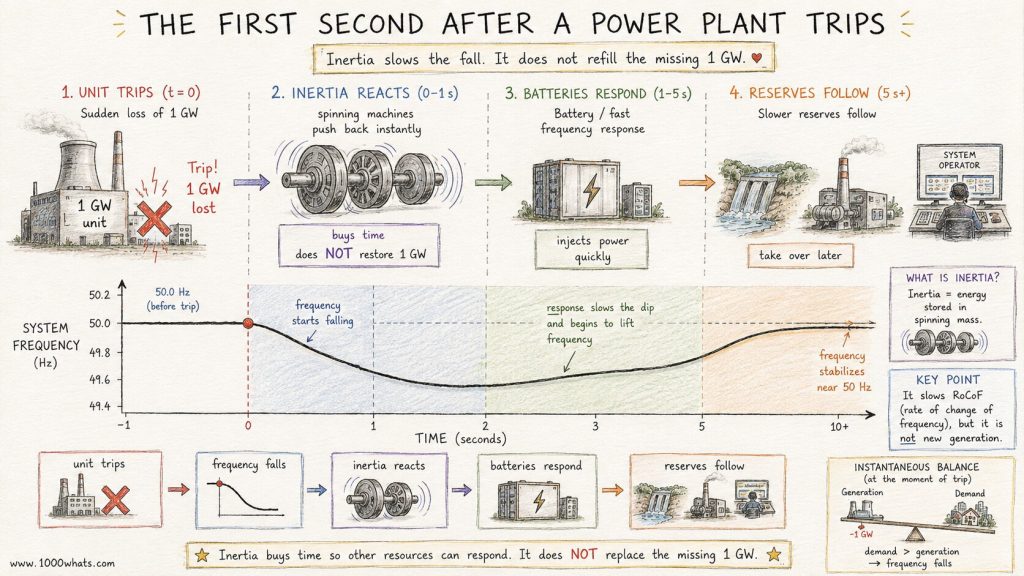
Imagine a huge power station suddenly disconnects from the grid.
Not slowly.
Not after a polite warning.
One moment it is producing 1,000 MW.
The next moment it is producing zero.
Electricity demand has not received the memo. Millions of motors, lights, computers, pumps, refrigerators, factories, and air conditioners keep asking for power exactly as before.
So what happens in the first fraction of a second?
Before a battery gets an instruction.
Before a gas turbine increases output.
Before a control-room operator can even say something unprintable.
Something else responds.
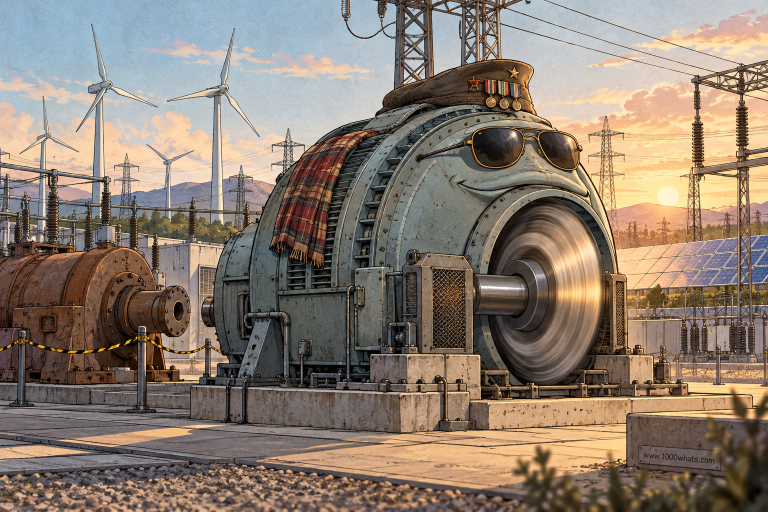
A lot of very heavy metal keeps spinning.
That sounds almost comically primitive for one of the world’s most sophisticated machines.
It is also incredibly useful.
⚡ “For decades, one of the grid’s fastest stability tools was not software. It was simply physics refusing to stop spinning.”
Welcome to 1000whats — where today we’re looking at the strange reason a cleaner electricity system sometimes misses several thousand tons of rotating machinery.
That reason is grid inertia.
First, remember what frequency is doing
An AC electricity grid has a rhythm.
In most of Europe, that rhythm is 50 Hz.
But 50 Hz is not just a number printed in a technical manual. It reflects something physical happening across the interconnected power system.
Traditional generators contain large synchronous machines rotating in step with grid frequency. If electricity generation and consumption are balanced, the system happily stays around 50 Hz.
If a large generator suddenly disappears, generation becomes lower than demand.
Frequency starts falling.
If demand suddenly disappears, the opposite happens.
Frequency starts rising.
We unpack that entire balancing act in What is power grid frequency?
But there is another question hiding underneath it:
How quickly does frequency start moving?
That is where inertia walks in.
So, what is grid inertia?
You already know ordinary inertia.
Push an empty shopping cart and it moves easily.
Push a fully loaded one and you suddenly discover muscles you didn’t know existed.
Once the heavy cart is moving, however, it also does not particularly want to stop.
That resistance to changing motion is inertia.
Traditional electricity grids contain enormous rotating masses:
turbines, generator rotors, shafts.
While synchronous generators are running, all that spinning equipment contains kinetic energy.
If the balance between generation and demand suddenly changes, those rotating masses cannot instantly change speed.
They resist the change.
That is grid inertia.
NESO describes system inertia as kinetic energy stored in the spinning parts of generators; when frequency suddenly changes, those machines keep rotating and slow the rate at which frequency moves while other controls respond.
And that delay is precious.
⚡ “Inertia does not fix the power imbalance. It makes the imbalance happen more slowly.”
That distinction matters.
A lot.
Imagine the grid without inertia
Suppose a large generator trips.
There is suddenly less electrical power entering the system than consumers are taking out.
Frequency begins falling.
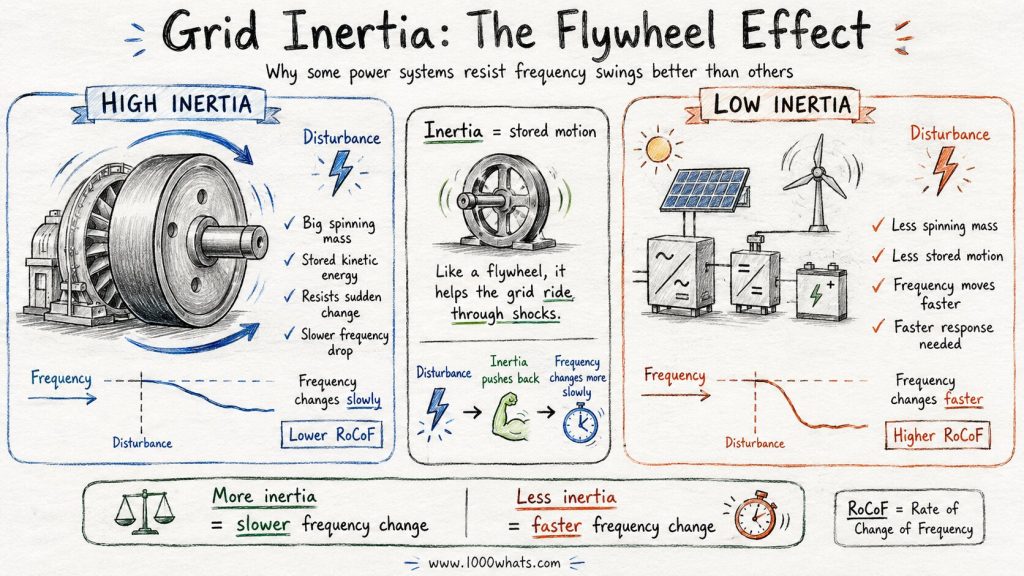
With plenty of inertia, it might behave something like this:
50.00 → 49.98 → 49.95 → 49.90 Hz
There is movement, but the system has time to react.
Frequency-response services activate.
Batteries inject power.
Generators increase output.
Demand may respond.
Operators have a fighting chance.
Now imagine exactly the same disturbance in a system with very little inertia.
Frequency can change much faster.
Same missing generator.
Same MW imbalance.
Very different problem.
The technical term for this is Rate of Change of Frequency, usually shortened to the wonderfully ugly acronym RoCoF.
Higher inertia generally means a slower initial frequency change after a disturbance.
Lower inertia means the system can move faster.
And electricity grids, much like people carrying expensive glassware, generally prefer sudden movements to be kept to a minimum.
Inertia is not frequency response
This distinction is easy to miss.
Suppose a power station suddenly trips.
Inertia reacts essentially immediately because it is inherent in the physics of the rotating synchronous machines.
Nobody sends the turbine a WhatsApp message saying:
Hi, frequency is falling. Could you please provide some inertia?
The machine simply resists the change in rotational speed.
Frequency-response resources then provide additional active power or reduce demand to help restore the balance.
So the rough sequence is:
Disturbance → inertia slows the initial change → fast frequency response reacts → slower reserves and redispatch restore the system.
In reality those responses overlap, but conceptually the distinction is extremely useful.
Inertia buys time.
Other services use that time.
Where did all this inertia come from?
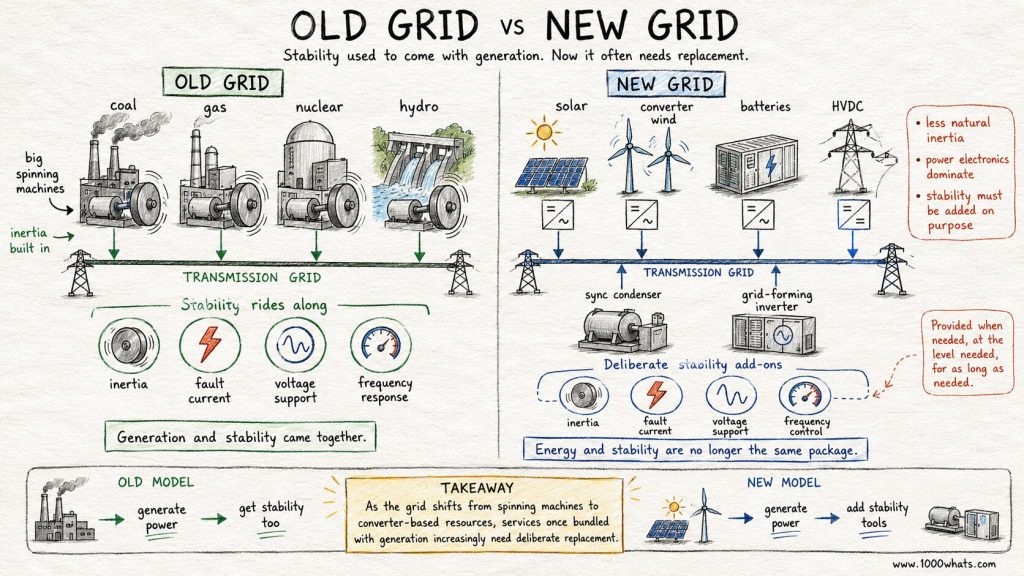
For most of electricity history, nobody needed to build an “inertia plant.”
We built coal plants.
Gas plants.
Nuclear plants.
Hydroelectric plants.
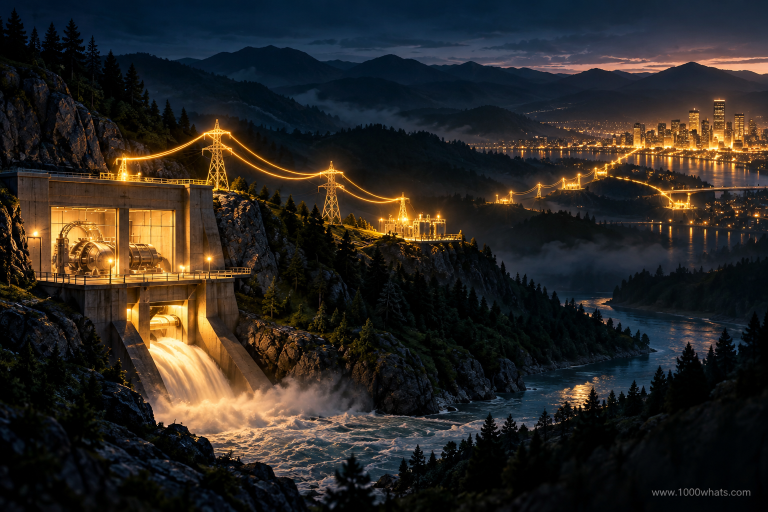
Many of them used large synchronous generators connected directly to the AC system.
Inside those plants were enormous rotating machines.
They produced electricity—and the physics of those machines happened to provide inertia at the same time.
It was effectively bundled into the power system.
Nobody ordered electricity and inertia separately.
You switched on the generator and got both.
What most people don’t see is that conventional power plants quietly provide several useful grid characteristics besides megawatt-hours.
This was easy to ignore while those machines dominated the system.
Then the generation mix started changing.
Solar ruined the accidental free lunch
Solar PV has no giant spinning generator.
A photovoltaic panel produces DC electricity.
Power electronics convert that electricity into grid-compatible AC.
Modern wind turbines do have large rotating blades and generators, obviously, but most are connected to the grid through power-electronic converters. Their mechanical rotation is therefore not inherently coupled to grid frequency in the same way as a traditional synchronous generator.
That distinction changes everything.
A conventional synchronous machine is physically participating in the AC rhythm.
Most conventional solar, wind, battery, and HVDC converter connections are electronically interfaced.
ENTSO-E notes that inverter-connected generation does not inherently behave like synchronous generation during frequency disturbances; its response depends on the control strategy programmed into the inverter.
So imagine this transition:
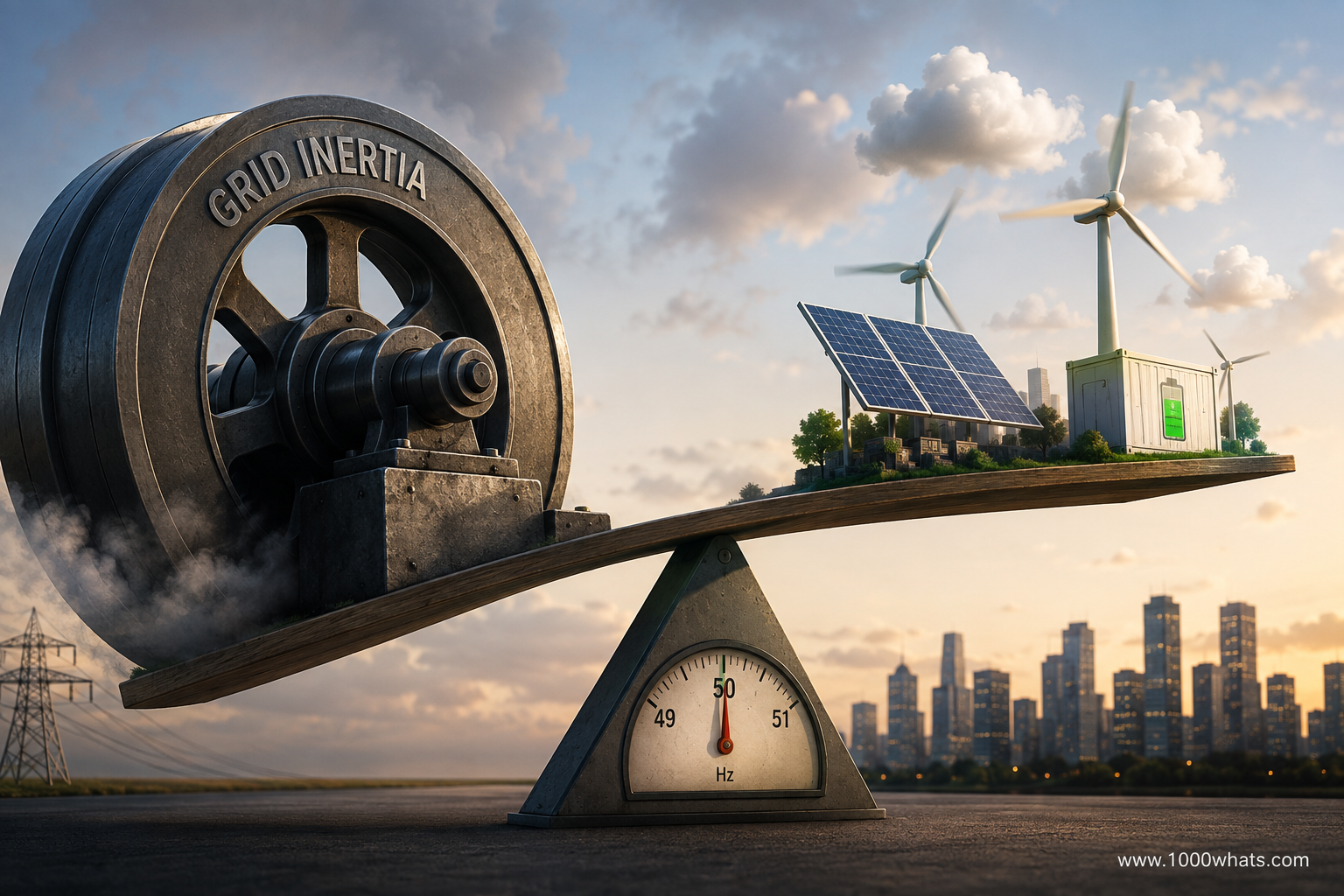
Old grid: lots of heavy spinning synchronous machines.
New grid: more solar, converter-connected wind, batteries, and interconnectors.
We successfully replace fossil electricity.
Great.
But we may simultaneously remove some of the physical characteristics that came bundled with the old generators.
Oops.
This does not mean renewables make stable grids impossible.
It means we have discovered that the old grid was doing more jobs than merely producing electricity.
And now we have to procure those jobs deliberately.
The wonderfully strange synchronous condenser
Here is where electricity engineering becomes beautifully weird.
Suppose you want the rotating mass of a traditional generator…
…but you do not particularly want the electricity from the power plant attached to it.
One solution is essentially:
Keep the big spinning machine. Lose the fuel.
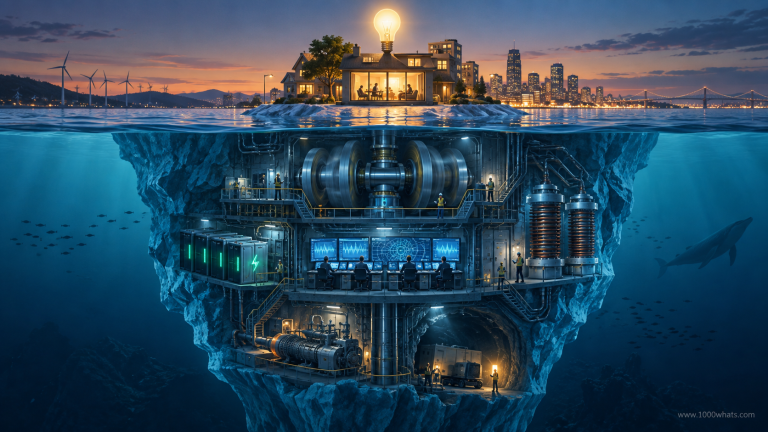
Meet the synchronous condenser, also called a synchronous compensator.
It resembles a synchronous generator, but it does not need to be driven by a steam turbine to continuously generate electrical energy.
Instead, the machine spins while connected to the grid and can provide useful stability characteristics such as inertia, voltage support, reactive power, and fault-current contribution.
In other words, we spent decades building huge rotating machines because we wanted electricity.
Now some electricity systems are installing huge rotating machines because they want…
the rotating machine.
That is not a joke.
Britain is already doing it. NESO says synchronous compensators are part of its approach to obtaining zero-carbon inertia, and new machines continue to enter service as conventional generation changes.
Energy transitions produce some wonderfully circular engineering.
But can’t batteries respond faster?
Absolutely.
And this is where the story gets more interesting.
A battery can respond extremely quickly to a frequency disturbance.
Modern power electronics can react far faster than conventional generators can ramp their fuel input.
So why do we need inertia at all?
Because speed and behavior are not exactly the same thing.
Traditional synchronous inertia is an inherent physical response.
A battery connected through an ordinary grid-following inverter measures or follows an existing grid waveform and changes its output according to its control system.
That can be incredibly fast.
But it is still a different mechanism.
This is also why battery storage has become such an important grid tool: batteries can provide very rapid frequency services in addition to shifting energy through time.
NESO says the growth of batteries and fast frequency response has actually reduced how much physical inertia Britain’s system needs to carry compared with the past.
That is an important nuance.
The future grid does not necessarily need to reproduce the old grid component-for-component.
It needs to reproduce—or improve—the functions that kept the old grid stable.
Then someone taught the inverter a new trick
Most inverter-based resources historically behaved as grid-following devices.
The name is refreshingly honest.
They look at the existing voltage and frequency waveform and follow it.
But what happens when more and more of the system is made of followers?
At some point someone has to lead the dance.
That brings us to grid-forming inverters.
Rather than merely following an externally established waveform, grid-forming controls can establish and regulate voltage and frequency behavior and respond to disturbances in ways designed to resemble useful characteristics of synchronous machines.
NESO describes grid-forming technology as allowing batteries and renewable resources to provide stability capabilities traditionally associated with conventional power stations.
Some implementations can provide an inertia-like active-power response—often called synthetic inertia or virtual inertia.
So we have reached a rather beautiful point in electrical engineering:
First we used actual mass.
Then we built electronics clever enough to imitate some of what the mass was doing.
Physical inertia vs. synthetic inertia
They aim at a similar system need but should not be casually treated as identical.
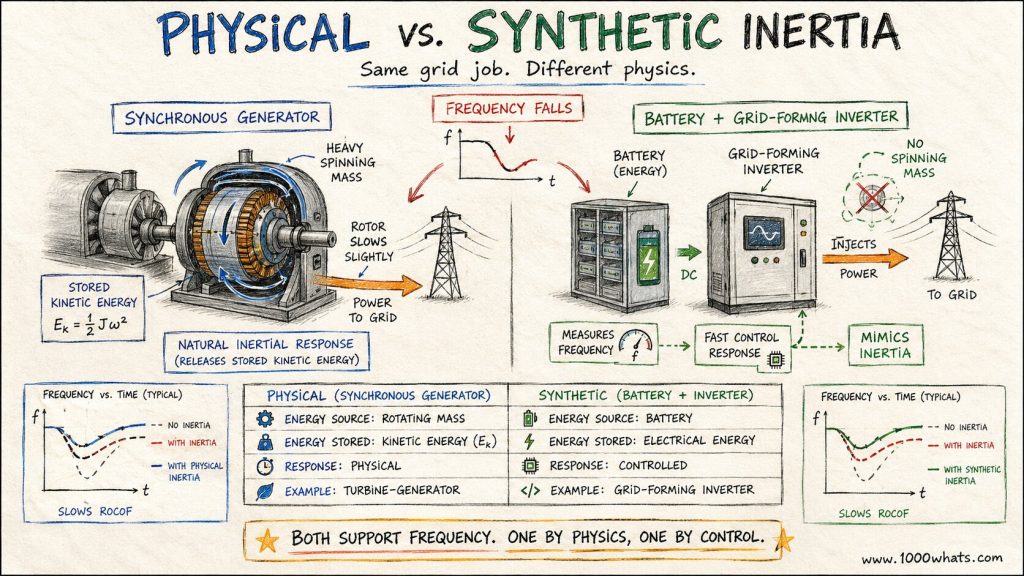
Physical synchronous inertia comes from kinetic energy already stored in rotating masses electrically coupled to the system.
Synthetic or virtual inertia is created through control algorithms and power electronics that rapidly alter active-power output in response to grid conditions.
For an inverter to inject extra electrical power, however, the energy must come from somewhere.
A battery has stored energy available.
A wind turbine may temporarily extract kinetic energy from its rotating rotor or operate with control headroom, depending on its design and operating state.
Solar PV running at its maximum available output cannot magically produce additional sunlight because frequency has fallen.
Physics remains annoyingly resistant to software updates.
That is why statements like:
“Batteries solve inertia.”
or:
“Renewables provide no inertia.”
are both too simplistic.
The useful question is:
What stability response can this specific technology provide, under what conditions, for how long, and how is it controlled?
That is a much less catchy sentence.
Unfortunately, it is also the right one.
Does low inertia mean renewables are bad for the grid?
No.
It means power systems change when generation technology changes.
That sounds obvious, but energy debates have a remarkable ability to turn engineering problems into ideological arguments.
High shares of inverter-based generation create new stability requirements.
Engineers respond with:
- synchronous condensers;
- batteries and faster frequency-response products;
- grid-forming inverters;
- improved measurement and forecasting of inertia;
- new grid-code requirements;
- redesigned stability markets;
- better protection and control systems.
Britain already measures and procures these capabilities. ENTSO-E is developing technical requirements for grid-forming capability across Europe.
This is not evidence that the transition cannot work.
It is evidence that an electricity system is more complicated than:
build solar panel → remove gas plant → done.
The grid is a machine.
Change its components and you must sometimes redesign how the machine behaves.
Why grid inertia matters more today
Twenty years ago, inertia was mostly something power-system engineers worried about.
The public had little reason to care.
Most large electricity systems contained plenty of synchronous generation, so inertia arrived almost automatically.
Today the situation is different.
Wind and solar are growing.
Coal plants are retiring.
Gas plants may operate fewer hours.
Batteries are multiplying.
HVDC interconnectors are expanding.
Power electronics are becoming central to electricity systems.
And that means a service that used to be hidden inside conventional generation is becoming visible.
That is a recurring theme in the modern power system.
We used to buy energy.
Increasingly, we also need to value:
flexibility,
capacity,
fast response,
voltage support,
system strength,
inertia,
and other services that make electrical energy actually usable.
The electrons were never the whole product.
We just had the luxury of pretending they were.
Final thoughts
Grid inertia is one of those concepts that reveals how misleading the phrase “electricity generation” can be.
A traditional power station did not simply make MWh.
Its enormous rotating machinery also helped determine how the entire grid behaved when something went wrong.
For decades, that service was sitting there in plain sight, spinning at 50 Hz, largely bundled with everything else.
Now the generation fleet is changing.
And suddenly we can see it.
The interesting part is not that renewables “lack” something fossil generators had.
The interesting part is what happens next.
We can keep rotating mass connected without burning fuel.
We can make batteries respond extraordinarily fast.
We can teach inverters to form the grid rather than merely follow it.
We can measure stability services and create markets for things that once arrived almost accidentally.
In other words, the grid is not losing its physics.
We are becoming much more deliberate about engineering it.
And that may be one of the least visible—and most interesting—parts of the energy transition.
What hidden grid service should we pull apart next?
Until next time, stay curious! 😎
Discover more from 1000whats
Subscribe to get the latest posts sent to your email.