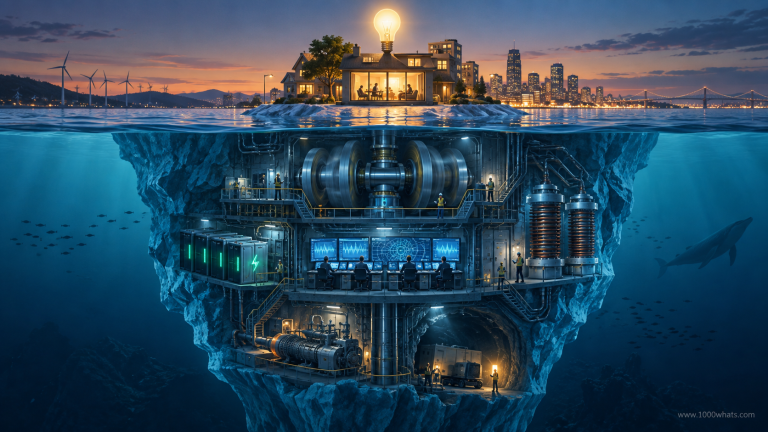
Imagine the power grid has collapsed.
Not one neighborhood.
Not one transmission line.
Not one power station.
A serious blackout.
Large parts of the system are dark.
The obvious solution is:
start the power plants.
Excellent.
Small problem.
Many large power plants need electricity to start.
Pumps need power.
Fans need power.
Fuel-handling equipment needs power.
Control systems need power.
Lubrication systems need power.
Excitation systems and auxiliaries need power.
So the grid needs the power plants.
And the power plants need the grid.
Everybody looks at everybody else.
Welcome to 1000whats — where today we discover that restarting civilization occasionally resembles trying to charge a dead phone using the charger stored inside the dead phone.
Something has to go first.
That something is:
black start.
⚡ “Black start solves one of electricity’s best circular problems: how do you start the machines that need the thing they are supposed to produce?”
A normal power plant does not start from nothing
This is the first thing that makes black start click.
A large generator may produce hundreds or thousands of megawatts once it is operating.
But that does not mean it can wake itself up in complete darkness.
Consider a large thermal power station.
Before it can export serious power, it may need electricity for auxiliary systems such as:
- pumps;
- fans;
- cooling systems;
- compressors;
- control equipment;
- lubrication;
- fuel preparation and handling;
- instrumentation.
Under normal conditions, that is not particularly interesting.
The station takes the auxiliary electricity it needs from the grid or from its own operating units.
But after a widespread blackout, the grid may no longer be there.
The machine capable of supplying a city can therefore find itself unable to supply:
itself.
This is why black-start capability means something quite specific: a generating plant or other resource can start and help restore the grid without relying on external electricity from that grid.
It is not simply:
a generator that starts quickly.
It is:
a generator that can start when there is effectively nothing electrical around it to help.
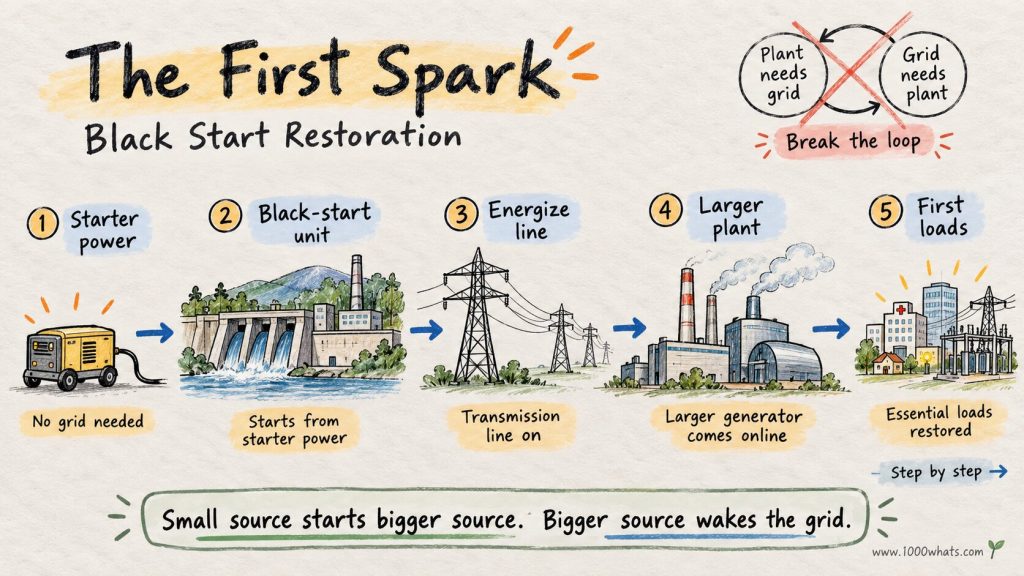
So what starts the black-start generator?
Now we have simply moved the problem one machine backward.
Fair question.
A black-start facility needs some independent source of energy for its own startup.
Historically, this might be:
a small diesel generator,
a dedicated small hydro unit,
a gas turbine with suitable starting arrangements,
or another self-contained source capable of energizing the station auxiliaries.
The exact architecture varies enormously.
But the principle is always the same:
the first source must not depend on the dead grid.
A useful way to imagine it is a row of increasingly large machines.
Machine A can start by itself.
A starts B.
B provides enough power to start C.
C helps energize a transmission corridor.
That corridor reaches D.
D is enormous.
Eventually D joins the party and suddenly the restoration has serious muscle.
The U.S. Department of Energy describes black start as exactly this kind of bootstrapping process: start a unit from a de-energized state, energize parts of the network, supply nearby loads, and progressively restart other generating units.
The grid essentially pulls itself up by its own electrical bootstraps.
Hence the name fits unusually well.
Why hydro has traditionally been so useful
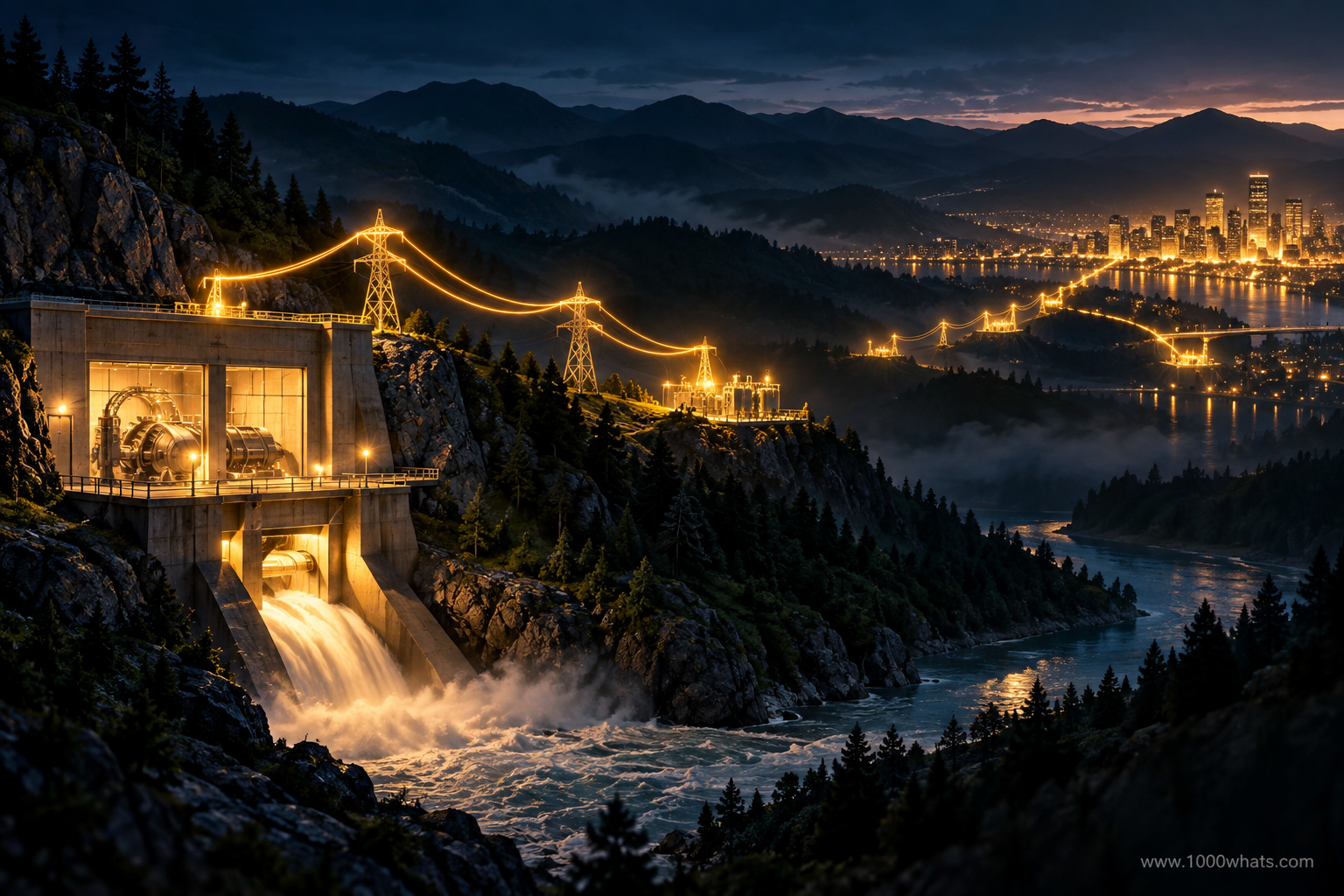
Hydropower is a particularly elegant black-start resource.
A reservoir already contains stored potential energy.
Water is sitting uphill.
Gravity is ready.
It has been waiting several million years and is not especially concerned about the blackout.
Open the appropriate water path.
Get the turbine-generator turning.
Establish electrical output.
The startup auxiliary demand can be relatively modest compared with many large thermal plants.
That is why hydropower has long been valuable for black start.
But hydro is not automatically black-start capable.
The plant still needs appropriate controls, auxiliaries, protection, excitation, communications and procedures.
And many places do not have convenient hydro plants sitting exactly where the restoration plan would like them.
Geography remains annoyingly resistant to grid planning.
Starting one generator does not mean the grid is back
This distinction matters enormously.
Suppose our black-start hydro unit is now running.
Excellent.
We have electricity.
Technically.
Somewhere.
What we do not yet have is a functioning national electricity system.
We have one energized generator surrounded by a great deal of dead infrastructure.
Now the difficult work begins.
Operators may progressively:
energize a busbar
↓
energize a transformer
↓
energize a transmission line
↓
connect carefully selected load
↓
start another generator
↓
build a stable electrical island
↓
expand that island
↓
synchronize it with another island
↓
restore more customers
↓
rebuild the interconnected system
The European network code on electricity emergency and restoration requires transmission system operators to maintain coordinated procedures for emergency, blackout and restoration states.
Because once the system has collapsed, improvising the entire thing from a dark control room would be considered suboptimal.
Why not simply reconnect everything?
Because a freshly restored electrical island is fragile.
Very fragile.
Imagine a black-start unit has created an island supplying:
100 MW of generation
and:
80 MW of load.
The island has:
20 MW of breathing room.
Now someone reconnects a city district demanding another:
60 MW.
Demand suddenly becomes:
140 MW.
Generation is still:
100 MW.
Frequency does not politely wait while everyone discusses the issue.
It falls.
Potentially very quickly.
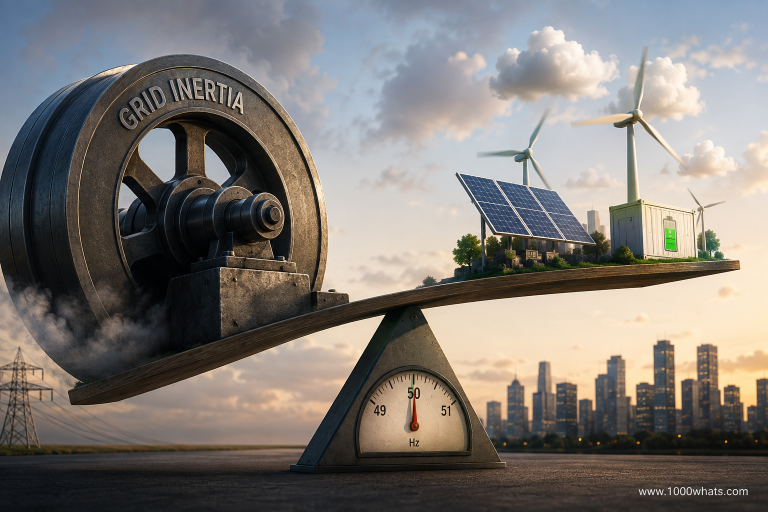
Our article on grid inertia explained why the rate of frequency change matters after a sudden imbalance.
During restoration, the problem can be even more delicate because the electrical island may contain only a small number of generators.
One large load block can therefore be:
a large percentage of the entire system.
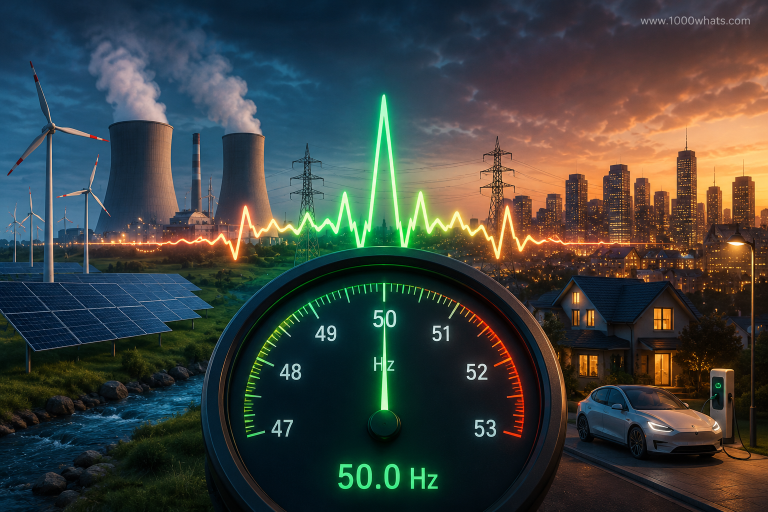
In the normal continental European grid, switching on a factory is background noise.
In a tiny restored island, the same factory can arrive like a hippopotamus entering a canoe.
So load is restored:
carefully.
⚡ “After a blackout, electricity demand is not merely something to serve. For a while, it is something operators have to ration into the grid in electrically survivable pieces.”
Restoration is a balancing act from the first megawatt
A black-start resource cannot simply generate into nowhere.
Generation and demand still need to balance.
Frequency still matters.
Voltage still matters.
Protection still matters.
Equipment limits still matter.
In fact, nearly everything that matters during normal grid operation still matters during restoration.
Only now the system is smaller, weaker and being rebuilt while you operate it.
Very relaxing.
This means operators need suitable loads to stabilize newly energized islands.
Add too much load:
frequency can collapse.
Add too little load while generation is too high:
frequency can rise.
The trick is to expand generation and demand together.
Think:
generator → load → generator → more load → more network
Not:
GENERATOR → EVERYTHING.
Voltage creates another problem
Dead transmission equipment does not behave like an empty water pipe waiting to be filled.
When long transmission lines, cables and transformers are energized, they interact electrically with the system.
Voltage can move.
Reactive power matters.
Transformer energization can create large transient currents.
Long lightly loaded lines can generate reactive power and push voltage upward.
Suddenly our apparently useless friend from the article on reactive power is back in the room.
During restoration, operators therefore need to think not only about:
Do we have enough MW?
but also:
Can we energize this network section without losing control of voltage?
That is why grid restoration is not merely generation restoration.
You are rebuilding an:
electromagnetic system.
The wires are part of the machine.
Then operators build islands
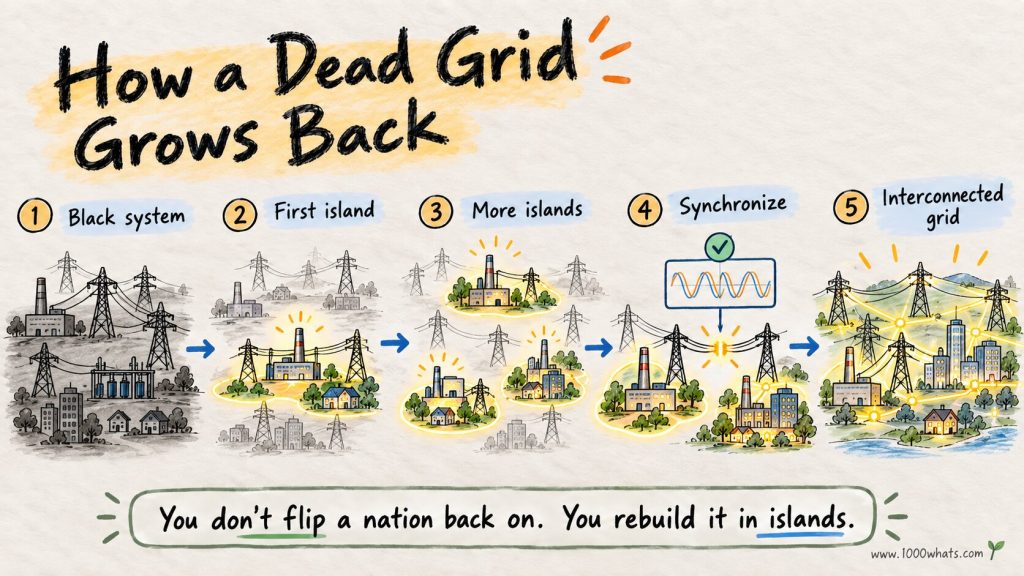
An electrical island is a portion of the power system operating independently from the larger interconnected grid.
During black-start restoration, that can be extremely useful.
Instead of trying to restart an entire country from one generator, operators can create several smaller islands.
Each island develops its own:
generation,
load,
frequency,
voltage,
and operating balance.
Gradually, it grows.
Another generator joins.
More transmission is energized.
More consumers return.
Eventually two restored islands approach each other electrically.
And then comes another deceptively simple instruction:
connect them.
Ah.
You cannot casually connect two live grids
Suppose Island A is operating at:
50.02 Hz.
Island B is at:
49.94 Hz.
Their voltage waveforms are not at exactly the same phase angle.
Closing the breaker between them at the wrong moment can create enormous electrical and mechanical stresses.
So before restored islands can be joined, they must be brought sufficiently close in:
- frequency;
- voltage magnitude;
- phase angle;
- phase sequence.
Then they can be:
synchronized.
This is one of the beautiful things about grid restoration.
The process starts with almost nothing.
Then small electrical islands appear.
They grow.
They meet.
They synchronize.
Eventually the islands stop being islands.
The grid is back.
There are two broad ways to restore a grid
European restoration planning generally distinguishes two broad strategies.
Bottom-up restoration
Start with resources inside the blacked-out area that can energize themselves.
Black-start units create electrical islands.
Those islands expand.
Eventually they reconnect.
This is the classic black-start picture.
Top-down restoration
Suppose a neighboring system is still alive.
Instead of creating voltage locally from nothing, the blacked-out system may receive electricity through an interconnection.
A healthy grid helps energize the dead one.
The older ENTSO-E restoration framework describes both approaches, with the actual strategy depending on system conditions, available black-start units and support from neighboring systems.
And, naturally:
real restoration can use both.
Because power systems have never seen a neat textbook distinction they could not complicate in practice.
Iberia showed exactly what this looks like
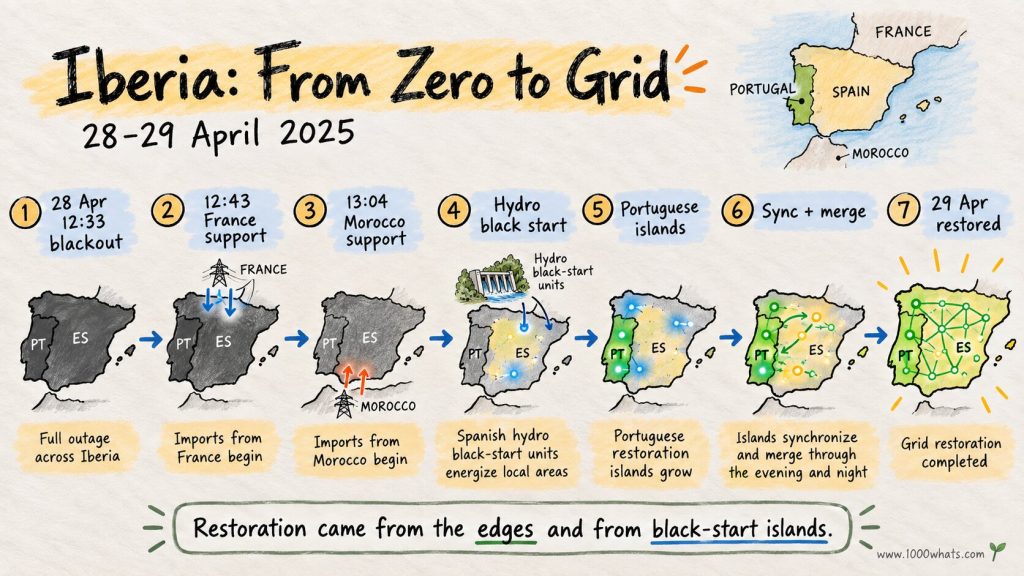
On 28 April 2025, continental Spain and Portugal experienced a total blackout.
Whatever one wants to understand about its causes—and the final ENTSO-E investigation goes deeply into those—the restoration itself is a fantastic real-world black-start lesson.
The system did not return because someone found the national ON button.
Restoration came from multiple directions.
At 13:04 CEST, the Morocco-Spain interconnection was re-energized.
From the beginning of restoration until around 13:30, several Spanish hydro plants with black-start capability initiated their black-start processes.
At 13:35, the eastern France-Spain interconnection was re-energized.
In Portugal, two black-start-capable plants eventually started successfully at 16:11 and 17:26, allowing restoration to proceed through two electrical islands.
At 18:36, the first 220 kV Spain-Portugal tie line was re-energized.
The Portuguese transmission system was restored by 00:22 on 29 April.
Spain’s transmission restoration was completed around:
04:00.
That chronology, documented by ENTSO-E’s investigation of the Iberian blackout, is black start made visible.
Hydro.
Interconnections.
Electrical islands.
Transmission corridors.
Synchronization.
Load restoration.
Hours of carefully rebuilding something that disappeared in seconds.
Does every power plant need black-start capability?
No.
That would be expensive and unnecessary.
The system needs enough strategically located restoration resources to execute its restoration plan.
A huge power station may be extraordinarily useful after somebody gives it startup electricity.
It does not necessarily need to produce that first electricity itself.
This creates an interesting hierarchy.
A tiny black-start generator may have almost no importance during normal market operation.
Its annual energy production may be trivial.
Its position in the merit order may be irrelevant.
Its contribution during normal Tuesday afternoon trading may be:
approximately nobody cares.
But after a system collapse?
That little machine may be the key that starts a generator one hundred times larger.
Energy systems are full of assets whose value appears only under very specific conditions.
Black start may be the purest example.
So how do black-start providers get paid?
Because operators need the capability available even if they hope never to use it.
That makes black start different from ordinary energy trading.
A provider is not primarily being paid because operators expect to buy lots of MWh from it.
The value is:
availability when the system is in an extraordinarily abnormal state.
Different markets procure restoration capability differently.
For example, Britain’s National Energy System Operator now calls Black Start its Restoration Service and procures resources capable of restarting without external supplies.
That is the commercial oddity.
A good year for black-start service is:
you got paid and nobody needed you.
Try putting that in a normal electricity sales forecast.
And black start itself is changing
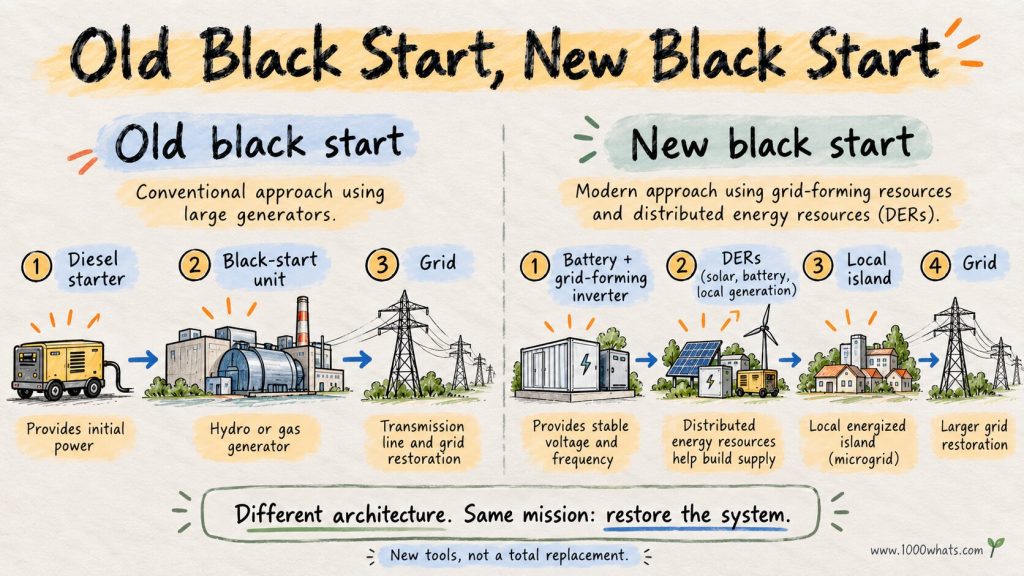
Historically, restoration plans were built largely around conventional generators.
Hydro was particularly attractive.
Some thermal units had dedicated black-start arrangements.
But the power system is changing.
We now have:
batteries,
distributed generation,
wind,
solar,
microgrids,
grid-forming inverters,
and much more sophisticated power electronics.
So an obvious question appears:
Can these resources restart the grid too?
Increasingly, the answer is:
potentially, yes.
But this is more complicated than saying:
“Battery fast. Battery good.”
Batteries have some extremely useful black-start characteristics
A battery does not need to wait for:
steam pressure,
combustion,
water flow,
or a giant turbine to warm up.
A properly designed battery energy storage system can establish electrical output rapidly.
More importantly, certain inverter systems can operate in:
grid-forming mode.
That phrase matters.
Most conventional grid-following inverters historically assumed that an energized grid already existed.
They measured the existing voltage and frequency and synchronized their output to it.
Useful.
But slightly problematic if:
there is no grid.
A grid-forming inverter can instead help establish the voltage and frequency reference itself.
That makes inverter-based resources potentially much more interesting for restoration.
Research at NREL is already exploring grid restoration using inverter-based resources, solar and storage, including forming and maintaining electrical islands during recovery.
This is a major conceptual shift.
The old restoration question was:
Which big spinning generator can start first?
The future question may increasingly be:
Which combination of batteries, inverters, distributed resources and conventional generators can establish a stable island first?
Britain has already tested the distributed version
Britain’s Distributed ReStart project explored whether distributed resources including wind, solar and hydro could help restore the transmission system from distribution networks.
That sounds almost backwards.
Traditionally:
big transmission-connected generator
→ energizes transmission
→ distribution returns
→ customers return
The alternative being explored is closer to:
distributed resources
→ establish local restoration zone
→ energize upward
→ help restore transmission
The project included live trials and studied the challenge of creating stable electrical islands with high shares of distributed and renewable resources.
The power plant that restarts tomorrow’s grid may therefore not look like:
one power plant.
It may look suspiciously like my existing article on a virtual power plant accidentally wandered into emergency operations.
But solar cannot black-start the grid at midnight, right?
Correct.
Which is why capability and availability are different questions.
A solar plant may have technically sophisticated grid-forming controls.
At midnight:
the Sun remains unavailable for comment.
A wind farm depends on wind.
A battery depends on its state of charge.
A hydro plant depends on water and plant availability.
A gas-fired resource depends on fuel supply.
And that last one has caused real concern.
A black-start generator is not useful merely because its control system knows how to start.
It also needs its:
fuel,
auxiliaries,
communications,
switchgear,
transmission path,
operators,
and supporting infrastructure
to survive the same event that knocked out the grid.
A 2023 FERC-NERC review of black-start availability during extreme cold highlighted exactly this issue after Winter Storm Uri: black-start capability on paper does not help if the resource cannot actually operate during the emergency.
This is where resilience stops being a generator specification and becomes a:
system property.
⚡ “A black-start unit is only the first domino standing up. The real job is making sure there is a path for all the others.”
Black start is not backup power
This distinction is worth making.
A diesel generator in a hospital can provide:
backup power.
It keeps that hospital operating while the wider grid is unavailable.
Very useful.
But that does not automatically make it a black-start resource for the power system.
Black start has a broader restoration purpose.
The resource must be capable of participating in a planned sequence that can:
energize network equipment,
support voltage and frequency,
start other generators,
pick up load,
and help rebuild the grid.
So:
backup power keeps something alive.
black start helps bring the system back to life.
Sometimes the same physical technology can participate in both jobs.
The purpose is different.
Black start is also not the same as islanding
Another useful distinction.
Islanding means part of the electrical system separates from the wider grid but continues operating independently.
Imagine a microgrid loses its grid connection but keeps its hospital, campus or industrial facility running.
The lights never went out.
That is islanded operation.
Black start begins after:
the lights did go out.
A resource starts from a de-energized condition and begins rebuilding.
There is also an interesting middle case called:
house-load operation.
A power station may disconnect from the collapsing grid but keep enough of itself running to supply its own auxiliaries.
If successful, it does not need a true black start later.
It survived the collapse with a tiny electrical island containing:
itself.
Electricity engineers apparently decided even power stations should practice self-care.
Why black start matters more as the grid changes
The need for restoration is not new.
The architecture available to provide it is.
Coal and conventional thermal plants are retiring in many systems.
Renewables are expanding.
Batteries are expanding.
Distribution networks contain increasing amounts of generation.
Power electronics are replacing some synchronous machines.
Interconnections are becoming more important.
And grid-forming inverter technology is developing rapidly.
That means restoration plans designed around yesterday’s generation fleet cannot simply be laminated and kept forever.
The EU’s Emergency and Restoration Network Code exists precisely because restoration must be planned, coordinated, simulated and tested rather than left to heroic improvisation after the lights go out.
The energy transition therefore creates a fascinating challenge.
We are not merely replacing:
coal MWh
with:
wind and solar MWh.
We are replacing an entire collection of physical capabilities that happened to come bundled with traditional power stations.
My articles on:
and:
are all versions of the same deeper story.
Electricity systems never needed only:
energy.
They needed:
machines capable of behaving like a grid.
Black start is what happens when we have to build that behavior again from zero.
So, what is black start in one sentence?
Black start is the capability to start electricity generation without relying on an energized external grid and use that initial power to progressively restore other generators, transmission infrastructure and loads after a major blackout.
But the better mental model is:
the first match after the lights go out.
One match does not heat the city.
It gives you the first flame.
Then you build from there.
Final thoughts
We normally experience the electricity grid as something binary.
Power:
on.
Power:
off.
So after a blackout, it is natural to imagine restoration in the same way.
Off.
Click.
On.
The real process is much more interesting.
A tiny source wakes up.
It starts something larger.
A busbar becomes live.
A transformer becomes live.
A transmission line becomes live.
A carefully selected load returns.
Another generator starts.
A small electrical island appears.
Then another.
They grow.
Operators manage frequency, voltage, reactive power, reserves and load while rebuilding the very system that normally provides those things.
Eventually the islands synchronize.
The network reconnects.
Cities light up.
And millions of people experience the entire engineering process as:
Oh, the power is back.
That may be the ultimate compliment to grid operators.
Black start is a service designed for a moment everyone hopes never happens.
But when it does, the difference between:
a collection of dead power plants
and:
a power system
is the ability to know exactly which machine goes first.
Until next time, stay curious! 😎
Discover more from 1000whats
Subscribe to get the latest posts sent to your email.