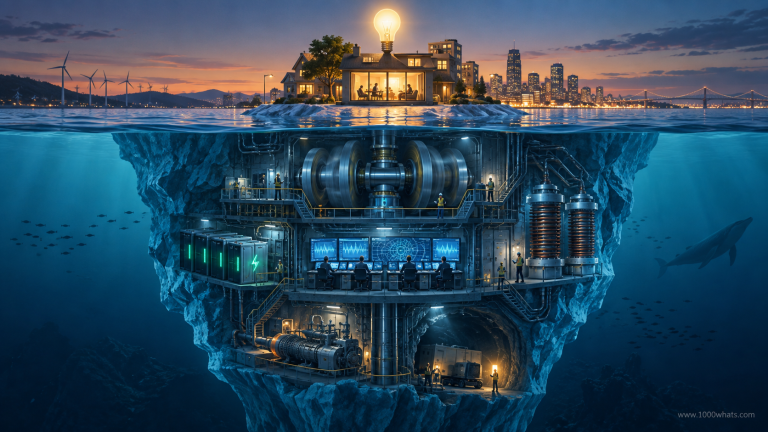
Imagine building an enormous electrical machine.
Hundreds of tons of steel, copper and carefully engineered components.
You connect it to the electricity grid.
You get it spinning.
You spend money keeping it maintained, cooled and lubricated.
And then you make sure it produces almost no electricity.
Excellent.
What have we achieved?
Quite a lot, actually.
Because the machine can help keep an entire power system stable.
It can support voltage.
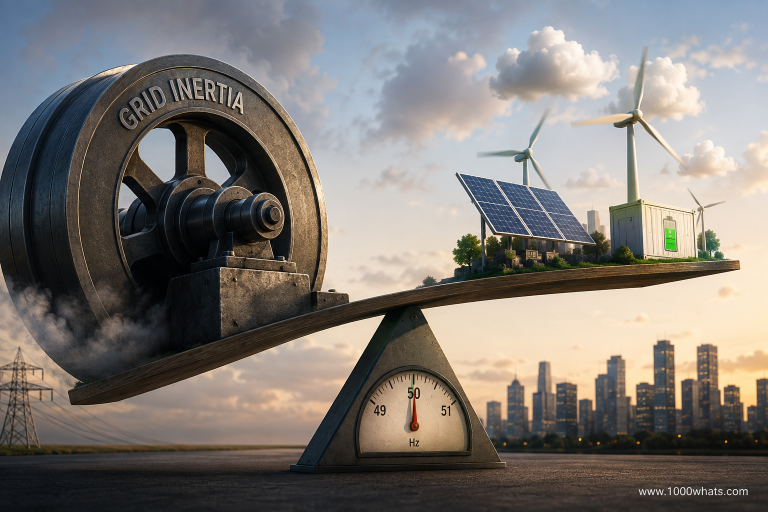
It can provide inertia.
It can strengthen the network during electrical faults.
And it can do those things without burning coal or gas to generate electricity.
Welcome to 1000whats – where today we meet a machine that looks like a generator, behaves like a generator in several important ways, and has deliberately retired from the business of generating electricity.
It is called a synchronous condenser.
Also known as a synchronous compensator.
And it is one of the stranger success stories of the modern energy transition.
⚡ “We used to keep enormous machines spinning because we needed their electricity. Now we sometimes keep them spinning because we need everything else they were doing.”
First, remember what a generator actually is
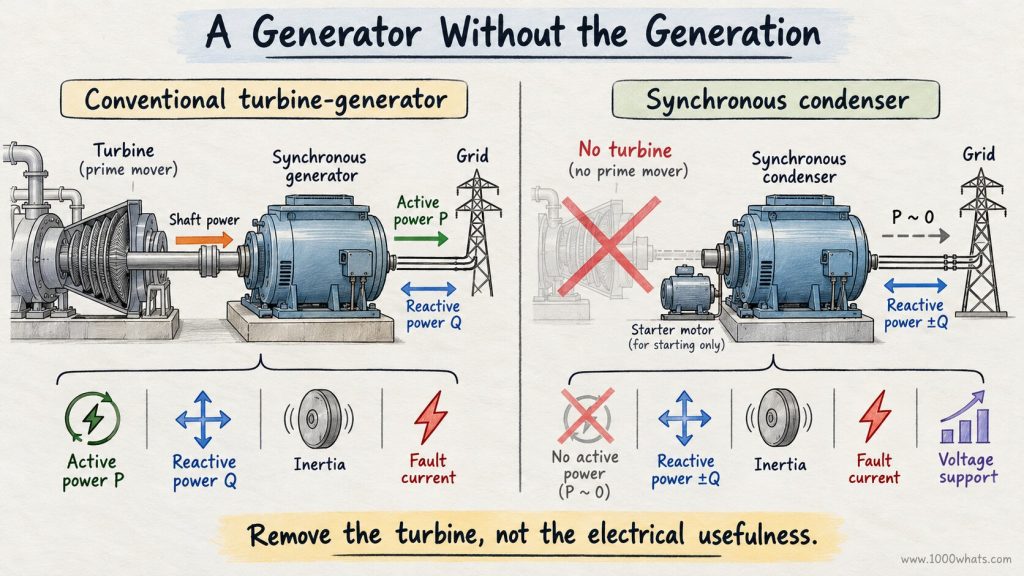
A conventional power station contains a rather impressive piece of machinery.
A turbine spins a shaft.
The shaft turns a generator.
Inside the generator, magnetic fields and electrical windings interact.
Mechanical energy becomes electrical energy.
The generator sends electricity into the grid.
Simple enough.
But a large synchronous generator does more than produce megawatts.
Because it is physically synchronized with the AC electricity system, its rotating mass also contributes inertia.
Its excitation system can help control reactive power and voltage.
And during an electrical fault, the machine can contribute substantial short-circuit current.
For decades, electricity systems received these characteristics alongside the electricity.
Buy the generator.
Get the stability services.
A rather generous package deal.
Then the generation mix started changing.
What happens when the generator stops generating?
Suppose we remove the turbine from the equation.
No steam.
No combustion.
No water driving the shaft.
We still have the synchronous electrical machine.
Could it remain connected to the grid?
Yes.
A synchronous machine can operate as a motor as well as a generator.
Instead of converting mechanical power into electricity, it can draw a relatively small amount of electrical power from the grid to keep itself rotating and cover mechanical and electrical losses.
Once operating, its rotor turns in synchronism with the grid’s alternating magnetic field.
The machine no longer produces sustained active power for sale.
But several of its other electrical characteristics remain.
That is the basic idea behind a synchronous condenser.
Keep the synchronous machine. Remove the need to generate electricity. Retain the useful grid-support characteristics.
The technology is not new.
Synchronous condensers have existed for more than a century.
What is new is the growing demand for their services.
GE Vernova’s technical overview describes modern synchronous condensers as rotating machines designed to provide voltage support, reactive compensation, system inertia and short-circuit strength.
They are essentially synchronous machines employed specifically for grid stability.
So what keeps it spinning?
This is the first question that usually appears.
If there is no turbine, what turns the shaft?
The answer is:
the electricity grid itself.
But the machine first needs to be brought into operation.
Depending on its design, it may use a small starting motor, often called a pony motor, or a static frequency converter.
These systems accelerate the rotor toward the speed required for synchronization.
Once synchronized, the machine operates as a synchronous motor.
The grid supplies the relatively small amount of active power required to overcome losses.
The machine keeps spinning.
Its excitation system controls its electromagnetic behavior.
And the system operator receives the services it needs.
For a 50 Hz system, the mechanical speed depends on the number of magnetic poles.
A two-pole synchronous machine rotates at:
3,000 rpm.
A four-pole machine rotates at:
1,500 rpm.
The rotor is not simply spinning at 50 revolutions per second in every design.
Electrical frequency and mechanical speed are related through the number of poles.
That is one of those details that matters considerably more to the engineer designing the machine than to the person writing the press release.
GE Vernova lists pony-motor and other starting arrangements among the options used in its synchronous condenser systems.
Now comes the important part: three jobs, one machine
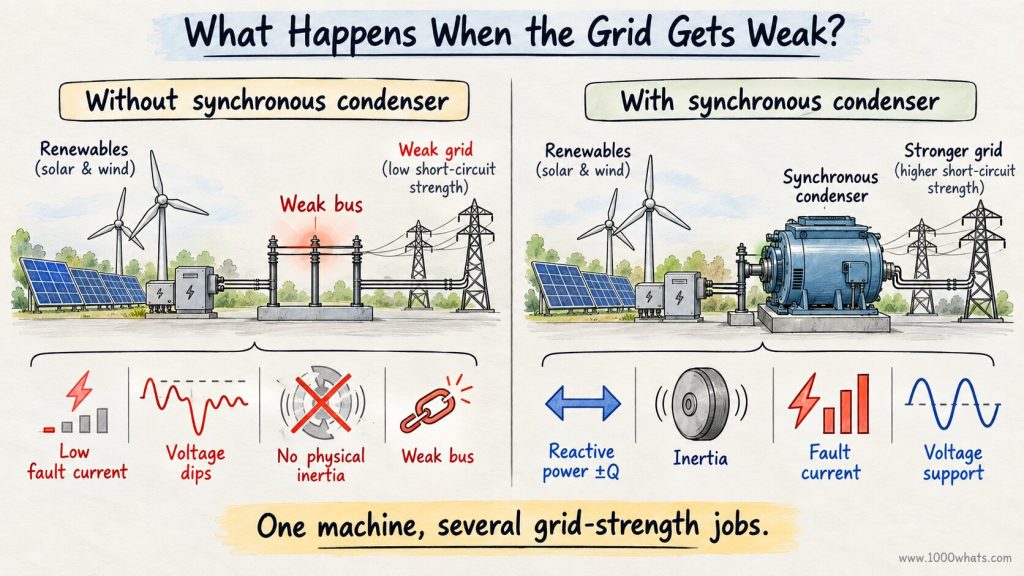
A synchronous condenser can provide three particularly valuable grid-support functions.
They solve different problems.
And understanding those differences is the key to understanding why the machine exists.
| Grid problem | What the condenser provides | Main benefit |
|---|---|---|
| Voltage too high or too low | Reactive power injection or absorption | Voltage control |
| Sudden generation or demand disturbance | Rotating inertia | Slower initial frequency change |
| Weak network or electrical fault | Short-circuit current contribution | System strength and fault behavior |
Notice something interesting.
None of these jobs requires the machine to sell electricity by the MWh.
That is why synchronous condensers are so commercially unusual.
Let’s unpack the three jobs.
Job 1: Keep voltage where it belongs
Electricity grids do not operate at one perfectly fixed voltage everywhere.
Voltage changes as:
generation changes,
demand changes,
transmission lines become more or less loaded,
and network conditions evolve.
A synchronous condenser helps regulate voltage by controlling its reactive power.
I explored the underlying physics in article on reactive power.
The important thing here is how the condenser provides it.
Inside the synchronous machine is a rotor with an electromagnetic field.
By changing the excitation current, the control system changes the strength of that field.
That changes the machine’s reactive-power exchange with the grid.
When the machine is overexcited, it generally supplies reactive power.
When it is underexcited, it generally absorbs reactive power.
Why would we want both?
Because voltage can be:
too low
or:
too high.
When voltage is too low
The condenser can supply reactive power.
That helps support the local voltage.
When voltage is too high
The condenser can absorb reactive power.
That helps bring voltage down.
The machine is therefore not simply a giant capacitor permanently injecting reactive power.
It is a controllable device.
Its excitation system continuously adjusts its operating point within its capability limits.
That is extremely useful.
Especially because reactive-power support is strongly dependent on location.
A voltage problem in one part of a transmission network cannot always be solved efficiently by asking a generator hundreds of miles away to send more MVAr.
Reactive power is not particularly enthusiastic about long-distance travel.
Voltage support often needs to be provided close to where the voltage problem exists.
Job 2: Give the grid some physical inertia
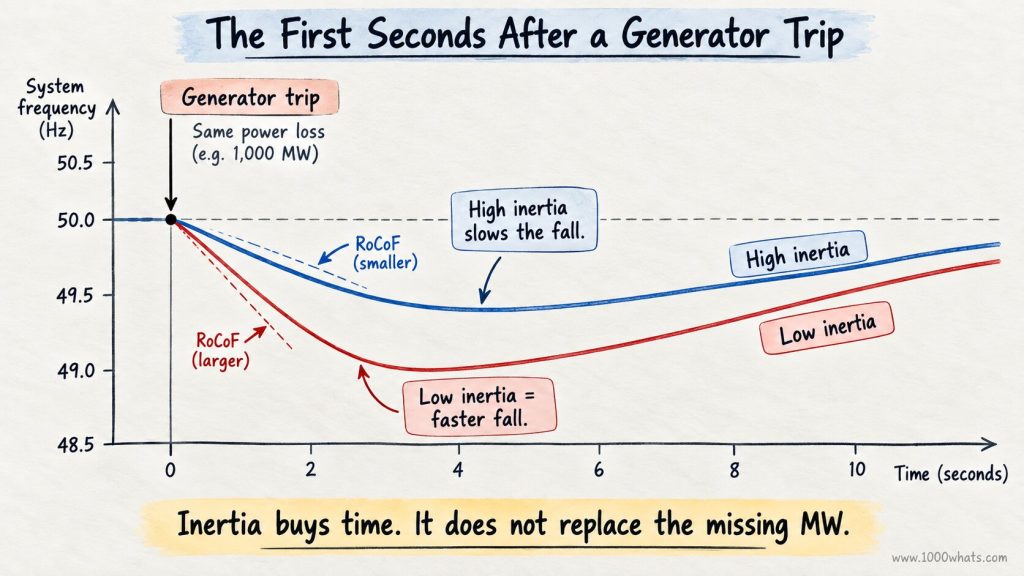
Now imagine a large power plant suddenly disconnects.
One moment:
1,000 MW.
The next:
zero.
Demand has not changed.
Generation has.
The system has an immediate active-power deficit.
Frequency begins falling.
But how quickly?
That depends partly on the amount of inertia connected to the system.
My article on grid inertia explains the physics in detail.
For today’s purpose, think about the synchronous condenser’s rotor.
It is heavy.
It is spinning.
It contains kinetic energy.
When system frequency suddenly falls, the rotor’s speed also begins to change.
Its stored kinetic energy can temporarily contribute to the electrical system, slowing the initial frequency decline.
No operator has to press a button to create this inertial response.
It follows from the physics of the synchronized rotating machine.
But there is an important limitation.
Inertia does not replace the missing generator.
It does not provide a sustained 1,000 MW replacement supply.
The rotating mass releases a limited amount of stored kinetic energy as its speed changes.
Other resources must then respond.
Generators.
Batteries.
Flexible demand.
Frequency reserves.
The condenser helps buy time for those responses.
⚡ “A synchronous condenser cannot replace the missing megawatts. It can help prevent the frequency from changing too quickly while somebody else replaces them.”
A flywheel makes the idea even more interesting
A synchronous condenser already has rotating mass.
But sometimes operators want:
more inertia.
One solution is beautifully mechanical.
Attach an additional flywheel.
A flywheel is essentially a large rotating mass designed to store kinetic energy.
Increase the rotating mass and its moment of inertia, and the machine can provide more inertial support.
This is exactly what happened at Lister Drive in Liverpool.
The project developed by Statkraft uses synchronous condensers combined with flywheels.
Each high-inertia configuration couples a 67 MVAr synchronous condenser with a 40-ton flywheel.
According to Statkraft, the flywheel increases the available inertia by approximately 3.5 times.
The two machines together provide more than 900 MW-seconds of inertia.
They entered service in March 2023.
Think about that for a moment.
We are living in an era of artificial intelligence, advanced semiconductors and extraordinarily sophisticated power electronics.
And one solution to a modern electricity-grid problem is:
attach another 40 tons of spinning metal.
Sometimes physics has excellent taste in simplicity.
Job 3: Make the grid stronger during faults
This is the least intuitive function.
It is also one of the most important.
Suppose a short circuit occurs somewhere in the transmission system.
The voltage near the fault may collapse.
Large currents can flow.
Protection systems must detect the problem and disconnect the affected equipment.
Traditionally, large synchronous generators contribute substantial current during faults.
Their electromagnetic characteristics allow them to deliver short-term fault currents that can be several times their normal rated current.
A synchronous condenser can do something similar.
Even though it is not generating sustained active power, it remains a synchronous electrical machine connected to the network.
During a fault, it can contribute significant short-circuit current.
That contributes to the local network’s short-circuit level, often used as an indicator of system strength.
The National Energy System Operator’s explanation of short-circuit level identifies synchronous condensers as one way to provide fault-current capability traditionally supplied by conventional generators.
Why does this matter?
Because power-electronic converters do not necessarily behave like synchronous generators during faults.
Their semiconductor components have current limits.
Their response depends on control design.
And their ability to remain stable in a weak network depends on several electrical and control-system characteristics.
A synchronous condenser can strengthen the electrical environment around them.
This can help with:
- fault detection and protection performance;
- voltage recovery following disturbances;
- stable operation of nearby converter-connected equipment;
- the integration of additional renewable generation.
There is an important qualification.
More fault current is not automatically better without limit.
Switchgear and protection equipment must be rated for the fault levels they may experience.
The objective is not:
maximum possible short-circuit current.
It is:
appropriate system strength and fault behavior for the network being operated.
Why does renewable energy make this relevant?
For much of the last century, power systems contained large numbers of synchronous generators.
Coal plants.
Gas plants.
Nuclear plants.
Hydroelectric plants.
Many were directly connected to the AC network.
Whenever they operated, they brought their rotating mass and electrical characteristics with them.
Now consider a power system with growing amounts of:
solar PV,
converter-connected wind,
battery storage,
and HVDC connections.
These technologies can provide many useful grid services.
But they do not inherently behave like conventional synchronous machines.
Solar panels do not contain giant spinning generators.
Modern wind turbines often connect through power-electronic converters that decouple their mechanical rotation from the AC grid.
Battery storage connects through inverters.
As conventional synchronous generation operates fewer hours, the amount of directly connected rotating machinery can decline.
The system may still have plenty of electricity.
But some of its traditional stability characteristics are no longer automatically present.
This is where the synchronous condenser becomes useful.
It can provide synchronous-machine characteristics without requiring a conventional power plant to generate electricity.
We are separating electricity production from the electrical characteristics historically associated with producing it.
That is a significant change in how power systems are designed.
The real-world example: Pembroke, Wales
In August 2026, Britain’s National Energy System Operator announced that a new synchronous condenser at the Pembroke power station site had entered service.
The machine was developed by RWE.
The location is particularly interesting.
Pembroke already hosts a large gas-fired power station.
Now the site also contains a dedicated machine that provides stability services without needing to generate electricity from gas.
The condenser is part of NESO’s Stability Pathfinder program.
That program procures services needed to maintain a stable electricity system as the generation mix changes.
The Pembroke installation was the first of sixteen new synchronous condensers in the program’s latest phase.
NESO reported that its existing stability program was providing approximately 17.2 GVA-seconds of inertia, with the next phase expected to add another 26.9 GVA-seconds.
These are program-level figures, not the inertia rating of the Pembroke machine alone.
The larger point is more interesting than the numbers.
Britain is deliberately buying stability services from machines that do not need to generate electricity.
That is a different way of organizing the electricity system.
And it changes what a commercially valuable energy asset can look like.
Wait. How does a machine that consumes electricity make money?
Now we arrive at the commercial puzzle.
A synchronous condenser consumes some active electricity to cover its losses.
It requires maintenance.
It occupies land.
It needs electrical infrastructure.
And it does not sell useful quantities of generated MWh.
So where is the revenue?
From the services it provides.
A transmission system operator may need a certain amount of:
inertia,
reactive-power capability,
voltage support,
or:
short-circuit strength.
Instead of requiring conventional generators to remain online solely to provide those characteristics, the operator can procure them from dedicated equipment.
That procurement may take the form of:
long-term availability contracts,
stability-service agreements,
or other regulated or competitive arrangements.
The precise commercial structure depends on the electricity system.
In Britain’s Stability Pathfinder program, for example, dedicated assets have received contracts to provide specified stability capabilities.
This is fundamentally different from a merchant generator selling electricity into a wholesale market.
A synchronous condenser’s commercial proposition is not:
I will produce electricity when prices are high.
It is:
I will provide a specified electrical capability when the system needs it.
The distinction is important.
A project can be economically valuable without producing energy.
That sounds unusual until you remember that electricity systems require more than energy.
They require the conditions that allow energy to be delivered safely and reliably.
Could we just keep an old gas plant running?
Technically, conventional generators can provide many of the same services.
And historically, that is exactly what electricity systems did.
But suppose electricity demand is low.
Wind and solar production are high.
The wholesale market does not need additional gas generation.
Yet the system operator still needs inertia or voltage support from synchronous machinery.
One option is to keep a conventional generator synchronized and operating.
That may involve fuel consumption and minimum stable generation.
The additional electricity might displace cheaper generation or require other operational adjustments.
A dedicated synchronous condenser can provide some of the required stability characteristics without that sustained generation.
In some cases, an existing generator can even be converted to synchronous-condensing operation.
GE Vernova describes conversion arrangements that allow suitable gas-turbine generators to operate in a condenser mode without burning fuel for normal electricity generation.
That does not mean every retired power station can be converted economically.
Mechanical arrangements matter.
Equipment condition matters.
Location matters.
The remaining useful life of the generator matters.
But it creates an interesting possibility.
A power station can stop being commercially useful as an electricity producer while some of its electrical machinery remains valuable.
The generator has retired.
The grid would still like to hire it.
Why not use a STATCOM instead?
Good question.
A STATCOM is a power-electronic device that can rapidly inject or absorb reactive current.
It is extremely useful for voltage regulation.
It has no enormous spinning rotor.
And it can respond very quickly.
So why install a synchronous condenser?
Because the two technologies do not provide identical services.
A conventional STATCOM can provide excellent dynamic reactive-power support.
But without additional technology, it does not provide the inherent mechanical inertia of a synchronous condenser.
Its short-circuit contribution is also governed by the capabilities and current limits of its converter.
A synchronous condenser, meanwhile, naturally provides:
reactive-power capability,
physical inertia,
and substantial short-circuit current.
But it comes with rotating machinery, losses and maintenance requirements.
Here is the simplified comparison.
| Characteristic | Synchronous condenser | Conventional STATCOM |
|---|---|---|
| Main technology | Rotating synchronous machine | Power electronics |
| Reactive power | Supplies or absorbs | Supplies or absorbs |
| Voltage control | Yes | Yes |
| Physical rotational inertia | Yes | No |
| Fault-current contribution | Significant synchronous-machine response | Converter-limited response |
| Moving mechanical parts | Yes | No large rotating rotor |
| Typical trade-off | Multiple stability services, but mechanical complexity | Fast voltage control, but different inertia and fault behavior |
This is not a universal ranking.
A modern grid-forming converter with suitable energy storage can provide additional stability capabilities beyond those of a conventional STATCOM.
And the best solution depends on what the network actually needs.
Sometimes a STATCOM is better.
Sometimes a synchronous condenser is better.
Sometimes the best answer combines technologies.
The engineering question is not:
Which machine is more modern?
It is:
Which electrical characteristics are missing, where are they missing, and what is the most economical way to provide them?
What about grid-forming batteries?
Now the comparison becomes more interesting.
Traditional grid-following inverters rely on an existing grid voltage waveform to synchronize their operation.
Grid-forming inverters are designed to establish and regulate voltage and frequency behavior through their control systems.
With suitable energy resources and controls, they can provide fast active-power responses and other stability services.
Britain is already procuring grid-forming battery systems alongside synchronous condensers.
In March 2025, NESO announced the connection of Britain’s first grid-forming battery project under its Stability Pathfinder program.
The broader European direction is similar.
ENTSO-E’s November 2025 technical report addresses grid-forming requirements for non-synchronous generation and electricity storage.
So are synchronous condensers a temporary solution?
Not necessarily.
But neither should we assume they are the only solution.
A future power system may combine:
physical inertia from synchronous machines,
fast active-power responses from batteries,
grid-forming control from inverters,
reactive-power support from several technologies,
and:
protection systems designed for a different generation mix.
The objective is not to reproduce the old grid exactly.
It is to preserve or improve the electrical capabilities needed for secure operation.
⚡ “The grid does not care whether stability comes from spinning steel or clever electronics. It cares whether the required response is actually there when something goes wrong.”
Does a synchronous condenser work during a blackout?
Not automatically.
And this is an important limitation.
A conventional synchronous condenser normally operates while connected to an energized grid.
It needs suitable starting equipment and a voltage reference for synchronization.
If the grid is completely dead, the machine does not simply begin generating electricity.
There is no turbine driving it.
No sustained source of active power.
So a conventional synchronous condenser is not automatically a black-start resource.
My article on black start explains why restarting a collapsed power system requires resources capable of establishing an energized network without depending on that network already being available.
A synchronous condenser can be valuable during restoration once suitable parts of the network have been energized.
It may help with voltage control and system strength.
But that is different from providing the initial independent energy needed to start the system.
The distinction matters.
A machine that helps keep a running grid stable is not necessarily capable of starting a dead one.
What are the disadvantages?
Synchronous condensers are useful.
They are not magic.
The machine has real costs and operational limitations.
First, it consumes electricity.
Even when it is not producing active power, the machine has electrical and mechanical losses.
The grid must supply the energy required to cover those losses.
Second, it requires maintenance.
Bearings, cooling systems, excitation equipment, starting equipment and other components require attention.
This is large rotating machinery.
It does not become maintenance-free simply because somebody removed the turbine.
Third, it occupies space.
A synchronous condenser installation needs land, foundations, transformers, switchgear and a suitable grid connection.
Fourth, location matters.
A condenser installed in the wrong part of the network may provide much less value than one located near the actual system-strength or voltage problem.
Fifth, it does not solve every stability problem.
It cannot provide sustained active-power balancing.
It cannot replace every frequency-response service.
It cannot remove transmission congestion.
And it cannot compensate for poor protection design or inadequate system planning.
The machine is excellent at several specific jobs.
It should be paid for those jobs.
Not credited with solving every problem involving electricity.
How do you measure what a synchronous condenser provides?
This is another detail worth understanding.
A synchronous condenser may have several ratings.
They are not interchangeable.
Reactive-power capability
Measured in:
MVAr
This tells us how much reactive power the machine can supply or absorb within its operating limits.
Inertia
Often expressed in:
MW-seconds
or related system-inertia conventions.
This describes stored rotational kinetic energy available to influence the initial frequency response.
Short-circuit contribution
Often described through:
fault current,
short-circuit power,
or:
short-circuit level.
These quantities describe how the machine contributes to the electrical system during faults.
The important point is that a synchronous condenser cannot be described completely by one familiar number such as:
100 MW.
In fact, MW is not its primary commercial output.
A developer or system operator needs to understand which stability services the installation is designed to provide.
That determines both its engineering value and its potential revenue.
Why is this technology making a comeback?
Because the grid’s generation mix is changing.
And that exposes a distinction that was easy to ignore for a century.
Electricity production and electricity-system stability are related, but they are not the same product.
A conventional synchronous generator can provide both.
An inverter-connected solar farm may provide energy and several controlled grid services, but not the same inherent physical response.
A battery may provide exceptionally fast active-power response.
A STATCOM may provide excellent voltage support.
A synchronous condenser may provide physical inertia, reactive power and fault-current contribution without producing sustained electricity.
Different technologies.
Different capabilities.
Different costs.
Different locations.
The electricity system has to assemble the right combination.
This is why synchronous condensers are returning.
Not because engineers have run out of modern ideas.
But because some old physical ideas remain extremely useful.
What is a synchronous condenser in one sentence?
A synchronous condenser is a rotating synchronous electrical machine connected to the power grid primarily to provide reactive-power control, physical inertia and short-circuit strength rather than sustained electricity generation.
But the more memorable version is:
A generator that stopped selling electricity and started selling stability.
That is the idea.
The machine still spins.
It still interacts electromagnetically with the grid.
It still provides valuable services.
It simply no longer needs to produce electricity as its main job.
Final thoughts
For most of electricity history, the grid received a surprisingly generous package from conventional power stations.
Electricity.
Inertia.
Reactive power.
Voltage support.
Short-circuit strength.
Several important services bundled into one operating generator.
Then we began changing the technologies that produce electricity.
Wind.
Solar.
Batteries.
Power electronics.
And we discovered that replacing the MWh does not automatically replace every electrical characteristic of the machine that used to produce it.
Synchronous condensers are one response to that discovery.
They take the rotating part of the old system and give it a new purpose.
No sustained electricity generation.
No need to burn fuel for power production.
Just a machine providing electrical stability.
It is not the only answer.
Grid-forming inverters, batteries, STATCOMs and other technologies are changing the available options.
But synchronous condensers demonstrate something important about the energy transition.
We are not merely replacing the sources of electricity. We are redesigning the machinery and services that make electricity systems work.
And sometimes that means installing a generator.
Then deliberately making sure it does not generate.
Electrical engineering has a wonderful sense of humor.
Until next time, stay curious! 😎
Discover more from 1000whats
Subscribe to get the latest posts sent to your email.