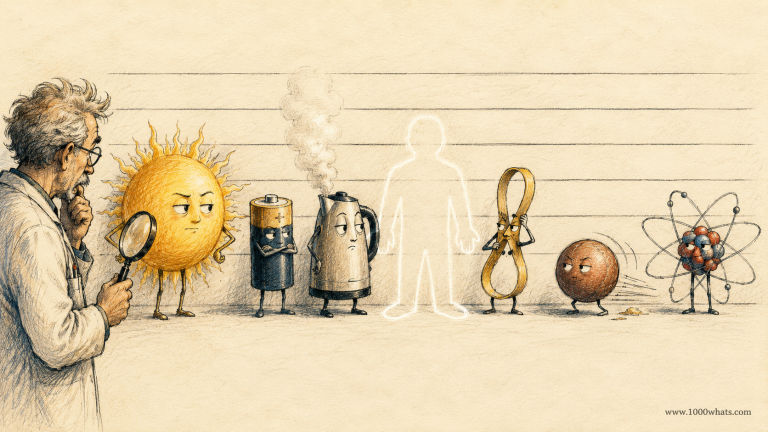
A power plant produces power.
Your laptop needs power.
A country can be an energy superpower.
A politician can seize power.
And somewhere in all of this, a physicist is quietly developing a headache.
Because in physics and energy, power has a very precise meaning.
It is not energy.
It is not electricity.
And it is not the amount of energy stored in something.
Power tells us how fast energy is being transferred, produced or used.
That tiny distinction explains why your electricity bill is measured in kilowatt-hours, your kettle is rated in kilowatts, a solar farm is described in megawatts, and a battery needs two numbers—MW and MWh—to tell you what it can actually do.
So let’s finally separate power from energy.
Because the difference is simple.
Once that clicks, watts, kilowatts, megawatts, kilowatt-hours, batteries, power plants, electricity demand, and half the numbers you see in energy news suddenly become much easier to understand.
Welcome to 1000whats — where today we’re finally separating two words the energy industry casually mixes together all the time.
Let’s add some power.
What is power?
Here is the clean version.
Power is the rate at which energy is transferred, converted, produced, or used.
That word rate is everything.
Mathematically:
Power = Energy / Time
Or:
P = E / t
If you transfer a certain amount of energy very quickly, you are delivering high power.
Transfer exactly the same amount slowly, and the power is lower.
The SI unit of power is the watt (W).
And a watt has a beautifully simple physical meaning:
1 watt = 1 joule per second.
So a 100 W device is transferring or converting energy at a rate of 100 joules every second.
A 2,000 W device?
2,000 joules every second.
Nothing mystical.
Power is basically a stopwatch attached to energy.
The formal SI definition follows exactly this relationship: the watt is the unit of power corresponding to one joule of energy per second.
Power vs. energy: Please stop making them twins
Power and energy spend so much time together that people treat them like different words for the same thing.
They are not.
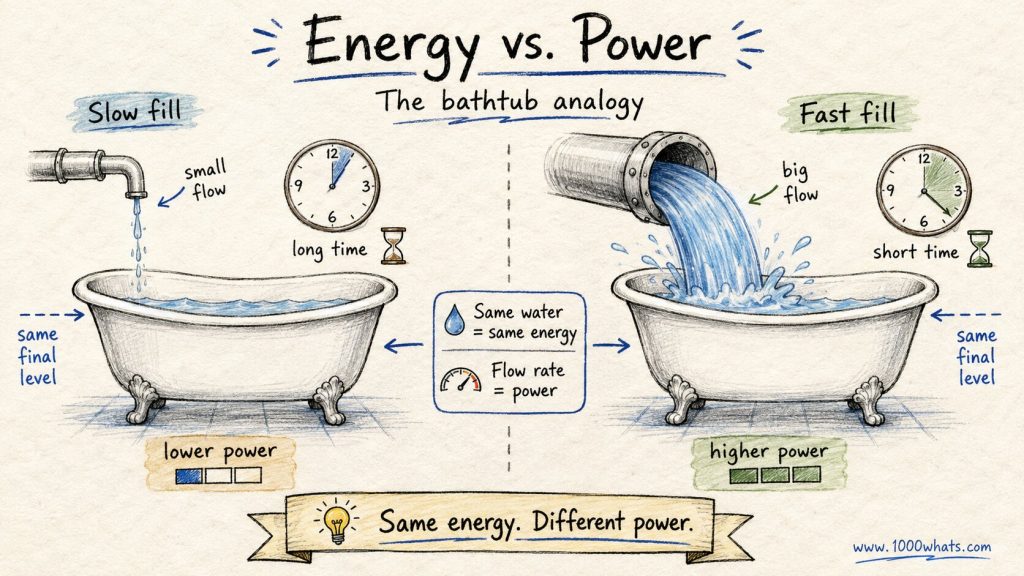
Think about filling a bathtub.
The amount of water in the tub is energy.
The flow rate coming from the faucet is power.
Open the faucet halfway and the bathtub still fills.
It just takes longer.
Open it fully and you get the same amount of water faster.
That is the relationship.
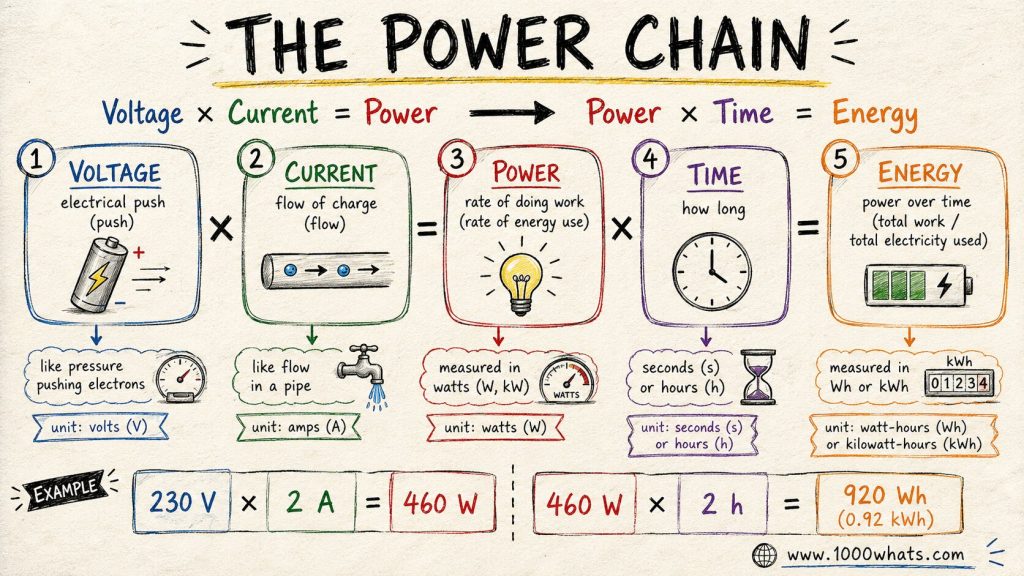
Energy = Power × Time
This one equation is hiding everywhere in the energy sector.
⚡ “Energy is the quantity. Power is the speed.”
And this is exactly why a powerful machine does not necessarily consume more energy.
Time gets a vote.
Your kettle is secretly teaching you energy physics
Let’s return to our aggressive little kettle.
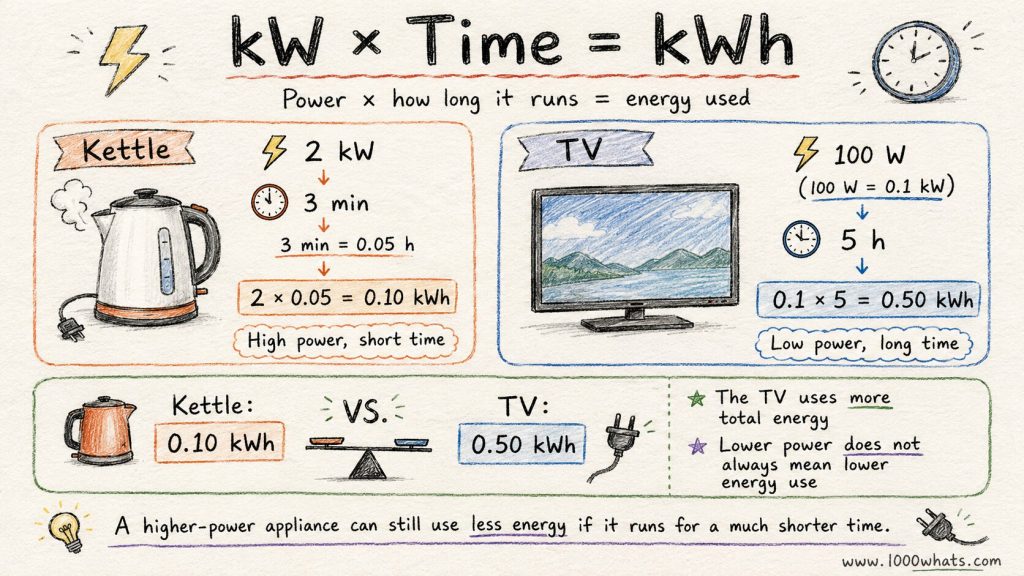
Suppose it is rated at:
2 kW
Run it for three minutes.
Three minutes is 0.05 hours.
So:
2 kW × 0.05 h = 0.1 kWh
Now take a 100 W television.
That is:
0.1 kW
Run it for five hours:
0.1 kW × 5 h = 0.5 kWh
So the television used five times more energy, despite having only one-twentieth the power.
That is the difference in one example.
The kettle delivers a lot of energy quickly.
The TV sips energy slowly but refuses to leave.
Like a guest who says, “I’ll stay for just one drink.”
Five hours later, somehow you’re ordering pizza.
So what exactly is a watt?
A watt measures power.
Not stored energy.
Not electricity sitting somewhere.
Not your total electricity consumption.
Power.
One watt equals one joule per second.
Because one watt is tiny for most energy applications, we quickly start adding zeros:
- 1 kilowatt (kW) = 1,000 W
- 1 megawatt (MW) = 1,000 kW
- 1 gigawatt (GW) = 1,000 MW
- 1 terawatt (TW) = 1,000 GW
That gives us a scale stretching from household appliances to entire countries.
A phone charger lives somewhere in the tens of watts.
A kettle lives in kilowatts.
A wind turbine lives in megawatts.
An electricity system lives in gigawatts.
Same physical quantity.
Just increasingly violent rates of energy transfer.
Then what on Earth is a kilowatt-hour?
This is where people understandably start getting suspicious.
A kilowatt measures power.
A kilowatt-hour measures energy.
Yes, someone decided the easiest way to name an energy unit was to multiply a power unit by a unit of time.
Thanks, physics.
But once you understand the relationship, it makes perfect sense:
Energy = Power × Time
So:
1 kWh = 1 kW × 1 hour
A 1 kW device running for one hour uses 1 kWh.
A 500 W device running for two hours also uses 1 kWh.
A 2 kW device running for half an hour?
Again:
1 kWh.
Watts and kilowatts describe power at a given moment, while watt-hours and kilowatt-hours measure electricity use over time.
If the unit zoo is already beginning to annoy you, I have an entire article for that: What is the unit of energy? Convert, compare, confuse!
Why your electricity bill says kWh, not kW
Now your electricity bill starts making more sense.
Your utility does not primarily care that your kettle briefly pulled 2 kW.
It cares about how much electrical energy you consumed over the billing period.
That means kWh.
Imagine paying for gasoline based only on how quickly it came out of the pump.
“Congratulations, sir. Excellent fuel flow rate. That’ll be €73.”
You would reasonably ask how much fuel you actually received.
Electricity is similar.
Power tells you the rate.
Energy tells you the quantity delivered over time.
Your electricity meter accumulates that quantity.
But the grid absolutely cares about power
Here is where things get interesting.
Your energy bill may live mostly in kWh.
The electricity system itself has to obsess over power.
Why?
Because the grid must continuously match how quickly electricity is being produced with how quickly electricity is being consumed.
Suppose electricity demand in a country is currently:
5 GW
That means consumers are drawing electrical energy at a combined rate of roughly 5 gigajoules every second.
Keep demand at 5 GW for one hour and total energy consumption becomes:
5 GWh
But the grid cannot say:
“Well, people need 120 GWh today, so we’ll deliver most of it this morning and let everyone sort it out.”
Unfortunately, your refrigerator is not emotionally prepared for that arrangement.
Electricity demand happens now.
Generation has to respond now.
That is why grids care so much about instantaneous power.
⚡ “Your electricity bill lives in energy. The power system lives in power.”
MW and MWh: The battery test
If there is one place where confusing power and energy creates spectacular misunderstandings, it is battery storage.
Someone tells you:
“We are building a 100 MW battery.”
Sounds impressive.
But you still do not know how much energy it can store.
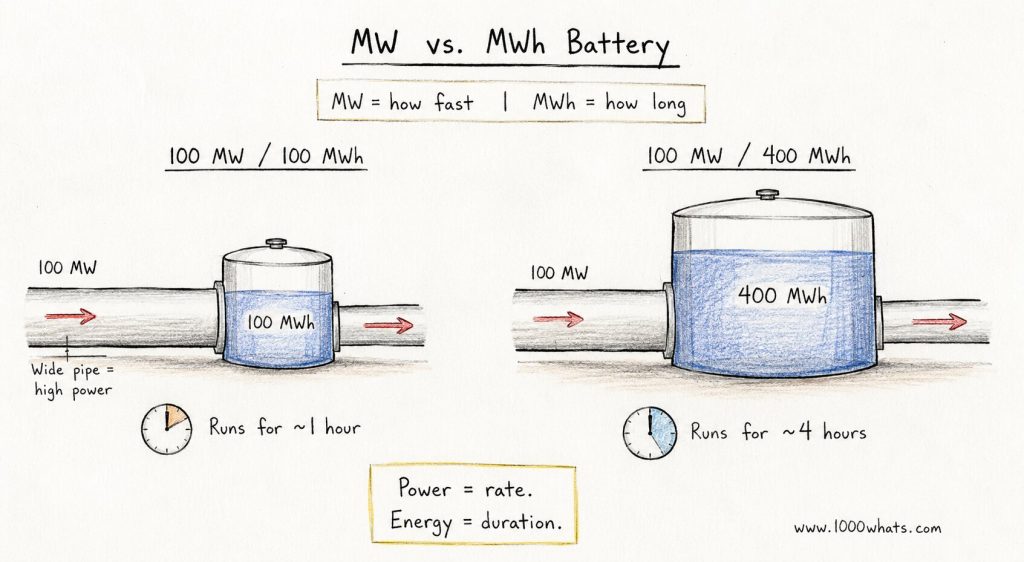
Consider two systems:
| Battery | Power | Stored energy | Approx. duration at full output |
|---|---|---|---|
| Battery A | 100 MW | 100 MWh | 1 hour |
| Battery B | 100 MW | 400 MWh | 4 hours |
Both can push electricity onto the grid at 100 MW.
But one runs out roughly four times sooner.
The easiest analogy is a water tank.
MW is the size of the pipe.
MWh is the size of the tank.
A giant pipe attached to a tiny tank can unleash a spectacular blast of water.
Briefly.
A large tank tells you how much water is available.
That distinction sits right at the heart of battery storage.
In real projects, usable duration also depends on operating limits, efficiency, state of charge, degradation, and other engineering details.
But the core concept never changes.
Power tells you how hard the battery can push. Energy tells you how long it can keep pushing.
What does MW mean for a power plant?
Now imagine a 500 MW power plant.
Does it generate 500 MWh?
Maybe.
For one hour.
If it operates continuously at 500 MW for exactly one hour:
500 MW × 1 h = 500 MWh
Run at that output for ten hours:
5,000 MWh
Run at half output for ten hours:
2,500 MWh
And here we hit another common energy confusion:
capacity and generation are not the same thing.
MW typically describes the plant’s power capacity or actual instantaneous output, depending on context.
MWh or TWh describe the energy produced over time.
This is why saying:
“The country added 2 GW of solar.”
does not tell you how many gigawatt-hours those solar panels will actually generate during the year.
You know the size of the engine.
You do not yet know how long or how hard it will run.
Power is not electricity either
Everyday language makes this even messier.
We say:
- power plant
- power line
- power grid
- power socket
- power supply
- power outage
So it is easy to start treating power as another word for electricity.
Technically, it isn’t.
Power is a general physical concept.
A car engine delivers mechanical power.
A heater transfers thermal energy at a certain rate.
Your muscles produce mechanical power when you climb stairs.
A turbine delivers rotational power to a generator.
A solar panel delivers electrical power.
The watt works for all of them.
That is the beautiful bit.
Power does not care what form the energy takes.
It only cares how quickly the energy is being transferred or converted.
Electrical power: When voltage and current finally meet
Now we can connect power to two old friends.
Voltage tells us about electric potential difference.
Electric current tells us how quickly electric charge flows.
Put them together and, in a simple DC circuit:
P = V × I
Power equals voltage multiplied by current.
Suppose a device operates at:
12 volts × 5 amperes
Its electrical power is:
60 watts
There is a nice physical logic underneath this equation.
Voltage describes energy per unit of charge.
Current describes charge moving per unit of time.
Multiply them and the charge disappears from the equation.
What remains?
Energy per unit of time.
Power.
That is one of those satisfying moments when the units themselves tell the story.
NIST likewise defines the watt as equivalent to the rate represented by one ampere of current under a potential difference of one volt.
For alternating current, the full story gets more interesting because voltage and current do not always line up perfectly in time.
That is where concepts such as power factor, real power, reactive power, and apparent power enter the room.
We will save that particular electrical family argument for another day.
Where does electrical power actually come from?
Here is another useful connection.
A generator does not manufacture energy.
It converts it.
Wind turns turbine blades.
Water turns a hydro turbine.
Steam turns a turbine in nuclear, coal, geothermal, and many gas-fired plants.
The turbine turns a generator.
Inside that generator, electromagnetic induction converts mechanical energy into electrical energy.
And power tells us how quickly that conversion is happening.
So when a wind turbine is producing 5 MW, the interesting physical statement is not:
“There are five megawatts stored inside the turbine.”
There aren’t.
It means energy is being converted and delivered electrically at a rate of 5 million joules every second.
Every.
Second.
When you stop and picture it that way, even an ordinary-looking generator starts to feel slightly ridiculous.
Is more power always better?
More power sounds better.
More horsepower.
Faster charger.
Bigger generator.
Stronger motor.
And sometimes it absolutely is.
Higher power can mean:
- faster EV charging
- quicker heating
- faster acceleration
- larger industrial output
- greater instantaneous electricity supply
- faster battery discharge
But power has a price.
Higher electrical power can require:
- larger cables
- stronger transformers
- bigger inverters
- higher connection capacity
- more cooling
- more robust equipment
- greater grid capacity
A 350 kW EV charger can theoretically charge much faster than an 11 kW home charger.
But your apartment’s electrical connection might have some fairly strong opinions about installing one in the kitchen.
From a grid perspective, this becomes even more important.
A city may use exactly the same total energy over two different days but create very different infrastructure problems depending on when that energy is demanded.
If everyone plugs in cars, turns on air conditioning, starts cooking, and heats water at exactly the same time, peak power demand shoots upward.
The total daily energy might not change dramatically.
The size of the system required to serve the peak certainly can.
Power is also why speed matters in the energy transition
This distinction is becoming more important, not less.
Consider electrification.
Replacing a gasoline car with an EV changes where energy comes from.
But installing millions of EVs also changes when and how quickly electricity is demanded.
Heat pumps do the same.
Data centers do the same.
Industrial electrification does the same.
Large batteries can help precisely because they can absorb or deliver substantial power at useful moments.
Solar may generate enormous quantities of energy during a year, yet if its power arrives mostly around midday while demand peaks later, the grid still has a timing problem.
This is one reason the energy transition cannot be understood just by adding up annual TWh.
When the energy arrives matters. How fast it can arrive matters too.
That is power.
Power, heat, and the kettle come full circle
Remember our kettle?
Electrical energy enters it at roughly 2 kW.
Its heating element resists the electric current and converts electrical energy into internal thermal energy.
That energy is then transferred into the water as heat.
So your kettle is actually a nice little energy-conversion chain:
electrical power → heating element → thermal energy → hot water
The wattage tells you how quickly the process can happen.
That is why a more powerful kettle generally boils the same amount of water faster.
Same destination.
Faster journey.
Power.
So, what is power in one sentence?
If someone corners you at a party and demands an energy-physics definition before allowing you back to the snacks, give them this:
Power is the rate at which energy is transferred, converted, produced, or used.
Its SI unit is the watt.
One watt equals one joule per second.
And if you want the entire article compressed into six words:
Energy is how much. Power is how fast.
That distinction is small enough to fit on a Post-it.
But it explains an absurd amount of the energy world.
Final thoughts
Power sounds like one of those concepts that needs no explanation.
We use the word constantly.
Power plant.
Power grid.
Powerful engine.
Powerful charger.
Solar power.
Nuclear power.
And yet underneath all those uses is something much more precise.
Power is energy with a clock attached.
It tells us whether energy arrives gently over ten hours or crashes through the door in ten seconds.
That is why a tiny battery can deliver huge power for a few moments.
Why a giant energy store can still have limited output.
Why your kettle can be more powerful than your television while consuming less energy.
Why electricity grids obsess over peak demand.
And why MW without MWh can tell only half the story.
Once you understand power, the numbers around energy stop looking like alphabet soup.
MW.
MWh.
kW.
kWh.
They start telling you two completely different things:
How much?
And:
How fast?
That difference is worth knowing.
What energy concept should we pull apart next?
Until next time, stay curious! 😎
Discover more from 1000whats
Subscribe to get the latest posts sent to your email.